Every summer I get the same phone call: someone bought a 15-foot or 18-foot above ground pool, they are adding chemicals on schedule, and the water still will not stay clear. Nine times out of ten the problem is not the chemicals at all. It is the pump that came in the box, and it was never sized to keep up with a pool that large. In this one I am walking through the actual math behind that call, what I tell owners when I explain it, and what the fix looks like once someone decides to do something about it.
The Call I Can Predict Before I Even See the Pool
Every summer I get the same call. Someone bought a 15-foot or 18-foot above ground pool with the kit, they are adding chemicals every week like they are supposed to, and the water keeps going cloudy anyway. By the time they call me, they have usually tried more shock, more algaecide, and a new test kit, and none of it holds. I can usually tell them what is wrong before I ask a single question about their chemical routine, because this is the stock pump call I get every summer, and it is almost always the same root cause.
The pump that came with the kit is not adequate for the pool size. That is it. The chemistry can be dead on and the water will still look hazy, because filtration and sanitation are two different jobs, and one of them is quietly failing.
Why People Think Their Pump Isn’t Working When It Actually Is
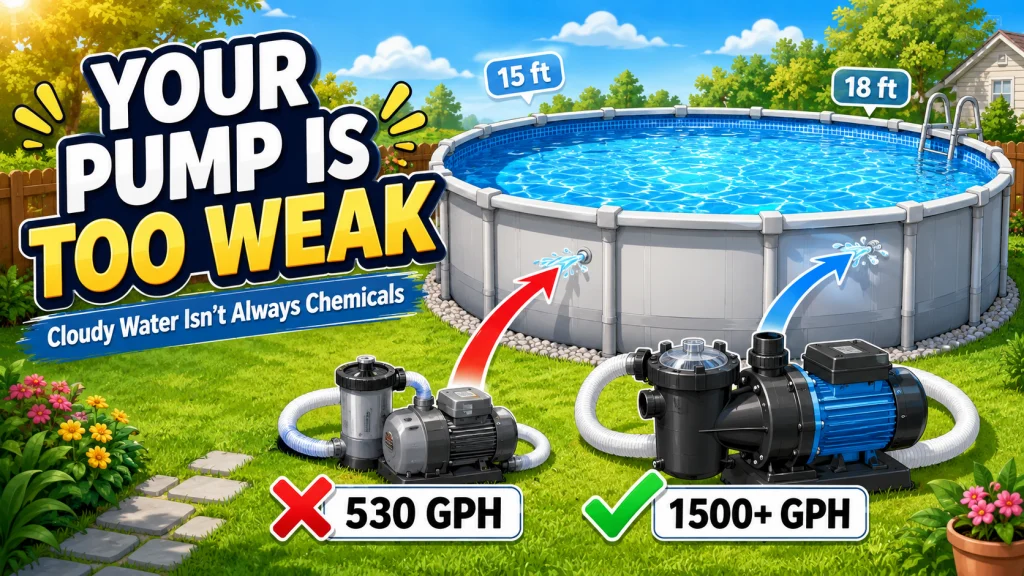
Here is the pattern I see over and over on the larger pools in the Intex and Bestway lineups. A 15-foot round pool at 48 inches deep holds roughly 4,440 gallons. For the water to actually turn over and stay clear, that full volume needs to pass through the filter about once every 8 hours, which works out to a minimum pump flow of around 555 gallons per hour. The stock pump included with a lot of 15-foot Easy Set style kits is rated at 530 GPH. That is below the 555 GPH the pool actually needs, not by a huge margin, but enough that the pump never quite catches up on a hot week with heavy swimmer load.
This is usually the moment an owner tells me their above ground pool pump is not working right. What they mean is that the water stays cloudy no matter what they do, and the label on the box never mentioned that the pump was sized for a smaller pool in the same product line, not the 15- or 18-footer they actually bought.
| Pool Size (48 in. depth) | Approx. Volume | Minimum GPH for 8 Hr Turnover | Common Stock Pump GPH |
|---|---|---|---|
| 12 ft round | ~3,000 gal | ~375 GPH | 330 to 530 GPH |
| 15 ft round | ~4,440 gal | ~555 GPH | 530 GPH |
| 18 ft round | ~6,400 gal | ~800 GPH | 530 to 1,000 GPH |
Look at that gap on the 18-footer for a second. A 15-foot pool and an 18-foot pool look like a small size jump on paper, but the volume difference means the stock pump that was already borderline on the 15-footer is flatly inadequate once you move up to the 18-footer. That is where the calls get more frequent, and where the cloudy water shows up faster in the season.
What Happens When I Explain This to an Owner
The reaction is almost always the same. Most people assumed a bigger pool automatically came with a bigger pump, since that is how it works with most appliances. Nobody told them the pump needs to be matched to the pool’s actual water volume, not just bundled in the box because it fits the fittings. The manufacturer is not lying about the spec. The pump does exactly what it says on the label. It is just sized for the smallest pool in that product line, not necessarily the one most people actually end up buying.
I do not blame Intex or Bestway for this. The included pump is technically functional, and on the smaller pools in the same lineup it is often close enough to get by. The problem only shows up once you scale the same kit hardware up to a 15- or 18-foot pool, and that is exactly the size range where I get the most cloudy water calls every year.
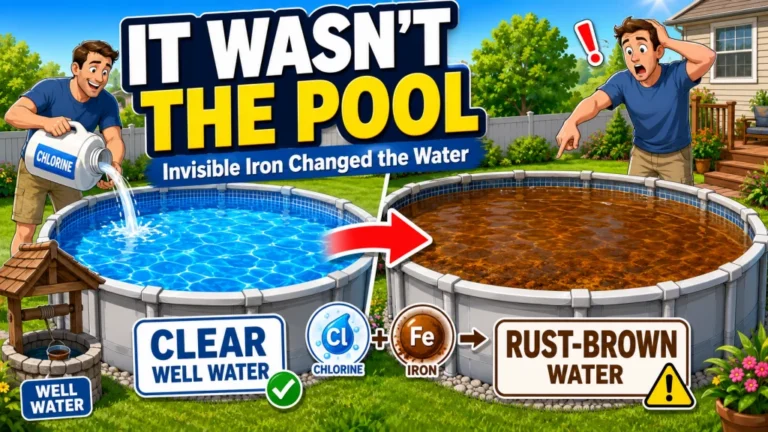
By the time most owners get to me, the pump is rarely their first suspect. The usual path goes something like this: first they figure the chlorine reading looked low, so they add more shock. When that does not clear it up, they buy a new test strip kit, assuming the old one was giving a bad reading. After that, some start wondering if it is their fill water, especially on well water or after a fresh top off. The pump is almost always the last thing anyone checks, mostly because it is still running and making noise, so it does not look like the part that is failing.
- Check the pump’s GPH rating on the label or the box, not just the pool’s advertised size.
- Calculate your pool’s approximate gallons for its diameter and water depth.
- Divide that gallon figure by 8 to get your minimum required GPH for a full daily turnover.
- Compare that number to your stock pump’s rated GPH before assuming the chemicals are the problem.
- If the pump is close to or below the minimum, treat that as your first troubleshooting step, not your last.
Once an owner runs that comparison themselves, the cloudy water usually stops being a mystery. It becomes a filtration math problem with a specific, fixable answer.
The Call That Made Me Start Writing This Down
Field Note: A family with an 18-foot Intex pool called me in their third summer of ownership, still fighting cloudy water every July. They had spent close to $200 on chemicals that season chasing clarity that a properly balanced pool should have needed closer to $80 to maintain. We swapped the stock pump for a unit rated in the 1,500 to 2,000 GPH range, at a cost of about $120. The pool was visibly clear within a week, and that same pump was still running strong three seasons later. That $120 upgrade saved them roughly $80 in chemicals in the first season alone, before anyone counted the time spent testing, dosing, and wondering what they were doing wrong.
That is the story I keep coming back to when someone hesitates about spending money on a pump when the pool already came with one. Once I saw that math play out in a real backyard, I started recommending a look at the pump before another bucket of chemicals, and that habit is what turned into this article.
What an Above Ground Pool Stock Pump Upgrade Actually Looks Like
An Intex pump upgrade, or the equivalent swap on a Bestway kit, is not the overhaul it sounds like. A properly rated above ground pool pump in the 1,500 to 2,000 GPH range typically runs somewhere between $100 and $200 depending on the model and filter type. On most kit pools it connects to the same hose fittings the stock pump used, so you are not cutting new plumbing or rebuilding the pad. The swap itself usually takes about 20 minutes from unboxing to running water.
You will not see the improvement the second you flip the switch. Give it 24 to 48 hours, since the pool needs two or three full filtration cycles to actually pull the fine particles that were clouding the water through the filter media, and that does not happen in a single pass no matter how strong the new pump is. Owners who check the water an hour after the swap and see no change usually just need to wait for the next cycle, not buy another product. For anyone still weighing pump sizes against their exact pool dimensions, the full GPH math is broken down separately in the pump sizing breakdown for above ground pools, alongside filter and turnover rate tradeoffs in the pump and filter guide.
Pro Tips: Before you upgrade, confirm your filter can actually handle the higher flow rate. A cartridge filter rated for the stock pump’s flow can bottleneck a bigger pump just as easily as the old pump bottlenecked your water clarity.
Final Thoughts: Do the Math Before You Blame the Chemicals
If you are on a 15-foot or larger above ground pool and the water will not stay clear no matter how carefully you dose it, run the gallon and GPH numbers before you buy another round of shock. In my experience, that five minute calculation solves more mystery cloudy water calls than any chemical adjustment does, and it usually saves a lot more than money. It cuts down the weekly guessing game of which chemical to try next, it means less time standing over the test kit trying to figure out what changed, and it means fewer weekends where the pool gets closed off right when everyone wants to use it.
Knowing this before you buy, or before you spend another summer guessing, is the difference between one relaxed pump swap and three seasons of chasing a problem that was never really about your chemistry in the first place.
Sources and References
The pump sizing and cloudy water patterns in this article are backed by the following community and industry sources.
- TroubleFreePool hosts detailed owner discussions on above ground pool chemistry and filtration troubleshooting.
- TractorByNet forums include owner threads confirming that circulation and filtration matter as much as chemical dosing.
- Inyo Pools publishes technical guidance on stock pump sizing and pump replacement for above ground pools.
FAQs
🏊 Why does my above ground pool keep turning cloudy even though I test the water regularly?
On 15-foot and larger pools, the most common cause is a stock pump that cannot turn over the full pool volume in 8 hours. Compare your pump’s GPH rating to your pool’s gallon count divided by 8 before assuming it’s a chemistry problem.
🔧 Is the stock pump enough for an 18-foot above ground pool?
Usually not. An 18-foot pool at 48 inches holds around 6,400 gallons, which needs roughly 800 GPH for a proper 8 hour turnover. Most stock kit pumps fall well short of that on the 18-foot size.
💧 How many gallons is a 15-foot above ground pool?
A 15-foot round pool at 48 inches deep holds approximately 4,440 gallons. That figure changes with water depth, so always check your actual fill line, not just the pool’s advertised size.
💰 Is it worth upgrading the pump on a pool that already came with one?
On 15-foot and larger pools, yes in most cases. A pump upgrade typically costs $100 to $200 and often pays for itself in reduced chemical spending within a single season, on top of clearer water.
⏱️ How long does it take to see results after a pump upgrade?
Give it 24 to 48 hours. The pool needs two or three full filtration cycles to pull the cloudy particles out, so checking the water after just an hour will not show the difference yet.
🧰 Does a bigger pump require new plumbing or fittings?
On most kit pools, no. A properly rated replacement pump typically connects to the same hose fittings as the original, and the swap usually takes about 20 minutes.