Finding the best above ground pools starts with a decision most buyers skip: how long do you actually plan to keep this thing in your yard? A pool you’ll use for two summers and a pool you want for the next fifteen years are not the same purchase, even when the price tags overlap. This guide breaks the market into four permanence tiers, walks through how to size a pool to your yard and your swim crew, lays out what a pool really costs once the water is in, and compares the two brands that dominate the under-$1,000 category. By the end you should know which tier fits your situation and where to go next for the specific decision in front of you.
Why Price Isn’t the First Decision
I have installed some of the best above ground pools money can buy right next to $200 inflatables in the same neighborhood, sometimes the same week, and the owner’s satisfaction almost never tracked with what they spent. It tracked with whether the pool matched how long they actually planned to keep it. In fifteen years of setting these up across the Midwest, the single biggest regret I hear isn’t “I paid too much.” It’s “I bought a two-season pool and I’m still using it in year five, patched and sagging.”
That mismatch happens because most buying guides organize above ground pools by price or by brand, which tells you almost nothing about how the pool will hold up. A $600 soft-sided frame pool and a $600 steel frame pool look similar on a shelf, but one is built to be taken down every fall and the other is built to survive a winter outdoors. The real question underneath every above ground swimming pool purchase is permanence: are you buying a seasonal convenience, a multi-year commitment, or something you want to still be swimming in a decade from now. Answer that first, and the size, brand, and cost decisions get a lot easier.
The Four Types, Sorted by How Long They Last
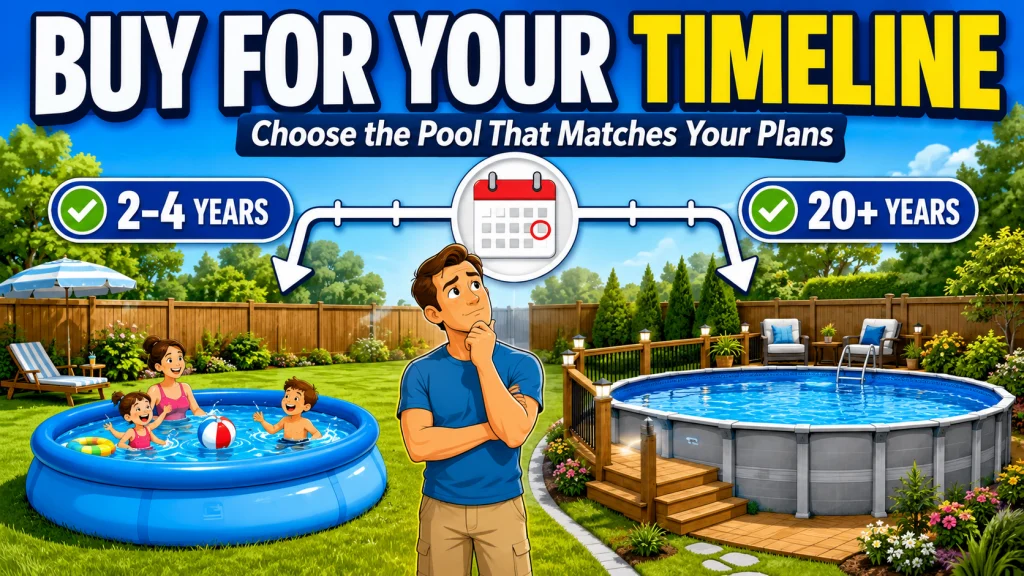
Above ground pools fall into four rough tiers, and the gap between the cheapest and priciest is enormous: an inflatable ring-top pool can run under $300, while a permanent steel wall or resin hybrid system can run $1,500 to $8,000 installed. Here’s how they break down by what you’re actually buying:
| Pool Type | Typical Cost | Realistic Lifespan | Best Fit For |
|---|---|---|---|
| Inflatable Easy-Set (ring-top) | Under $300 | 2 to 4 seasons | Renters, first-time buyers, young kids |
| Soft-sided frame | $200 to $800 | 3 to 7 years | Families testing pool ownership for a few summers |
| Steel or hybrid frame | $500 to $2,000 | 10 to 15 years (structure) | Multi-year owners who still want to take it down eventually |
| Steel wall or resin (permanent) | $1,500 to $8,000 | 20 to 25 years | Owners who want a fixture, not a seasonal setup |
The inflatable tier is where most first pools land, and there’s nothing wrong with that if you know what you’re signing up for. The ring holds its shape as the pool fills, setup takes an afternoon, and the whole thing packs away for winter. The tradeoff is durability: connector seams and UV-stressed vinyl start failing within a few seasons, so this tier makes sense for testing the idea of pool ownership, not committing to it.
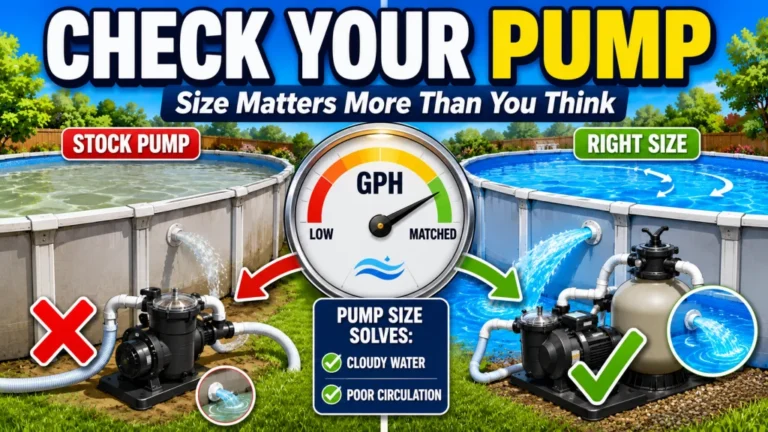
Soft-sided and steel frame pools step up in structure, using a tubular frame to hold a vinyl liner instead of an air ring, which is what lets them go deeper and hold more water. This is also where the stock pump problem shows up most often. The pump included in a boxed frame pool kit is almost always sized for the smallest pool in that product line, not the 15-foot or 18-foot model most people actually buy. If a stock pump is rated well under the turnover rate a pool that size needs, water stays cloudy no matter how much chlorine you throw at it, and that’s a topic covered in depth in the breakdown of each above ground pool type.
Note: Any 15-foot or larger frame pool deserves a pump check before you commit. Compare the pump’s GPH rating against the pool’s gallon volume and confirm it can turn the water over on the schedule your filter needs, not just the schedule printed on the box.
At the permanent end, steel wall and resin hybrid pools are a different category of commitment. Some buyers ask about partially burying a wall to blend it into a sloped yard, and this is where I have to be direct: a standard above ground wall is engineered for water pressure pushing outward, not soil pressure pushing in from the sides. Burying a pool that isn’t rated for semi-inground use risks the wall buckling. Only pools specifically built and rated for semi-inground installation should ever go partly below grade.

This 12 foot by 30 inch round inflatable pool holds 1,485 gallons and sets up in about 10 minutes by inflating the top ring and filling with water. It comes with a 530 GPH cartridge filter pump using dual suction fittings and HydroAeration Technology for better circulation and clarity, plus one Type A cartridge. The 3 ply PVC construction resists punctures, and a repair patch is included for peace of mind.
Check On AmazonIf you click this link and buy, we earn a commission at no additional cost to you.
Sizing the Pool to Your Yard and Your Swim Crew
Once you’ve settled on a tier, the next question is how much pool you actually need, and that’s a separate decision from which type you’re buying. Most people either buy too small for the people who’ll actually use the pool, or too large for the yard that has to hold it. Both mistakes are expensive to fix after the fact, since a liner and frame are sized to one specific pool footprint. The rule of thumb I use on site: plan for roughly 15 square feet of water surface per swimmer you expect at once, and remember only about half your guest list is usually in the water at any given moment.
A 15-foot round pool holds around 8,800 gallons and comfortably fits 3 to 4 swimmers, which is fine for a couple or a small family who mostly float rather than swim laps. Step up to an 18-foot round pool and you’re closer to 8,800 to 9,900 gallons depending on wall height, with room for 4 to 6 people. The jump from 15 feet to 24 feet looks small on paper but roughly doubles the water volume, at which point that borderline stock pump on the smaller pool becomes flatly inadequate. Bigger pools also mean bigger yard footprints once you add the 2 to 3 feet of working clearance most installers want around the wall for maintenance access.
- Measure your usable yard space first, including clearance for the pump pad, ladder swing, and any fencing you’ll need, not just the pool footprint itself.
- Count your realistic swimmer load at peak use, not your total household size, since not everyone swims at once.
- Check local setback and fencing rules before you buy. Many municipalities require a barrier around any pool holding water 18 inches deep or more.
- If you’re torn between two sizes, sizing up one tier usually costs less in the long run than replacing an undersized pool two summers later.
Oval pools solve a different problem: fitting real water volume into a narrow yard where a round pool wouldn’t work. A 12-by-24-foot oval suits four to five swimmers in a tighter footprint, while a 15-by-30-foot oval comfortably handles a family that hosts. The full breakdown of gallon counts, clearance math, and shape tradeoffs by yard type lives in the sizing guide for above ground pools, which is worth reading in full before you settle on a footprint.

This pump uses HydroAeration Technology to improve water circulation, filtration, clarity, and negative ion levels at the surface. It delivers a 1,500 GPH flow rate at the pump and 1,180 GPH in the pool, suitable for Intex above ground pools up to 9,400 gallons with a 1.25 inch hose fitting. Installation just requires hooking up the hoses and plugging in, with partial assembly needed. It uses easy to clean Type A Dacron paper cartridges, which should be replaced every 2 weeks.
Check On AmazonIf you click this link and buy, we earn a commission at no additional cost to you.
What These Pools Actually Cost Once the Water’s In
The sticker price is the smallest number in this whole decision, and it’s the one every retailer leads with. Once a pool is filled, running costs settle in fast: expect somewhere between $500 and $1,800 a year for chemicals, pump electricity, and small parts on a typical DIY-maintained above ground pool, with the exact number driven by pool volume, climate, and how consistent you are with testing. Chemicals alone usually run $300 to $600 a year for a standard 10,000 to 15,000 gallon pool, and electricity for the pump adds another $200 to $500 depending on how many hours a day it runs and whether you’re on a single-speed or variable-speed unit.
Then there’s the liner. Any vinyl-lined above ground pool, soft-sided or steel, will need a new liner eventually, and this is a cost a lot of first-time buyers never budget for. Soft-sided frame pools typically need a new liner every 5 to 9 years, while steel wall pools stretch that to 7 to 12 years with good chemistry. Replacement runs roughly $500 to $1,500 for the liner itself, more if you hire out the drain-and-reinstall labor. That single expense, spread across the pool’s life, often changes which tier actually makes financial sense for someone planning to stay put for a decade.
Note: Factor in one liner replacement over any ownership horizon past five years. It’s the most commonly skipped line item in above ground pool budgeting, and it’s rarely optional.
None of this means ownership is complicated, just that the honest total cost sits well above the box price. A full walkthrough of chemical budgets, electricity ranges by pump type, and the true multi-year cost by pool tier is laid out in what an above ground pool really costs to own, including the numbers on when a pricier permanent pool actually pays for itself against a cycle of cheaper replacements.

This overlap liner fits 21 foot round above ground pools with a 48 inch or 52 inch sidewall and measures 216 by 216 inches. Made from standard gauge vinyl with double welded seams, it is built to withstand harsh winter conditions and last for years. The swirl bottom design adds a vibrant blue look to crystal clear water. Swimline has manufactured pool liners and accessories since 1971.
Check On AmazonIf you click this link and buy, we earn a commission at no additional cost to you.
Intex Versus Bestway: The Two Brands Under $1,000
Below the $1,000 mark, the market is basically a two-brand conversation. Intex and Bestway both make inflatable, soft-sided frame, and steel frame pools, and both are the brands I get asked about most from buyers who haven’t decided on a permanent installation yet. The two companies overlap heavily on price and format, which is exactly why buyers get stuck comparing them line by line instead of asking the more useful question: does either brand’s frame design, liner thickness, and included pump match the pool size you actually need.
I won’t tell you one brand wins across the board, because it depends on the specific pool line and what you’re prioritizing between setup ease, liner durability, and included equipment. What I will say is that this comparison only matters once you already know your target size and permanence tier from the sections above. Buying based on brand loyalty before nailing down size and type is how people end up with a pool that’s the wrong footprint for their yard, just from a brand they’d heard of. A full side-by-side on frame construction, liner specs, and where each brand tends to fall short is covered in the Intex versus Bestway comparison.

This 15 foot round pool holds 4,231 gallons with a 48 inch depth, giving the whole family plenty of room to swim. The Tritech 3 layer liner is 83 percent more puncture resistant, 33 percent more stretch resistant, and 15 percent more tear resistant than standard PVC, while the corrosion resistant steel frame snaps together tool free with ClickConnect joints. The set includes a 1,000 GPH cartridge filter pump compatible with Type III cartridges, a safety ladder, and a debris cover. A built in flow control valve allows easy garden hose draining and tool free disassembly for storage.
Check On AmazonIf you click this link and buy, we earn a commission at no additional cost to you.
Which Tier Actually Fits Your Situation
The permanence framework above is only useful once you map it onto who’s actually going to use the pool and how settled you are where you live. A renter or someone who expects to move within a few years has almost no reason to look past the soft-sided or steel frame tiers, since a permanent installation adds cost you likely won’t recoup and can complicate a lease or a sale. A first-time homeowner who just closed on a house and plans to stay put is in the opposite position: buying cheap now often means buying twice within five years.
Household composition matters as much as the address. Families with toddlers usually do fine with a smaller frame pool and shallow depth, since the point is supervised splashing, not laps. Once kids hit their teenage years and start inviting friends over, that same small pool starts feeling undersized fast, which is worth planning for if your kids are still young now. Empty nesters and weekend-only swimmers tend to be better served by a mid-size steel wall pool than by anything at the largest end of the range, since a bigger pool mostly just means more chemicals and electricity for water nobody’s using.
Final Thoughts: One Answer Before Any Price Tag
If you take one thing from this guide, make it this: decide how long you want a pool in your yard before you look at a single price tag. That one answer eliminates most of the wrong purchases I get called out to fix, whether that’s a soft-sided pool that was never going to survive a fourth summer or a permanent steel wall pool bought by someone who was moving in two years anyway.
From here, go wherever your specific gap is. If you’re still not sure which tier fits your yard and your plans, the type breakdown above is the place to slow down and reread. If you know your tier but not your footprint, sizing is next. If you’re trying to justify the number to a spouse or a budget, the ownership cost numbers do that work for you.

This 24 foot by 52 inch round pool holds 12,481 gallons, offering plenty of space for family fun all summer. The 3 ply liner combines high strength polyester mesh with thick PVC for excellent tear resistance, backed by a 2 year warranty on the liner, frame, and filter pump. The galvanized steel frame has inner and outer powder coating to resist rust, with UV resistant T Joints for lasting durability. Assembly uses an Easy Lock System with no tools or pins, and the set includes a 2,800 GPH sand filter pump, ladder, pool cover, and ground cover, with sand lasting up to 5 years between changes.
Check On AmazonIf you click this link and buy, we earn a commission at no additional cost to you.
Where to Go Next
Each of the topics above has its own full guide, and which one to read next depends on where you’re stuck. Start with type if you don’t know what you’re buying yet, sizing if the type is settled but the footprint isn’t, cost if you need the full financial picture, or the brand comparison if you’re down to Intex or Bestway specifically.
| Guide | What it helps with |
|---|---|
| Above Ground Pool Types Explained | Goes deep on each permanence tier, including which failure modes show up most in each one. |
| How to Size an Above Ground Pool | Full gallon-by-gallon breakdown for round and oval footprints, plus yard clearance math. |
| What an Above Ground Pool Really Costs | Year-by-year cost modeling across the ownership life of each pool tier, not just the sticker price. |
| Intex vs Bestway Above Ground Pools | Frame, liner, and pump comparison between the two dominant budget brands. |
Whichever one you open next, keep the tier you landed on in mind. It’s the anchor for whether a given size or brand actually makes sense for your yard.
FAQs
🏊 What is the best type of above ground pool for a family that wants to keep it more than five years?
A steel or hybrid frame pool is the realistic minimum for a five-plus-year plan, and a permanent steel wall or resin pool is the safer bet past ten years. Soft-sided frame pools are rated for 3 to 7 years and often don’t make it that far with heavy use.
💰 How much does a good above ground pool cost including setup?
Budget $500 to $2,000 for a steel or hybrid frame pool kit, or $1,500 to $8,000 for a permanent steel wall or resin installation, before adding annual running costs of roughly $500 to $1,800. The exact number depends on pool size, wall height, and whether you’re installing it yourself.
⏳ How long does an inflatable above ground pool actually last?
Most inflatable ring-top pools hold up for 2 to 4 seasons before connector seams or UV-stressed vinyl force a replacement. That’s normal for the category and not a sign of a defective pool.
📏 What size above ground pool do I need for a family of four?
An 18-foot round pool or a 15-by-30-foot oval both comfortably fit a family of four with room for a friend or two. Go with the 24-foot round or larger only if you regularly host bigger groups, since the extra volume adds real cost to chemicals and electricity.
🧱 Is a steel wall pool worth the extra cost over a frame pool?
It’s worth it if you plan to keep the pool past the 10 to 15 year mark a frame pool’s structure realistically lasts. If you’re testing pool ownership for a few summers first, a steel or hybrid frame pool is the more sensible starting point.
🧴 Does a bigger pool always mean bigger chemical bills?
Yes, water volume is the main driver of chemical cost, so a 24-foot pool will run higher chemical bills than a 15-foot pool at the same water chemistry standard. Climate and sun exposure shift that number further, since chlorine burns off faster under strong UV.
Sources and References
The cost, sizing, and lifespan figures in this guide are cross-checked against the following:
- Above ground pool cost data by type, used for pricing tiers and lifespan-by-material figures.
- Pool sizing guidance by surface area per swimmer, used for the 15-square-foot-per-swimmer rule and gallon figures by pool size.
- Above ground pool maintenance cost breakdown, used for annual chemical, electricity, and liner replacement ranges.
- Above ground pool type comparison by lifespan and climate, used for structural lifespan by pool type and the semi-inground rating context.