Above ground pool troubleshooting starts with a diagnosis, not a fix, and most owners skip straight to the fix. Green water, cloudy water, and foam all look like filtration problems because the water looks dirty, but two of those three are chemistry problems that a filter cannot solve on its own. This guide walks through what each problem actually is, why running the filter longer rarely helps on its own, and where to go for the specific correction each one needs.
The Single Most Common Troubleshooting Mistake
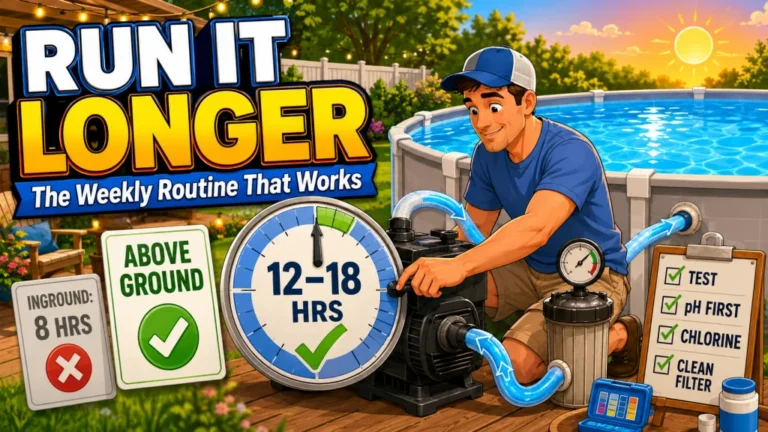
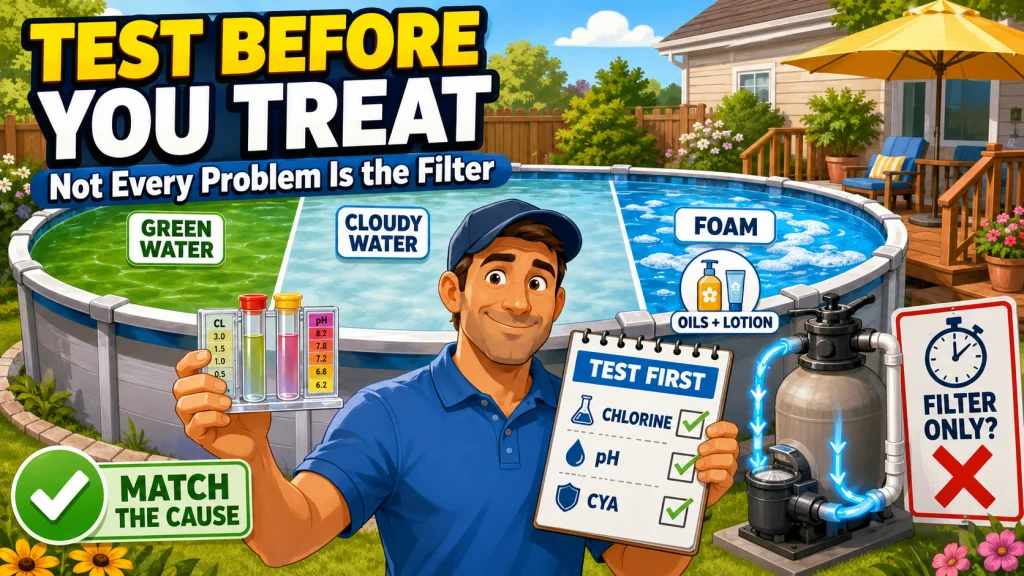
The mistake I see more than any other is an owner running the filter longer once the water turns green or cloudy, then getting frustrated a few days later when nothing has changed. It makes sense as a first instinct. The water looks dirty, so the tool that cleans the water seems like the obvious answer. But filtration does not fix a chemistry problem, and two of the three water problems covered here are chemistry problems first and filtration problems a distant second.
Experienced pool-care communities are blunt about this specific misconception: cloudy or green water is described as a chemical problem, not a filtration problem, and running the filter alone will not resolve it. The correct order is to diagnose the cause first, then apply the fix that actually matches it. Below is a quick way to match what you are seeing to the likely cause, followed by the full diagnosis for each of the three most common above ground pool water problems.
Quick Diagnosis: Match What You See Before You Add Anything
Before reaching for a chemical, it helps to match what the water actually looks like to the most likely cause. This is a starting point, not a final answer, since a proper test is still what confirms it, but it keeps you from treating the wrong problem while you get your test kit out.
| What you see | Most likely cause | Check first | Do not do first |
|---|---|---|---|
| Green water | Active algae | Free chlorine relative to stabilizer | Do not just run the filter longer |
| Cloudy, milky, or hazy water | Chemistry imbalance, fine particles, or a filter that cannot keep up | Chlorine, then pH, alkalinity, and calcium hardness | Do not add a clarifier before testing |
| Cloudy water right after shocking | Dead algae or fine particles still settling out | Filter pressure and chlorine loss overnight | Do not assume the shock treatment failed right away |
| Foam that lingers on the surface | Body oils, sunscreen, lotion, or a foaming additive | What swimmers or products were recently in the water | Do not keep adding more chemicals to chase it |
| Bubbles from the return jets that vanish when the pump stops | Air leak in the plumbing | Pump lid, hose connections, and fittings | Do not treat it like a water chemistry problem |

These test strips check pH, total chlorine, free chlorine, bromine, alkalinity, total hardness, and cyanuric acid using medical industry technology for accuracy comparable to liquid tests. Simply dip the strip, wait 15 seconds, and compare it to the color chart, with no drops or measuring involved. Each color pad uses paper designed to keep colors vibrant and prevent bleeding for reliable readings. AquaChek has over 35 years of experience helping maintain healthy pool and spa water.
Check On AmazonIf you click this link and buy, we earn a commission at no additional cost to you.
Green Water: An Algae Problem, Not a Filter Problem
Green water almost always means algae, and algae is a chemistry problem that a filter cannot outrun. Algae reproduces fast enough that even a filter running at full efficiency cannot remove it as quickly as it grows in water without enough active chlorine. The filter’s real job during a green water event is cleanup after the chlorine has done the work, not the other way around.
The correction that actually works is raising free chlorine to a shock level and holding it there. The water needs to pass three specific checks before you are done: it stays clear, chlorine loss overnight drops to a normal rate, and combined chlorine reads at or near zero. This process typically takes several days, not a single treatment, and it depends on testing accurately multiple times a day rather than guessing at how much chlorine to add. Owners who try to shortcut it by adding a single big dose and walking away are usually back to a green pool within a week.
Filtration still matters here, just not the way most owners assume. Running the filter continuously while chlorine is elevated helps clear out dead algae once it stops multiplying, and backwashing or cleaning the filter partway through prevents it from getting so clogged that circulation drops. The full step-by-step for reaching and holding shock level is covered in the green water diagnosis and treatment guide, including how to figure out the correct chlorine target for your specific stabilizer level.

This non-stabilized chlorine shock treatment contains 65% available chlorine for powerful, fast-acting algae control and sanitization. Suitable for above ground or in-ground pools, spas, and hot tubs, it should be pre-dissolved or diluted before use to avoid bleaching the liner, then spread across the deepest part of the pool. For routine maintenance, use 1 pound per 10,000 gallons weekly to maintain 5 to 10 ppm chlorine levels.
Check On AmazonIf you click this link and buy, we earn a commission at no additional cost to you.
Cloudy Water: Several Distinct Causes That Need Different Fixes
Cloudy water is trickier than green water because it has more than one root cause. The fix only works if it matches the actual cause. The particles making the water hazy could be algae that has not fully bloomed into visible green yet, dead algae or fine particles left over after a chemical treatment, calcium that has fallen out of solution because pH or hardness climbed too high, or fine debris a tired or undersized filter cannot keep up with. Treating all of these the same way, usually by dumping in a clarifier and hoping, fixes one cause and leaves the others untouched.
The diagnostic order matters more than the fix itself. Check whether chlorine has actually been holding at the right level for your stabilizer reading first, since low chlorine relative to stabilizer lets algae and bacteria multiply even before the water looks obviously green. If chlorine checks out, look next at pH, alkalinity, and calcium hardness, since any of those running high can cause a hazy, milky look even in a properly sanitized pool. Only after chemistry is confirmed correct does it make sense to look at the filter itself, whether that means a longer run time, a cleaning, or simply patience while it polishes out the last of the fine particles.
Key point: a clarifier or flocculant is a finishing step, not a first response. Adding one before the underlying chemistry is corrected usually just adds another variable to a problem that was never about filtration in the first place.
The cloudy water diagnosis guide walks through each of these causes individually with the specific test order and correction for every one, since guessing at cloudy water tends to waste more chemicals and more patience than any other troubleshooting mistake.

This all-in-one kit tests for free and total chlorine, pH, acid and base demand, total alkalinity, calcium hardness, and cyanuric acid, working with any pool, hot tub, or spa. It includes a carrying case, water comparator, water balance calculator, base demand reagent, color-coded instructions, and a waterproof chemistry guide for quick reference. Taylor test kits are the only testing supplies recommended by the American Swimming Coaches Association, ensuring professional-level accuracy.
Check On AmazonIf you click this link and buy, we earn a commission at no additional cost to you.
Foam: A Contaminant Problem That Filter Cleaning Does Not Resolve
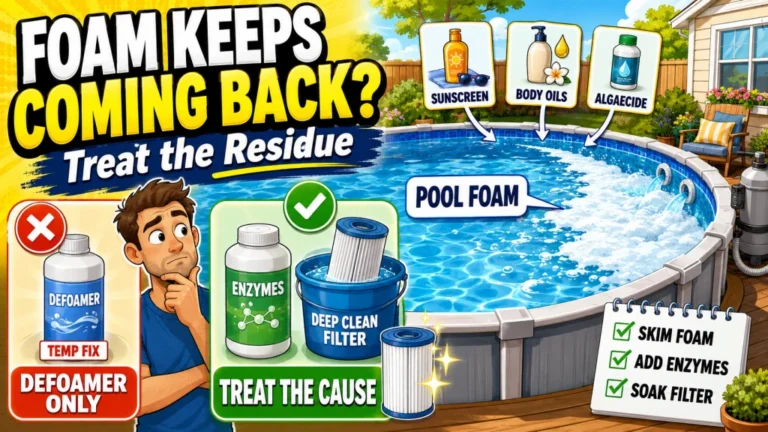
Foam behaves differently from green or cloudy water because it usually is not a sanitation failure at all. It is almost always caused by something reducing the surface tension of the water, most commonly body oils, sunscreen, lotion, or a lower-quality algaecide that includes foaming compounds as a side effect. Elevated phosphates can add to the organic load in the water as well, though phosphates alone rarely explain foam on their own. None of that is something a filter, however clean, is designed to strip out on its own.
The fix depends on identifying which contaminant is doing the foaming. If it started after swimmers with sunscreen or lotion, the water usually clears on its own within a day or two of normal filtration once no more contaminant is being added, sometimes helped along with an enzyme-based product that breaks down oils. If the foam started right after adding an algae treatment, checking the label for the active ingredient is worth doing before adding anything else, since certain compounds used in cheaper products are known to cause foaming on their own.
- Foam that sits on the surface and lingers after the pump shuts off usually points to a contaminant in the water, not the equipment.
- Bubbles that shoot out of the return jets and vanish the moment the pump stops usually point to an air leak in the plumbing, which is a mechanical issue rather than a water chemistry one.
- Foam that reappears every time a specific product gets added is a strong signal to stop using that product rather than treating the symptom again.
The foam diagnosis and fix guide breaks down how to tell these causes apart and what to actually do once you know which one you are dealing with.

This 12-ounce, pH-neutral enzyme formula treats up to 25,000 gallons per bottle with just one monthly dose, breaking down sunscreen, body oils, sweat, and other organic waste that cause cloudy water and waterline scum. It works alongside your existing sanitizer to support chlorine efficiency, with visible results in 24 to 48 hours. Biodegradable and residue-free, it is compatible with in-ground and above-ground pools, including saltwater, chlorine, UV, ozone, and mineral systems.
Check On AmazonIf you click this link and buy, we earn a commission at no additional cost to you.
Final Thoughts: Diagnose Before You Treat
What the test shows tells you which category you are actually in. Chlorine not holding relative to stabilizer puts you in the algae and chlorine group. pH, alkalinity, or calcium running high puts you in the water balance group. Foam tied to sunscreen or body oils puts you in the contaminant and cleanup group. Bubbles from the return jets put you in the mechanical group, not a chemical one at all. Match the category before you buy or add anything, and above ground pool troubleshooting stops being a guessing game. Once the water is clear and stable again, staying there comes down to the everyday numbers covered in the chemical target ranges guide, which is worth a look even if nothing is wrong right now.
Explore More Above Ground Pool Guides
Each water problem above has a full diagnosis-first walkthrough with the specific tests, targets, and corrections to use. These are worth bookmarking even if your water looks fine today.
| Guide | What it helps with |
|---|---|
| Above Ground Pool Green Water | Confirming an algae problem and running the shock sequence correctly from start to finish. |
| Above Ground Pool Cloudy Water | Sorting through the several distinct causes of cloudy water and matching each one to its actual fix. |
| Above Ground Pool Foam | Telling apart contaminant-based foam and mechanical air leaks, and resolving each correctly. |
Once the current problem is diagnosed and corrected, the next task is keeping the numbers steady enough that the same problem does not come back.
FAQs
🟢 Why won’t my green pool clear up even though the filter is running 24/7?
Because green water is an algae problem, and algae multiplies faster than any filter can remove it without enough active chlorine in the water. The filter helps clean up dead algae after chlorine does the work, not before.
🌫️ Is cloudy water always caused by algae?
No. Cloudy water can come from early-stage algae, leftover particles after a chemical treatment, calcium precipitating out of solution at high pH or hardness, or a filter that cannot keep up. Testing in order tells you which one applies.
🧴 What causes foam in an above ground pool?
Most foam comes from something lowering the surface tension of the water, commonly body oils, sunscreen, lotion, or a lower-quality algae treatment. It is a contaminant problem, not something a clean filter can strip out on its own.
⏱️ How long does it take to fix above ground pool water problems?
Green water typically takes several days of sustained shock-level chlorine. Cloudy water can clear in a day or two once the actual cause is corrected. Foam from contaminants often clears within a day or two of normal filtration once no more is being added.
🧪 Do I need to test before treating a water problem?
Yes. Guessing at a fix without testing chlorine, pH, and stabilizer first is the most common reason a water problem lingers for weeks instead of days. The correct fix depends entirely on what the numbers actually show.
🫧 What is the difference between foam and bubbles in an above ground pool?
Foam sits on the surface and lingers after the pump shuts off, and it usually points to a contaminant. Bubbles that shoot from the return jets and disappear the moment the pump stops usually point to an air leak in the plumbing instead.
Sources and References
Every claim above that depends on outside evidence traces back to one of the following:
- Trouble Free Pool’s guide to clearing cloudy pool water, on cloudy and green water being a chemical problem rather than a filtration problem, and on treating chemistry before adding a clarifier.
- Trouble Free Pool’s SLAM process reference, on the shock, hold, and confirm sequence used to clear an algae bloom.
- Trouble Free Pool’s discussion on green pools and filtration, on algae reproducing faster than any filter can remove it in an unsanitized pool.
- Poolburg’s guide to foamy pool water causes and fixes, on body oils, sunscreen, and lower-quality algaecides as common foam sources, and on the difference between surface foam and return-jet bubbles.
- Trouble Free Pool’s list of non-recommended pool chemicals, on additive-heavy products that can cause side effects like foaming.