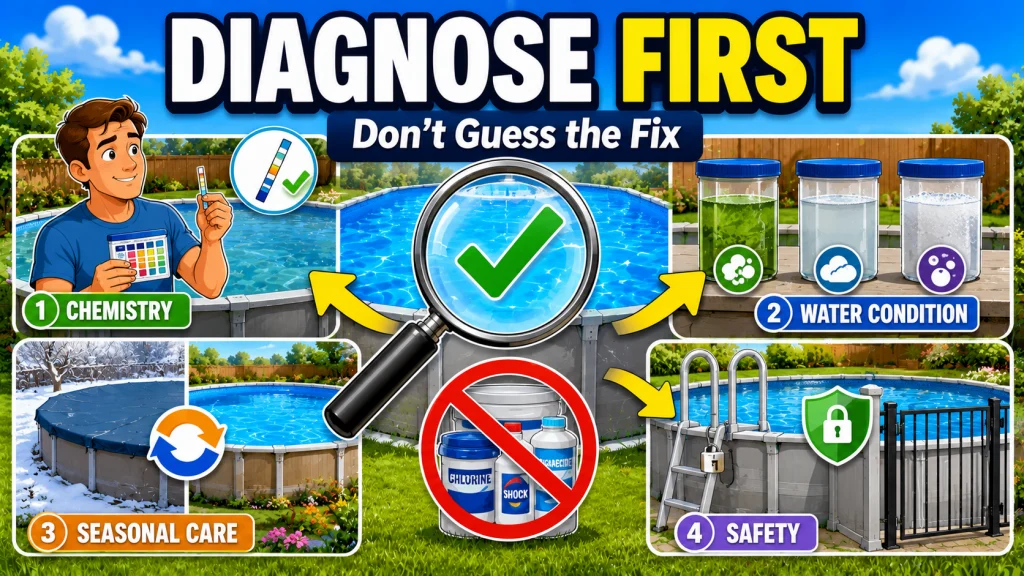
Above ground pool maintenance breaks down in one of four ways: the weekly chemistry routine slips, a problem gets the wrong fix, the seasonal open or close is done incorrectly, or the pool is missing basic safety controls. This guide walks through all four, including where some brand pool guides quietly get pH wrong, why most first attempts at fixing a green pool make it worse, and what actually determines whether spring opening takes an afternoon or a week of recovery chemistry. Read this before your next test kit reading confuses you, not after the water’s already green.
Four Ways Above Ground Pool Maintenance Goes Wrong
Every above ground pool maintenance failure I get called about traces back to one of four things. The weekly chemistry routine slips and the water gets ahead of the owner before they notice. A real problem develops. Maybe it’s green water, cloudy water, or foam. Whatever it is, the wrong fix gets applied first, which usually wastes money and sometimes makes things worse. The seasonal close or open gets done incorrectly and causes weeks of chasing chemistry that a correct close would have prevented. Or the pool simply lacks the basic access controls that keep an unsupervised moment from becoming an emergency.
None of these four are complicated on their own, but they get treated as one big vague category called “pool maintenance,” which is exactly why they slip. Weekly chemistry, troubleshooting, seasonal transitions, and safety are four separate skills, and knowing which one you’re actually dealing with is most of the battle.
Weekly Chemistry and Water Balance
Five numbers determine whether an above ground pool stays clear: free chlorine, pH, total alkalinity, calcium hardness, and cyanuric acid (CYA). Test at least twice a week during swim season, more often after heavy rain or a pool party, and adjust total alkalinity before pH, since alkalinity acts as the buffer that keeps pH from swinging every time something else changes.
| Parameter | Target Range |
|---|---|
| Free chlorine | 1 to 3 ppm (up to 4 ppm during heavy use) |
| pH | 7.2 to 7.6 |
| Total alkalinity | 80 to 120 ppm |
| Calcium hardness | 200 to 400 ppm |
| Cyanuric acid (outdoor pools) | 30 to 50 ppm |
Note: Some brand-published pool guides list a wider pH window, up to 8.0, as acceptable. That’s outside the range most pool professionals actually target. Once pH climbs past 7.6, chlorine’s disinfecting power drops off noticeably even though the test strip might still look “in range” on a brand chart, and scale starts forming on equipment. If a brand guide and this range disagree, follow the tighter one.
The order matters more than most owners assume. Alkalinity first, because it stabilizes everything that follows. pH second, since chlorine barely works once pH drifts high. Calcium hardness matters more for long-term equipment and liner protection than for same-day water clarity, and CYA is the one people skip most, even though it’s what keeps chlorine from burning off within hours of a sunny afternoon. The full weekly routine, dosing math by pool volume, and what actually causes each of these five numbers to drift is covered in the chemical levels guide for above ground pools.

These test strips check pH, total chlorine, free chlorine, bromine, alkalinity, total hardness, and cyanuric acid using medical industry technology for accuracy comparable to liquid tests. Simply dip the strip, wait 15 seconds, and compare it to the color chart, with no drops or measuring involved. Each color pad uses paper designed to keep colors vibrant and prevent bleeding for reliable readings. AquaChek has over 35 years of experience helping maintain healthy pool and spa water.
Check On AmazonIf you click this link and buy, we earn a commission at no additional cost to you.
Troubleshooting: Green, Cloudy, and Foamy Water
This is where most first-time owners make their maintenance situation worse, not better, because the instinct is to throw more chemicals at whatever the pool is doing. Before touching anything, figure out whether you’re looking at a chemistry problem or a filtration problem, since the fix for one does nothing for the other.
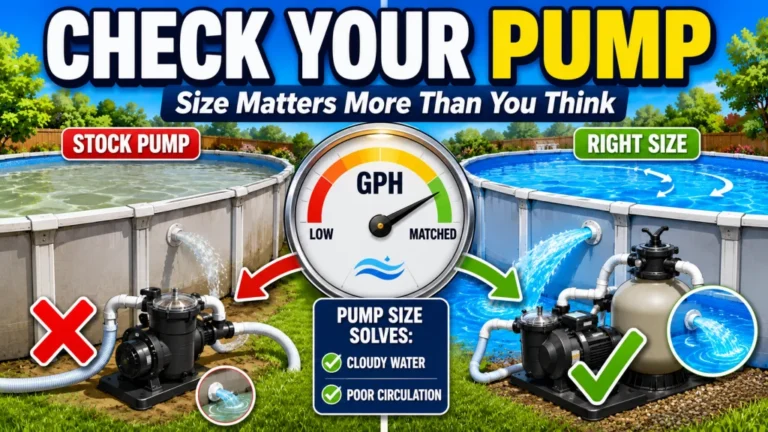
A green pool is almost always chemistry. Free chlorine dropped too low for too long, and algae took hold. The fix is the SLAM process: raise chlorine to a level based on your CYA reading and hold it there, with the filter running continuously, until the water passes clear. Adding a splash of shock and calling it done is the most common mistake, since a single dose rarely gets the pool to the level needed and green water returns within days. Cloudy water splits roughly down the middle. Sometimes it’s chemistry, low chlorine about to turn into algae, or calcium hardness precipitating out of solution. Other times it’s a filtration or circulation problem, a dirty or undersized filter that can’t catch fine particles even though the chemistry tests fine.
- Test free chlorine first. If it’s low, treat as an early algae problem and start the SLAM process rather than waiting.
- If chlorine and pH both test fine but water stays hazy, check the filter next: look at pressure, clean or backwash it, and give it 24 to 48 hours before assuming something else is wrong.
- Cloudy water after a SLAM is usually dead algae particles too small for the filter to catch immediately. Patience and continuous filtration clear this in 2 to 5 days, not more chemicals.
- Foam is almost always a product problem, not a pool problem: lotions, sunscreen, and some cheap algaecides create foam that chlorine and pH adjustments won’t fix on their own.
Sorting a symptom into one of these two buckets before you buy anything from the pool aisle saves both money and a week of frustration. The full diagnostic sequence, exact SLAM chlorine targets by CYA level, and what to do when a fix isn’t working after 48 hours is covered in the troubleshooting guide for above ground pools.

This calcium hypochlorite shock treatment offers fast-acting, non-stabilized chlorine for routine algae control and sanitization, with 65 percent available chlorine for crystal-clear water. It is suitable for above ground or in-ground pools, spas, and hot tubs. Pre-dissolve or dilute before adding to avoid bleaching the liner, spreading granules in the deepest part of the pool and brushing if needed. Use 1 pound per 10,000 gallons weekly to maintain 5 to 10 ppm chlorine levels.
Check On AmazonIf you click this link and buy, we earn a commission at no additional cost to you.
Seasonal: Closing Right So Opening Isn’t a Fight
How a pool gets closed in the fall determines almost everything about how easy it is to open in the spring. A pool closed with balanced chemistry, a properly fitted winter cover, and the right equipment winterized opens to water that needs a day of adjustment, not a fight to get it back under control.
The most common closing mistake is treating it as just “cover and walk away.” Skipping a closing shock, leaving chlorine too low going into winter, or using a cover that lets sunlight through gives algae months to establish itself under conditions nobody’s checking on. On the opening side, the rush to swim as soon as the cover comes off is what turns a simple spring startup into an extended green pool recovery. Testing before assuming the water’s fine, running the filter before adding a full round of chemicals, and being willing to SLAM immediately if the water looks even slightly off saves far more time than skipping straight to swimming.
Timing the close correctly matters too. Closing too early wastes a swim season, and closing too late means the water’s already fighting cooler temperatures and shorter sun exposure that make normal chemistry harder to hold. The full close and open sequence, including the pre-close chemical checklist and the exact order to bring a pool back online in spring, is covered in the seasonal guide for above ground pools.

This kit streamlines pool closing with all necessary chemicals included, offering safe and reliable protection without damaging pool surfaces or other winterizing chemicals. It suits pools of any shape and size, with larger kits available for pools exceeding 35,000 gallons. The Winter Sorb absorbs 40 times its weight in oils to prevent waterline scum. The kit includes 1 quart Winterizer, 1 quart Winter Stain-Away, 2 pounds of chlorine free pool shock oxidizer, 1 Winter Sorb, and 1 Winter Pool Floater.
Check On AmazonIf you click this link and buy, we earn a commission at no additional cost to you.
Safety: Access Control, Not Just Water Quality
This is the maintenance area that has nothing to do with water chemistry and everything to do with who can get to the water in the first place. Requirements vary by state and municipality, so treat what follows as common patterns rather than your specific local code, and check with your city or county before assuming your setup is compliant.
A recurring pattern across most state and local pool codes: an above ground pool wall of roughly 48 inches or taller can often serve as part of the required barrier on its own, but only if the access ladder or steps can be removed or locked when the pool isn’t in use. If the ladder just folds up but a determined child could still reach it, most codes don’t consider that sufficient. Where a separate fence is required, the common standard is a barrier at least 48 inches high with no gap wide enough for a 4-inch sphere to pass through, and any gate needs to be self-closing and self-latching with the release mechanism at least 54 inches off the ground.
Warning: A locking ladder or a compliant fence handles physical access, but pool alarms are a separate layer, not a substitute. Alarms built to the ASTM F2208 standard detect entry into the water itself and are meant to work alongside a barrier, not instead of one.
None of this replaces direct supervision when kids or pets are anywhere near the pool, and no single safety feature is described as sufficient on its own in the codes that require them, which is exactly why most jurisdictions require at least two layered measures rather than one. The full breakdown of ladder and fence requirements by common code pattern, plus how to evaluate a pool alarm, is covered in the safety guide for above ground pools.

This pool alarm installs easily without damaging the pool structure or surface and runs on a 9V battery, sold separately. It meets ASTM Safety Specification F2208 requirements, offering reliable protection for families with children and pets. Adjustable sensitivity settings help reduce false alarms during high winds or heavy rain while still detecting objects 15 lbs and above. Multiple alarms can be used together for comprehensive coverage in larger pools, though the device may not suit in-pool fountains, waterfalls, or saltwater pools.
Check On AmazonIf you click this link and buy, we earn a commission at no additional cost to you.
Final Thoughts: Diagnose Before You Treat
From a distance, a slipping chemistry routine, a real troubleshooting situation, a seasonal transition done out of order, and a missing safety control all just look like “something’s off with the pool.” Each one needs a completely different response, and the fix for one won’t touch the other three.
Test before you treat, diagnose before you buy a product, and don’t let any of these four areas coast just because the water happens to look fine this week.
Where to Go Next
Each maintenance area above has a full guide with the exact numbers, sequences, and checklists for your situation.
| Guide | What it helps with |
|---|---|
| Chemical Levels Guide | Weekly testing routine, target ranges, and dosing math by pool volume. |
| Troubleshooting Guide | The SLAM process, cloudy water diagnosis, and foam fixes. |
| Seasonal Guide | Closing checklist and the correct spring opening sequence. |
| Safety Guide | Fence, ladder, and alarm requirements by common code pattern. |
Start with whichever area matches what’s actually happening with your pool right now, not the one you assume is the culprit.
FAQs
🧪 What is the correct pH range for an above ground pool?
7.2 to 7.6 is the range most pool professionals target. Some brand pool guides list a wider window up to 8.0, but chlorine loses effectiveness well before that point, so it’s worth following the tighter range regardless of what a brand chart says.
🟢 Why did my pool turn green even though I was adding chlorine?
A single dose of shock usually isn’t enough once algae has taken hold. The SLAM process, raising and holding chlorine at a level based on your CYA reading with the filter running continuously, is what actually clears it, not repeated small doses.
☁️ My pool water is cloudy but my chemistry tests fine. What’s wrong?
If chlorine and pH are in range and the water is still hazy, suspect the filter rather than the chemistry. A dirty or undersized filter can’t catch fine suspended particles no matter how balanced the water tests.
🔒 Can the pool wall itself count as a safety barrier?
In many jurisdictions, yes, if the wall is roughly 48 inches or taller and the ladder can be removed or locked when the pool isn’t in use. Requirements vary by state and city, so confirm with your local code before relying on this.
❄️ How do I avoid a week of green water when opening my pool in spring?
Close the pool correctly in the fall with balanced chemistry and a properly fitted cover, then test before swimming in spring instead of assuming the water is fine. If the water looks even slightly off at opening, start the SLAM process immediately rather than waiting.
Sources and References
The chemical target ranges, troubleshooting sequence, and safety barrier figures in this guide are cross-checked against the following:
- A widely used above ground pool brand’s own chemical level guidance, referenced for the wider pH range some brand guides publish.
- Practical pool water chemistry target ranges, used for the 7.2 to 7.6 pH standard and the alkalinity-before-pH sequence.
- Cloudy pool water diagnostic sequence, used for the chemistry-versus-filtration distinction and the SLAM process.
- Federal residential pool safety barrier guidelines, used for common above ground pool wall, ladder, and fence barrier patterns.
- Pool alarm and safety cover standards reference, used for ASTM F2208 alarm standards and layered safety feature requirements.