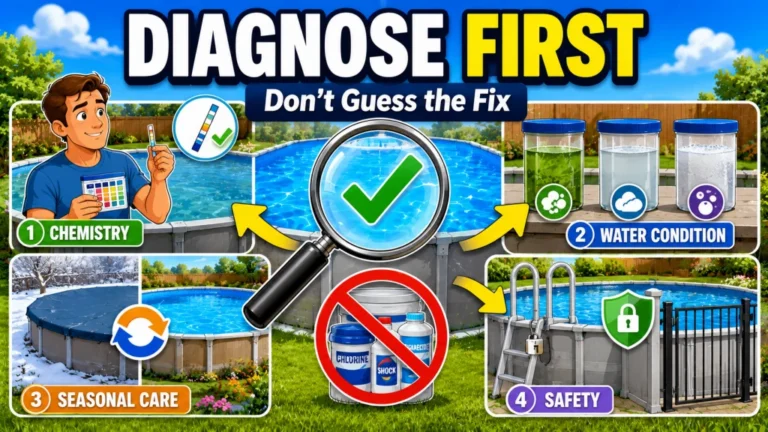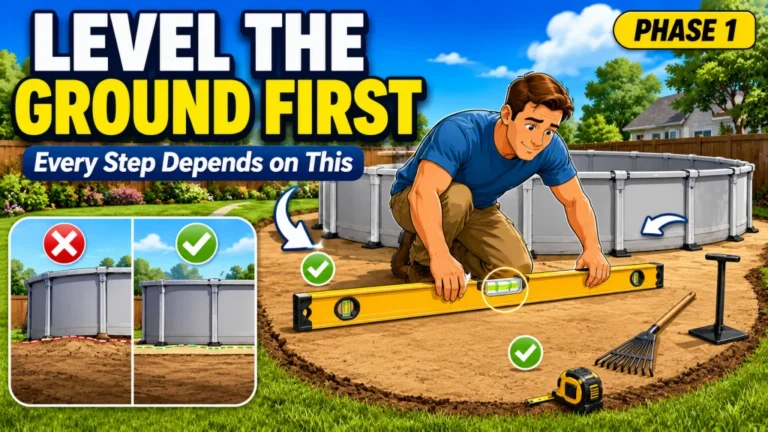
Above ground pool equipment breaks into five categories, and the pump and filter in the box are only the first one. This guide walks through what each category actually does for the pool, when the stock version that came with your kit is enough, and when it’s worth upgrading. You’ll get a clear picture of pump sizing, cleaning options, cover types, heater choices, and how to decide between patching a liner and replacing it. Read this before you assume the kit has everything you need, because most owners find out otherwise within the first season.
The Kit Is a Starting Point, Not the Full List
Above ground pool equipment gets treated like an afterthought because the kit already includes a pump and a filter, and that feels like the job is done. It isn’t. Most owners discover additional equipment needs within the first season, usually because something in the kit underperforms for the pool size they actually bought, or because they want the pool to run with less manual effort than the box assumes they’re willing to put in.
That discovery process doesn’t have to be trial and error. Five categories cover essentially everything an above ground pool owner will ever need to buy beyond the initial kit: the pump and filter system, cleaning equipment, covers, heaters, and the liner itself. Each one solves a different problem, and none of them substitute for another. Knowing which category you’re actually short on saves you from buying the wrong upgrade or ignoring a real gap for another season.
The order these usually come up in ownership is fairly predictable, too. First season, it’s almost always pump verification and a basic manual cleaning kit, since those are the two things that determine whether the water even stays clear. Once the pool settles into regular use, an automatic cleaner or a cover becomes worth it depending on debris load and how much of the season you actually swim. A heater tends to enter the conversation once you’re past the first year or two and want to stretch the season rather than just survive it. Liner repair or replacement is the equipment decision that shows up last, simply because it takes years for a liner to reach that point on its own.
Pump and Filter: The System That Keeps Water Moving
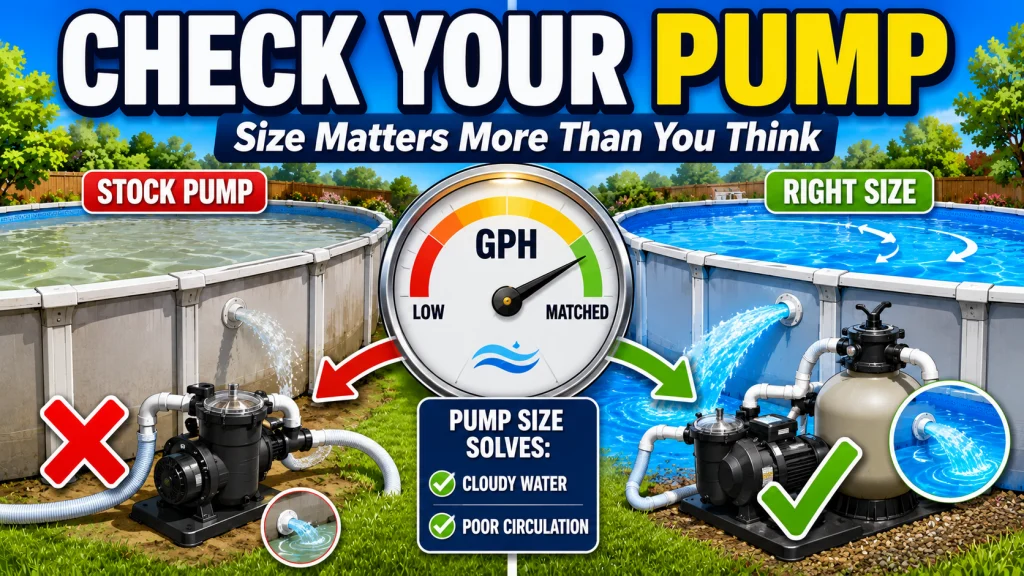
This is the equipment category most likely to need an upgrade, and it’s also the one most owners don’t think to question because the pool came with one already installed. The pump and filter’s job is to turn the pool’s entire water volume over on a schedule, generally once every 8 hours for a residential pool, and the stock pump in a boxed kit is sized for the smallest pool in that product line, not necessarily the 15-foot or 18-foot model most buyers actually take home.
| Pool Volume | GPH Needed for an 8-Hour Turnover |
|---|---|
| 8,800 gallons (15-foot round) | About 1,100 GPH |
| 15,000 gallons (24-foot round) | About 1,875 GPH |
| 21,000 gallons (large oval) | About 2,625 GPH |
Note: Any pool 15 feet or larger deserves a pump check against this math before you assume the included pump is adequate. If your pool’s GPH requirement is higher than the pump’s rated flow, the water can look fine on a mild week and still fall behind the moment bather load or heat spikes.
The filter side of the equation matters just as much, since the pump’s flow rate should never exceed what the filter can safely handle. A cartridge filter that’s undersized for the pump pushing water through it won’t filter effectively no matter how strong the pump is, and an oversized pump paired with a small filter tends to shorten both components’ working life. When people ask why their week-old pool still looks cloudy despite dosing chlorine correctly, this pairing is where I start looking before I touch the chemistry. The full sizing math, filter type comparison, and how to size a replacement for your specific pool volume is covered in our full pump and filter guide.

This sand filter pump features a 0.33 HP copper motor with overload protection and a max flow rate of 3,000 GPH for fast, efficient circulation. Key components come pre-installed for easy setup, even for first-time users. The reinforced, corrosion-resistant thermoplastic tank is easy to carry, while the multi-port valve and durable threaded fittings help prevent leaks, with a compatible adapter for above-ground frame pools. It offers 6 modes, including filter, backwash, rinse, waste, winter, and closed, for complete pool maintenance.
Check On AmazonIf you click this link and buy, we earn a commission at no additional cost to you.
Cleaning and Vacuuming: Getting Debris Off the Floor and Walls
Once water is circulating and filtering correctly, the next equipment gap is usually debris removal, and this category has three genuinely different approaches rather than one product with different price points. A manual vacuum head on a telescoping pole, connected to the skimmer, costs under $50 total and takes 20 to 30 minutes to clean a typical above ground pool. It’s slow, but it’s also the only option with zero moving parts to fail and the fastest way to spot-clean one dirty corner without running a full cycle.
Suction cleaners connect to the skimmer or a dedicated suction port and use the pump’s own flow to move around the floor, typically running $100 to $400. They’re a reasonable middle ground, but every bit of debris they pick up runs through your main filter, which means more frequent backwashing or cartridge cleaning if you run one often. Robotic cleaners sit at the top of the category, starting around $400 and climbing well past $1,000 for larger units, and they carry their own onboard filter instead of taxing your pool’s system at all. For a heavily used pool or one under a lot of tree cover, that difference in filter load adds up over a season.
- Small above ground pools or light debris loads: a manual vacuum is often genuinely enough, not just the budget fallback.
- Moderate debris and moderate budget: a suction cleaner, with a plan to clean your filter more often than the “monthly” default.
- Heavy debris, heavy use, or you want to stop thinking about it: a robotic cleaner, checking first that the model is rated for above ground and flat-bottom use.
- Regardless of which automatic option you pick, keep a manual vacuum kit on hand. Every pool owner needs one eventually, usually right after a storm or an algae treatment.
Whichever you choose, the return on it shows up as less chlorine wasted fighting settled debris and less strain on whichever pump and filter setup you landed on above. A full comparison of cleaner types, compatibility with different pool wall heights, and maintenance schedules for each is in our full cleaning equipment guide.

This cordless pool vacuum delivers 2280 GPH suction to remove leaves, sand, dirt, and other debris from the pool floor. Its dual layer filtration system uses a 180 micron precision filter and textured foam to improve filtration efficiency by up to 50 percent over standard robots. The cleaner parks itself near the wall when battery is low and pauses at edges for deeper cleaning. It runs up to 130 minutes, covers pools up to 1,100 square feet, and recharges in 2 to 3 hours, making it suitable for in-ground pools with water depth under 2.5 meters.
Check On AmazonIf you click this link and buy, we earn a commission at no additional cost to you.
Covers: Three Purposes, Not One Product
This is the equipment category where I see the most dangerous assumption, and it’s worth being direct about it: a cover that keeps debris out is not automatically a cover that keeps a child or pet from falling in. Solar covers, winter covers, and safety covers solve three different problems, and none of them substitute for the others.
Warning: A solar blanket floating on the water is not a safety barrier. It can actually increase entrapment risk if someone steps onto it expecting it to hold weight. If drowning prevention is the goal, only a cover built and rated for that purpose, generally an anchored mesh or solid safety cover, does the job.
Solar covers are the thin bubble-style blankets that float directly on the water, and their job is heat retention and reduced evaporation, typically raising water temperature somewhere in the 5 to 15 degree range depending on climate and sun exposure. Winter covers, often a tarp-style cover secured with a cable and winch on above ground pools, exist to keep debris, sunlight, and snowmelt out during the off season. They’re the cheapest category and also the least protective if a person or animal wanders onto one. Safety covers are a different category of product entirely, engineered and rated to support real weight, and while they’re less common on above ground pools than inground ones, they’re worth considering directly if young kids or pets have regular access to the yard.
Most cover mismatches happen because a buyer picks based on what the cover is called rather than what it’s built to do. “Pool cover” gets used loosely enough online that a solar blanket and a winter tarp end up sounding interchangeable in casual conversation, even though their materials and purpose have nothing in common. It’s also common to need more than one type on the same pool: a solar cover during swim season for heat and evaporation control, then a separate winter cover once the pool closes for the year, since a solar blanket isn’t built to sit under snow load or freezing temperatures. The tradeoff across all three types is consistent: better heat retention and lower cost usually means less durability and no safety function, while a genuine safety cover costs more and does less for water temperature.
Buying one cover and expecting it to handle all three jobs is the mistake I see most, usually from an owner who bought a solar cover thinking it doubles as a safety measure. It doesn’t, and treating it that way is worse than having no cover assumption at all, since it can create false confidence around the pool. The full breakdown of materials, lifespan by cover type, and how to size one to your specific pool is covered in the cover guide for above ground pools.

This solar cover harnesses the sun's energy to raise water temperature by up to 15 degrees and traps heat to help maintain warmth overnight. It reduces evaporation by up to 95 percent, cutting back on chemical use and the need for extra water. The durable design also blocks leaves and debris from entering the pool, reducing maintenance. Extra overlap makes installation and removal easy, and the cover can be trimmed to fit around protrusions for above ground or inground pools.
Check On AmazonIf you click this link and buy, we earn a commission at no additional cost to you.
Heaters: Extending the Season, Not Just Warming the Water
Heaters are the equipment category most owners consider only after a few seasons, usually once they’re tired of a swim window that closes the moment fall temperatures drop. Three distinct options exist for above ground pools, and they solve genuinely different problems rather than competing on the same axis.
Solar heaters, a set of panels the pump circulates water through, are the cheapest to run since the energy itself is free, but they’re slow and weather-dependent. On a modest above ground pool, expect a rise of maybe 5 degrees over several sunny days, not a quick fix before a weekend party. Heat pumps pull ambient heat from the air rather than generating it directly, which makes them efficient and steady, but they stop working well once air temperatures drop below roughly 45 to 55 degrees, and they heat gradually rather than quickly. Gas heaters are the opposite tradeoff: higher to run, but they can raise water temperature fast and keep working regardless of how cold the air gets, which matters if you’re heating for a specific weekend rather than maintaining a steady temperature all season.
| Heater Type | Typical Unit Cost | Best Fit |
|---|---|---|
| Solar panel system | $300 to $1,000+ | Sunny climate, patient owners, lowest running cost |
| Heat pump | $800 to $3,000+ | Daily swimmers wanting a steady, moderate temperature |
| Gas heater | $1,500 to $3,000+ | Weekend use, fast heat-up, works in cold air |
None of these are mandatory equipment the way a pump is. They’re a season-extension decision, and the right one depends heavily on how often you actually swim, not just your climate. A daily swimmer in a moderate climate usually gets the most value from a heat pump, while someone heating up the pool only when guests are coming over is often better served by the faster recovery a gas heater provides. The full cost breakdown, sizing by pool volume, and what climate rules each option out is covered in the heater guide for above ground pools.
Liners: Knowing When to Patch and When to Replace
The liner holds the water in, so it’s not optional the way a heater is, but the repair-versus-replace decision still belongs in this category because it’s a purchase most owners eventually face. Soft-sided frame pool liners typically last 5 to 9 years, and steel wall pool liners run 7 to 12 years, with water chemistry and installation quality being the biggest factors in where you land in that range. Replacement runs roughly $500 to $1,500 depending on pool size, so the patch-or-replace question has real money behind it.
A small tear, generally under 6 to 8 inches, on a liner that’s only a couple years old is almost always worth patching. A vinyl patch kit runs $20 to $50, cures underwater in most cases, and can buy years of extra life if the rest of the liner is still in good shape. The calculation changes once the liner is fading, feels brittle rather than pliable, or has more than one tear showing up in different spots. At that point a patch is treating a symptom of a liner that’s simply reaching the end of its service life, and the next tear is already on its way.
- Small, isolated tear on a liner under 5 years old: patch it and keep swimming.
- Fading, brittleness, or wrinkles that keep recurring: start budgeting for replacement even if today’s damage is minor.
- Multiple tears or damage near a seam: replacement is usually the better use of money over another round of patching.
- Any tear near the skimmer or a fitting: these are harder to patch reliably and worth extra scrutiny before you commit to a repair.
Measuring correctly for a replacement liner, matching liner type to your specific pool frame, and the full patch kit process are covered in the liner guide for above ground pools, including what to check before you assume a leak means the whole liner needs to go.

This kit fixes small holes, tears, and leaks on vinyl liner pools, above ground pools, inflatable pools, floats, toys, and other vinyl products. The strong adhesive works both underwater for wet repairs and on dry surfaces, creating a durable, waterproof bond ideal for air and water leaks in inflatables, boats, and rafts. It bonds tightly to original vinyl for long lasting results that help extend the life of liners and inflatables. The kit includes vinyl patch material, an applicator tool, and a 4 oz adhesive tube.
Check On AmazonIf you click this link and buy, we earn a commission at no additional cost to you.
Final Thoughts: Match the Symptom to the Category
Cloudy water is usually a pump and filter problem, not a chemical one. A pool that’s always dirty on the surface is a cleaning equipment gap. A short swim season is a heater question, and a slow leak is a liner question, not a sign the whole pool is failing. Most equipment money gets wasted when an owner buys something that sounds like an upgrade without pinning down which specific system was actually underperforming.
Match the symptom to the category before you spend anything, and you’ll fix the real gap once instead of working through equipment by trial and error over a couple of frustrating seasons.

This gas pool heater delivers 135,000 BTU of heating power for fast warm ups, helping extend the swimming season. It features a durable cupro-nickel heat exchanger built to resist corrosion in demanding pool and spa environments. Low emission combustion technology keeps operation clean and energy efficient while lowering costs. A digital control panel makes it easy to set temperatures and monitor performance, and the Totally Managed cupro-nickel water flow system enhances efficiency while protecting key components.
Check On AmazonIf you click this link and buy, we earn a commission at no additional cost to you.
Where to Go Next
Each equipment category above has a full guide covering sizing, options, and what actually matters when you’re ready to buy.
| Guide | What it helps with |
|---|---|
| Pump and Filter Guide | Sizing math, filter types, and when the stock pump needs an upgrade. |
| Cleaning Equipment Guide | Manual, suction, and robotic cleaners compared by pool size and debris load. |
| Cover Guide | Solar, winter, and safety cover materials, lifespan, and sizing. |
| Heater Guide | Solar, heat pump, and gas heater costs and climate fit. |
| Liner Guide | Measuring for replacement, liner types, and the full patch process. |
Start with whichever category matches the problem you’re actually having, not the one that seems like the obvious next purchase.
FAQs
🔧 How do I know if my pool’s stock pump is too small?
Divide your pool’s gallon volume by 8 to get the GPH your pump needs for a standard turnover, then compare that to your pump’s rated flow. If your pool is 15 feet or larger, it’s worth checking this math directly rather than assuming the included pump is adequate.
🧹 Is a robotic pool cleaner worth it for an above ground pool?
For pools with heavy debris or frequent use, yes, since it runs independently of your main filter and reduces backwashing frequency. For a small, lightly used pool, a manual vacuum or suction cleaner is usually enough.
☀️ Does a solar cover count as a safety cover?
No. A solar cover floats on the water for heat retention and can actually increase entrapment risk if someone steps onto it. Only a cover specifically built and rated as a safety cover protects against a child or pet falling in.
🔥 What’s the fastest way to heat an above ground pool?
A gas heater raises temperature fastest and works regardless of outside air temperature, which makes it the right fit for weekend or occasional use. A heat pump is more efficient for steady daily use but heats more gradually and only works well above roughly 45 to 55 degree air temperatures.
🩹 Should I patch or replace a liner with a small tear?
Patch it if the tear is small, isolated, and the liner is still under about 5 years old. If the liner is already fading, brittle, or has multiple tears, replacement is the better use of money even if today’s damage looks minor.
Sources and References
The GPH figures, equipment costs, and lifespan ranges in this guide are cross-checked against the following:
- Pool pump sizing and turnover rate guidance, used for the 8-hour turnover standard and GPH calculation.
- Pool cleaner cost and category comparison, used for manual, suction, and robotic cleaner pricing and maintenance differences.
- Pool cover types and safety cover standards, used for the solar cover safety myth and cover category breakdown.
- Pool heater cost and operating comparison, used for heat pump and gas heater cost ranges.
- Pool liner repair versus replacement guidance, used for liner lifespan and patch decision criteria.