The pump and filter are the life support system of an above ground pool, and when they’re undersized, nothing else compensates, not chemicals, not vacuuming, not a better cover. This guide covers the three things that actually determine whether that system is doing its job: whether the pump is sized correctly for your pool’s volume, which filter type fits your specific setup, and how a 2021 federal efficiency regulation changed what replacement pumps look like. It routes you to the full guide for whichever of those three is your actual gap.
The Pump and Filter Do the Work Everything Else Depends On
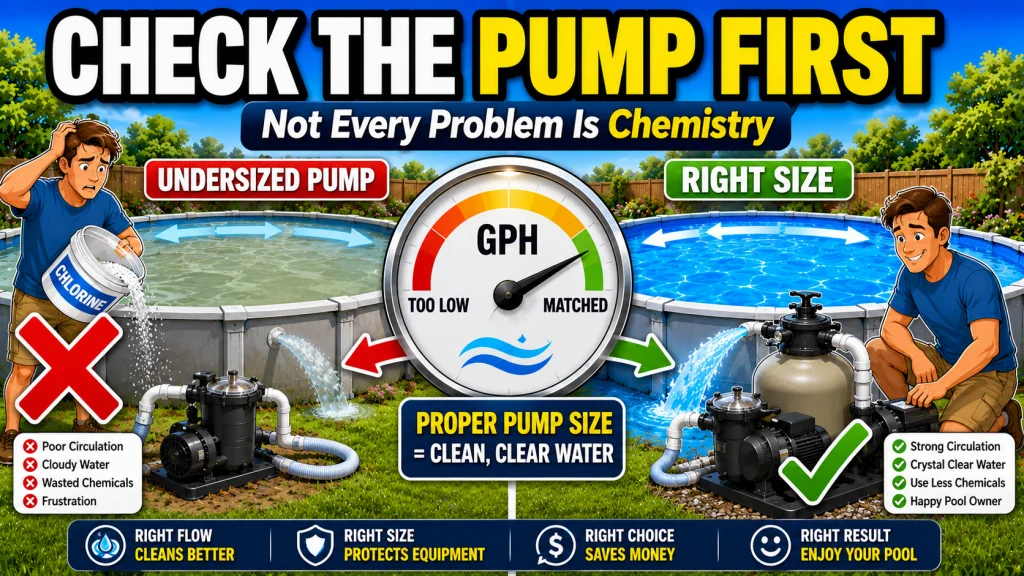
Your pool’s pump and filter have one job: keep water moving through the filter media on a schedule that removes what’s suspended in the water before it has a chance to feed algae or cloud things up. It’s the first of the five categories covered in the full above ground pool equipment guide, and it’s the one every other piece of equipment depends on. Chemistry only works on water that’s actually being filtered. Add chlorine to a pool with an undersized pump and you’re treating water that isn’t circulating fast enough to distribute that chlorine evenly or catch what the filter is supposed to catch.
This is why pump and filter problems get misdiagnosed so often. The water looks cloudy, the owner assumes it’s a chemistry issue and starts adding more chlorine or clarifier, and nothing improves because the actual bottleneck sits upstream of the chemistry entirely.
Telling the two apart usually comes down to timing and pattern. A chemistry problem tends to show up gradually, water clarity drifting worse over a few days as chlorine or pH slips out of range, and it usually responds within a day of correcting the numbers. A pump or filter problem looks different: the water stays hazy no matter how much chlorine goes in, filter pressure runs high, or the pool clears briefly after cleaning and clouds right back up within hours. If chemistry has already tested fine more than once and the water still isn’t clearing, that’s the signal to check flow and filtration before adding anything else to the water.
Getting the pump and filter right is the equipment decision every other above ground pool maintenance habit depends on, which is why it’s worth confirming before troubleshooting anything else. Three questions matter most here: is the pump sized correctly, does the filter type fit your setup, and does a replacement pump need to meet current federal efficiency rules?
Pump Sizing: The GPH Math That Actually Matters
Pump sizing comes down to one calculation: your pool’s total gallons divided by the hours you want for a full turnover, generally 8 hours for a residential above ground pool. That gives you the gallons per hour, or GPH, your pump needs to deliver. A 15,000-gallon pool needs roughly 1,875 GPH to hit an 8-hour turnover, and a pump rated below that number is working against a deficit no amount of chemical dosing will fix.
Note: The stock pump included with a boxed above ground pool kit is typically sized for the smallest pool in that product line, not necessarily the 15-foot or 18-foot model most buyers actually take home. If you’ve never checked your pump’s rated GPH against your pool’s actual volume, that’s the first thing worth doing before assuming a chemistry problem is the cause of persistent cloudiness.
Filter flow rate has to be part of this calculation too, since a pump’s flow rate should never exceed what the connected filter can safely handle. A filter that’s too small for an otherwise adequate pump still leaves you short, just for a different reason. Getting both halves of this pairing right, including the exact GPH targets by pool size and how to check your current pump against them, is covered in the pump size calculator guide for above ground pools.

This sand filter pump features a 0.33 HP copper motor with overload protection and a max flow rate of 3,000 GPH for fast, efficient circulation. Key components come pre-installed for easy setup, even for first-time users. The reinforced, corrosion-resistant thermoplastic tank is easy to carry, while the multi-port valve and durable threaded fittings help prevent leaks, with a compatible adapter for above-ground frame pools. It offers 6 modes, including filter, backwash, rinse, waste, winter, and closed, for complete pool maintenance.
Check On AmazonIf you click this link and buy, we earn a commission at no additional cost to you.
Sand vs. Cartridge: The Two Filter Types That Cover Most Above Ground Pools
Sand filters and cartridge filters solve the same problem with different tradeoffs, and above ground pools are split fairly evenly between the two depending on pool size and how hands-on the owner wants to be. A sand filter traps particles as water passes through a bed of specially graded sand, and maintenance is a periodic backwash, a quick reverse-flow flush that clears trapped debris without opening anything up. A cartridge filter uses a pleated fabric element that physically catches particles, and maintenance means pulling the cartridge out and hosing it down, with full replacement every one to three years depending on use.
Neither type is a universal upgrade over the other. Sand filters tend to be simpler to maintain long term since there’s no cartridge to replace, but they filter to a slightly coarser particle size than a quality cartridge filter can catch. Cartridge filters generally give clearer water and lower water usage since there’s no backwash cycle wasting water out the drain, but they require more hands-on cleaning and a periodic replacement cost that sand filters don’t have. Which one fits better depends on your pool size, how often you’re willing to handle physical maintenance, and how sensitive your specific water source is to fine particulates. The full comparison, including which filter type handles which pool sizes best and how to know when a cartridge needs replacing versus just cleaning, is covered in the sand filter versus cartridge filter guide for above ground pools.

This pump uses HydroAeration Technology to improve water circulation, filtration, clarity, and negative ion levels at the surface. It delivers a 1,500 GPH flow rate at the pump and 1,180 GPH in the pool, suitable for Intex above ground pools up to 9,400 gallons with a 1.25 inch hose fitting. Installation just requires hooking up the hoses and plugging in, with partial assembly needed. It uses easy to clean Type A Dacron paper cartridges, which should be replaced every 2 weeks.
Check On AmazonIf you click this link and buy, we earn a commission at no additional cost to you.
Variable Speed Pumps and the Federal Regulation Behind Them
A federal Department of Energy efficiency regulation that took effect in July 2021 reshaped the replacement pump market, and it’s worth understanding even though it applies unevenly to above ground pools specifically. The rule sets minimum efficiency standards for pool pumps above a certain power threshold, and in practice, most single-speed pumps in that range can no longer be manufactured, which has pushed variable speed pumps into becoming the default replacement option industry-wide.
Where this gets genuinely confusing for above ground pool owners is that the regulation treats above ground and inground applications differently in practice, even though it doesn’t always draw a clean line between them on paper. Many stock above ground pool pumps, especially the integral pump and filter units that ship with boxed kits, fall outside the regulated range entirely or are classified in a way that exempts them.
Larger standalone replacement pumps for bigger above ground pools can fall within the regulated range and may need to meet the same efficiency standard that’s pushed the inground market toward variable speed. Don’t assume your specific pump either is or isn’t affected without checking its actual rating. The answer depends on the pump’s power classification, not simply whether it’s labeled for an above ground pool.
None of this means you’re required to replace a working single-speed pump. If it’s already installed and running fine, you can keep using it. The regulation only affects what’s available new. What it means for anyone shopping for a replacement pump on a larger above ground pool is that a variable speed option is worth serious consideration anyway, since the same efficiency gains that drove the regulation, lower electricity cost from running at reduced flow most of the day, apply just as much to an above ground pool as to an inground one. The full breakdown of which above ground pump categories are affected, what the efficiency labeling actually means, and when a variable speed upgrade pays for itself is covered in the variable speed pump guide for above ground pools.

This pump features a digital control interface and corrosion-proof polymeric housing, suitable for in-ground and above-ground pools, spas, and aquaculture systems. It offers ECO, CLEAN, and BOOST preset speeds with step-less control from 1,500 to 3,450 RPM, plus a variable-speed motor that reduces energy consumption by up to 80 percent. The LCD screen displays wattage and speed settings, and a built-in 24-hour time clock allows custom scheduling. Weatherproof, industrial-grade construction includes a rainproof shell, overload protection, and anti-dry spin protection, with a 1.5-inch fitting adapter included.
Check On AmazonIf you click this link and buy, we earn a commission at no additional cost to you.
Final Thoughts: Confirm the Hardware Before You Adjust Anything Else
A pool that never quite feels clean, burns through chemicals faster than it should, or clouds back up within hours of clearing is usually telling you something about the pump or filter, not the chemical routine. Confirm the pump is sized for your pool’s volume and that the filter type you’re running fits how you use the pool before changing your dosing.
Once the pump and filter side of the equipment picture is settled, cleaning equipment is the next layer worth checking, and that’s covered in the cleaning equipment guide for above ground pools, which picks up debris removal once circulation and filtration are already working correctly. If the water itself is fine but evaporation, heat loss, or debris between uses is the actual complaint, the cover guide for above ground pools covers that separate equipment category instead.

This sand filter pump features a 6-function valve for filtering, backwashing, rinsing, recirculating, draining, and closing the system, plus HydroAeration Technology for improved circulation, clarity, and negative ion levels. A built-in 24-hour timer offers 2 to 12-hour preset cycles for automatic operation. It delivers a 1,500 GPH capacity flow rate and 1,050 GPH in-pool flow rate, suitable for Intex pools up to 8,400 gallons, and includes two 1.5-inch connector hoses. Sand can last up to 5 years with regular backwashing, and the pump comes with a 2-year limited warranty.
Check On AmazonIf you click this link and buy, we earn a commission at no additional cost to you.
Explore Each Pump and Filter Topic
If you’re unsure where your system is falling short, start with whichever topic below matches your symptom.
| Guide | What it helps with |
|---|---|
| Pump Size Calculator Guide | Exact GPH targets by pool volume and how to check your current pump against them. |
| Sand vs. Cartridge Filter Guide | Which filter type fits which pool size and maintenance style. |
| Variable Speed Pump Guide | What the DOE regulation means for above ground pool pump replacements specifically. |
Start with pump sizing if you’ve never checked your pump’s rated flow against your pool’s actual volume. That’s the gap I see most often.
FAQs
🔧 How do I know if my above ground pool pump is too small?
Divide your pool’s gallon volume by 8 to get the GPH your pump needs for a standard turnover, then compare that number to your pump’s rated flow. If your pool is 15 feet or larger, it’s worth checking this directly rather than assuming the stock pump is adequate.
🏖️ Is a sand filter or cartridge filter better for an above ground pool?
Neither is universally better. Sand filters are lower maintenance long term with no replacement part, while cartridge filters generally give clearer water and use less water overall but need periodic cleaning and replacement.
⚡ Do above ground pool pumps have to be variable speed now?
Not automatically. Many stock above ground pump units fall outside the federal efficiency regulation’s regulated range, but larger standalone replacement pumps can fall within it depending on their power rating, so it’s worth checking the specific pump rather than assuming either way.
💰 Is a variable speed pump worth the extra cost for an above ground pool?
Often, yes, if you’re already replacing a pump on a larger above ground pool. The electricity savings from running at reduced speed most of the day apply to above ground pools the same way they do to inground ones.
Sources and References
The GPH sizing math, filter comparison, and federal regulation details in this guide are cross-checked against the following:
- DOE pool pump efficiency regulation and exemptions, used for the July 2021 effective date and which pump categories are excluded from the standard.
- Manufacturer technical guidance on the DOE regulation and above ground pump classification, used for how non-self-priming above ground pump units are treated under the standard.
- Pool pump sizing and turnover rate calculation guidance, used for the 8-hour turnover standard and GPH calculation method.