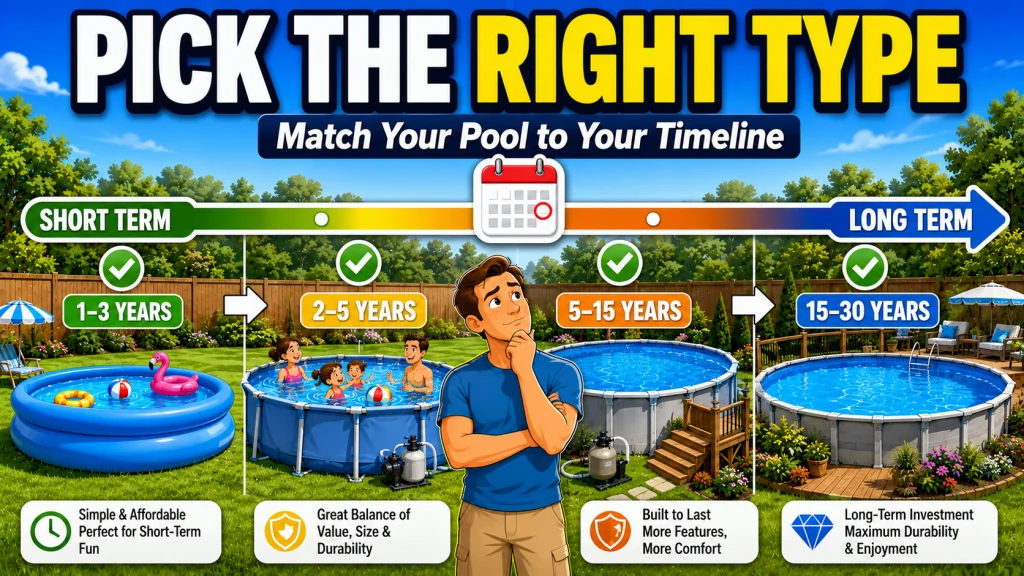
Above ground pool types split into four tiers based on how permanent they are, not on price or brand. Getting this one decision right before you look at anything else saves you from the most expensive mistake in above ground pool buying: buying a temporary pool and expecting a permanent experience out of it. This guide walks through all four tiers, the two questions that narrow you down to one of them, and where each type actually fits a real backyard and a real budget.
Permanence Is the Real Decision Behind Above Ground Pool Types
Above ground pool types get sorted by price on most shelves and most articles, which is exactly backwards. A $250 inflatable and a $2,500 hybrid frame pool both count as above ground pools, but they answer completely different questions. One is a seasonal convenience. The other is a structure you’re committing to for a decade or more. Sorting by price first is how a buyer ends up disappointed with a pool that was never built to do what they wanted from it.
The better filter is permanence: how long do you actually want this pool to stay in your yard, and does a deck or built-in landscaping factor into that plan. Those two questions eliminate three of the four tiers in most cases, and once you know your tier, price and brand comparisons actually mean something.
Tier 1: Inflatable Easy-Set
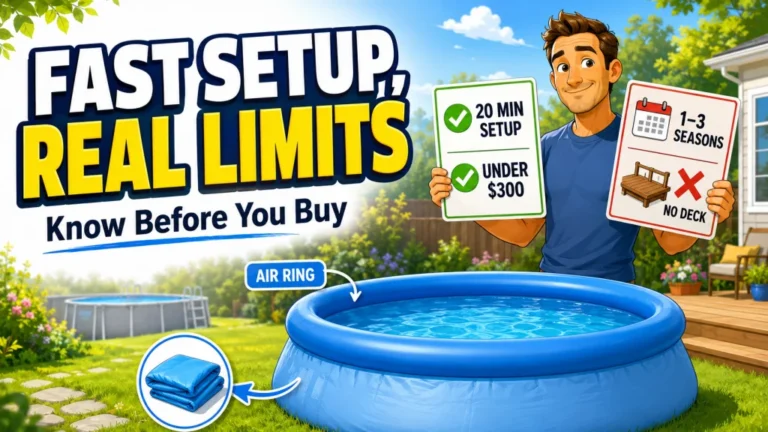
This is the entry point to above ground pool ownership, and it’s exactly what it sounds like: an air-filled ring at the top holds the pool’s shape as it fills, no frame assembly required. Setup takes under an hour for most models, cost runs $100 to $300, and the whole thing packs flat for storage once the season ends. This tier is common for round pools in the 8 to 18-foot diameter range and works well for young kids or a household testing whether pool ownership fits their life.
The tradeoff is durability. Expect 1 to 3 seasons out of an inflatable before connector seams or UV-stressed vinyl force a replacement, and don’t plan on integrating one with a deck. The ring-and-liner construction isn’t rated for that kind of structural load, and most manufacturers say so directly. If your plan is a couple of summers before deciding whether to commit further, this tier does exactly what it’s designed for. Specific models, depth options, and setup differences within this tier are covered in the inflatable above ground pool guide.

This 15 foot by 42 inch round inflatable pool holds 3,284 gallons at 80 percent capacity and is ready for water in about 15 minutes. The set includes a 1,000 GPH cartridge filter pump with dual-suction fittings and HydroAeration Technology, one Type A cartridge, a ladder, pool cover, and ground cloth. Built with puncture-resistant 3-Ply PVC, the pool comes with a patch for easy repairs. All Intex products include a 180-day manufacturer limited warranty.
Check On AmazonIf you click this link and buy, we earn a commission at no additional cost to you.
Tier 2: Soft-Sided Frame
Soft-sided frame pools swap the inflatable ring for a lightweight metal or resin frame holding a vinyl liner in place, which lets them go a bit deeper and hold more water than a pure inflatable. Setup is still simple, usually under two hours, and the pool stores flat for winter just like Tier 1. Cost runs $200 to $800, and realistic lifespan is 2 to 5 seasons with reasonable care.
This tier still isn’t deck-compatible, and that’s worth being direct about, since it’s a common point of confusion. The frame gives more structure than an inflatable, but it isn’t engineered to carry the weight or lateral load a deck attachment puts on a pool wall. If a deck is part of your eventual plan, this tier is a placeholder at best, not a starting point you build around. Where it earns its place is as a multi-year option for a family that wants more depth and stability than an inflatable without committing to a semi-permanent installation yet. Frame materials, liner thickness options, and depth ranges within this tier are covered in the soft-sided above ground pool guide.

This round above-ground pool measures 14 feet in diameter with a 42-inch depth and holds up to 3,357 gallons of water. Assembly takes about 45 minutes using the included ground cloth, strong powder-coated steel tubing, and composite T-Joint design. The T-Joints create a water-tight, rust-resistant seal and are infused with UV inhibitor for weather resistance. Built with puncture-resistant 3-Ply PVC, the pool includes a repair patch and a 1,000 GPH cartridge filter pump with HydroAeration Technology for improved circulation and clarity.
Check On AmazonIf you click this link and buy, we earn a commission at no additional cost to you.
Tier 3: Steel and Hybrid Frame
This is where above ground pools shift from seasonal to semi-permanent. Steel frame pools use a powder-coated or galvanized tubular frame, while hybrid versions pair a steel wall with resin top rails and uprights for better corrosion resistance. Cost runs $500 to $2,000, and the structure itself can last 5 to 15 years, with the vinyl liner being the component that needs replacing periodically within that span, typically every 7 to 12 years depending on water chemistry and installation quality.
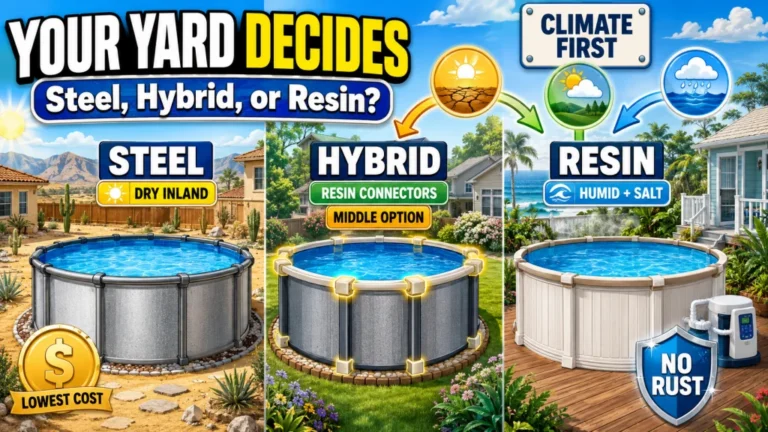
Some models in this tier are rated for basic deck attachment, though not all of them, so this is a detail to confirm on the specific pool rather than assume across the whole tier. Steel components will eventually show rust or heat stress from sun and pool chemical exposure, which is the tradeoff for the lower cost compared to Tier 4. Hybrid versions with resin components reduce that concern and stay noticeably cooler to the touch, a real comfort difference during direct summer sun rather than a marketing detail. This tier is the realistic middle ground for someone who wants a pool that survives more than a couple of seasons but isn’t ready for a full permanent installation and its price tag. Steel versus hybrid construction, corrosion resistance by climate, and liner options for this tier are covered in the steel frame above ground pool guide.

This 18-foot by 52-inch round pool holds 6,981 gallons, giving families plenty of room to enjoy the water. The 3-ply liner combines high-strength polyester mesh with thick PVC for exceptional tear resistance, backed by a 2-year warranty on the liner, frame, and filter pump. The galvanized steel frame has inner and outer powder coating to resist rust, with UV-resistant T-Joints for lasting durability. Assembly uses an Easy Lock System with no tools or pins, and the set includes a 2,100 GPH sand filter pump, ladder, pool cover, and ground cover, with sand lasting up to 5 years between changes.
Check On AmazonIf you click this link and buy, we earn a commission at no additional cost to you.
Tier 4: Steel Wall and Resin, Including Semi-Inground
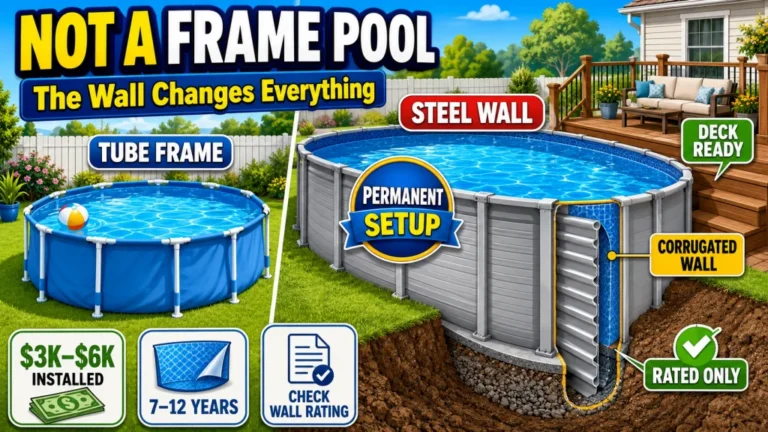
This is the permanent end of the above ground category, and the only tier genuinely built to support a deck without qualification. Steel wall and resin pools in this tier run $1,500 to $8,000 plus installation, with a structural lifespan of 15 to 30 years. Resin components resist corrosion better than steel and don’t heat up the way metal does, which is part of why they carry a higher price than the steel-only option within this same tier.
Warning: A standard above ground wall, even in this tier, is engineered to resist water pressure pushing outward, not soil pressure pushing in. Burying or partially burying a pool that isn’t specifically rated for semi-inground use risks the wall buckling under the surrounding soil load. Only pools built with reinforced, thicker-gauge walls designed for that purpose should ever go below grade.
Semi-inground installation is available within this tier for buyers who want an inground look without the inground budget, since the pool can sit a foot or two below grade and support coping and decking similar to a true inground pool. That option requires professional installation and site excavation, and it’s the most expensive configuration in the above ground category for exactly that reason. For anyone planning to keep a pool in place for a decade or more, build a deck, or landscape permanently around it, this is the tier built for that commitment rather than a compromise toward it. It’s also the point where most buyers start treating the pool as part of the property rather than seasonal equipment. Steel wall versus resin construction, semi-inground requirements, and deck integration options are covered in the permanent above ground pool guide.
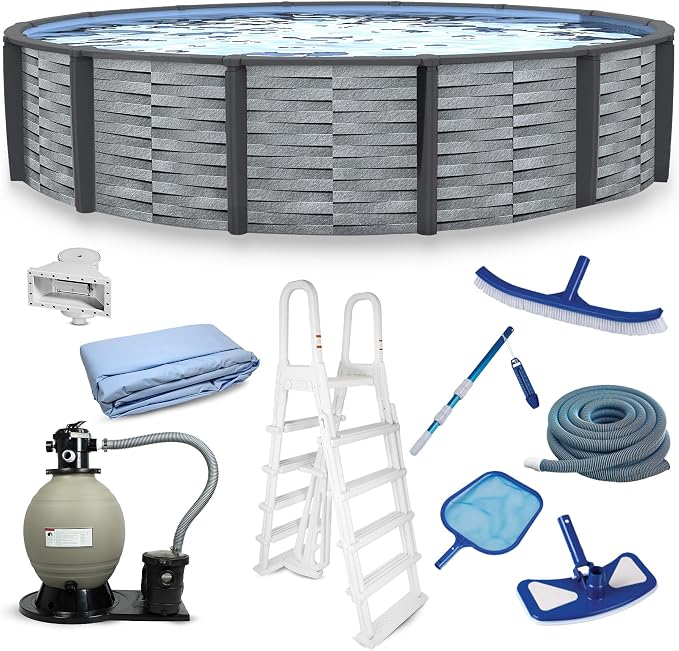
This 18-ft round pool features 52-in deep walls with a 7,200-gallon capacity, comfortably fitting four to six swimmers. Hot-dip galvanized steel with a zinc-aluminum coating and protective enamel top coat delivers triple-layer rust resistance, while 7-in resin top seats and 6-in resin verticals reduce exposed metal at critical load points. The complete package includes a standard-gauge blue overlap liner, a 1.0 HP dual-speed sand filter system with a 6-position multi-port valve, and a dual safety resin A-Frame ladder. The filter system delivers up to 2,000 GPH filtration and 16,000-gallon 8-hr turnover, requiring 110 lbs of sand and professional installation on level ground.
Check On AmazonIf you click this link and buy, we earn a commission at no additional cost to you.
The Two Questions That Narrow This to One Tier
Two questions eliminate three of these four tiers for most buyers. First, how many years do you actually want this pool around? An answer of one or two summers points straight at Tier 1 or Tier 2. An answer of five years or more rules those two out and points toward Tier 3. An answer of ten-plus years, or “as long as I own this house,” points to Tier 4.
Second, do you plan to build a deck around the pool, now or later? A yes to that question rules out Tiers 1 and 2 immediately regardless of how long you want the pool, since neither is structurally rated for it. Community discussion on forums like troublefreepool.com consistently shows the most common first-time buyer regret is exactly this mismatch: someone buys a soft-sided pool expecting it to behave like a permanent inground-style setup, and it simply isn’t built for that. Answering these two questions honestly before comparing brands or prices is what prevents that regret.
| If You Want… | Start With |
|---|---|
| The cheapest possible entry point | Tier 1: Inflatable |
| 3 to 5 years without a deck | Tier 2: Soft-Sided Frame |
| 5 or more years, maybe a deck later | Tier 3: Steel or Hybrid Frame |
| A permanent backyard fixture with a deck | Tier 4: Steel Wall or Resin |
Once you know your tier, the buying decisions that are actually about your specific yard, budget, and swimmer count are covered in the buying guide for above ground pools.
Final Thoughts: Answer the Timeline Question First
Every above ground pool type conversation gets easier once the timeline question is answered honestly. A pool bought for the wrong permanence tier doesn’t fail because it’s a bad product. It fails because the buyer chose the wrong tier before comparing products at all. Answer how long you want it and whether a deck is part of the picture, and the right tier is usually obvious.
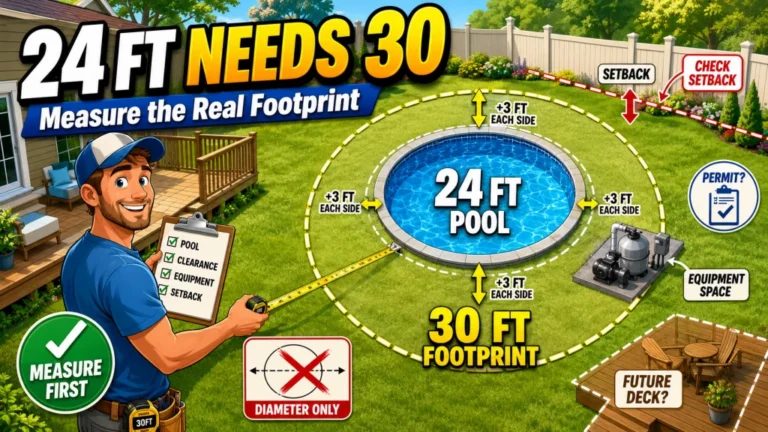
From there, sizing the specific pool to your yard is the next real decision, and that’s covered in the guide to sizing an above ground pool, which picks up exactly where this permanence decision leaves off.

This steel-framed pool holds 3,955 gallons of water at 90 percent capacity, with a heavy-duty corrosion-resistant frame for stability and longevity. The ClickConnect System uses quick-click joints for tool-free setup and takedown, making off-season storage simple. The Tritech 3-layer liner offers added strength and puncture resistance over standard PVC. The set includes a 1,000-gallon filter pump, one Type III A/C filter cartridge, a ladder, and a cover.
Check On AmazonIf you click this link and buy, we earn a commission at no additional cost to you.
Explore Each Tier in Full
Each tier above has its own full guide covering specific models, construction differences, and buying details within that permanence level.
| Guide | What it helps with |
|---|---|
| Inflatable Above Ground Pool Guide | Ring-top construction, sizing, and realistic lifespan expectations. |
| Soft-Sided Above Ground Pool Guide | Frame materials, liner thickness, and depth options in this tier. |
| Steel Frame Above Ground Pool Guide | Steel versus hybrid construction and corrosion resistance by climate. |
| Permanent Above Ground Pool Guide | Steel wall versus resin, semi-inground requirements, and deck integration. |
Start with whichever tier matched your answers to the two questions above.
FAQs
🏊 What type of above ground pool should I get for a family that wants a deck eventually?
Go straight to Tier 3 or Tier 4. Inflatable and soft-sided pools aren’t structurally rated for deck attachment, regardless of how long you plan to keep them.
⏳ How long does an inflatable above ground pool actually last?
1 to 3 seasons is realistic before connector seams or UV-stressed vinyl force a replacement. That’s normal for the category, not a sign of a bad purchase.
🧱 What’s the difference between a frame pool and a steel wall pool?
A frame pool uses tubular supports holding up a vinyl-lined structure and is typically seasonal to semi-permanent. A steel wall pool uses the steel itself as the structural wall, which is what makes it deck-compatible and rated for 15 to 30 years.
⛏️ Can any above ground pool be partially buried?
No. Only pools specifically built and rated for semi-inground use, with reinforced walls designed to resist soil pressure, should ever go below grade. Burying a standard above ground pool risks the wall buckling.
💰 Is it worth paying more for a hybrid frame instead of steel?
If you’re in a humid, coastal, or salt-system pool situation, yes, since resin components resist corrosion better than steel. In a dry, mild climate, standard steel often holds up fine for a lower price.
Sources and References
The construction, lifespan, and deck compatibility details in this guide are cross-checked against the following:
- Steel wall pool construction and semi-inground specifications, used for wall gauge, deck integration, and semi-inground wall requirements.
- Above ground pool deck compatibility requirements, used for minimum pool size and construction type needed for deck attachment.
- Community discussion on above ground pool buyer regrets, used for the permanence mismatch pattern among first-time buyers.