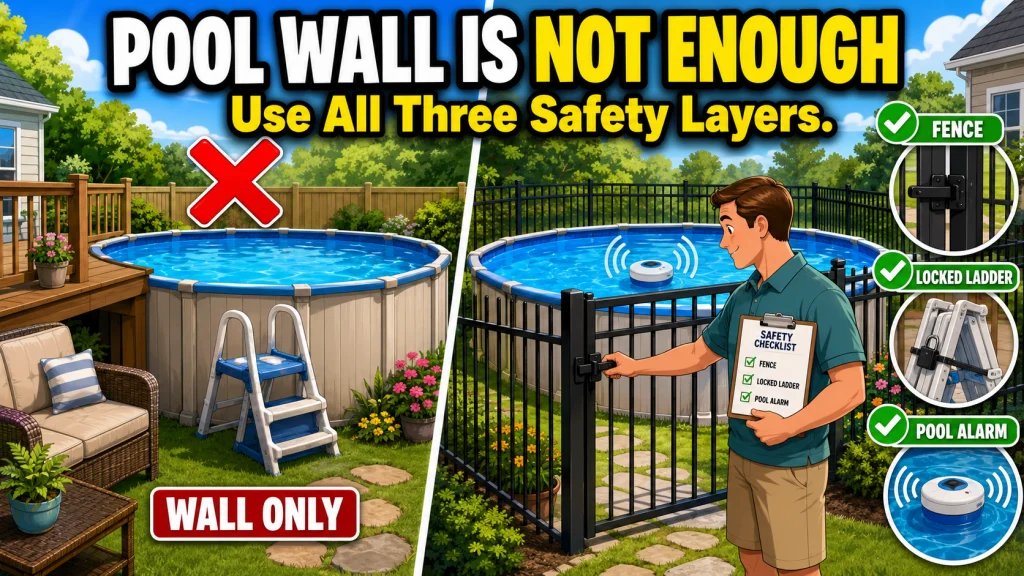
Above ground pool safety comes down to three access control layers: a compliant fence, a ladder that is actually secured between swims, and an alarm that catches what the first two miss. I have inspected plenty of backyards where the owner assumed the 48-inch pool wall was doing the job on its own, and in most of those yards a deck, a leaning ladder, or a stack of pool toys had already quietly removed that protection. This guide walks through what each layer actually requires, where owners get the pool-wall assumption wrong, and how the three layers work together rather than functioning as a checklist from which you choose only one. It does not cover chemical safety or the weekly maintenance side of pool ownership, since that is handled separately.
The Above Ground Pool Wall Is Not an Automatic Safety Barrier
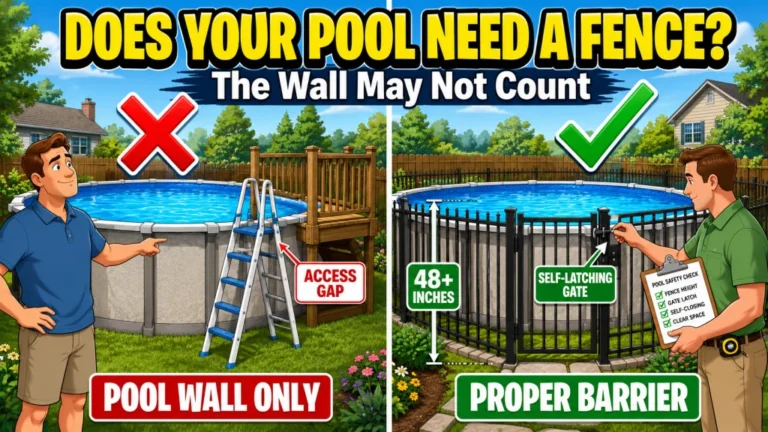
Above ground pool safety starts with a wrong assumption I hear from almost every first-time owner: the pool wall itself is 48 inches tall, so the barrier requirement is already handled. Sometimes that is true. More often, something in the yard has already broken that assumption before the owner ever thought about it. A deck built flush against the pool, a set of steps left in place, a stack of patio furniture pushed against the wall, or climbable landscaping near the rim can all give a toddler a route that wall height alone cannot block.
I have walked into service calls where the owner was genuinely surprised to learn this. The pool itself was code-compliant on paper: steel wall, correct height, factory ladder. What changed the picture was a wooden platform the previous owner built around two sides of the pool for lounging. That platform put a flat, walkable surface at wall height, which meant the 48 inches of vertical wall no longer mattered because a child could simply walk onto the deck and step over the top rail. The lesson is not that decks are unsafe. It is that any structure, pump housing, or piece of furniture within reach of the wall needs to be evaluated as part of the barrier, not treated as a separate backyard decision.
The wall itself can also work against you in a way that has nothing to do with decks or furniture. In 2025, the CPSC coordinated a recall of about five million above-ground pools 48 inches and taller after finding that the external compression strap wrapping around the support poles on some models could double as a foothold, letting a child climb in even with the ladder removed. Nine drowning deaths were linked to that specific hazard before the recall. If your pool has a strap running on the outside of the support legs rather than behind them, check the model against the manufacturer’s recall list before assuming the structure itself is not part of the problem.
Above Ground Pool Safety Fence Requirements That Actually Meet Code
The most reliable layer, and usually the one owners resist first because of cost, is a dedicated fence around the pool. Most state and local codes set a 4-foot minimum height measured from the outside grade, with a gate that is self-closing, self-latching, and fitted with a latch mounted out of a young child’s reach. The exact height and latch placement shift from state to state, so I always tell owners to confirm the local number before buying materials rather than assuming the 4-foot figure applies everywhere.
A fence earns its keep because it works whether or not anyone remembers to use it correctly that day. A ladder has to be moved every single time. An alarm has to be armed and functioning. A fence with a self-latching gate just sits there and does its job, which is why a compliant fence is generally treated as the primary physical barrier among the three. If you want the state-by-state breakdown, gate hardware options, and gap spacing rules in one place, I cover that in detail in the fence requirement guide for above-ground pools, including how to handle sloped yards where the fence line does not sit level with the pool.

This removable mesh fence section measures 4 feet high by 12 feet long and includes five integrated aluminum poles, deck sleeves and caps, a safety latch, template, and instructions. The Textilene PVC-coated nylon mesh is UV resistant, while stainless steel mounting pins fit into installed deck sleeves. The section is backed by a limited lifetime warranty, and the self-closing gate is sold separately.
Check On AmazonIf you click this link and buy, we earn a commission at no additional cost to you.
How a Locking Ladder Reduces Unsupervised Pool Access
If a full fence is not yet in place, securing the ladder is an immediate risk-reduction step for above ground pool child safety, but it is not a substitute for fencing where a compliant barrier is required. The ladder is the most obvious access point on many frame and steel wall pools, but it may not be the only climbable route, so removing it, locking it, or folding it away when the pool is not in use closes the most visible entry point without closing every one of them. Washington State’s health department puts it plainly for above-ground and inflatable pools with ladders: remove or secure the ladder when the pool is not in use, because failing to do so remains one of the most obvious and preventable access failures I see, even though it is not the whole picture.
I have replaced more low-profile A-frame ladders than any other single pool accessory, and almost every call starts the same way: the owner swam earlier in the day, left the ladder down to make it easier for the next swim session, and did not think about the two hours in between. A 2-year-old does not need adult strength to climb a lightweight aluminum ladder, only curiosity and a few unsupervised minutes. Treat the ladder the same way you would treat a car seat buckle, something you check every single time, not something you set once and forget. But do not stop at the ladder. Walk the outside of the pool and check the support frame, compression straps, or reinforcing belts that run along the legs, since some of those can create a foothold of their own, and confirm your specific model is not part of a manufacturer recall before assuming removal alone solves access. In June 2026, the Consumer Product Safety Commission granted a petition directing staff to develop measurable performance requirements for child-resistant ladders on above-ground and portable pools, after identifying 128 reported drowning deaths of children under five between 2020 and 2025 linked to pool ladders. That review is ongoing rather than a finished federal rule, but it confirms the ladder itself deserves more scrutiny than a simple remove-it-and-move-on habit. For the specific removal, locking, and folding options that fit different ladder styles, the locking ladder guide breaks down which hardware actually holds up outdoors.
Leaving the ladder in place after the last swim of the day because it is one less thing to deal with in the morning.
Removing or locking the ladder as the final step of every swim session, the same way you would lock a front door.
That habit alone will not satisfy every local code requirement, and it will not stop a child who finds a foothold somewhere other than the ladder. Pair it with a fence when you can, and treat it as a daily routine rather than a one-time fix in the meantime.

This A-frame safety ladder fits above-ground pools 48 to 56 inches high and supports up to 300 pounds. It has 5-inch by 18-inch Comfortread steps, an extra-large platform, curved side rails, and a lockable roll-guard barrier with the lock included. It fits top rails up to 14 inches wide and must attach to the pool frame; it is not intended for soft-sided or inflatable pools.
Check On AmazonIf you click this link and buy, we earn a commission at no additional cost to you.
Pool Alarms and What ASTM F2208 Actually Requires
A pool alarm is the layer that catches whatever the fence and ladder missed. It does not stop entry the way a fence does, but it may alert an adult sooner after an unexpected entry, which only helps if someone is close enough to hear it and respond. ASTM F2208 is the safety specification that governs residential pool alarms, and it defines four types: a surface alarm that floats on the water, a subsurface alarm mounted below the surface, a perimeter alarm that detects motion around the pool area, and a personal immersion alarm worn by the swimmer. The standard is written for detecting a child of one year or older, and it explicitly says it is not meant to replace a fence, gate, or supervision, only to add a layer on top of them.
In my experience, subsurface and perimeter alarms produce fewer false alarms from wind or debris than basic floating surface units, which matters because an alarm owners disable out of frustration is not protecting anyone. Whatever type you land on, look for a manufacturer statement that the unit meets, has been tested to, or is certified to ASTM F2208, not just a package that mentions the standard’s name without saying the alarm was actually evaluated against it. I go through the tradeoffs between the four alarm types, including which ones hold up best outdoors through a full season, in the pool alarm guide for above-ground pools.
Field Note: The one alarm complaint I hear most often is not about sensitivity. It is about owners turning the unit off during pool parties because it kept going off from normal splashing, then forgetting to turn it back on afterward. If that happens, follow the manufacturer’s supervised-swim and rearming instructions rather than leaving the unit disabled once the swimming stops.

The PA-30 is a battery-powered pool alarm certified to ASTM F2208 and suitable for above-ground, in-ground, inflatable, and soft-sided pools up to 20 by 40 feet. Adjustable sensitivity helps reduce false alarms from wind or heavy rain, while an indoor wireless receiver provides an additional alert. It requires a 9-volt battery and is not recommended for saltwater pools or pools with fountains or waterfalls.
Check On AmazonIf you click this link and buy, we earn a commission at no additional cost to you.
How the Three Above Ground Pool Safety Layers Work Together
None of these three layers is meant to carry the full weight of above-ground pool safety on its own. A fence does little if its gate is left unlatched. A locked ladder closes off one entry point but does nothing for a foothold created by the pool structure itself or for a neighbor’s child who wanders in through a side gate. An alarm does not physically stop access. Depending on the type, it may detect movement near the water or alert only after someone has already entered it, and either way it only helps if someone is close enough to hear it and respond. Layering them changes the math: a child now has to get past a physical barrier and then avoid detection before or immediately after reaching the water, instead of just walking up to an unguarded pool.
| Layer | Primary function | Typical cost range | Main weakness |
|---|---|---|---|
| Fence and self-latching gate | Blocks physical entry from any direction | $200 to $800 for a DIY-installed removable mesh kit | Useless if the gate is propped open |
| Locked or removed ladder | Removes the main designed entry route | Under $50 for a lock kit, free if just removed | Depends on the owner remembering every time, and does not address other footholds |
| ASTM F2208 pool alarm | Detects movement near the water or entry into it, depending on type | $100 to $250 per unit | Detects but does not prevent access; response time and false-alarm rates vary by type |
I recommend starting with whichever layer closes the biggest gap in your specific yard. If your pool sits against a deck, has climbable landscaping nearby, or uses an external compression strap, the fence takes priority because the wall itself is already compromised as a barrier. If the pool is isolated in open yard with nothing nearby to climb, a locked ladder plus an alarm can reduce risk while you plan for a fence, but neither one meets a fence requirement on its own and neither should be treated as sufficient if a child can reach the pool area unsupervised.
What This Guide Does Not Cover
Access control is only one slice of above ground pool safety requirements. Keeping chemical levels balanced is a separate concern covered in the guide to keeping chemical levels in range, and safety covers along with seasonal opening and closing risks are covered in the seasonal opening and closing guide. A cover alone rarely replaces a fence, since it only protects the pool when it is actually in place, so treat it as a seasonal layer rather than a substitute for the fence and ladder habits covered here.

This 4-foot gate provides a 2-foot walk-through opening and works with the Pool Fence DIY safety system. It uses powder-coated aluminum square stock, Textilene PVC-coated nylon mesh, a magnetic latch, and self-closing hinges, with adjustable left- or right-hand swing. Concrete installation hardware is included, and the gate is backed by a limited lifetime warranty.
Check On AmazonIf you click this link and buy, we earn a commission at no additional cost to you.
Final Thoughts: Pick the Weakest Layer in Your Yard First
If you take one thing from this guide, let it be this: walk around your pool today and ask what is actually stopping a child from reaching the water right now. Not what the wall height says on paper, but what a curious 2-year-old could physically use to get up and over in the next five minutes. Most of the yards I have serviced had one obvious weak point once I asked that question out loud, whether it was a deck, a ladder left down, or a gate that never quite latched.
Start with whichever layer closes that specific gap, then build toward having all three in place. Above-ground pool ownership already asks a lot of a first-time buyer between sizing, filtration, and chemistry, and access control is the part that carries the highest stakes if it gets skipped. For the rest of what goes into owning one of these pools well, the complete above ground pool maintenance guide ties the buying, setup, equipment, and upkeep pieces together.
- Walk the pool perimeter and note anything within reach of the wall that a child could climb: decks, furniture, pumps, or landscaping.
- Check the support frame and compression straps for a foothold, and confirm your pool model is not part of a manufacturer recall.
- Confirm your local fence height and gate latch requirements before buying materials, since the number varies by state.
- Remove or lock the ladder every time the pool goes unused, not just at the end of the season.
- Choose a pool alarm the manufacturer states meets or is certified to ASTM F2208, not just one that mentions the standard’s name.
- Treat all three layers as complementary, not as a checklist where one item is enough.
Explore More in This Section
Each of the three layers above gets its own detailed breakdown, covering hardware options, cost ranges, and installation specifics I could not fit into this overview.
| Guide | What it helps with |
|---|---|
| Above Ground Pool Fence Requirements | State-by-state height and gate rules, plus which fence types hold up on sloped or uneven ground. |
| Locking Ladder Guide for Above Ground Pools | Lock kits, folding ladder options, and how to retrofit a ladder that was not designed to be secured. |
| Above Ground Pool Alarm Guide | How the four ASTM F2208 alarm types compare and which ones hold up best through a full swim season. |
FAQs
🧱 Does the wall of an above ground pool count as a legal safety barrier?
Sometimes, but only if nothing near the pool gives a child another way up, such as a deck, steps, or climbable landscaping, and only if it meets your local height requirement. Check with your local building department before relying on the wall alone.
🪜 Do I have to remove the ladder every time I’m done swimming?
You should remove, lock, or fold it away every time the pool is not in use, not just at the end of the season. A ladder left down for a few hours is one of the most common and preventable ways a small child reaches the water unsupervised.
📏 How tall does a fence need to be around an above ground pool?
Most codes set a 4-foot minimum measured from the outside grade, though some states require 5 feet. Confirm the exact number and gate latch height with your local building department before buying materials.
🔔 Are pool alarms required by law for above ground pools?
Requirements vary by state and locality, and some areas count an alarm as one of several approved safety features rather than a standalone requirement. Look for a unit that meets ASTM F2208 regardless of whether your area mandates one.
🏠 Can my house wall count as part of the pool barrier?
In some jurisdictions, a house wall may be allowed to form part of the barrier, but doors leading to the pool area must meet locally required protections, which may include alarms or self-closing, self-latching hardware. This is a local code question, so verify it before treating a house wall as sufficient on its own.
🌳 Can trees or landscaping next to the pool create a safety problem?
Yes. Any branch, shrub, or raised planter within reach of the pool wall can give a child a foothold that defeats the wall height. Clear a buffer around the pool the same way you would clear one around a fence line.
Sources
- Pool Guard USA on why an above-ground pool wall does not automatically count as a barrier
- National Drowning Prevention Alliance drowning facts and non-swim time data
- Washington State Department of Health pool safety guidance on ladder removal
- OnPoint home inspection guide to pool fencing requirements and climb hazards
- ASTM F2208 standard safety specification for residential pool alarms
- CPSC recall notice on above-ground pool compression strap foothold hazards
- CPSC statement granting the child-resistant pool ladder petition
- CDC guidance on preventing drowning around residential pools