Above ground pool sizes usually get picked backward: someone falls for a diameter that looks right in a photo, then finds out later how many gallons it actually holds, how much yard it eats up once clearance and fencing are added, and whether round or oval even fits the space they own. In my years installing these pools, the two mistakes I see most are buying a pool too small for how many people actually use it on a hot Saturday, and measuring only the pool’s diameter while forgetting the space it needs once someone has to walk around it. This guide splits the decision into three parts: how many people genuinely fit at once, how much yard the pool needs beyond its own footprint, and whether round or oval makes more sense for the shape of your lot. Get those three answered in order, and the size question mostly answers itself.
The Two Mistakes That Show Up on Almost Every Install
Above ground pool sizes get chosen the wrong way around more often than not. A buyer sees a 24-foot round pool on sale, likes the price, and works backward from there instead of starting with who is actually going to be in the water and how much yard is actually available. That is the point of this above ground pool size guide: sort those three questions out before a diameter chart makes the decision for you.
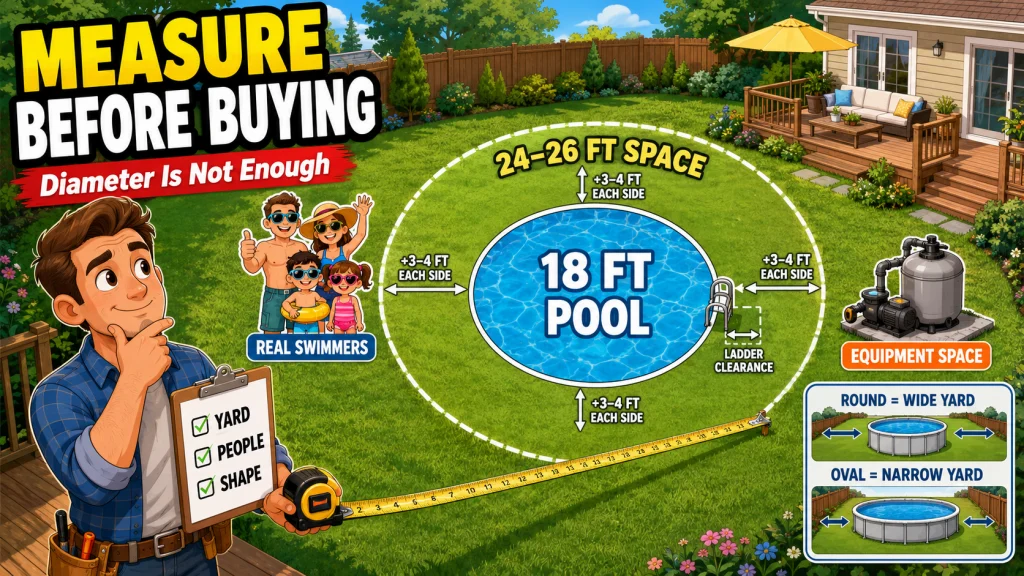
The first mistake is sizing for a quiet Tuesday afternoon instead of the Saturday everyone actually cares about. A pool that feels roomy for two adults gets crowded fast once three kids and a couple of neighbors show up. The second mistake is treating the pool’s diameter as the total space required. A 15-foot pool is not a 15-foot commitment in your yard. Once you add a walking path, a ladder, pump clearance, and whatever setback your city or HOA requires from the property line, that same pool can easily need a 20-foot circle of usable yard. Both mistakes get discovered after the pool is already assembled, which is the worst possible time.
How Many People Actually Fit, Not How Many the Box Implies
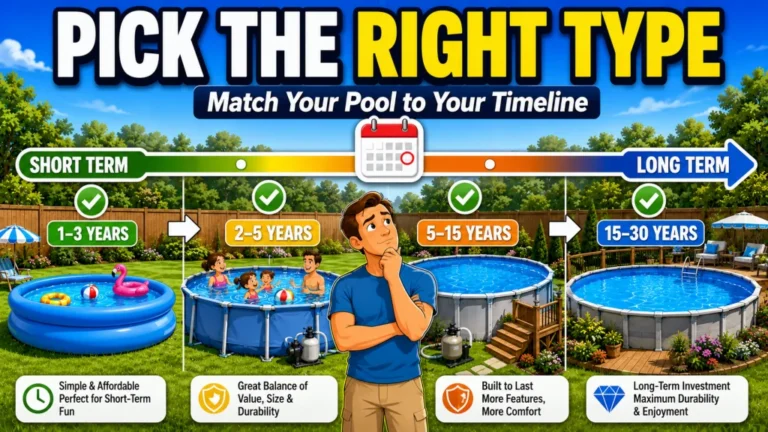
I do not size a pool off a marketing capacity number, and you should not either. A 12-by-24-foot oval is genuinely comfortable for a family of four to five people using it casually, which lines up with what most retailers list for that size. A small round pool in the 12 to 15-foot diameter range is realistically a couple’s pool or a pool for one child plus a parent, not a gathering spot. Once you get into the 18 to 24-foot range, you are in the size most families actually settle on, and it is also the size where the gap between “people who technically fit” and “people who are comfortable” starts to matter.
Here is the part that trips up first-time buyers: bigger does not always mean proportionally more room per swimmer. A 24-foot round pool holds a lot more water than an 18-footer, but it is still commonly treated as a pool for roughly five comfortable swimmers for comfortable use, not ten. The extra gallons buy you more water volume and elbow room, not double the guest list. If you are buying for a family that regularly hosts, that gap between technical capacity and comfortable capacity is exactly why the people-per-size math deserves its own look before you commit to a number.
Field Note: The install I remember most clearly was a family who bought a 15-foot round pool for their two kids, then found themselves hosting the entire cul-de-sac every weekend by July. They called me in August asking whether they could just buy a second pool instead of returning the first one. There was no return window left. Sizing for the quiet week instead of the busy one is the single most common regret I hear.
The honest answer to what size above ground pool you should get depends on how many people are usually in the water at the same time, not how many people are invited over. A pool that fits your household on a normal day and your extended group once or twice a summer is usually the right compromise, since oversizing a pool for the rare big party means paying for extra gallons, extra chemicals, and extra yard space every single week in between.

This steel-framed pool holds 6,092 gallons of water at 90 percent capacity, with a heavy-duty corrosion-resistant frame for stability and longevity. The ClickConnect System uses quick-click joints for tool-free setup and takedown, making off-season storage simple. The Tritech 3-layer liner offers added strength and puncture resistance over standard PVC. The set includes a 1,500-gallon filter pump, one Type III filter cartridge, a ladder, and a cover.
Check On AmazonIf you click this link and buy, we earn a commission at no additional cost to you.
The Diameter Is Not the Space You Need
This is the mistake I run into on-site more than any other. A homeowner measures the flattest 18 feet of their yard, orders an 18-foot pool, and then realizes there is nowhere left to walk around it, no room for the pump and filter, and no clearance for the fence their city requires around the water. The pool itself is only the starting point of the space calculation, not the whole thing.
Plan on roughly 3 to 4 extra feet of clear space around the entire pool wall for a walking path, pump and filter access, and ladder clearance. That is before you factor in whatever setback distance your local zoning or HOA rules require between the pool and your property line, which many buyers do not check until a permit application forces the issue. A pool that measures 18 feet across can realistically need a 24 to 26-foot clear circle in your yard once all of that is added in.
- Measure the actual flat, level area available, not just the widest open stretch of lawn.
- Add 3 to 4 feet of clearance on every side for walking room, the pump, and the filter.
- Check your local setback requirement from the property line before you assume a size fits.
- Confirm there is no overhead power line, septic field, or slope where the pool would sit.
- Leave room for a deck or steps if you plan to add them later, even if you skip them this year.
Skipping that last step is how I end up on a call explaining that a customer’s dream 24-footer will not legally sit where they wanted it, and that the yard actually supports something closer to 18 feet once the setback and clearance are subtracted. Measuring first and shopping second avoids that conversation entirely, and it is the single habit that separates an easy install from a stressful one.
Round vs Oval Is a Functional Decision, Not Just a Look
Most buyers treat round versus oval as a style preference, and I understand why: an oval does look a little more like an in-ground pool. But the shape decision actually comes down to your yard’s dimensions and how you plan to use the water. A round pool distributes water pressure evenly around a simple frame, which tends to make it the more straightforward, less expensive setup. An oval needs additional bracing hardware to handle the uneven pressure along its straight sides, and its liner is shaped specifically for that pool, which usually costs more to replace down the road than a round pool’s liner.
Where oval genuinely earns its keep is a long, narrow yard where a round pool’s diameter would eat up nearly the entire width available. A 15-by-30-foot oval fits a long, skinny side yard where an equivalent-volume round pool simply would not. Ovals also give a little more usable length if anyone in the household actually swims laps rather than floats. On a square or already-wide yard, though, a round pool of the same volume is usually the simpler, cheaper, and easier-to-maintain choice, and I do not talk buyers into an oval just because it looks closer to an in-ground pool in photos.
Choosing oval because it looks upscale, without checking whether the yard’s actual width supports it or whether the added liner replacement cost fits the budget.
Measuring the yard’s usable width first, then choosing round for a square or wide yard and oval only when the lot’s shape genuinely calls for it.
Once you know your yard’s real dimensions and how many people you are sizing for, round versus oval usually stops being a debate and starts being an obvious answer.

This 15 by 30-foot above-ground pool features galvanized steel construction with 6-inch top ledges, 5-inch uprights, and painted steel walls designed to resist rust. The traditional vinyl liner uses North American cut material that is hand-folded to help reduce permanent creasing and excess wrinkling. Designed to remain installed year-round, the Bermuda offers durable construction with a simple one-time installation.
Check On AmazonIf you click this link and buy, we earn a commission at no additional cost to you.
Above Ground Pool Size Chart: Diameter, Gallons, and Realistic Fit
Numbers make this easier to act on, so here is a rough above ground pool size chart using the standard volume formula for round pools (diameter times diameter times depth times 5.9) at a common 48-inch wall height, alongside the household fit each size realistically supports.
| Pool Size | Approx. Gallons at 48-Inch Wall Height | Realistic Household Fit |
|---|---|---|
| 12-ft round | ~3,400 gallons | Couples or one adult and one child |
| 15-ft round | ~5,300 gallons | Small family, 1 to 3 swimmers at once |
| 18-ft round | ~7,600 gallons | Most families, comfortable for casual gatherings |
| 24-ft round | ~13,600 gallons | Most popular size, comfortable for up to about five swimmers at once |
| 15 x 30 ft oval | ~13,000 gallons at 52-inch wall height | Similar swimmer comfort to a 24-ft round, better fit for a narrow yard |
Treat these as planning numbers, not a promise from any specific manufacturer. Actual capacity varies by wall height and brand, so always confirm the listed gallon figure on the exact model you are considering before you finalize a size.
Quick Sizing Shortcut Before You Shop
The three decisions above work together, so here is what that looks like combined into one shortcut: pool size next to the usable yard footprint it realistically needs once clearance and setback are added, and when to lean toward it or away from it.
| Pool Size | Approx. Usable Yard Space Needed | Choose This If | Avoid This If |
|---|---|---|---|
| 12-ft round | ~16 to 18-ft clear circle | Yard is small and it is mostly a couple or one parent and child using it | You expect regular guests or a growing family |
| 15-ft round | ~20 to 22-ft clear circle | Small family, limited yard, occasional guest | Neighbors or extended family swim over regularly |
| 18-ft round | ~24 to 26-ft clear circle | Typical family default, casual weekend use | Yard cannot clear that footprint plus setback |
| 24-ft round | ~30 to 32-ft clear circle | Frequent family use and regular guests | Yard is narrow or setback rules eat most of the space |
| 15-by-30-foot oval | ~19 x 34-ft clear footprint | Long, narrow yard where a round pool’s diameter will not fit | Yard is square or wide, where round is simpler and cheaper |
These footprint numbers are planning estimates built from the clearance and setback guidance earlier in this guide, not a fixed code requirement, so always confirm your own yard’s dimensions and your local setback rule before finalizing a size.

This 15-foot by 48-inch round frame pool holds up to 4,440 gallons and uses puncture-resistant 3-ply PVC construction. Its tool-free T-joint design allows setup in about 45 minutes. The set includes a 1,000 GPH cartridge filter pump with HydroAeration Technology, a filter cartridge, ladder, pool cover, ground cloth, and repair patch.
Check On AmazonIf you click this link and buy, we earn a commission at no additional cost to you.
Where Sizing Fits Next to Type, Cost, and Brand
Sizing rarely happens in isolation. If you have not settled on a pool style yet, the above ground pool types overview by frame and material is worth a look before you lock in a size, since some styles only come in a limited range of diameters. Cost tracks size closely too, and the above ground pool cost breakdown by size and type walks through what each extra foot of diameter really adds to the total bill, equipment included.
If you are also weighing the two dominant brands, the Intex versus Bestway size and build comparison is a useful next stop, since the same nominal diameter is not always the same actual footprint between the two. And for the full decision from type through setup, the complete above ground pool buying guide ties all of these pieces together in one place.

This 24-foot by 52-inch round pool holds up to 12,481 gallons and features a 3-ply liner made with high-strength polyester mesh and thick PVC. The galvanized steel frame has powder coating for rust resistance and tool-free Easy Lock assembly. It includes a 2,800 GPH sand filter pump, ladder, pool cover, and ground cover, plus a 2-year warranty on the liner, frame, and filter pump.
Check On AmazonIf you click this link and buy, we earn a commission at no additional cost to you.
Final Thoughts: Measure Before You Fall for a Diameter
If you remember nothing else about how to choose an above ground pool size, remember this: measure your yard first, count your realistic swimmer group second, and only then start comparing diameters. Every regret I have seen on a job site traces back to skipping one of those two steps.
A tape measure, an honest headcount, and the shortcut table above will get you to the right size faster than any marketing page will. Once that part is settled, the type, cost, and brand decisions tend to fall into place a lot faster too.
Explore More Above Ground Pool Sizing Guides
Each of the three questions above has enough detail to deserve its own full breakdown. Here is where to go next depending on which part of the decision you still need to work through.
| Guide | What it helps with |
|---|---|
| Above Ground Pool Size for a Family | The full people-per-size calculation, including how the comfortable swimmer count changes as diameter increases. |
| Above Ground Pool Yard Space Requirements | A step-by-step way to measure clearance, setback, and equipment space before you ever order a pool. |
| Round vs Oval Above Ground Pool | A deeper look at frame stress, liner cost, and which yard shapes actually call for an oval. |
Start with whichever guide matches the question you still have open, then come back to this page if you need the full picture again.
FAQs
📏 What size above ground pool should I get for a family of four?
An 18 to 24-foot round pool or a 12-by-24-foot oval is a common fit for a family of four using the pool casually. The right choice still depends on how often guests join in and how much yard space and budget you have.
🧮 How many gallons is a 15-foot vs a 24-foot above ground pool?
A 15-foot round pool at a common 48-inch depth holds roughly 5,300 gallons. A 24-foot round pool at the same depth holds roughly 13,600 gallons. Exact figures shift with wall height and brand, so confirm the listed capacity on the specific model.
📐 How much yard space does an above ground pool actually need?
Plan on the pool’s diameter plus roughly 3 to 4 feet of clearance on every side for walking room and equipment access, then add whatever setback distance your local zoning or HOA requires from the property line.
⭕ Is a round or oval above ground pool better for a small yard?
Round is usually simpler and cheaper for a square or wide yard. Oval earns its place in a long, narrow yard where a round pool’s diameter would not fit the available width.
👥 How many people can comfortably swim in an 18-foot above ground pool?
An 18-foot round pool is typically comfortable for a small family plus a couple of guests at once. It has more room than a 15-footer, but it still is not meant for a full-yard party. A 24-footer gives more breathing room, but even that should be sized around realistic swimmers, not everyone invited over.
📋 What is the most popular above ground pool size?
A 24-foot round pool is the most commonly chosen size, with a 15-by-30-foot oval as the most common oval alternative. Popularity does not mean it is the right fit for every yard, so measure before assuming it will work for yours.
Sources and References
- Angi’s breakdown of common above ground pool sizes and swimmer capacity, used for the people-per-size figures cited above.
- The Pool Factory’s pool volume calculator, source of the diameter-times-diameter-times-depth-times-5.9 formula used in the size chart.
- Watson’s guide to deciding what size above ground pool to buy, used for the yard clearance and space-planning guidance above.