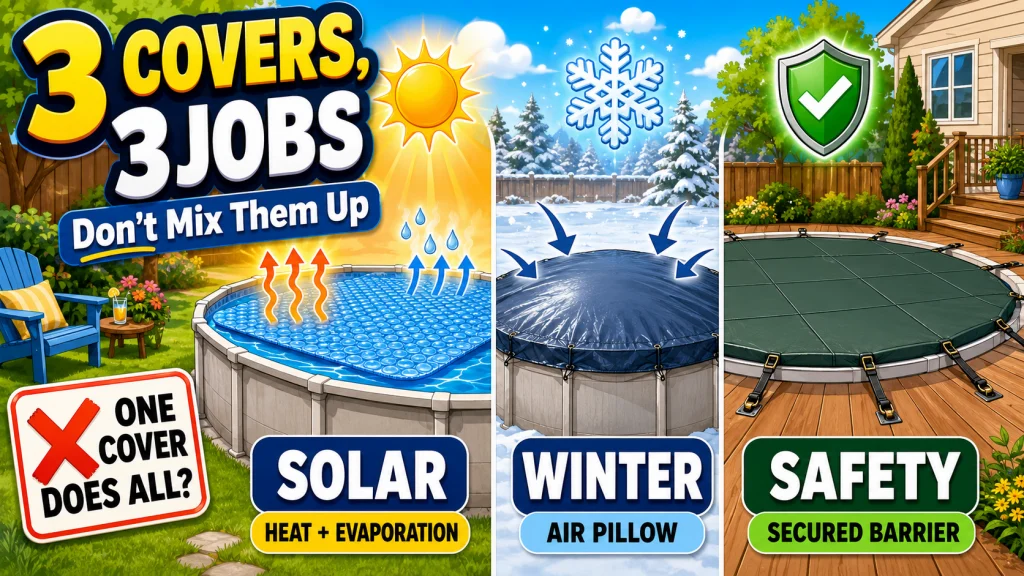
Above ground pool covers are not interchangeable, and mixing them up is where most owners get into trouble. A solar cover heats the water and cuts evaporation. A winter cover, paired with an air pillow, protects the pool structure during closing. A safety cover is the only one built to keep a person or pet from falling in. I have seen owners treat a solar cover like it will stop an accident, and it will not. This guide walks through what each cover actually does, so you can match the right one to the job instead of guessing.
Above Ground Pool Covers: Three Types, Three Jobs
There are three types of above ground pool covers, and each one is built for a single job. A solar cover traps heat and slows evaporation. A winter cover, working with an air pillow, protects the pool during the closed season. A safety cover is built specifically to prevent accidental entry into the water. None of these do each other’s job, and treating any of them as if they can is where most cover-related problems start.
The most serious version of that mix-up is using a solar cover as a stand-in for a safety cover. A solar cover floats on the water surface and cannot support a person’s weight. If someone steps or falls onto one, it does not act as a barrier. It gives way, and the person can end up trapped underneath it, unable to find the surface. This is not a minor labeling issue. The U.S. Consumer Product Safety Commission has documented drowning deaths tied specifically to solar covers being mistaken for a safety barrier, and pool safety organizations continue to flag that same misconception today. Once you understand what each cover is actually built to do, that mistake becomes easy to avoid.
Solar Covers: Heating and Evaporation, Nothing Else
A solar cover, sometimes called a bubble cover, is a thin sheet of UV-treated plastic with air bubbles built into the underside. It floats directly on the water and works by trapping solar heat during the day and slowing evaporation around the clock. On a well-sized above ground pool, a solar cover can raise water temperature by several degrees over a few days of consistent use. It also noticeably cuts the amount of water and chemicals you lose to evaporation, which matters most in hot, dry climates where evaporation is already working against you.
What a solar cover does not do is protect anyone. It has no anchoring system, no rigid frame, and no rated weight capacity. I have talked to more than one owner who assumed a floating cover was better than nothing if a child wandered into the yard unsupervised. It is not. A solar cover left on an unattended pool is arguably more dangerous than no cover at all, because it hides the water instead of blocking access to it. If heating and evaporation control are your only goals, a solar cover is the right tool, and the detailed side of sizing, thickness, and daily use lives in the dedicated guide on how a solar cover heats an above ground pool.

This 18-foot round solar cover is designed for above-ground and inground pools and uses a floating bubble-style blanket to retain heat. The 800 Series cover is made from resin and is listed as lightweight, thermally insulating, and UV resistant. Listing data shows a 4.1-star rating from more than 6,500 reviews.
Check On AmazonIf you click this link and buy, we earn a commission at no additional cost to you.
Winter Covers and Air Pillows: Protecting the Pool During Closing
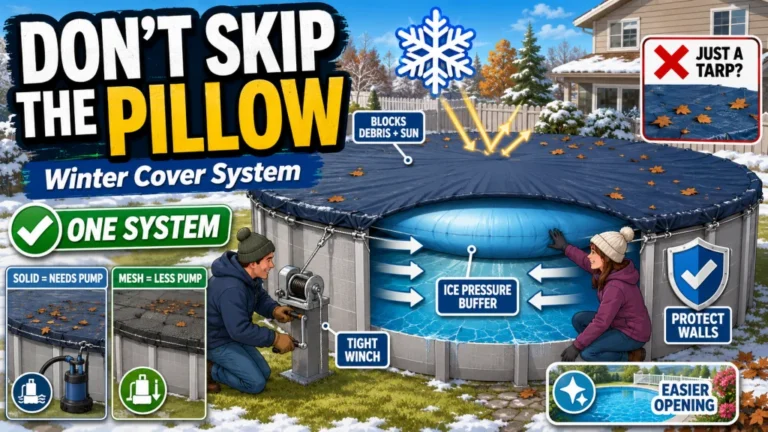
A winter cover is a heavier, opaque cover strapped or cabled around the top of the pool to keep debris, sunlight, and most precipitation out while the pool sits closed for the season. Unlike a solar cover, it is not designed to float loosely on the water. It is meant to be secured at the wall, and in climates that freeze, it almost always needs an air pillow underneath it to do its job correctly.
The air pillow’s role is simple but easy to underestimate. Without one, a winter cover rests close to the water surface, and as that water freezes, the ice has nowhere to expand except outward against the pool wall and liner. An inflated pillow placed in the center of the pool creates a gap, so the ice expands inward toward the pillow instead of pushing out on the structure. Skip the pillow in a freezing climate and you are gambling with the wall and liner, not just the cover. I have opened pools in spring where a missing or deflated pillow meant a bowed wall that never fully recovered its shape.
Winter covers also are not rated to hold weight, even though they look more substantial than a solar cover. A layer of ice and snow sitting on top does not mean the cover underneath can support a person standing on it. The full closing sequence, including how to size and inflate the pillow correctly for your climate, is covered in closing an above ground pool with a winter cover and air pillow.

This 4-foot by 4-foot air pillow is made for winterizing above-ground pools beneath a winter cover. Its heavy-duty vinyl construction is designed for cold-season use and to help accommodate pressure as water freezes. The large inflatable design is also made for straightforward inflation and deflation during seasonal closing and reopening.
Check On AmazonIf you click this link and buy, we earn a commission at no additional cost to you.
Safety Covers: The Only Cover Built to Prevent a Fall
A true safety cover is an engineered barrier, not a floating sheet or a strapped tarp. It anchors into the deck or the pool’s top rail with a tensioned system designed to hold significant weight, enough to support a child, an adult, or a pet in the event someone walks or falls onto it. That rating is what separates a real safety cover from everything else on this page, and above ground pools have far fewer safety cover options than inground pools because the anchoring hardware has to work with the pool’s frame rather than a concrete deck.
This is where the dangerous misconception comes in, and it is worth repeating plainly: a solar cover is not a safety cover, and neither is a standard winter cover. Federal safety officials have specifically warned that solar pool covers create a drowning hazard when someone assumes the cover will hold their weight or believes a partially covered pool is safe to enter. Pool safety organizations echo the same warning today for both solar and winter-style covers. If keeping children or pets out of the water when nobody is supervising is a real concern for your yard, that decision deserves its own dedicated read rather than a quick assumption, and I break down exactly what qualifies as a true safety cover for an above ground pool in what actually qualifies as an above ground pool safety cover.
Warning: Never rely on a solar cover or a standard winter cover to prevent someone from entering the pool. Neither is designed to hold weight, and both can increase the risk of entrapment if someone falls onto or under one.

This winter cover is sized for an 18-foot round above-ground pool and uses durable polyethylene with a 7x7 scrim construction. A 4-foot overlap, reinforced grommets, cable, and locking winch help secure the cover around the pool. Its black underside limits sunlight, while heat-sealed seams add durability. The cover is backed by an 8-year limited warranty.
Check On AmazonIf you click this link and buy, we earn a commission at no additional cost to you.
Matching the Cover to the Actual Problem
Most owners do not need just one cover. A household that wants warmer water in June, a protected pool over the winter, and peace of mind around unsupervised access typically ends up owning two or three cover types, each doing its own job rather than one cover trying to do all three. Buying a single expensive cover and expecting it to heat the water, survive winter, and stop a fall is the same mistake as buying one tool and expecting it to do a carpenter’s whole job.
- Want to swim in warmer water and cut evaporation during the season? That is a solar cover’s job.
- Closing the pool for the winter in a climate that freezes? That is a winter cover plus an air pillow.
- Worried about a child, pet, or guest falling in when nobody is watching? That is a safety cover, and nothing else on this page qualifies.
- Not sure your pump and filter setup can keep up once the cover comes off in spring? That is a separate equipment question, not a cover question.
Covers are only one piece of the equipment picture. If you have not settled on the pump and filter running underneath that cover, that decision affects water clarity far more than which cover you buy, and it is worth working through separately in sizing a pump and filter for your pool. Owners in colder regions closing the pool for the season should also check whether a heater changes the winterizing timeline, which is covered in deciding whether your pool needs a heater.
Key point: Before You Choose a Cover, Name the Job First
| Your real problem | Cover type that fits | What to check before buying | What not to assume |
|---|---|---|---|
| Warmer water, less evaporation | Solar cover | Pool shape, size, thickness, reel or storage needs | It is not a safety barrier |
| Winter debris and freeze protection | Winter cover plus air pillow | Local freeze risk, pillow size, cable or winch fit, water level | It is not rated to hold a person |
| Fall prevention | Safety cover | Rated anchoring system and compatibility with your pool’s frame or top rail | A tarp or floating cover is not enough |
| Unsure, or trying to cover everything at once | More than one cover type | Main season, local climate, who has unsupervised access to the yard | One cover rarely solves all three jobs |
Naming the actual problem first, heat, winter protection, or fall prevention, is what keeps owners from buying one cover and expecting it to quietly do a second or third job it was never built for.

This solar cover reel is designed for rectangular above-ground frame pools from 9 to 16 feet wide. Its adjustable interlocking aluminum shaft works with a hand-cranked reel, while the locking mechanism helps prevent unintended unrolling during storage. The solar cover itself is not included. Listing data shows a 4.4-star rating from nearly 5,000 reviews.
Check On AmazonIf you click this link and buy, we earn a commission at no additional cost to you.
Final Thoughts: Know What Each Cover Is Actually For
Before buying any cover, name the job first: heat, winter protection, or fall prevention. Once the job is clear, the wrong cover becomes much easier to avoid, and confusing a solar cover for a safety cover stops being a risk you are carrying without realizing it.
Once you know which job you are actually solving for, picking the right cover stops being a guess. If your equipment setup still needs attention beyond the cover, the guides on choosing the right equipment for an above ground pool and the pump, filter, and heater pages linked above cover the rest of what keeps the pool running once the cover comes off.
Explore More Above Ground Pool Cover Guides
Explore more in this section: each cover type below gets its own detailed breakdown, from sizing and daily use to the safety standards that actually matter.
| Guide | What it helps with |
|---|---|
| Above Ground Pool Solar Cover | How a solar cover heats water, cuts evaporation, and how to size and use one correctly. |
| Above Ground Pool Winter Cover | Closing the pool for the season, including how to size and inflate an air pillow for freezing climates. |
| Above Ground Pool Safety Cover | What actually qualifies as a rated safety cover and why solar and winter covers do not meet that standard. |
Each of these goes deeper into one cover type. Start with whichever problem matches your current situation, whether that is summer heat loss, an upcoming freeze, or a safety gap you want closed before pool season starts.
FAQs
☀️ Can a solar cover work as a safety cover for my above ground pool?
No. A solar cover floats on the water and cannot support a person’s weight. It should never be relied on to prevent someone from falling into or under the water.
❄️ Do I really need an air pillow under my winter cover?
If you live somewhere temperatures drop below freezing, yes. The pillow gives expanding ice somewhere to push besides your pool wall and liner, which is exactly what it is there to prevent.
🛡️ What actually counts as a safety cover on an above ground pool?
A cover engineered and rated to anchor into the pool’s frame or deck and support significant weight, unlike a floating solar cover or a strapped winter cover, neither of which is rated to hold a person.
💧 Does a solar cover really heat the water or is that a myth?
It genuinely works. A solar cover traps solar heat during the day and slows evaporation, which is the main way pools lose heat, so consistent use can noticeably raise water temperature over several days.
🧰 Do I need all three cover types for one above ground pool?
Not necessarily, but most owners who want summer heating, winter protection, and drowning prevention end up needing two or three, since no single cover is built to do all of that at once.