Above ground pool cleaning equipment is not a one-size-fits-all category, and a lot of the confusion I hear from owners comes from shopping guides written for inground pools. In this guide I walk through the three cleaning options that actually work on an above ground pool with a vinyl liner: suction-side cleaners, robotic cleaners, and manual vacuuming. I also explain why pressure-side cleaners, the kind you see all over inground pool stores, usually will not work with the plumbing on a standard above ground setup. By the end you should know which category fits your pool and where to go for the specifics on each one.
Above Ground Pool Cleaning Equipment Has Its Own Compatibility Rules
Above ground pool cleaning equipment has to work within a different set of plumbing and structural limits than inground equipment does, and that catches a lot of first-time buyers off guard. A vinyl liner is softer than a plaster or tile surface, the plumbing usually runs through a single skimmer and one or two return jets, and there is no dedicated pressure line built into the wall the way many inground pools have. Not every automatic cleaner sold at a big-box store or online was designed with those constraints in mind, and pressure-side cleaners in particular are the category I see cause the most frustration once someone gets one home and realizes it needs equipment their pool was never plumbed for.
This guide is the starting point. It sorts above ground cleaning equipment into the three categories that genuinely apply to your pool, explains the tradeoffs between them, and points you to the detailed guide for whichever one fits your situation, your budget, and how much hands-off cleaning you actually want.
The Cleaning Equipment Categories That Actually Apply Here
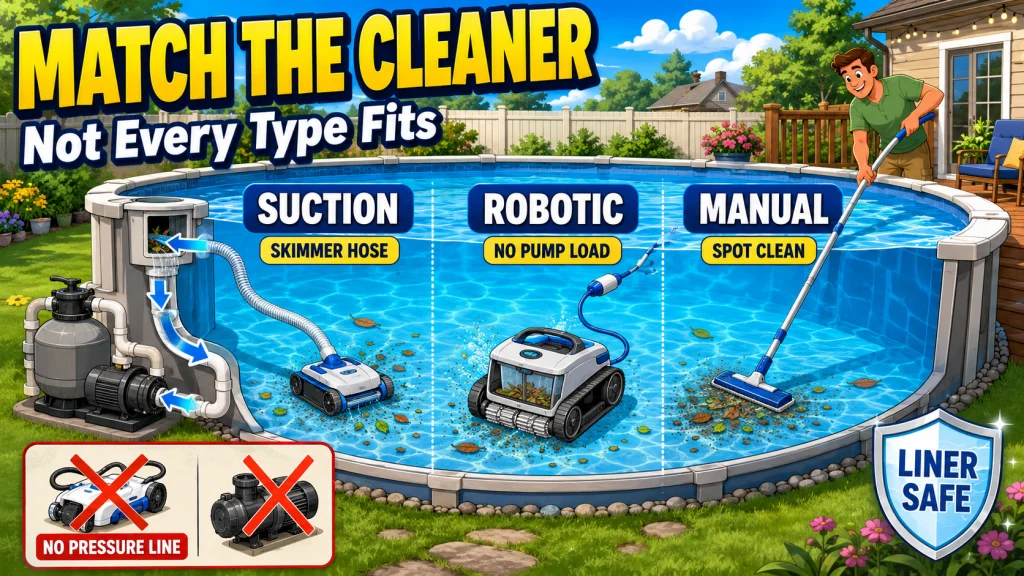
I break above ground pool cleaning equipment into three working categories, and each one solves a different problem. An automatic pool cleaner for above ground pools usually means either a suction-side cleaner or a robotic cleaner. A suction-side cleaner is the low-cost, low-effort entry point. A robotic cleaner costs more up front but runs independently of your pump and filter, which matters more than people expect once they understand what that filter load is doing to their equipment over a season. Manual vacuuming is not obsolete, and there are situations where it is still the right call even if you already own an above ground pool cleaner that runs on its own.
| Cleaning type | Connects through | Typical cost tier | Best fit |
|---|---|---|---|
| Suction-side cleaner | Skimmer, uses existing pump | Low | Light debris, tighter budget |
| Robotic cleaner | Self-contained, plugs into an outlet | Mid to high | Vinyl liner care, no added pump load |
| Manual vacuuming | Telescopic pole and vac head, uses existing pump | Lowest | Spot cleaning, closing season, algae cleanup |
The category you land in usually comes down to two questions: how much debris does your yard actually put in the water, and how much wear are you willing to put on your existing pump and filter to deal with it. Suction and manual cleaning both lean on the equipment you already own. A robotic cleaner sidesteps that tradeoff entirely, at a higher purchase price.
Which Cleaning Option Fits Your Situation
The category breakdown above answers what each option is. This is closer to what most owners actually want to know: given my pool, my equipment, and what I am dealing with, where do I start.
| Your situation | Start here | Why |
|---|---|---|
| Small pool, light debris, tight budget | Suction-side cleaner | Lowest cost, uses the skimmer and pump you already have |
| Pump is already undersized or a cartridge filter clogs fast | Robotic cleaner | Runs independently, adds no extra load to filtration |
| Heavy leaves after a storm | Manual vacuum first | Prevents an automatic cleaner from clogging on volume it cannot handle |
| Cleaning up algae after a chemistry problem | Manual vacuuming | Gives you control over vacuum-to-waste instead of recirculating it through the filter |
| Want the lowest-effort weekly routine | Robotic cleaner | Self-contained and the least hands-on of the three |
| Already own a pressure-side cleaner from an inground pool | Usually skip it here | Standard above ground plumbing rarely supports it without a booster pump |
If your situation does not line up cleanly with one row, that is normal. Most owners end up combining two of these, typically an automatic cleaner for the weekly routine and manual vacuuming for the situations automatic equipment was never meant to handle.
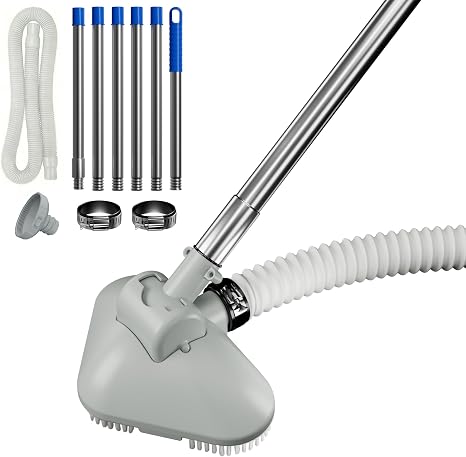
Driven indirectly by your pool filter pump, this vacuum is designed for small above-ground pools, connecting through the pool outlet to collect debris as the pump runs. Made from durable nylon, its heavy triangle head with bristles stays close to the pool surface for effective cleaning. The set includes a vacuum head, 13-foot hose, water outlet device, and an 8-foot telescopic pole, with assembly required before use.
Check On AmazonIf you click this link and buy, we earn a commission at no additional cost to you.
Suction-Side Cleaners: The Skimmer-Connected Option
A suction-side cleaner is the cleaning equipment most above ground pool owners buy first, mostly because it is the cheapest way to stop hand-vacuuming every week. It connects through the skimmer, and the same suction your pump already generates pulls the cleaner around the floor while it picks up dirt and fine debris. There is no separate motor to buy or maintain, which is the appeal, but it also means the cleaner is only as effective as the pump and filter already running your pool.
The tradeoff I mention to every buyer considering this route is filter load. Debris the suction cleaner picks up goes straight into your pump basket and filter, the same place it would end up from normal circulation, but faster and in larger amounts. On a pool with a lot of tree cover, that means checking and rinsing the filter more often than you would without one running. Sizing by pool volume, the connection steps, and where a suction cleaner falls short are all covered in the dedicated guide to suction-side cleaners for above ground pools.
Robotic Cleaners: Self-Contained and Vinyl-Friendly When Matched Correctly
A robotic cleaner is a self-contained unit with its own motor, filter, and drive system, and it does not touch your pool’s pump or filtration at all. It plugs into a nearby outlet, drops into the water, and runs its own cycle independent of whatever your circulation system is doing. That independence is the main reason owners upgrade to this category: no added strain on the pump, no extra debris routed through your main filter, and in most cases a more thorough clean on the walls and waterline than a suction cleaner reaches.
Vinyl liner compatibility is the detail that actually separates a good match from a bad one in this category, and it gets skipped in a lot of general buying guides. A vinyl liner is a soft membrane, not a rigid shell, so a robotic cleaner built around stiff scrubbing bristles or aggressive suction can wear a visible track along the wall over repeated cycles, the same way manual scrubbing with the wrong brush does. Look specifically for a model rated for vinyl surfaces and built with a brush and suction design meant to spread contact pressure rather than concentrate it on one line. Sizing to your pool, the specific features that protect a vinyl liner, and whether the extra cost is worth it in your case are covered in the full guide to robotic cleaners built for above ground pools.

Suited for above ground or in-ground pools up to 33 feet, this robotic cleaner works on vinyl, fiberglass, and gunite surfaces. Its oversized debris cartridge holds up to 60% more debris, and the Hyperbrush scrubbing brush tackles algae and stubborn contaminants without messy bags. Energy-efficient 24 volt DC motors filter over 4000 GPH, while SmartNav 2.0 navigation scans the pool for efficient cleaning around obstacles. Weighing only 14 pounds with quick water release, it is backed by a two-year quality assurance warranty.
Check On AmazonIf you click this link and buy, we earn a commission at no additional cost to you.
Manual Vacuuming: Still Necessary, Even With an Automatic Cleaner
Manual vacuuming is not a step backward, and I would rather see a new owner spend one season learning the correct technique with an above ground pool vacuum than watch them fight an automatic cleaner that was never going to solve the problem they actually have. Heavy debris after a storm, algae cleanup after a chemistry problem, and closing the pool at the end of the season are all situations where a suction cleaner or robotic unit either cannot keep up or should not be running at all.
Here is where manual vacuuming still earns its place in a cleaning routine, even for owners who already own an automatic cleaner:
- Clearing heavy leaf or debris loads after a storm, before an automatic cleaner clogs trying to handle it.
- Spot-vacuuming settled algae directly to waste during a shock treatment, instead of recirculating it through the filter.
- Working corners and steps that a suction or robotic cleaner consistently misses on an irregular pool shape.
- Closing the pool for the season, when you want full control over exactly what gets pulled and where it goes.
The technique matters more than the equipment here. Vacuuming a vinyl liner with the wrong head or the wrong speed can scuff the liner surface just as easily as the wrong automatic cleaner can. I walk through the correct setup, vacuum-to-waste versus vacuum-to-filter, and the mistakes that damage a liner in the step-by-step guide to vacuuming an above ground pool manually.

This skimmer features an oversized 20-inch frame and deep fine-mesh bag for clearing leaves, bugs, and surface debris in fewer passes. Its angled front lip glides along the pool floor to scoop sunken debris, working in inground and above ground pools, ponds, and spas. The push-clip handle fits any standard 1-inch telescoping pole, sold separately, and rounded plastic edges protect vinyl liners, tile, and fiberglass from scratches. Weighing under 10 ounces, it drains quickly and is built from durable ABS plastic and fine nylon mesh.
Check On AmazonIf you click this link and buy, we earn a commission at no additional cost to you.
Why Pressure-Side Cleaners Are Usually Off the Table
Warning: most pressure-side cleaners are built for inground pools with a dedicated pressure line and a booster pump, and standard above ground pool plumbing is not set up that way. A typical above ground pool runs on a single pump pushing water through one or two return jets, with no separate pressure port for a cleaner and no room in that plumbing for a booster pump without adding equipment most owners never planned to install.
This is the gap I see missing from most cleaning equipment overviews. Suction-side and pressure-side cleaners get lumped together in a lot of comparison articles as if they are interchangeable, connected the same way, and equally available for any pool type. They are not. A suction-side cleaner draws off the same skimmer line your pump already uses, which almost every above ground pool has. A pressure-side cleaner needs water actively pushed out to it at a specific pressure, which is either delivered by a dedicated booster pump or, on a small number of low-pressure models, borrowed from an existing return line strong enough to drive it. Most above ground pumps are sized for filtration, not for running a second piece of equipment on top of that load, so even the low-pressure pressure-side models are hit or miss on a standard setup.
If you already own a pressure-side cleaner from a previous inground pool and are wondering whether it will work on your above ground setup, the honest answer is that it depends entirely on your return line pressure and whether you are willing to add a booster pump. That is real added cost and complexity for a cleaning category this site does not build around. For nearly every above ground owner, a suction-side cleaner, a robotic cleaner, or manual vacuuming covers the job without that extra equipment.

Designed for above ground and on-ground pools of all sizes and shapes, this suction cleaner uses a turbine system to move gently and quietly across the pool floor while improving water circulation. Patented SmartDrive technology helps it cover the bottom thoroughly, and a deluxe bumper ring guides it away from walls, steps, and ladders. It connects to your skimmer with a 32 foot hose, installing in under 10 minutes without tools or a booster pump. Backed by Hayward's 80 years of industry experience.
Check On AmazonIf you click this link and buy, we earn a commission at no additional cost to you.
What This Guide Does Not Cover
Cleaning equipment is only one piece of the equipment picture, and it is worth being clear about where this guide’s scope ends. Pump and filter sizing, which directly affects how well a suction-side cleaner performs, is covered separately in the guide to sizing a pump and filter for your pool, since that decision usually gets made before the cleaning equipment does. Covers, which reduce the debris load your cleaning equipment has to deal with in the first place, are covered in the guide to choosing a cover for an above ground pool. Heating is a separate equipment category entirely and is covered in the guide to heating options for an above ground pool. None of those topics get folded into the cleaning equipment guides linked above, so if that is what brought you here, those are the right starting points instead.
For a wider view of how cleaning equipment fits into the rest of what an above ground pool needs, from the pump and filter to covers and heating, the full equipment buying guide for above ground pools ties all of it together in one place.
Final Thoughts: Match the Cleaner to Your Plumbing, Not Just Your Budget
Budget is usually the first thing owners sort by when they are shopping for cleaning equipment, but plumbing compatibility should come first. A suction-side cleaner works with almost any above ground setup because it uses equipment you already have. A robotic cleaner sidesteps your plumbing entirely, at a higher price. Manual vacuuming stays relevant for the jobs neither one handles well. Pressure-side cleaners are the one category that usually will not work without equipment your pool was not plumbed for, and that is worth ruling out before you spend money on one. Once you know which category fits, the guides linked throughout this page cover the sizing, setup, and buying details for each.
Explore More Above Ground Pool Cleaning Guides
| Guide | What it helps with |
|---|---|
| Above Ground Pool Suction Cleaners | How suction-side cleaners connect, what pump size they need, and where they struggle. |
| Above Ground Pool Robotic Cleaners | Vinyl liner compatibility, sizing by pool footage, and when the extra cost is worth it. |
| How to Vacuum an Above Ground Pool | Correct manual vacuuming technique, vacuum-to-waste setup, and liner-safe habits. |
FAQs
🧹 What is the best type of cleaning equipment for an above ground pool?
It depends on debris load and budget. A suction-side cleaner is the cheapest starting point, a robotic cleaner adds cost but skips your pump entirely, and manual vacuuming still matters for storms, algae cleanup, and closing season.
🔌 Can I use a pressure-side pool cleaner on an above ground pool?
Usually not without adding equipment. Most pressure-side cleaners need a dedicated booster pump or a return line pressure that standard above ground plumbing does not provide.
🤖 Are robotic pool cleaners safe for a vinyl liner?
Most are, as long as the model is explicitly rated for vinyl and uses a brush and suction design built to spread contact pressure instead of concentrating it on one line.
💧 Does a suction-side cleaner add work to my filter?
Yes. Debris it collects goes into your pump basket and filter, so pools with heavy tree cover need more frequent filter checks when running one.
🪣 Do I still need to manually vacuum if I own an automatic cleaner?
Yes, in specific situations: heavy debris after a storm, algae cleanup during a shock treatment, corners an automatic cleaner misses, and closing the pool for the season.
Sources and References
- The Pool Factory: Above Ground Automatic Pool Cleaners, Robotic vs Suction, on how suction-side and pressure-side cleaners each connect to a pool’s filtration system.
- Beatbot: Can You Use a Robotic Pool Cleaner on a Vinyl Pool, on brush type and suction design as the factors that protect a vinyl liner during automatic cleaning.
- Pool Mart: Which Pool Cleaner Is Right for You, Robotic vs Suction vs Pressure, on booster pump requirements and cost tiers across pressure-side, suction-side, and robotic cleaners.