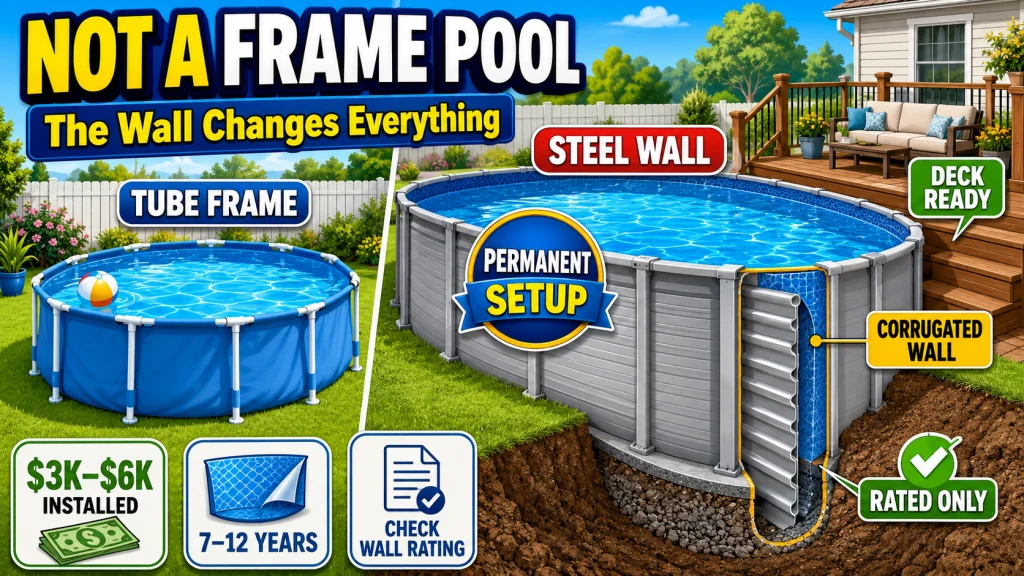
A permanent above ground pool is not just a bigger version of the inflatable or tube-frame kits I install most weeks. It is built around a corrugated steel wall panel that carries the structural load, which is what allows a semi-inground pool to go partly below grade without the wall folding in on itself. In this guide I get into what separates a true permanent pool from a standard frame pool, what the semi-inground option changes, and where the 3,000 to 6,000 dollar installed range actually goes. I also cover the liner and frame longevity math, since that is the part most buyers skip until the first replacement bill shows up.
A Permanent Above Ground Pool Is Not an Intex With a Better Frame
A permanent above ground pool is a different product category from the pools I set up for most first-time buyers. It is not a tube frame with a thicker tube, and the difference shows up the moment a customer sees the wall panel before assembly starts. It is heavier, stiffer, and clearly built to be a fixture rather than a seasonal setup. I have installed both categories dozens of times, and I will get into exactly what changes structurally in the next section, but the short version is that this category opens the door to deck integration, longer service life, and, on some models, partial burial.
This matters because the price jump from a soft-sided frame pool to a steel wall above ground pool looks steep on a spec sheet, but it buys a fundamentally different structure, not just a nicer paint job on the same tube-and-liner design. Everything else in this guide, the semi-inground option, the cost breakdown, and the long-term math, comes back to that one distinction.
What Actually Makes a Pool Permanent
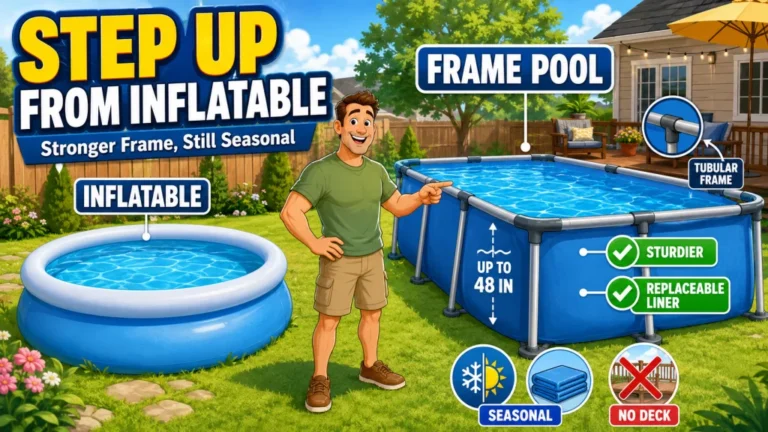
On a standard tube frame pool, the frame holds the shape and the liner and water do the rest of the work against a thin wall that is really just a barrier, not a load-bearing part. A steel wall above ground pool flips that. The corrugated wall panel is the structural element. Uprights bolt into the wall itself rather than a separate tube skeleton, and that connection point is stable enough to plan deck framing around, as long as the deck itself carries its own weight on independent footings rather than leaning on the pool. I have seen homeowners build a full wraparound deck around a steel wall pool by aligning the framing to the upright locations, something I would not trust on a tube frame pool where the wall was never meant to anchor anything.
The corrugation is not decorative. It stiffens the panel the same way corrugated cardboard resists bending better than a flat sheet of the same material, which lets manufacturers use a panel that is strong under outward water pressure without making it unworkable to ship or assemble. If you are still sorting out how this compares to the pools most first-time buyers land on, I break down how frame material and wall construction differ across the full lineup of above ground pool types in more detail, since the permanent tier only makes sense once you can see what it is stepping up from.
Wall as Structure, Not Just a Barrier
This distinction sounds academic until you are the one deciding whether to bury part of the wall. A wall designed only to hold water back has one job: resist pressure pushing outward. Not every permanent steel wall pool goes further than that. A semi-inground-rated wall is engineered to also handle inward soil pressure in a way a standard permanent wall is not, which is the entire reason a semi-inground installation is possible on some pools and a serious mistake on others. I get calls every summer from owners who assumed any above ground pool could be partially buried because the listing photo showed one sitting flush with a deck. It almost never means what they think it means.

This 18 foot by 52 inch pool holds 7,192 gallons of water and is designed for semi-permanent, year-round backyard use. Galvanized steel supports, walls, and top platform resist corrosion for lasting stability, while the FastLatch structure allows setup with just 3 tools and no professional help. The inner liner resists sun damage and includes Polar-Shield protection for colder temperatures. It comes complete with a 1,600-gallon sand filter pump, Polysphere filtration balls, a steel ladder, skimmer, ChemConnect dispenser, ground cover, and pool cover.
Check On AmazonIf you click this link and buy, we earn a commission at no additional cost to you.
The Semi-Inground Option: What It Changes and What It Risks
A semi-inground pool is a permanent steel wall pool installed with part of the wall below grade, usually somewhere between 12 and 24 inches, which drops the above-grade profile enough that the pool reads more like a built-in feature than a backyard add-on. This is the setup people mean when they search for an above ground pool that looks inground once the deck and coping go in. It is a real category, but it only works on models specifically engineered for it.
Warning: a standard above ground pool wall is engineered to resist outward water pressure only. Burying it, even partially, exposes the wall to soil pressure pushing inward, and that is a load the wall was never designed to handle. Only pools rated for semi-inground use should go below grade. This is not a workaround you can improvise with a standard tube frame or entry-level steel wall kit.
The reasoning is closer to intuition than engineering theory once you picture it. A sealed, pressurized container can be surprisingly rigid under outward force and still buckle the moment that same force gets applied from the outside, which is essentially what happens when a wall built for outward pressure gets backfilled against. I have been called out to fix exactly this kind of failure, and it is never a small repair. The liner and part of the wall structure are usually gone by the time anyone notices the bulge.
Burying a standard tube frame or entry-level steel wall pool to save money on grading, assuming any above ground wall can handle a few feet of backfill against it.
Choosing a pool the manufacturer explicitly rates for semi-inground or partial burial, confirming the maximum burial depth in writing, and planning drainage around the buried section before the wall goes in.
Once you confirm the pool is rated for it, semi-inground installation changes more than the look. A buried section needs less step height for entry, but it adds excavation cost and makes a future liner change more involved, since part of the wall is no longer accessible from outside. Ask about that tradeoff before you commit to a depth, not after the hole is already dug.
What the Investment Actually Buys
Permanent above ground pool shells start around 1,500 dollars before installation, and that number surprises people who assumed the entry point would be closer to what an inflatable or tube frame kit costs. Installation, which covers leveling, electrical bonding, and the first fill, typically adds another 1,000 to 3,000 dollars depending on site conditions and whether any grading or excavation is involved. All in, most permanent installations land in the 3,000 to 6,000 dollar range, and that total is doing real work: it is buying a structural wall, deck-ready uprights, and a build that is meant to outlast several liner cycles rather than a single one.
| Cost component | Typical range |
|---|---|
| Pool shell (steel wall, frame, hardware) | $1,500 and up |
| Installation (leveling, bonding, first fill) | $1,000 to $3,000 |
| Total installed, standard steel wall permanent pool | $3,000 to $6,000 |
| Total installed, semi-inground-rated models | $5,000 to $10,000 |
The spread between a standard permanent pool and a semi-inground-rated one is real, and it comes down to the thicker, often interlocking wall construction that semi-inground-rated models use instead of a single rolled steel sheet. That construction is what lets the wall resist soil pressure, and it is not something a manufacturer can bolt onto a standard model after the fact.
When the Permanent Tier Actually Makes Sense
I do not tell every buyer to spend at the top of this range. A standard steel wall pool that stays fully above grade is often the right call for a flat yard with no burial plans, and it is meaningfully cheaper to install. In my experience, the best permanent above ground pool setups share a few traits regardless of budget: a yard that was checked for level ground before the shell arrived, a burial rating confirmed in writing when any part of the wall goes below grade, and a deck plan that was decided before the pool went up, not after. Where I do push someone toward the semi-inground tier is when the yard has a real slope, when a deck is already planned, or when the owner wants the finished look of an inground pool without the inground price tag. In those cases, the extra cost buys a wall rated for the job instead of a wall that will eventually need to be dug back out.
Before any of that cost breakdown means much, the yard itself has to cooperate. I walk every site the same way before quoting a permanent installation, and the answers usually decide the budget more than the pool itself does. Is there a genuinely flat area, or one that can be leveled without major grading, large enough for the shell plus clearance on all sides? Can a delivery truck and the crew actually reach that spot without tearing up the lawn or routing around a fence line? Where is the nearest electrical panel, since bonding and any pump wiring add cost the farther the run gets? If part of the wall is going below grade, where does water drain once it hits that buried section during a heavy rain, and is the deck framing being planned now or as an afterthought once the pool is already in? A yard that checks those boxes keeps the project inside the ranges above. A yard that does not can push a standard installation closer to the semi-inground price band once grading, extra electrical runs, or drainage work get added in.
Why Not Just Buy an Inground Pool?
At the 5,000 to 10,000 dollar range where a fully installed semi-inground pool sits, a traditional inground vinyl liner pool starts at 30,000 to 50,000 dollars. That gap is not a rounding error, and it is the entire reason this category exists. A permanent above ground pool with a partially buried wall and a well-built deck can close most of the visual distance for a fraction of the cost.
The tradeoff most buyers do not expect is on the resale side. Most real estate listings and appraisers do not distinguish between a properly engineered semi-inground pool and a standard above ground pool that someone buried without the right wall rating. Both often get lumped into the same category on paper, even though one is a structurally sound feature and the other is a liability waiting to surface. If resale value is part of your reasoning for going permanent, get that distinction in writing from whoever installs it, and keep the manufacturer’s burial rating on file.

Made from durable HDPE, this foam cove keeps its shape under water pressure, creating a protective buffer between the wall and liner that prevents stretching, ballooning, and punctures. Unlike sand coves, it offers a consistent, uniform profile that resists uneven settling. The peel-and-stick backing allows tool-free installation on any clean, dry surface. This 24-pack provides 98 feet of coverage, suited for round pools up to 30 feet or oval pools up to 18 by 33 feet, and fits any brand.
Check On AmazonIf you click this link and buy, we earn a commission at no additional cost to you.
The Liner and Frame Longevity Difference
A vinyl liner on a steel wall above ground pool typically lasts 7 to 12 years, and replacement usually runs 1,000 to 2,500 dollars depending on pool size and liner thickness. That is longer than the 5 to 9 year range I quote for soft-sided frame pools, and it matters because the frame and wall on a permanent pool are built to outlast several liner cycles, not just one. The cost-of-ownership math for a permanent pool is really a liner-replacement schedule stacked on top of a wall and frame that should still be sound decades later, which is a completely different calculation from a frame pool where the whole structure is often replaced around the same time as the liner.
Here is a short checklist I walk buyers through before they commit to the permanent tier, since skipping any one of these is where most regret shows up later:
- Confirm whether the pool is rated for above-grade use only or also for semi-inground burial, in writing from the manufacturer, not just the retailer’s marketing copy.
- Get the maximum burial depth in writing if any part of the wall will go below grade.
- Budget separately for the liner (1,000 to 2,500 dollars every 7 to 12 years) instead of folding it into the pool’s sticker price.
- Plan the deck framing around the upright spacing before the wall goes up, since retrofitting deck attachments later is far more work.
- Ask what drainage the site needs if any section is buried, since standing water against a buried wall is its own slow failure mode.
A steel wall pool with a well-maintained liner and a properly executed cove base can run 30 or more years on the same structure, cycling through two or three liners along the way. That is the number that actually justifies the price premium over a frame pool, not the shell cost on its own. If you are comparing this against a seasonal setup, steel-frame pools built for lighter, seasonal use follow a different maintenance and replacement pattern entirely, since the frame itself is not meant to be a decades-long fixture the way a permanent wall is.
Putting the whole guide together, here is roughly how I sort buyers once they have walked through the numbers with me. A standard permanent pool makes sense if the yard is flat, burial was never part of the plan, and the goal is a structure that outlasts a frame pool without paying for features you will not use. The semi-inground tier makes sense if the yard has real slope, a deck is already in the plan, or the finished look matters enough to justify the extra 2,000 to 4,000 dollars. This tier is usually the wrong call if you only need the pool for a season or two, if the budget cannot absorb a liner replacement down the road, or if the yard cannot pass the readiness questions above without significant extra grading or electrical work.

Designed as a standard overlap replacement liner for above ground pools with metal walls, this liner fits pools up to 54 inches deep and requires coping for installation. Made from 25 gauge high-quality virgin vinyl, it is chemically treated to resist UV rays and fading. It comes backed by a 25-year limited prorated warranty against manufacturing defects.
Check On AmazonIf you click this link and buy, we earn a commission at no additional cost to you.
Final Thoughts: Match the Wall Rating to Your Yard, Not the Photo You Liked
The corrugated steel wall is what separates a permanent above ground pool from everything else on this site, and the semi-inground option only works when that wall was specifically engineered for it. Get the burial rating in writing before anyone digs, and budget for the liner separately from the shell. Those two habits prevent almost every failure I get called out to fix. For a broader look at how this fits against every other price tier on the market, I keep a full comparison of above ground pools across every budget and pool type updated separately from this guide.

This complete setup includes a slide-lock resin A-frame ladder with barrier, widemouth skimmer, 25 gauge overlap liner, 3 bags of Rx Clear Luster Filter Media, and a 16 inch sand filter system with pump. The steel wall is hot dip galvanized and resin coated inside and out to resist premature rusting. Exact-fit components, including interlocking stabilizer rails and coping strips, lock the liner securely in place for one-time, all-year installation. The North American cut liner is hand-folded to prevent creasing.
Check On AmazonIf you click this link and buy, we earn a commission at no additional cost to you.
FAQs
🏗️ What makes an above ground pool “permanent” instead of a regular frame pool?
A permanent above ground pool uses a corrugated steel wall panel as the structural element instead of a tube frame with a thin liner-backed wall. That wall can support deck framing and, on rated models, can be partially buried.
⚠️ Can I bury a standard above ground pool to make it look inground?
No. Standard walls are engineered to resist outward water pressure only. Burying one risks the wall collapsing inward under soil pressure. Only pools specifically rated for semi-inground use should go below grade.
💰 How much does a permanent above ground pool cost installed?
Most standard permanent installations land between 3,000 and 6,000 dollars total. Semi-inground-rated models typically run 5,000 to 10,000 dollars installed, depending on excavation and site conditions.
📏 How deep can a semi-inground pool be buried?
Typical burial depth on rated models runs 12 to 24 inches. The exact maximum depends on the specific pool, so get that number from the manufacturer in writing before digging.
🧵 How long does the liner last on a steel wall above ground pool?
Expect 7 to 12 years with proper maintenance, with replacement typically costing 1,000 to 2,500 dollars. The frame and wall are built to outlast several liner cycles.
🏊 Is a permanent above ground pool worth it compared to an inground pool?
It depends on budget and how much you value the inground look. A properly rated semi-inground pool can close much of the visual gap at a fraction of the 30,000 to 50,000 dollar starting cost of a traditional inground vinyl pool, but resale recognition varies by market.
Sources and References
- MGK Pools: DIY Inground Above Ground Pool guide, on why standard rolled-wall pools cannot handle earth pressure and what semi-inground-rated construction changes.
- MGK Pools: Semi Inground Pools buying guide, on typical burial depth and installation practices for semi-inground-rated pools.
- Beatbot: Above Ground Pool Types guide, confirming that standard above ground pool walls are engineered to resist outward water pressure only.
- AquaDoc: Above-Ground Pool Liner Care guide, on vinyl liner lifespan and typical replacement cost for above ground pools.