I get asked the round vs oval above ground pool question almost every week, and it almost never starts out as a swimming question. It starts as a looks question, and that is the wrong way into this decision. Round above ground pools are cheaper, simpler to install, and structurally straightforward because of how the water pressure lands on the wall. Oval above ground pools cost more and take up extra yard clearance because of how they handle that same pressure differently, but they are the only above ground shape that gives you real lap swimming distance. By the end of this, you will know which shape actually fits your yard, your budget, and what you plan to do in the water once it is full.
Round vs Oval Above Ground Pool: What Actually Decides It
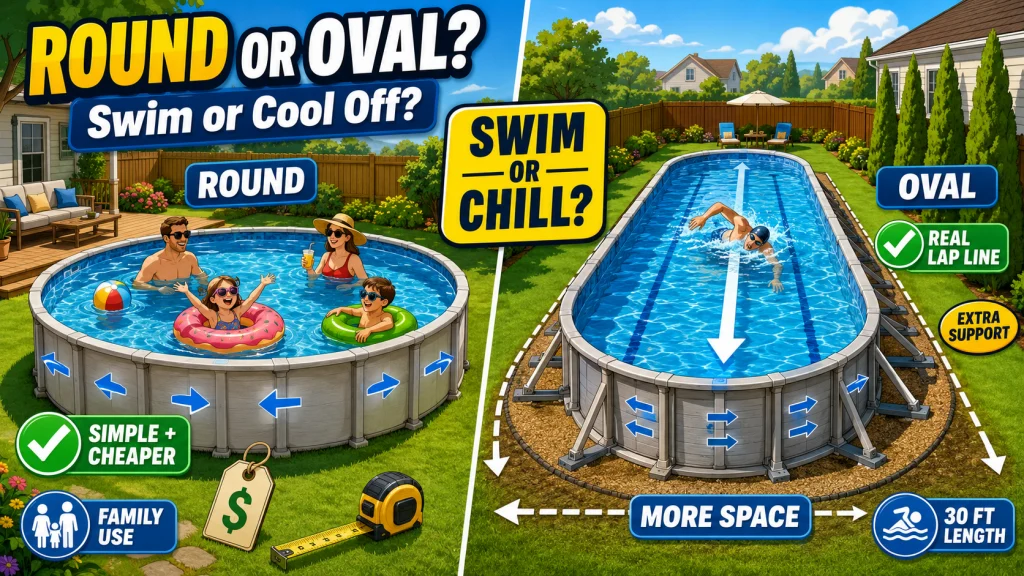
Every round vs oval above ground pool decision I have walked a homeowner through comes down to one question I ask before we talk about anything else: are you swimming, or are you cooling off? A round pool handles water pressure the same way in every direction, which keeps the structure simple and the price down. An oval pool trades that simplicity for length, and length is the only thing that gives you a real lap line in an above ground setup.
Most buyers land on oval because it looks like it belongs in a nicer yard, then get surprised at checkout when the price is higher than the round pool they compared it to. That surprise is avoidable. Once you understand what the extra length is actually paying for, the shape decision stops being about looks and starts being about how the pool sits in your yard and what you and your family will actually do in it.
Why Round Pools Are the Simpler Structural Choice
A round wall pushes outward evenly in every direction, so the frame only ever has to resist one kind of load. That is the entire reason round pools dominate the above ground market. There is no weak side, no long flat run of wall that needs extra bracing, and no engineering workaround required to keep the pool standing once it is full. I have set up more round pools than I can count, and the assembly sequence barely changes from one brand to the next because the shape does not demand anything special from the kit.
That structural simplicity is what keeps the price down and the install time short. A crew, or a handy homeowner with help, can usually get a round frame pool from unpacked parts to a pool ready for water in a single day because there is nothing to fight beyond leveling the ground and setting the wall. If your yard is roughly square or you just want the most straightforward setup available, a round pool is doing exactly what it was designed to do.

This steel-framed pool holds 6,092 gallons of water at 90 percent capacity, with a heavy-duty corrosion-resistant frame for stability and longevity. The ClickConnect System uses quick-click joints for tool-free setup and takedown, making off-season storage simple. The Tritech 3-layer liner offers added strength and puncture resistance over standard PVC. The set includes a 1,500-gallon filter pump, one Type III filter cartridge, a ladder, and a cover.
Check On AmazonIf you click this link and buy, we earn a commission at no additional cost to you.
What an Oval Pool Adds to Handle Uneven Pressure
An oval pool is not just a stretched-out round pool. The curved ends behave almost exactly like a round pool and need no extra support, but the two straight sides do not distribute water pressure the same way. That flat run of wall pushes outward with nothing to balance it on its own, so every oval kit includes some kind of support system on those straight sides to keep the wall from bowing.
Older and lower-cost oval kits use a buttress, sometimes called an A-frame support, that physically extends out from the pool wall. Support systems that extend outward from oval pool walls commonly reach 3 feet or more on each straight side, and I have seen older Wilbar-style buttress designs push past that. Newer buttress-free designs pull that support underneath the pool instead of out to the side, which is why manufacturer specs for a 15-by-30-foot oval pool package still list an outside footprint about 3 feet wider than the water dimension, even on a space-saving model.
Field Note: I have shown up to more than one install where the buyer measured the water dimension of the oval pool against the fence line and never accounted for the support system sticking out beyond that. On a buttress-style oval, that mistake means the pool physically does not fit once you factor in the braces, and there is no fixing that after the pool arrives.
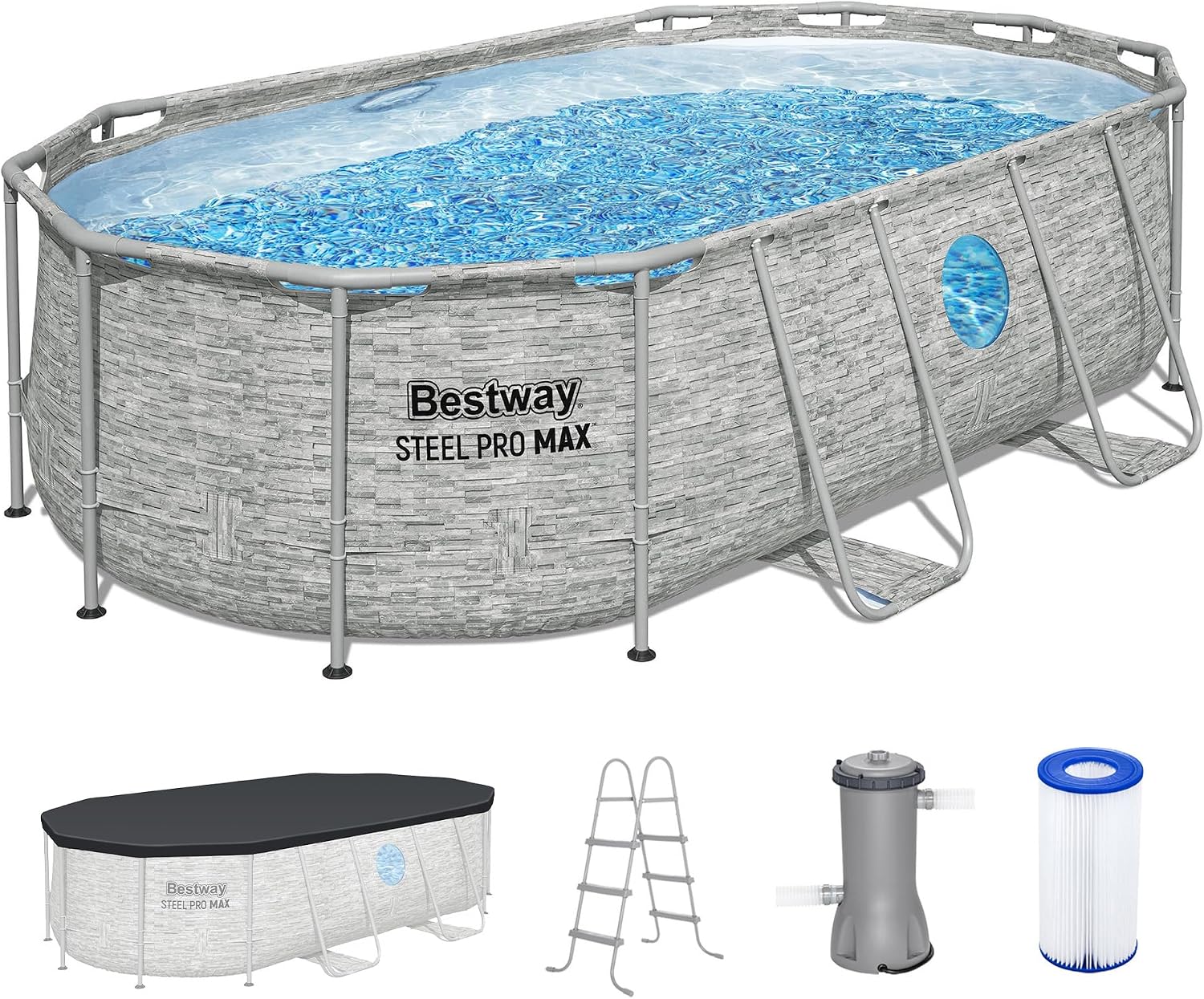
This oval pool measures 14 feet by 8 feet 2 inches and holds 1,915 gallons at 90% capacity. Its corrosion-resistant steel frame uses ClickConnect joints, while the reinforced 3-layer Tritech liner adds puncture resistance. The set includes a 530-gallon filter pump, ladder, and pool cover. Tool-free assembly also makes seasonal setup and takedown simpler.
Check On AmazonIf you click this link and buy, we earn a commission at no additional cost to you.
When the Oval Actually Makes Sense
Oval pools earn their keep in two situations. The first is a yard that is longer than it is wide, where a round pool of any reasonable diameter either does not fit or leaves awkward dead space on the sides. The second is lap swimming, and this is the one most buyers underestimate going in. A round pool, no matter the diameter, never gives you a straight swim line long enough to matter. An oval does, but only past a certain length.
If swimming laps is the actual goal, look for an oval at least 30 feet long. A 15-by-30-foot oval is the common starting point for anyone serious about lap distance in an above ground pool, and it is also one of the most widely available oval sizes, which keeps liner and cover replacement easier down the road. Anything shorter than that and you are back to swimming in place rather than swimming laps, which defeats the reason you paid the oval premium to begin with. If you are still working out how much yard your family actually needs before committing to a shape, that is a separate question worth walking through on its own, and I cover the sizing side of that decision in how to size a pool for a growing family.
- Is your yard noticeably longer than it is wide, to the point a round pool would waste usable space on the sides?
- Do you or someone in the household actually want lap swimming, not just floating room?
- Have you confirmed at least 30 feet of straight yard length after accounting for the support system footprint, not just the water dimension?
- Are you comfortable paying more upfront for that extra length and structural complexity?
- Are you planning to keep the pool fully above ground, since burying or partially burying it is a separate decision with its own structural requirements?
If none of those match your situation, a round pool is not a compromise. It is usually the better fit, and I tell buyers that directly instead of upselling them into a shape they do not need.
The Real Cost Gap Between Round and Oval
Oval pools cost more than a round pool of similar water volume, and the reason traces directly back to the structural work in the last two sections. You are paying for the extra frame components, the support system on the straight sides, and in many cases a longer liner that is harder to manufacture and ship than a standard round liner. None of that is marketing markup. It is the actual cost of building a shape that has to fight uneven pressure instead of even pressure.
The gap gets wider once you factor in freight and replacement parts. A round pool uses a simpler wall and frame layout, so the parts list is usually easier to understand and compare across similar models from the same brand. An oval pool has straight wall sections, curved end sections, and support hardware that are not interchangeable with each other, which shows up later as a higher parts cost if something needs replacing.
| Factor | Round Pool | Oval Pool |
|---|---|---|
| Water pressure distribution | Even in all directions | Uneven; straight sides need extra support |
| Support system required | None | Buttress or buttress-free system on straight sides |
| Typical footprint addition beyond water dimension | Minimal | Roughly 1 to 3-plus feet per side, depending on design |
| Relative cost for similar volume | Lower | Higher |
| Best suited for | Square or standard yards, general family use | Long, narrow yards or lap swimming |
A comparison I use often is a 24-foot round pool against a 15-by-30-foot oval. The two hold roughly similar water volume, somewhere in the range of 13,000 to 15,000 gallons depending on wall height, but the oval usually runs a few hundred to over a thousand dollars more once you account for the support hardware, hold-down plates, and the longer liner. That is the comparison that actually matters. Comparing an oval to a round pool by length and width alone hides where the money is going.
None of this means oval is a bad value. It means the price difference is doing real structural work, not just charging you for a different look. Once you compare the real footprint, the install work, and that same-volume cost gap side by side, the extra cost is either worth it for your yard and your goals or it is not.

This 24-foot round pool is 52 inches high and holds 12,481 gallons. Its galvanized-steel frame uses a precision-engineered locking system for added stability and durability. The set includes a 2,100 GPH sand filter pump, ladder, pool cover, and ground cloth. Intex also includes a 2-year warranty.
Check On AmazonIf you click this link and buy, we earn a commission at no additional cost to you.
Installation: Where Oval Pools Get More Involved
A round pool install follows a predictable sequence: level the ground, lay the base, stand the wall, run the liner, fill the water. An oval install has all of those same steps plus a support system that has to be placed correctly before the pool ever sees water. Get that placement wrong and the straight walls can bow outward once the pool is full, which is not a small fix once thousands of gallons are already in.
This is also where I see the most first-timer mistakes. Buyers who are used to picturing a round setup underestimate how much attention the support hardware on an oval needs during leveling, and skipping that step is one of the most common calls I get after an oval install goes sideways. If you are still deciding between an oval and a round pool at all, it helps to first nail down the general footprint your yard can handle, which I walk through in more detail in choosing the right pool size for your yard, since size and shape decisions really have to be made together, not one after the other.
Note: An oval pool is not harder to own once it is filled and running. The added difficulty is almost entirely at the install stage, in getting the support system level and correctly seated before you add water.
How the Shape Feels After the Pool Is Installed
Everything up to this point has been about buying and setup, but shape also changes how the pool actually feels once it is running. A round pool tends to feel more open for general family use. There is no long narrow lane cutting through the middle, so floating, kids playing, and a group standing around talking all share the same space without anyone feeling boxed into a lane.
An oval pool gives you that lane, and it is genuinely better for laps or volleyball-style games that need a straight run. The catch is that if nobody in the household actually uses that length regularly, the premium you paid for it goes mostly unused, and the pool ends up functioning like a more expensive pool with length your family rarely uses. Circulation is worth a quick mention too. Shape has far less effect on water clarity than pump sizing and filtration do, but an oval with a weak pump or poorly aimed return can make slow-flow areas more noticeable along the longer run of the pool. That is a pump and turnover rate issue more than a shape issue, and it is worth keeping in mind once you get to equipping the pool rather than just buying it.
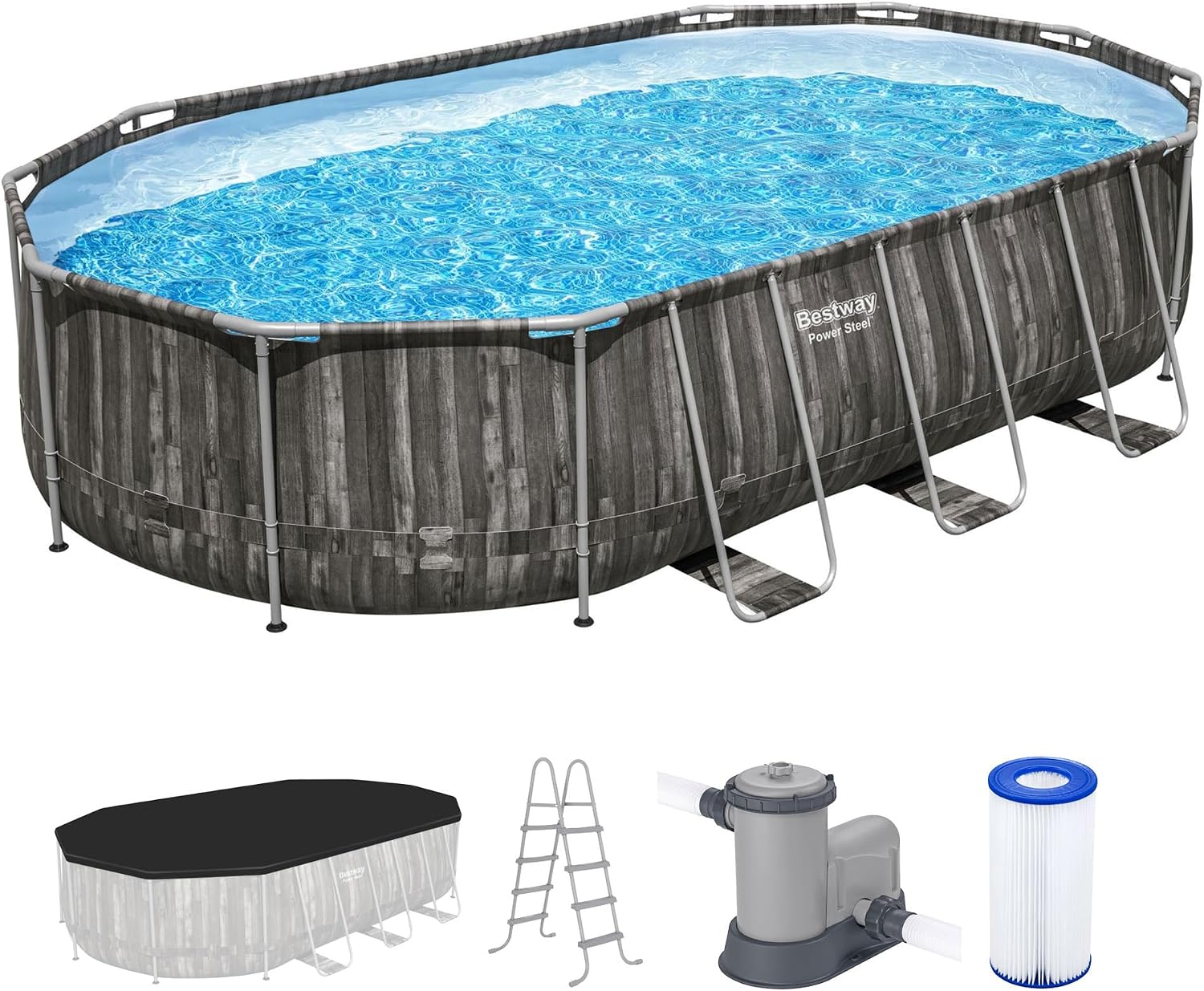
This 20-foot by 12-foot oval pool is 48 inches high and holds 5,347 gallons at 90% capacity. Its corrosion-resistant steel frame uses ClickConnect joints, while the reinforced 3-layer Tritech liner adds strength and puncture resistance. The set includes a 1,500-gallon filter pump, ladder, and pool cover. Assembly and seasonal takedown require no additional tools.
Check On AmazonIf you click this link and buy, we earn a commission at no additional cost to you.
Final Thoughts: Pick the Shape That Matches What You Will Actually Do
Round stays the simpler, cheaper default for most backyards. Oval earns its extra cost and extra install attention only when the yard or the swimming goal genuinely calls for it. Neither shape is objectively better. They solve different problems.
Before you commit, measure your actual yard against the outside footprint of the pool, not just the water dimension, and be honest about whether you want a straight lap line or just a place to cool off with the family. Get that part right, and picking between round and oval stops being a guessing game and turns into a decision you can defend with your own tape measure. If sizing is still the open question, that is worth settling before shape, and it deserves its own read rather than a rushed answer here, so start with how to choose the best above ground pool for your yard if you have not already.
FAQs
🏊 Is a round or oval above ground pool better for swimming laps?
Oval is the only above ground shape that gives you a real straight swim line. A round pool, no matter the diameter, does not offer usable lap distance.
💰 Why do oval above ground pools cost more than round ones?
Oval pools need an extra support system on the straight sides to handle uneven water pressure, plus a longer, more complex liner. Round pools distribute pressure evenly and need none of that, which keeps the cost down.
📏 What size oval pool do I need to actually swim laps?
Look for at least 30 feet of length. A 15-by-30-foot oval is the common starting size for anyone serious about lap swimming in an above ground pool.
🔧 How much extra yard space does an oval pool’s support system need?
It depends on the design. Older buttress-style supports can extend 3 feet or more per side, while newer buttress-free systems tuck closer to the pool wall. Always check the outside footprint on the spec sheet, not just the water dimension.
🏗️ Is an oval above ground pool harder to install than a round one?
The overall sequence is similar, but the support system on an oval has to be leveled and seated correctly before the pool is filled, which adds a step round pools do not have.