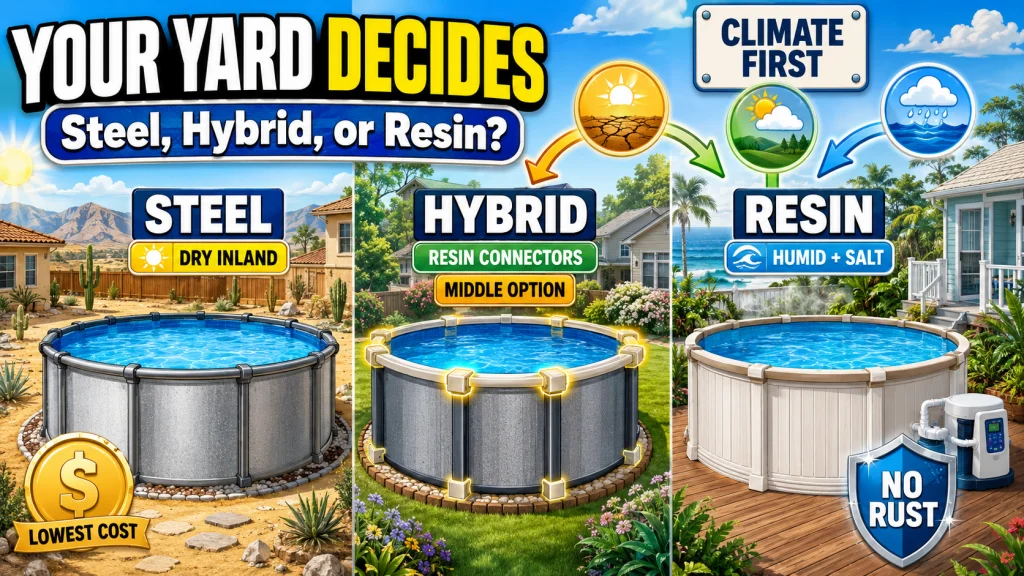
Steel, resin, and hybrid are the three construction options once you move past a soft-sided frame pool, and they are not interchangeable just because they hold the same amount of water. A steel frame above ground pool is the cheapest and stiffest option, but it is also the one most likely to rust if it sits somewhere humid, coastal, or hooked up to a salt chlorine generator. Resin solves the corrosion problem completely but costs more, and hybrid tries to split the difference by putting resin only at the connection points that fail first. What actually decides which one is worth the money is your climate and whether you plan to run salt, not a general opinion about which material is “better.”
Why Steel, Resin, and Hybrid Frames Are Not Sold in Equal Numbers
Walk into the above ground pool aisle of any big box store in the Midwest and you will see almost all steel frame above ground pool kits on the shelf, with maybe one resin model tucked at the end. That is not an accident. Steel dominates the budget tier because it is cheap to manufacture and rigid enough to hold a straight wall without much engineering. Resin sits at the premium tier because it costs more per foot of tubing, and hybrid occupies the middle by mixing the two materials in the same frame.
The question I get asked most is which one is best, and that is the wrong question. I have installed steel frame pools that are still standing after eight seasons in a dry inland yard, and I have replaced steel connectors after two seasons on a saltwater setup near a lake. The material that holds up depends on where the pool sits and what water treatment method the owner runs, not on a universal ranking.
What a Steel Frame Above Ground Pool Actually Gets You
A steel frame pool uses galvanized or powder-coated steel tubing for the uprights and top rails, paired with a steel wall and a vinyl liner. Steel is the most rigid structural option in this lineup, which is why it holds a straight, even wall shape better than a soft-sided frame pool. That rigidity is the whole reason steel stayed the default choice for decades.
The tradeoff shows up at the connection points first, not across the whole frame at once. Where two pieces of steel bolt together, moisture gets trapped, the protective coating wears thin from repeated assembly and disassembly, and rust starts working its way in. In a humid, coastal, or high-rainfall region, a steel frame without a solid protective coating will typically start showing surface rust at those connection points within three to five years.
Field Note: The steel pools I have serviced longest were all in dry, inland yards where the owner tore the frame down and stored it dry every winter. The ones that failed early were almost always left assembled year-round in a humid climate, with rust starting exactly where the top rail bolts to the upright.
If your yard sits in a dry inland climate with no salt air and no plans to run a salt chlorine generator, steel is a reasonable choice and it saves real money. The failure mode only accelerates once you introduce humidity or salt into the equation, and that is where the decision starts to change.

This 12 foot by 30 inch pool holds up to 1,710 gallons of water and features a corrosion-resistant steel frame for stability and durability. The FrameLink System allows for tool-free setup and takedown, while the 3-layer Tritech liner is reinforced for puncture resistance. It comes complete with a 530-gallon filter pump, 2 hoses, and a Type III A/C filter cartridge for an easy start.
Check On AmazonIf you click this link and buy, we earn a commission at no additional cost to you.
What a Resin Above Ground Pool Changes
A resin above ground pool replaces the steel uprights, top rails, and connectors with high-density resin, which is a rigid plastic that does not rust or corrode under any water condition. That single change removes the failure mode that ends most steel frame installations early. Resin is naturally suited to coastal environments, humid climates, and any setup where the owner already knows they want to run a salt system.
The cost difference is not small. A resin frame pool at the same size as a comparable steel model typically runs noticeably higher, and that premium is the main reason resin has not taken over the entry-level market. For an owner in a dry climate with no salt plans, that extra cost buys corrosion resistance they may never actually need.
Where resin earns its price is a straightforward case: humid climate, coastal air, or a salt chlorine generator in the plan. In any of those three situations, a resin frame removes the maintenance conversation about rust entirely, which matters more than the sticker price once you have replaced a corroded steel connector yourself.

This steel-framed pool holds 6,092 gallons of water at 90 percent capacity, with a heavy-duty corrosion-resistant frame for stability and longevity. The ClickConnect System uses quick-click joints for tool-free setup and takedown, making off-season storage simple. The Tritech 3-layer liner offers added strength and puncture resistance over standard PVC. The set includes a 1,500-gallon filter pump, one Type III filter cartridge, a ladder, and a cover.
Check On AmazonIf you click this link and buy, we earn a commission at no additional cost to you.
Where a Hybrid Above Ground Pool Fits In
A hybrid above ground pool keeps a steel wall for structural rigidity but swaps the uprights, top rails, and connectors to resin. That puts the corrosion-resistant material exactly where steel usually fails first, the connection points, while keeping the cost lower than a full resin build. It is the most common middle-ground recommendation I give when an owner wants better durability than steel without paying full resin pricing.
One detail buyers miss: not every hybrid model uses the same ratio of steel to resin. Some hybrid frames only resin-coat the connectors while the rest of the frame stays steel underneath, and others use resin for the entire upright assembly. If you are comparing two hybrid pools by price alone, check exactly which components are resin and which are still steel, because that detail changes how the pool behaves in a humid or salt environment over time.
Hybrid construction is a genuinely useful middle option for an owner in a moderately humid climate who is not ready to pay full resin pricing, or for anyone running a salt system on a budget that steel alone cannot support over the long term.

This 52 inch deep, 18 foot round pool holds 7,200 gallons and comes complete with an overlap liner, skimmer, filter system, A-frame ladder, and maintenance kit. The steel wall features a basket weave pattern with 7 inch weather-resistant resin top rails and uprights for added stability. A 1-HP dual-speed sand filter pump circulates water efficiently, while the heavy-duty resin ladder supports up to 250 pounds and includes a locking, flip-up design for safety. Backed by a 30-year limited warranty.
Check On AmazonIf you click this link and buy, we earn a commission at no additional cost to you.
Matching the Frame Material to Your Climate and Water Setup
Once you separate the three materials by what they actually resist, the decision comes down to three questions: how humid is the air where the pool sits, is it near salt air or coastal spray, and are you running a salt chlorine generator. Answer those honestly before comparing prices, because the cheapest steel frame above ground pool and the most expensive resin model are not competing for the same buyer.
| Frame Material | Best Fit Climate | Salt Chlorine Generator | Relative Cost |
|---|---|---|---|
| Steel frame | Dry, inland, low humidity | Not recommended | Lowest |
| Hybrid frame | Moderate humidity or occasional coastal exposure | Acceptable only if exposed steel is limited | Middle |
| Resin frame | Humid, coastal, or high salt exposure | Best suited option | Highest |
A salt chlorine generator changes this math faster than climate alone does. Running salt through a pool with exposed steel accelerates corrosion at every connection point compared to a standard chlorine routine, so if a salt system is part of the plan, resin or hybrid stops being a preference and starts being a requirement.
If two pools are close in price, do not compare the frame label first. Compare which parts are still exposed steel. A cheaper hybrid with steel-heavy uprights can behave a lot more like a plain steel pool in a salt or humid yard than the product name suggests, and that is exactly where buyers get caught off guard a season or two in.
Note: Regardless of which frame material you choose, the vinyl liner sits on its own replacement schedule. Expect 5 to 9 years out of a soft-sided liner and 7 to 12 years out of a steel wall liner before it needs replacing, and budget for that cost separately from the frame itself. In most setups the frame will outlast the liner, not the other way around.
Before comparing specific models, run through the same checklist I use on a service call:
- Check average summer and winter humidity for your yard, not just the regional climate label.
- Confirm whether the pool sits within coastal salt air range, even a few miles inland can still carry salt spray.
- Decide now whether a salt chlorine generator is part of your long-term plan, not just this season.
- Ask exactly which components are resin versus steel on any hybrid model you are comparing.
- Budget the liner replacement separately from the frame, since the two do not wear out on the same timeline.
Once you have answered those five points, the choice between a permanent steel wall pool built to stay put for years and a semi-permanent steel, resin, or hybrid frame gets a lot easier, since a permanent installation carries its own separate durability tradeoffs beyond frame material alone.

Built with a copper bearing steel wall that is hot dip galvanized and resin coated inside and out, this pool resists premature rusting for lasting durability. The North American cut, hand-folded liner is designed to prevent creasing and stretches evenly when warmed before installation. Exact-fit components, including interlocking stabilizer rails and coping strips, lock the liner securely in place for all-year, one-time setup.
Check On AmazonIf you click this link and buy, we earn a commission at no additional cost to you.
How to Read the Specs Before You Buy
Product listings do not always spell out what “hybrid” actually means on a given model, and that is where a lot of buyers get surprised after the pool is already in the yard. A listing that says “resin-coated” is describing a thin resin layer over a steel core, which is not the same as “solid resin,” where the component is resin all the way through. The first one still has steel underneath that can corrode once the coating wears through; the second one does not.
Work through the frame piece by piece instead of trusting the overall label. Check the upright, the top rail, the connector, and the wall separately, because a manufacturer can call a pool “hybrid” while only one of those four pieces is actually resin. Hardware matters too. Even a fully resin frame usually still uses metal bolts or brackets at the joints, and those small steel parts are often the first thing to show rust in a humid or salt setup, regardless of what the rest of the frame is made from.
If a listing describes the frame in vague terms without naming the specific parts, treat that as a reason to dig further rather than assume the best case. Match whatever you find against your climate and salt plan from the checklist above before you compare price tags side by side. A pool that looks like a bargain on the shelf can end up costing more once you are replacing corroded hardware two seasons in.
Final Thoughts: Match the Frame to the Failure Mode You Are Most Likely to Hit
Instead of asking which frame material is best, ask which failure mode your yard makes most likely. Dry inland yards can usually justify steel without a second thought. Humid, coastal, or salt-system setups should pay for resin somewhere in the frame rather than find out the hard way where the connection points give in first. Hybrid makes the most sense when you need corrosion protection at the weak points but cannot justify full resin pricing, as long as you have actually checked which parts are resin.
If you are still working out which overall type and size of above ground pool fits your yard before narrowing down the frame material, it helps to start from a full comparison of above ground pool types by budget and permanence, and from there the broader buying decisions covered in the complete guide to choosing an above ground pool before you commit to steel, resin, or hybrid.
FAQs
🧂 Does a salt chlorine generator ruin a steel frame pool?
It speeds up corrosion at exposed connection points compared to a normal chlorine routine. A steel frame is not an automatic failure with salt, but resin or hybrid holds up longer under a salt system.
💰 Is a hybrid above ground pool worth the extra cost over steel?
It usually is if your yard sees moderate humidity or occasional salt exposure. Check which specific components are resin on the model you are comparing before deciding, since ratios vary by model.
🌧️ Can a steel frame pool rust in a dry climate?
It can still happen, just much more slowly. Low humidity and no salt exposure are the two conditions that keep steel connection points from corroding within the first few seasons.
🧴 How long does the liner last on a steel or hybrid frame pool?
Plan on 7 to 12 years for a steel wall liner, separate from how long the frame itself holds up. The liner and the frame wear out on different schedules.
🏝️ How close to the coast does salt air start affecting a steel frame?
Salt spray can reach a yard several miles inland depending on wind patterns, not just properties directly on the water. If you are unsure, treat your setup as coastal exposure when choosing frame material.
🔧 Can I add rust protection to an existing steel frame pool?
A protective coating applied to connection points can slow corrosion, but it will not fully replace the corrosion resistance built into resin or hybrid components from the start.