Test strips and a liquid test kit are not interchangeable tools for an above ground pool, even though most owners treat them that way. Test strips are built for a quick weekly check on a pool that is already stable. A liquid test kit is built for the moment something is wrong and you need a number you can actually trust. Owners who reach for a strip when they are troubleshooting a stubborn chemistry problem usually end up chasing the same green or cloudy water for weeks. This guide walks through what each tool measures, where strips lose accuracy, and when it is time to switch to a liquid kit.
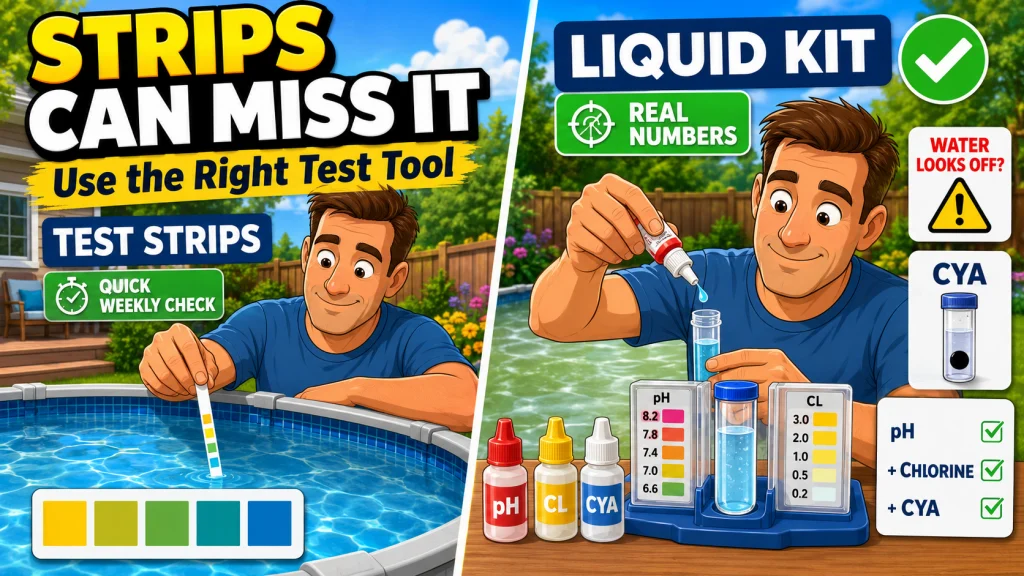
Test Strips vs a Liquid Test Kit: Two Different Jobs
An above ground pool test kit is not one product. It is really two categories that get lumped together because they both tell you something about your water. I have handed strips to plenty of owners who then wonder why their pool still looks off even though the strip read “fine.” The strip was not lying. It was just not precise enough for the situation they were in.
Test strips are the right call for a normal week: pool is clear, chemistry has been stable, and you just want a quick confirmation before you swim. A liquid kit earns its place when something has already gone sideways, when you are running a shock sequence, or when you are opening or closing the pool and need a real baseline. Mixing up which tool belongs to which job is one of the most common reasons an above ground pool owner spends weeks fighting a problem that should have cleared up in days.
Field Note: a few patterns come up over and over on service calls. The pool looks clear but the chlorine reads low on a strip, which usually means it was already borderline before the strip could catch it. The strip says everything is fine but the water smells strong, which points to combined chlorine that a basic strip will not separate out. The pool stays cloudy days after a shock treatment, which almost always means nobody confirmed the actual chlorine level with a tool that can read the higher range.
What Test Strips Measure and Where They Fall Short
A typical pool test strip reads free chlorine, total chlorine, pH, total alkalinity, and often cyanuric acid (CYA) in one dip. That range covers the basics for a fast weekly check, which is why strips are the cheap, easy option most owners reach for first. The problem is resolution, not the concept. A strip gives you a color band, not an exact number.
Here is where that matters in practice: a strip that reads chlorine somewhere between 1 and 3 ppm will not tell you if the true reading is 2.8 ppm or 0.8 ppm. Both can land in the same color block on the card. A 0.8 ppm reading is already below the level most above ground pools need to sanitize properly, but the strip will not flag it as a problem. That gap is exactly why a pool can look “tested” on paper while it is still building toward algae underneath.

These test strips check pH, total chlorine, free chlorine, bromine, alkalinity, total hardness, and cyanuric acid using medical industry technology for accuracy comparable to liquid tests. Simply dip the strip, wait 15 seconds, and compare it to the color chart, with no drops or measuring involved. Each color pad uses paper designed to keep colors vibrant and prevent bleeding for reliable readings. AquaChek has over 35 years of experience helping maintain healthy pool and spa water.
Check On AmazonIf you click this link and buy, we earn a commission at no additional cost to you.
Why a Liquid Test Kit Gives You Numbers You Can Trust
A liquid kit works differently. You add reagent drops to a water sample, and the color change is proportional to the actual chemical concentration, not a rough band. That is why FAS-DPD liquid testing is the standard choice when you need to verify high chlorine levels during a shock sequence, sometimes called SLAM. Strip color comparison simply cannot hold up at the higher chlorine levels a shock treatment requires, somewhere in the 10 to 40 ppm range depending on your CYA level.
I usually tell owners to think of it this way: a strip is a smoke detector, and a reagent kit is a thermometer. One tells you something is worth paying attention to. The other tells you exactly how much you are dealing with. If you are trying to confirm whether a shock treatment actually worked, or whether your pool is holding a stable chlorine level day to day, you need the thermometer, not the smoke detector.
Key point: not every liquid kit covers the same ground. A basic drop kit that only checks free chlorine and pH is still a step up from strips, but it will not help you during a shock sequence or a stubborn algae problem. A complete kit that reads free and combined chlorine, pH, alkalinity, and CYA, with the reagents needed for high chlorine ranges, is the one that actually earns its keep when the pool is fighting you.
Digital testers come up often too. They remove the guesswork of matching a color against a chart, which helps in low light or for anyone who has trouble judging shades. What a digital tester does not do is decide which parameters you need to be checking in the first place. If you are troubleshooting cloudy water, you still need a device or kit that reads the same full range a complete liquid kit does, not just chlorine and pH.

This all-in-one kit tests for free and total chlorine, pH, acid and base demand, total alkalinity, calcium hardness, and cyanuric acid, working with any pool, hot tub, or spa. It includes a carrying case, water comparator, water balance calculator, base demand reagent, color-coded instructions, and a waterproof chemistry guide for quick reference. Taylor test kits are the only testing supplies recommended by the American Swimming Coaches Association, ensuring professional-level accuracy.
Check On AmazonIf you click this link and buy, we earn a commission at no additional cost to you.
The CYA Blind Spot in Strip Testing
Cyanuric acid is where strip accuracy falls apart the hardest. CYA controls how much of your chlorine is actually available to sanitize the water, so getting this number wrong throws off every other chemistry decision you make afterward. Strip pads for CYA rely on comparing a color square against a chart, and that comparison is subjective even under good lighting.
A liquid CYA test works on a completely different principle. You dilute a reagent into the water in a tube until a black dot underneath becomes impossible to see through the turbidity, and the point where it disappears correlates with the actual CYA concentration. It takes a couple of extra minutes compared to a strip, but for outdoor above ground pools where CYA drifts up over a season from stabilized chlorine, that extra accuracy is worth it. Getting the CYA number wrong is one of the quieter reasons owners end up adding chlorine that never seems to do its job.

This test kit measures the parts per million of cyanuric acid in pool water using a test vial designed for a positive readout. It includes 8 ounces of reagent along with instructions, housed in a styrene box with a clear top. Each pack contains 1 kit, measuring 8-1/2 inches long, 13 inches high, and 8-3/4 inches wide.
Check On AmazonIf you click this link and buy, we earn a commission at no additional cost to you.
Why Good Tests Still Give Bad Readings
Even the right tool gives a wrong answer if it is used carelessly, and this trips up strips and liquid kits about equally. Strips left in a hot garage or a sun-exposed pool bag lose accuracy over time, and reagent bottles behave the same way once heat starts breaking down the chemistry inside them. A damp finger touching a strip pad before it hits the water can throw the color off before you even dip it.
Timing matters just as much as storage. Reading a strip a few seconds early or late changes the color you are comparing, and most owners are not standing there with a stopwatch. Where you pull the water sample matters too. Scooping from right at the surface or too close to a return jet gives you a reading that does not reflect what the rest of the pool actually looks like. Pull your sample from elbow depth, away from jets and skimmers, for a result you can trust.
Warning: do not make a major chemical decision off a single strange result. If a reading does not match how the water looks or smells, retest with a fresh strip or a new reagent sample before adding anything. Do not keep shocking a pool just because it has not cleared yet if you have not confirmed the actual chlorine and CYA numbers first, and do not treat a CYA strip as the final word when an outdoor pool is already showing signs of a problem.
How to Test Above Ground Pool Water at Each Stage
The honest answer to which tool is best depends entirely on what stage your pool is in. A stable pool in the middle of a normal summer week does not need lab-level precision every time. A pool coming out of winter storage, fighting algae, or heading into a shock sequence absolutely does.
| Situation | Better tool | Why |
|---|---|---|
| Routine weekly check on a clear, stable pool | Test strips | Fast, cheap, accurate enough when nothing is actively wrong |
| Troubleshooting cloudy or green water | Liquid test kit | Precise chlorine and pH numbers reveal the actual cause |
| Confirming shock treatment progress | Liquid test kit | Strips cannot read high chlorine ranges reliably |
| Seasonal opening or closing | Liquid test kit | You need an accurate baseline before adjusting anything |
| Checking CYA on an outdoor pool | Liquid test kit | Turbidity-based reading beats color-strip comparison |
A simple checklist helps here more than a paragraph does. Before you decide which test to reach for, walk through this:
- Has the water looked normal all week, with no cloudiness, odor, or color change?
- Are you in the middle of a shock sequence or trying to confirm chlorine dropped back to normal?
- Is this the first test of the season, right after opening or right before closing?
- Has your last CYA reading been more than a season old?
- Have you added a strip result to a chemical decision that did not match how the water actually looked?
If you answered yes to anything past the first question, that is your signal to pull out the liquid kit instead of the strips. It also helps to match the kit itself to the actual problem, not just the general category of testing:
- Pool is stable and clear: a basic strip covering chlorine, pH, and alkalinity is enough.
- Pool turns cloudy or green on and off: you need a kit that separates free and combined chlorine, not just a total reading.
- Mid-shock or confirming a SLAM sequence: you need a kit that can read high chlorine ranges, not a standard 0 to 5 ppm strip.
- Struggling to judge color shades accurately: a digital reader removes that variable, as long as it still covers the same parameters a complete kit does.
Once your pool settles back into a stable pattern, you can go back to strips for the weekly check and save the more precise kit for the next time something changes. This same logic is what keeps your above ground pool chemical levels from drifting quietly out of range between checks, and it fits into a broader above ground pool maintenance routine where testing accuracy is what makes every other step actually work. Once you know which tool to trust, the next question is usually what number you are aiming for, which is covered separately when we walk through the exact target ranges for each chemical.

This digital tester reads pool test strips for clear numerical results, measuring total chlorine, free chlorine, bromine, total hardness, cyanuric acid, total alkalinity, and pH. It comes with 30 test strips and delivers digital readings in seconds after dipping and inserting a strip. Built-in memory stores up to 100 previous results, making it easy to track water balance changes over time. It is brought to you by AquaDoc, a trusted pool and spa chemical brand.
Check On AmazonIf you click this link and buy, we earn a commission at no additional cost to you.
Final Thoughts: Do Not Let One “Fine” Reading Decide Everything
Keep both tools in the same bin by the pool. The habit that actually matters is not memorizing which tool wins in the abstract, it is noticing the moment a strip result stops matching what you see, smell, or feel about the water and switching tools right then instead of trusting the number out of habit. A strip that says “fine” is only as good as the situation it was designed for. The owners who fight the same chemistry problem for a month are usually the ones who kept trusting that word past the point it was still true.
FAQs
🧪 How do I know if my test strips are giving accurate readings?
Strips are accurate within a range, not to an exact number. If your pool looks clear and chemistry has been stable, strips are reliable enough. If the water looks off or a reading seems inconsistent with how the pool looks, confirm with a liquid test kit before making a chemical decision.
💧 Is a liquid test kit better than test strips for an above ground pool?
Better depends on the situation. For a routine weekly check, strips are fast and accurate enough. For troubleshooting, confirming a shock sequence, or checking CYA, a liquid kit gives a precise number that strips cannot match.
🔬 Why does my chlorine reading not match how the water looks?
This usually happens because a strip reading falls inside a wide color band. The true chlorine level could be near the top or bottom of that range, and a low actual reading will not sanitize properly even though the strip looks fine. A liquid kit removes that guesswork.
🧫 What is the best way to test CYA in an above ground pool?
A liquid turbidity test is more reliable than a CYA strip pad. It works by diluting a reagent into a water sample until a black dot underneath disappears, and that point correlates closely with the actual CYA level, which strip color comparison cannot match.
⏱️ How often should I use a liquid test kit instead of test strips?
Use a liquid kit at the start and end of the season, any time the water looks cloudy or green, and any time you are confirming a shock sequence. Strips are fine for the routine weekly checks in between, as long as the pool is behaving normally.
🌡️ Can I use pool test strips year round for an above ground pool?
Strips work fine year round for routine checks once the pool is stable. Keep a liquid kit on hand as well, since seasonal openings, closings, and any troubleshooting situation call for more precision than a strip alone can give you.
Sources and References
Every claim above that depends on outside evidence traces back to one of the following:
- Swim University’s guide to using pool test strips correctly, on test strips as the standard easy option for weekly pool maintenance.
- Swim University’s comparison of pool test kit options, on digital testers removing color-matching guesswork.
- Trouble Free Pool’s reference page on pool test kits, on FAS-DPD testing as the accepted method for confirming high chlorine levels during a shock sequence.
- Trouble Free Pool’s guide to CYA testing procedure, on the turbidity-based liquid CYA test as more reliable than strip color comparison.
- Field pattern observed across above ground pool installs and service calls, on strip resolution masking a below-threshold chlorine reading.