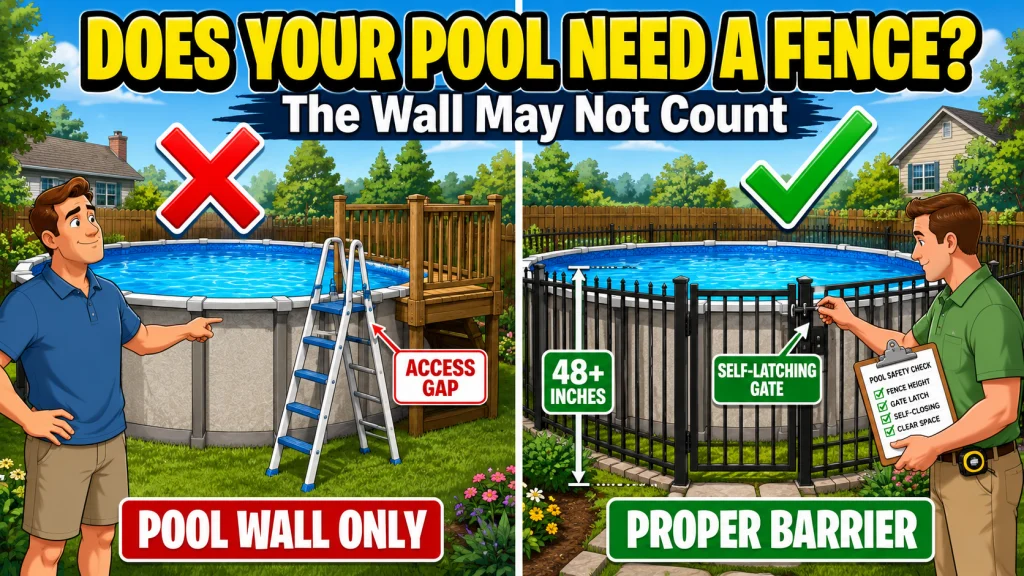
Many local codes start regulating above ground pools once the water can hold 24 inches or more, though some jurisdictions use 18 inches or a different definition entirely, so the number that actually applies to your yard depends on where you live. The part that trips people up is not the fence itself. It is the assumption that the pool wall automatically counts as the barrier, and that assumption only holds up when the ladder and any other climbable access point are secured, locked, or removed. This guide covers when a fence is generally required, the height standard most codes point back to, the gate rules that get missed, and the specific conditions under which a pool wall can or cannot stand in as a barrier on its own.
Do You Need a Fence for an Above Ground Pool?
In most US jurisdictions, yes. Fence rules for above ground pools are generally triggered by water depth, not by whether the pool sits above or below grade. Many codes use 24 inches as the point where a pool barrier becomes required, though some cities and counties set the line at 18 inches or define it differently, so it is worth confirming the exact number where you live rather than assuming one figure applies everywhere. A 15-foot frame pool filled to its normal operating depth clears most of these thresholds easily, which is why this question comes up on almost every install I do, usually from a first-time buyer who assumed the wall itself was enough.
I have set up plenty of pools where the owner genuinely believed a locked yard gate, or a pool wall tall enough to keep a toddler out, satisfied the legal requirement. Sometimes it does. More often, there is a specific gap an inspector or an insurance adjuster will flag later, and it usually traces back to a ladder or a set of deck stairs that gives a child an unsecured way up and over. Treat the depth trigger as a starting point and confirm the exact number and definition with your own municipal code before you assume your setup is covered.
The Minimum Fence Height Most Codes Point To
The Consumer Product Safety Commission publishes a widely used safety guideline that recommends 48 inches as the minimum height for a residential pool barrier. It is a guideline, not a nationwide law, but it is the benchmark that most local codes are built around, which is why that number shows up constantly in above ground pool fence discussions. Whether it is enforceable where you live depends on whether your state or municipality has adopted a code that incorporates it, so it is a reference point, not an automatic requirement everywhere.
California is a useful example of how far a state can go beyond that benchmark. Under its pool safety law, California requires a 60-inch minimum, a full foot taller than the CPSC guideline. Florida sets its own requirement at 48 inches, matching the common benchmark rather than adding to it. I tell every owner the same thing before they buy fencing: look up your own state’s actual requirement first, because a fence height that satisfies Florida’s rule can fail inspection in California, and retrofitting extra height onto an existing fence is a far more annoying weekend than getting it right the first time.
| Standard | Minimum Fence Height | Notes |
|---|---|---|
| CPSC guideline | 48 inches | Widely used benchmark; enforceable where local code adopts it |
| California | 60 inches | State law exceeds the CPSC benchmark |
| Florida | 48 inches | State requirement matches the common benchmark |
Treat that table as a starting point, not a final answer. City and county codes can add requirements on top of whatever your state sets, and a separate homeowners association may layer on its own design or placement rules beyond that. A five-minute call to your local building department before you buy fencing saves you from redoing the job later.

This removable pool fence stands 4 feet high and spans 108 feet. It uses premium mesh fabric with high-quality aluminum posts for outdoor durability. The fence can be rolled up for compact storage when not needed, and its sections connect to create a customizable layout. Installation hardware and instructions are included.
Check On AmazonIf you click this link and buy, we earn a commission at no additional cost to you.
Why the Pool Wall May Not Count as a Barrier
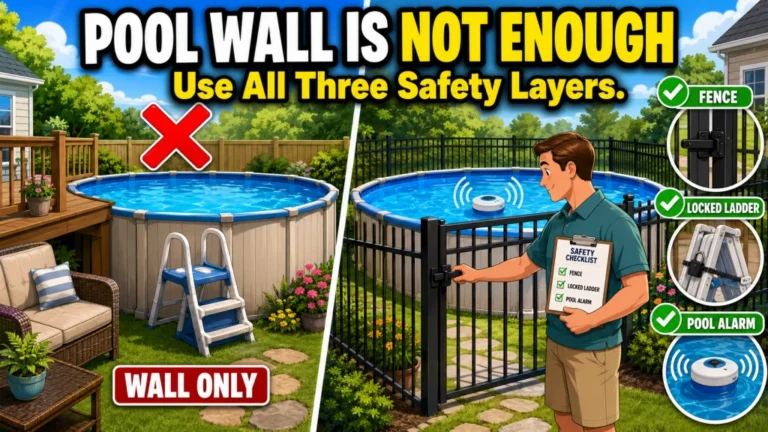
This is the part of above ground pool fence requirements that catches the most owners off guard. A lot of buyers assume that because their frame pool wall already stands 48 inches tall, it automatically doubles as the required barrier and they can skip a separate fence entirely. Under CPSC guidance, the pool structure itself can serve as the barrier, but only when every means of access, ladders, steps, or anything else a child could climb, is secured, locked, or removed so it cannot be used without help.
In my experience, this is where the theory runs into an actual backyard. A pool needs some way in and out, and if that ladder or set of steps is left unsecured rather than locked away or physically removed, it becomes the access point that undoes the wall’s case for being a compliant barrier on its own. I have had homeowners point at their pool wall with total confidence that it met the standard, only to realize the ladder sitting against it, unlocked and reachable the rest of the day, was the actual problem. A removable, self-locking ladder changes that calculation, and it is worth reading through what actually makes a locking ladder work as a real access barrier before you decide the wall alone is enough.
Field Note: The setups I have seen fail an inspection over barrier issues almost never fail because the fence was too short. They fail because a ladder, a set of deck stairs, or stacked patio furniture next to the wall gave a kid an unsecured foothold nobody accounted for. The wall height was rarely the problem. The unsecured access point was.
If your setup includes a deck built right up against the pool wall, that deck needs the same treatment as a ladder: it counts as an access point unless it is genuinely blocked off, and the barrier requirement follows the access route, not the pool’s advertised wall height. That is a separate issue from burying or partially recessing a pool into a slope, which carries its own structural risk and is not what this guide covers. For a fuller look at how barrier rules fit into everything else around the pool, our guide to above ground pool safety basics covers the related pieces, including alarms and supervision, that work alongside a fence rather than replacing it.
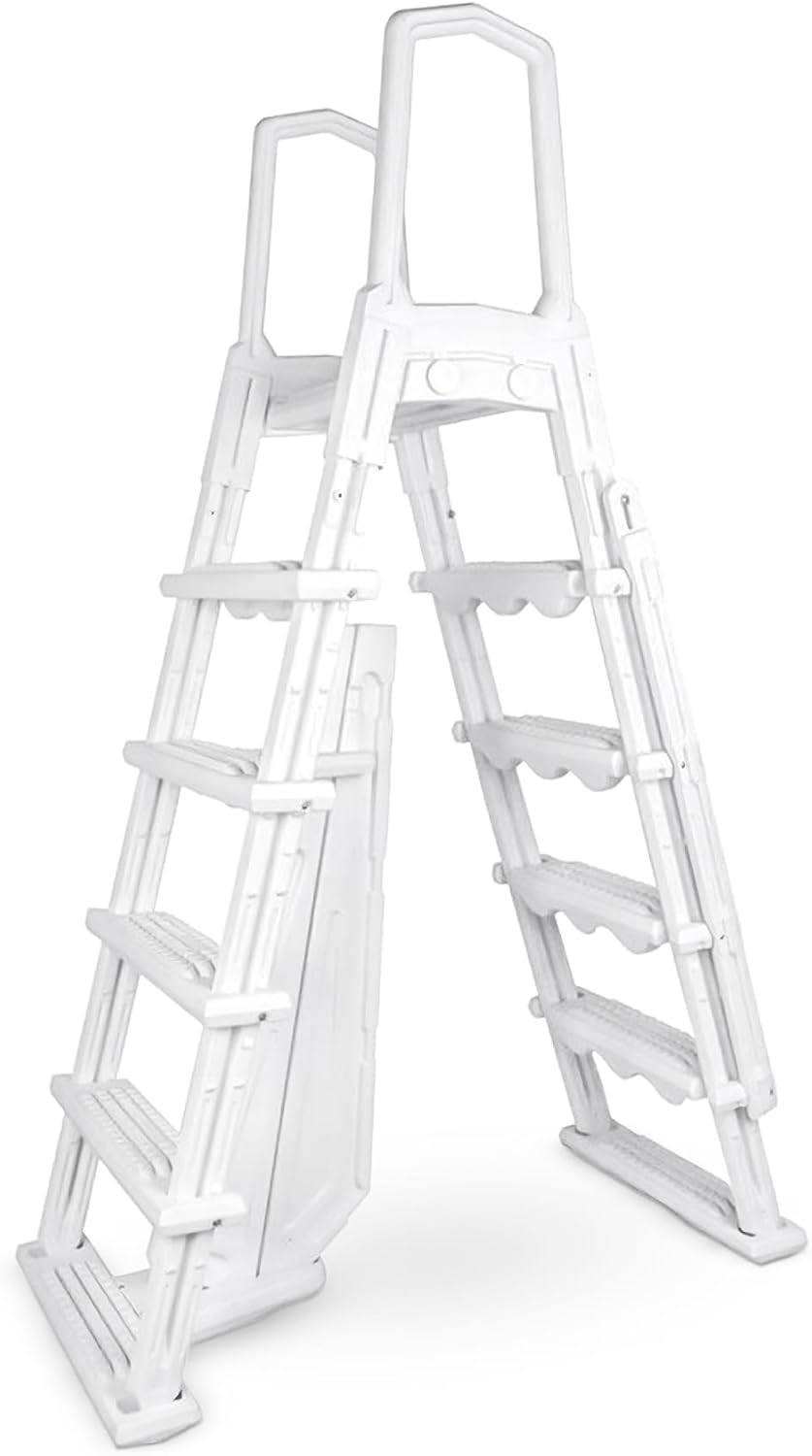
This A-frame ladder is designed for above-ground pools between 48 and 54 inches high and supports up to 250 pounds. It has five 24-inch by 5-inch non-slip steps, double handrails, and an extra-large base tread. The exterior ladder flips up and locks when not in use, while a slide-lock anti-entrapment barrier controls access. Its non-corrosive, UV-resistant construction is designed for outdoor pool use.
Check On AmazonIf you click this link and buy, we earn a commission at no additional cost to you.
Gate Requirements That Actually Get Enforced
A fence that meets the height number still fails inspection constantly because of the gate. The common rule is that any pedestrian gate in the pool barrier has to swing away from the pool, and it has to be self-closing and self-latching, meaning it shuts and locks on its own without anyone reaching back to secure it. That combination catches more first-time buyers than the height number ever does, since many off-the-shelf fence kits ship with a basic manual latch that does not satisfy self-closing and self-latching requirements at all.
Latch placement adds another layer most owners miss. In many codes, when the release mechanism sits low enough on the gate to be within a child’s reach, the requirement is for that release to sit on the pool side rather than the yard side, so a child standing outside the fence cannot reach through or over the gate to open it. California pushes further, requiring the latching device itself to sit no lower than 60 inches. The exact clearance and placement rules shift enough between codes that this is a case to verify against your own local requirement rather than assume the same setup applies everywhere. Here is a short checklist worth running through before you consider a gate installation finished:
- Confirm the gate swings away from the pool and closes and latches on its own, without being pushed shut manually.
- Check where the latch release sits and whether your local code requires it on the pool side for reachable heights.
- Measure latch height against your specific state and local requirement rather than assuming the 48-inch benchmark applies.
- Walk the fence line looking for anything nearby, furniture, equipment, or landscaping, that a child could climb to bypass the gate entirely.
- Test the gate at least monthly, and again anytime you notice the hinge sagging or the latch catching late.
A gate that technically self-closes but takes three tries to actually latch is not compliant. It is a gate waiting for the one day someone assumes it caught when it did not. I have serviced enough backyards to know the gate is usually the first thing to degrade, well before the fence panels themselves show any wear.
How to Measure Your Barrier Before You Buy
Before you order fencing or decide the pool wall alone will do, it helps to walk your actual yard with a tape measure rather than relying on a spec sheet. Ground slopes, furniture, and nearby structures all change what counts as compliant in a way a product listing cannot tell you. A few minutes spent checking these details up front is cheaper than a fence you have to redo once an inspector or an insurance reviewer points out the gap.
- Confirm your city or county’s depth threshold and barrier definition instead of assuming 24 inches applies by default.
- Measure barrier height from the side facing away from the pool, accounting for any grade change around the yard.
- Check for gaps under the fence and opening sizes between rails that a small child could squeeze through or use as a foothold.
- Look for furniture, pumps, filter housings, or landscaping features close enough to the fence or wall to act as a step-up point.
- If you plan to rely on the pool wall as the barrier, confirm the ladder or steps can be locked, removed, or otherwise secured against unsupervised use.

This 4-foot pool gate provides a 2-foot walk-through opening and is designed for the Pool Fence DIY safety system. It uses powder-coated aluminum framing with industrial-strength mesh. A magnetic latch and self-closing hinges provide automatic closing and latching, while the swing can be adjusted for left- or right-handed opening. The gate can be removed or permanently anchored.
Check On AmazonIf you click this link and buy, we earn a commission at no additional cost to you.
What Happens Legally When the Fence Is Missing
Above ground pool fence requirements are not just a box to check for a permit. In a drowning lawsuit, one of the central questions is often whether the homeowner took reasonable safety measures before the incident happened, and that inquiry varies by state and by the specific facts of the case. A required fence that was never installed, or a barrier that technically existed but had a visible defect like an unlatched gate or an unsecured ladder, may become a major factor when liability is evaluated.
This is not meant to scare anyone away from owning a pool. It is meant to explain why the fence, the latch, and the ladder situation are worth getting right the first season rather than treating them as something to get around to later. Pools bring real value to a backyard, and the barrier requirements exist because the failure mode they are guarding against is the one every installer hopes never to hear about from a client.

This 20-inch top-pull gate latch uses a sealed magnetic self-latching mechanism for outdoor pool gates. It adjusts vertically and horizontally to accommodate gate sag or ground movement. The rekeyable 6-pin lock includes a visible lock indicator. Industrial-strength polymer and stainless steel components are designed to resist rust and weather exposure.
Check On AmazonIf you click this link and buy, we earn a commission at no additional cost to you.
Final Thoughts: Confirm the Number, Then Check the Gaps
The depth trigger and the common 48-inch height benchmark are a starting point, not the finish line. Your state may require more height, your gate may need a latch and swing direction you have not checked yet, and your pool wall only works as a standalone barrier once the ladder or steps are actually secured, locked, or removed rather than just present. Confirm your local number with your building department, walk your own yard for the access points an inspector would flag, and treat the ladder and the gate as part of the same decision as the fence itself. That is the difference between a barrier that looks right on paper and one that actually holds up.
FAQs
🏊 Do you need a fence for an above ground pool?
In most US jurisdictions, yes, once the water depth reaches a threshold that many codes set at 24 inches, though some use 18 inches or another definition. Check your specific city or county code since the exact trigger varies.
📏 What is the minimum height for an above ground pool fence?
The CPSC’s widely used guideline points to 48 inches, but enforceability depends on whether your state or local code adopts it. California requires 60 inches, while Florida requires 48 inches.
🧱 Does the pool wall count as the required barrier?
It can, but only when the ladder, steps, or any other climbable access point is secured, locked, or removed. An unsecured ladder left in place usually creates the access point that disqualifies the wall on its own.
🔒 Does the gate need a special latch?
Yes, the gate generally needs to swing away from the pool and be self-closing and self-latching, with the release positioned so a child cannot reach it from outside the fence. California also requires the latch to sit at least 60 inches high.
⚖️ What happens if my pool does not have a required fence?
Beyond a permit or inspection issue, a missing or defective required barrier can become a significant factor if liability is ever evaluated after a drowning incident, since reasonable safety measures are typically part of that review.
🧰 How often should I check my pool fence and gate?
Check the latch and hinge function at least monthly, and test again any time you notice the gate closing slower or catching later than usual. Gates loosen well before fence panels show visible wear.
Sources
- OnPoint NYC, on the common depth trigger and self-closing, self-latching gate standard
- Pool Guard USA, on the pool wall not automatically qualifying as a required barrier
- Consumer Product Safety Commission, Safety Barrier Guidelines for Residential Pools
- UpCodes, California Pool Safety Act height and latch requirements
- Heartwood Fence, Florida’s 48-inch fence height requirement
- National Drowning Prevention Alliance, guidance on regular fence and gate maintenance checks