
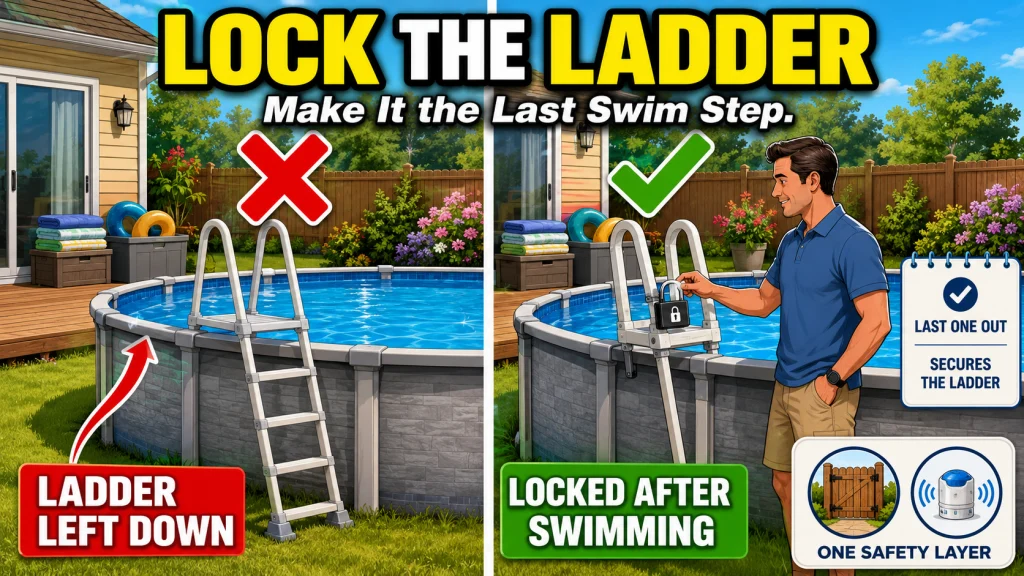
Nearly 70 percent of drownings among young children happen during non-swim time, when the child was not expected to be in or near the water, and for an above-ground pool, a ladder left down after the last swim can remain one of the clearest access routes into that risk. I have walked up to more than one backyard where the pool “looked closed” but the ladder was still hanging over the wall, open to a toddler who cannot swim yet but can absolutely climb. Removing or locking that ladder takes about 30 seconds and it is one of the cheapest safety steps an owner can take. This article explains why that 30 seconds matters, how to actually build it into a routine, and what it does not protect against, because no single step covers everything, including a few other climbing risks the ladder alone will not fix.
Why the Locking Ladder Matters More Than Owners Think
A locking ladder for an above-ground pool can be swung up, secured, or fully removed so a child cannot use it to climb into the pool when no adult is watching. It sounds almost too simple to matter, and that is exactly why I see it skipped constantly. Owners spend real money on a pump upgrade or a nicer liner and then leave the one component that controls physical access to the water swinging loose against the side of the pool every night.
The reason this gets overlooked is that most people picture drowning as something that happens during a pool party, with kids splashing and an adult half-watching from a lawn chair. That is not where the statistic points. The National Drowning Prevention Alliance reports that nearly 70 percent of toddler drownings happen during non-swim time, when the child was not expected to be in the water at all. A ladder left down turns a closed pool into an open one, even when every adult in the house believes the pool is done for the day.

This A-frame safety ladder adjusts for above-ground pools 48 to 56 inches high and supports up to 300 pounds. Its lockable Roll-Guard barrier and integrated side rails help restrict ladder access when the pool is not in use. Extra-large treads and curved side rails provide a stable entry path, while the design fits pool top seats up to 14 inches wide.
Check On AmazonIf you click this link and buy, we earn a commission at no additional cost to you.
The Access Point Most Owners Never Think About
Most above-ground pool walls run 48 to 54 inches high, which is tall enough that a young child cannot climb it without help. That is actually good news. A smooth wall that height, with no straps, rails, or nearby objects to stand on, keeps many toddlers out, which is more than you can say for a lot of inground setups where the deck is flush with the ground. The catch is that the wall only works as a barrier when nothing is leaning against it, and nothing built into it, that a child could use to get over.
The ladder is usually the most obvious version of that problem. Whether it is a full A-frame ladder or a set of steps with a platform, it turns the wall into a staircase. Washington State’s health department states plainly that for above-ground and inflatable pools with ladders, the ladder should be removed or secured when the pool is not in use, and that guidance lines up with what I have seen working with above-ground pool owners for 15 years. The wall is the barrier. The ladder is the door. Leave the door open and the barrier stops mattering, though the ladder is not the only thing that can prop that door open, which is worth walking the pool perimeter to check.
Key point: removing the ladder eliminates the most obvious access route for the age group most at risk, children roughly 1 to 4 years old, but it does not guarantee the wall itself has no other footholds.
Why “Non-Swim Time” Is the Actual Danger Window
When people worry about pool safety, they usually picture supervision during a swim session. That instinct is not wrong, but it is aimed at the smaller half of the problem. The window that catches families off guard is the hour after the pool session ends, when the adults have gone inside, the pool “looks closed,” and a child wanders into the yard on their own.
I have had more than one homeowner tell me a version of the same story: everyone came inside for dinner, the pool was still full and the ladder was still down, and a young child got out to the yard for a few minutes unnoticed. Nothing happened in that particular case, but it is exactly the setup behind the non-swim time numbers. A ladder left down is one of the most preventable features that can turn that moment into an emergency. Without it, a young child has lost the pool’s most obvious entry route, provided the wall and the area around it have no other footholds.
Field Note: the calls I get about a near-miss almost never happen during an actual swim session. They happen 20 minutes after everyone thought the pool day was over, which is exactly why the ladder has to come off as part of ending the session, not as an afterthought.
Removing the Ladder Versus Locking It
There are really two ways to handle this, and which one fits depends on the ladder you already have. If your ladder simply lifts off the wall, the job is straightforward: lift it, carry it a few feet away, and lean it somewhere a small child cannot drag it back to the pool. That takes less time than filling a glass of water, and it is the cheapest option because it requires nothing extra.
Some entry systems are not practical to remove every day, especially heavier A-frame ladders or deck-mounted steps bolted into place. For those, a lockable gate or swing-up mechanism that requires a key or combination to open is closer to the equivalent of a fence gate for the ladder itself, though the cost varies a lot depending on whether you are adding a simple lock to an existing ladder or replacing it with a full gated system. One safety resource focused specifically on above-ground pool access control puts it in a way that matches what I tell homeowners directly: ladder control is an active layer, meaning it only works when someone actually removes, raises, or locks the ladder after every session.
That is the real distinction. A lockable ladder still depends on someone locking it, the same way a removable ladder depends on someone removing it. Neither one is automatic. If you already have a four-sided barrier around the pool, our guide to fence requirements for above-ground pools covers how that layer works alongside ladder control, not instead of it.

This gated entry ladder is designed for above-ground pools with side walls up to 4.5 feet high and supports one user up to 300 pounds. Its top platform adjusts from 48 to 56 inches, while the latching gate closes and locks when the pool is not in use. The ladder uses plastic construction with double handrails and deck-mount flanges for a more secure entry system.
Check On AmazonIf you click this link and buy, we earn a commission at no additional cost to you.
What Ladder Removal Does Not Prevent
I want to be straight about the limits here, because I have seen owners treat the ladder as the whole solution and stop thinking about the pool after that. It is not the whole solution. Older, more capable climbers can often get over a bare wall using a nearby chair, cooler, or deck railing even with the ladder gone, and a teenager or adult can usually lift themselves over without much trouble at all.
Where ladder removal does the most good is with young children, especially those ages 1 to 4, who make up the highest-risk age range for drowning and who generally need some kind of climbing aid to clear a bare wall. That is also the age range the non-swim time statistic is built around, which is why this one habit lines up so directly with the actual risk, even though it is not an absolute guarantee for every child or every pool.
- Helps keep young children, especially ages 1 to 4, from reaching the water unsupervised
- Does not stop older or more capable climbers who can use nearby furniture or structural footholds
- Does not stop teens or adults from entering uninvited
- Does not replace a four-sided fence if the pool sits in a yard with other access points
- Does not replace active supervision whenever anyone is actually swimming
None of that makes the ladder step less worth doing. It just means it is one layer, not a finished safety plan, and it should be paired with whatever fencing or supervision setup your yard actually needs.
Check for Other Footholds Before You Rely on the Ladder Alone
Here is the part that surprises a lot of owners: the ladder is not always the only way up the wall. In July 2025, the CPSC issued a recall covering roughly 5 million above-ground pools, 48 inches and taller, from several major brands, because the compression strap that wraps around the outside of the support legs on some models can double as a foothold. Nine children between 22 months and 3 years old drowned after climbing pools this way between 2007 and 2022, and in some of those cases the ladder had already been removed.
That recall is a useful reminder rather than a reason to panic. If your pool has an external strap running around the legs, or any horizontal frame member, pump housing, filter, cooler, or stacked object sitting close to the wall, that object can undo the exact protection you are counting on the ladder removal to provide. Walk the full perimeter of the pool, not just the side where the ladder sits, and look at it the way a determined 2-year-old would: what is the lowest thing here I could stand on?
- Check whether your pool’s model is part of the CPSC compression strap recall and request the free repair kit if it is
- Keep pumps, filters, coolers, chairs, and toy bins away from the pool wall, not just away from the ladder
- Confirm any swing-up or gated ladder is fully locked, not just resting in the raised position
- Walk the entire perimeter after locking the ladder, since a single overlooked foothold defeats the whole point
A locked ladder and a smooth, foothold-free wall work together. One without the other still leaves a way in.
Turning It Into a Habit Instead of a One-Time Fix
The technical part of this is easy. The habit part is where families slip. A ladder removed once and left down the next three afternoons offers no protection on days two, three, and four. The single sentence that fixes this in most households I have worked with is simple: last one out takes the ladder down.
That phrase works because it assigns the action to a moment that already happens every single swim session, the moment everyone gets out. It does not depend on remembering later, checking a list, or a separate walk-through of the yard. Pair it with a written pool rule near the ladder itself if you have kids old enough to read, and the habit holds even on the days you are distracted by dinner, weather, or a phone call.
Pro Tip: keep the stored ladder somewhere a toddler cannot drag it back, not just a few feet away leaning on the deck. I have seen kids move a lightweight ladder section back to the wall in under a minute.
Where the Ladder Fits Among Other Barriers
Ladder control is usually the cheapest layer to act on, but it is meant to sit alongside a fence and, in a lot of yards, a pool alarm as a backup rather than stand on its own. Here is a quick look at what each layer is actually built to stop.
| Barrier | How It Works | What It Actually Stops |
|---|---|---|
| Removable or locking ladder | Requires action after every session | Young children, especially ages 1 to 4, from using the ladder to climb the wall |
| Four-sided pool fence with self-latching gate | Stays in place passively | Unsupervised access from any direction, without daily action |
| Surface or subsurface pool alarm | Detects entry after the fact | Alerts adults once someone is already in the water |
The alarm is the only one of the three that reacts after entry instead of blocking access. If you want more detail on how that backup layer behaves in real conditions, our guide on how a pool alarm works as a backup layer covers that. These layers address different failure points, so the right combination depends on the pool setup and any applicable local safety requirements, and for many owners, ladder control is the layer they can improve immediately at little to no cost.
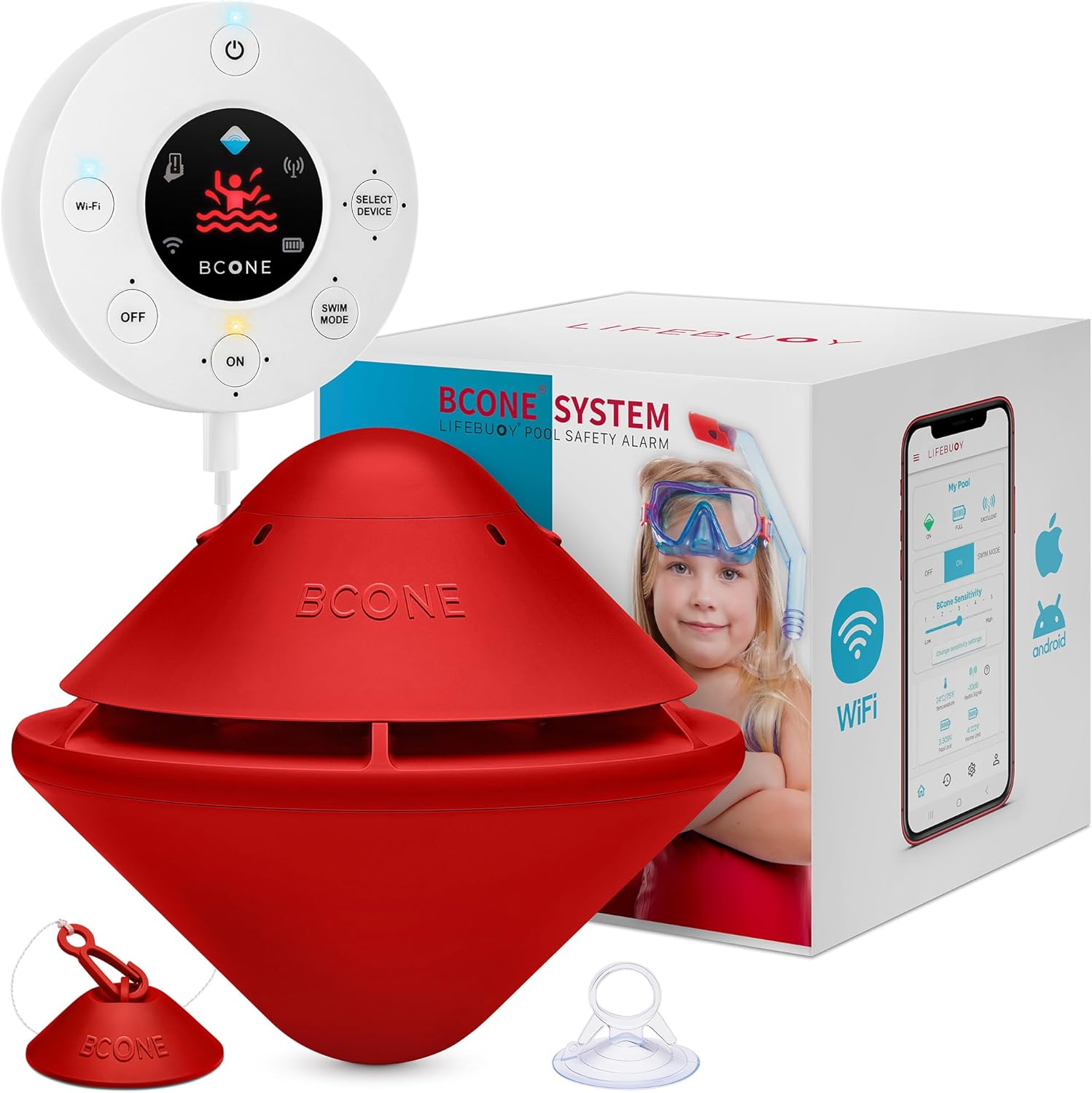
BCONE is a floating pool alarm that works with swimming pools, spas, and garden ponds. It connects to a smartphone app, Alexa, and Google Assistant, and supports up to four pool units with one home unit. The system meets ASTM F2208 requirements, carries a 3-year manufacturer warranty, and is IP68 waterproof. Swim Mode automatically rearms after several minutes without movement.
Check On AmazonIf you click this link and buy, we earn a commission at no additional cost to you.
Final Thoughts: The Cheapest Safety Step You Actually Control
Of everything I tell new pool owners, the ladder habit is one of the easiest to actually keep up with. Removing an existing removable ladder costs nothing but a few seconds. Adding a lock to a ladder that already has a compatible gate might cost very little. Replacing a ladder with a fully gated, lockable system costs more and varies by design, so treat the price as something to check for your specific setup rather than a fixed number. Whatever the cost, it takes less time than skimming a leaf off the surface, and building the habit around the moment the last person climbs out is what makes it hold up on the busy days.
Treat it as one part of a bigger plan rather than the whole plan, and remember that the pool session is not over until the access point is actually secured, ladder locked or removed, and the surrounding wall checked for anything else a child could stand on. Our seasonal above-ground pool maintenance routine covers the broader upkeep side of ownership, and the full above-ground pool safety overview ties the ladder, fence, and alarm pieces together in one place.

The Pool Patrol PA-30 is a battery-powered floating alarm designed as an added safety layer for pools up to 20 by 40 feet. It meets ASTM F2208 requirements, produces an 85-plus dB alert at 10 feet, and triggers for objects weighing 15 pounds or more. Adjustable sensitivity helps tune detection to pool conditions, and the battery is designed to last a full swimming season under normal operation.
Check On AmazonIf you click this link and buy, we earn a commission at no additional cost to you.
FAQs
🪜 Do I really need to remove my above-ground pool ladder every day?
Yes, if young children have any access to the yard. A ladder left down even one evening is enough time for an unsupervised toddler to reach the water, which is why treating it as a nightly habit matters more than treating it as a one-time setup step.
🔒 Is a lockable ladder better than just removing the ladder?
Both work, and the right choice depends on your ladder. A lightweight ladder that lifts off easily is simplest to remove daily. A heavier A-frame ladder or deck-mounted entry system is usually a better fit for a locking or gated mechanism, since removing it daily is impractical.
🧒 What age group does ladder removal actually protect?
It helps the most with young children, especially ages 1 to 4, who generally need a climbing aid to clear a 48- to 54-inch wall. Older or more capable children who can use nearby furniture or structural footholds, or teens and adults, are not stopped by ladder removal alone.
🪢 Can a child still climb in if the ladder is already removed?
Yes, in some cases. Certain above-ground pools have external compression straps or frame parts that can act as a foothold even with no ladder present, which is why the CPSC recalled millions of these pools in 2025. Check your model and walk the full pool perimeter, not just the ladder side.
⏰ Why do most pool drownings happen when no one is swimming?
Adults naturally supervise closely during an actual swim session, but the risk shifts once everyone assumes the pool is done for the day. A ladder left down turns that “closed” pool back into an open access point without anyone realizing it.
🚧 Do I still need a fence if I already remove the ladder?
In most cases, yes. A four-sided fence with a self-closing, self-latching gate provides a passive perimeter barrier that does not depend on removing the ladder after every swim, which covers gaps a ladder habit cannot, such as a neighbor’s yard access or a child arriving from outside your own property.
🔔 Does a pool alarm make ladder removal unnecessary?
No. An alarm alerts you after someone has already entered the water, while ladder removal is meant to prevent access in the first place. The two solve different problems and work best used together.