When you decide what water level to leave in an above ground pool for winter, the question is not really how much water you feel like leaving behind, it is about keeping the walls standing until spring. Water pressure is what holds an above ground pool wall in shape, and pulling most or all of that water out leaves the frame to fight snow load and frost heave on its own. This article covers why draining too far is a real collapse risk, the two accepted water level approaches for closing, and what to do about the return jet fitting so it does not crack over the winter. It does not walk through the full closing sequence or spring reopening, both of which are covered elsewhere.
Why the Water Level You Leave Behind Matters
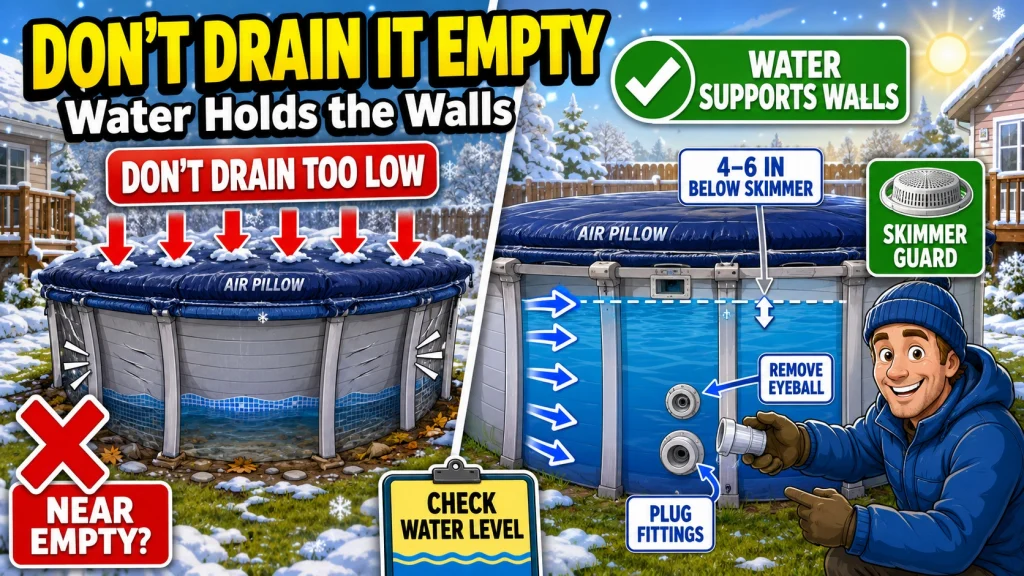
An above ground pool wall is not really holding itself up. Water pressure pushing outward against the liner and the wall is what keeps that wall standing upright and rigid, and the frame around it is mostly there to keep the shape, not to bear a serious structural load on its own. Drain the pool down for winter and you take away the one thing doing most of the work.
I have walked into more than one backyard in April to find a wall buckled inward or a whole section leaning, and in almost every case the owner had drained the pool close to empty in the fall because it seemed like the responsible thing to do before winter. It is the opposite of responsible. The correct move is leaving enough water in the pool that the wall keeps its support, while still protecting the plumbing from freeze damage.
What Actually Happens When a Pool Is Drained Too Low
Home improvement guidance on this is direct about the mechanism: Family Handyman explains that water in the pool is what helps keep the walls upright, and the less water sitting in there, the more likely snow load and ice end up pulling the wall down instead. What is left facing a whole winter is a thin metal or resin wall carrying snow weight, ice, and wind pressure with nothing behind it pushing back. A pool drained down to only a few inches behaves more like an unsupported shell than a supported pool wall.
Frost heave adds another layer to the problem. Ground around and under the pool can shift slightly as it freezes and thaws through the winter, and a wall with no water pressure behind it has far less resistance to that movement. Wind pressure on an empty wall behaves differently too, since there is nothing on the inside pushing back against a gust hitting the outside. None of these forces are dramatic on their own, but stacked together over a whole winter, they are exactly what turns a fine fall closing into a spring collapse.
Field Note: The worst case I have seen was a steel frame 18-foot pool drained almost completely by an owner trying to save on a winter cover. By March, one full wall section had folded inward under a heavy snow load, and the liner tore in the process. Even replacing the liner alone can be expensive, before you account for a bent wall panel.
The Two Water Level Options for Closing
There are two accepted approaches for handling water level at closing, and both are built around the same goal: keep enough water in the pool to support the wall while keeping water out of places where it can freeze and crack something.
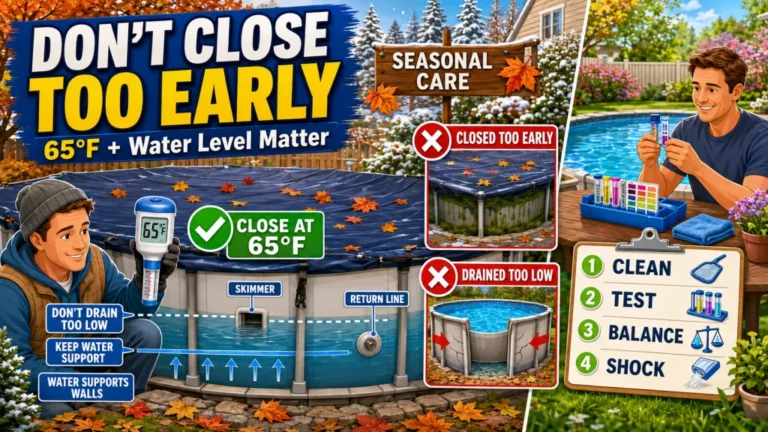
The first option is lowering the water four to six inches below the skimmer opening, then plugging the return jet and skimmer inlet with rubber winterizing plugs so water cannot sit in either fitting and freeze. This is the approach most closing kits are built around, and it is well documented across pool retailer guidance as the standard method. The second option is leaving the water at its normal operating level, meaning wherever it sits during a normal summer with the pump running, and covering the skimmer opening with a skimmer guard or gizmo instead of draining at all. Some guidance treats this second approach as the safer choice in colder climates because it lets the owner keep the water at a normal level while still blocking the skimmer from freezing.
| Approach | Water Level | Wall Support | Best For |
|---|---|---|---|
| Lower and plug | 4 to 6 inches below skimmer | Good, still substantial water volume | Milder winters, standard closing kits |
| Normal level with skimmer guard | Normal operating level | Maximum, full water volume retained | Heavy snow or ice climates |
Key point: How to Choose the Safer Option for Your Situation. Choose lower-and-plug if your winters are mild to moderate and your closing kit already includes the right rubber plugs for your fittings. Choose normal level with a skimmer guard if you get heavy snow or repeated ice, want maximum wall support, and can confirm the guard actually seals your skimmer opening. If the water drops too low partway through winter from a slow leak or evaporation, check that the pool is still safe to approach and refill it back toward a supporting level before the next heavy snow or ice event, rather than waiting until spring.
Either option keeps the pool well ahead of a fully drained setup, and the real decision usually comes down to your climate and what your closing kit already includes.

This four-plug set includes 1-inch, 1.25-inch, 1.5-inch, and 2-inch rubber plugs plus a T-handle for installation and removal. The cold-resistant rubber plugs use stainless steel hardware and are designed for return and drain ports on inground and above ground pools. Multiple sizes make it easier to match different fittings during winterization.
Check On AmazonIf you click this link and buy, we earn a commission at no additional cost to you.
Where the Partial Drain Approach Gets Risky
Some closing guides suggest draining down to below the return jets and stopping there, which is fine as a general rule in milder climates where snow load is light or infrequent. The problem shows up when that same 4 to 6 inch guideline gets stretched further than it should in a region that actually gets hit with heavy snow and repeated freeze-thaw cycles.
I have seen owners drain an extra foot or more past the recommended level because they were worried about ice expansion cracking the wall, which is a reasonable fear pointed at the wrong problem. Ice expansion is a plumbing issue, handled by plugging fittings and adding air pillows, not a reason to remove more water than necessary. Draining further than the 4-to-6-inch range in a heavy snow climate removes wall support at exactly the time of year that support matters most.
- Stick to the 4 to 6 inch guideline if you are lowering the water at all
- Do not drain further because you are worried about ice, that is a plumbing problem, not a water level problem
- In heavy snow regions, consider the normal-level skimmer guard approach instead of lowering at all
- Check the water level once or twice mid-winter if evaporation or a slow leak could be pulling it down further than intended
That last point catches people off guard. A pool closed correctly in October can still end up under-supported by February if nobody checks on it, especially with a slow leak nobody noticed during the summer.
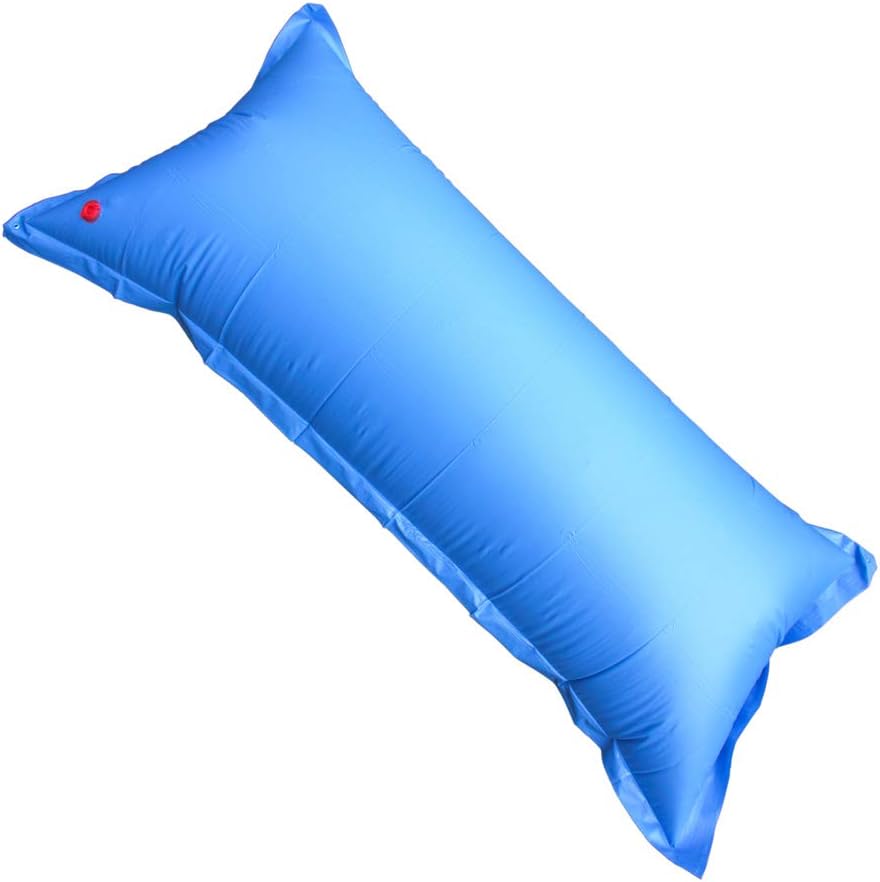
This 4-foot by 8-foot pool pillow is made from 0.22 mm heavy-duty vinyl and is designed for winterizing above ground pools. It helps absorb pressure from ice buildup under the winter cover while lifting the cover to reduce water, leaf, and snow accumulation. Robelle recommends filling it halfway to two-thirds with air rather than fully inflating it.
Check On AmazonIf you click this link and buy, we earn a commission at no additional cost to you.
What to Do About the Return Jet Fitting
The return jet fitting is a small detail that causes a disproportionate amount of spring frustration. If you leave the directional eyeball fitting in place over winter, any water trapped inside it can freeze and crack the fitting from the inside, and you will not know it happened until you turn the pump back on in spring and water starts spraying somewhere it should not.
Pull the eyeball fitting out and thread in a winterizing plug instead before you close for the season. It is a five-minute job while the pool is still at a workable water level, and it is a much smaller job than the alternative. A cracked return fitting is not expensive to replace on its own, typically five to fifteen dollars for the part, but replacing it means draining the pool back down below the jet line again to get access, which defeats the purpose of getting the water level right the first time.

This 2-pack includes 1.5-inch threaded winterizing plugs for above ground and inground pools. The plugs fit 1.5-inch threaded replacements and are compatible with many Hayward, Pentair, Waterway, and other pool filter drain fittings. They are made from material designed to tolerate very cold temperatures without slipping or shrinking.
Check On AmazonIf you click this link and buy, we earn a commission at no additional cost to you.
Final Thoughts: Leave the Water Doing Its Job
The instinct to drain a pool for winter usually comes from good intentions, an owner trying to protect the equipment from freezing. The problem is that draining too far protects the plumbing while putting the wall itself at risk, and a collapsed wall is a far more expensive spring surprise than a cracked fitting. Pick either the lower-and-plug method or the normal-level skimmer guard method based on your climate, plug the return jet fitting properly, and check the water level again partway through winter if you can.
This decision is one piece of a larger seasonal above ground pool care routine. If you are working through the rest of the shutdown at the same time, the full above ground pool closing sequence covers where this water level step fits alongside chemical balancing and cover placement. For the bigger picture of keeping a pool in good shape from one season to the next, long-term above ground pool maintenance planning covers where winter water level fits alongside opening, closing, and the maintenance tasks in between. When spring comes around, the correct steps for opening in spring pick up right where this closing decision leaves off.

This skimmer freeze-protection device screws into place and is designed to absorb expansion from winter freeze-up. The Amazon listing states that it fits 99 percent of skimmers and requires no assembly. It provides a straightforward winterizing option intended to reduce freeze-related damage around pool skimmers.
Check On AmazonIf you click this link and buy, we earn a commission at no additional cost to you.
FAQs
❄️ How much water should I leave in my above ground pool for winter?
Either lower the water 4 to 6 inches below the skimmer opening and plug the fittings, or leave the water at its normal level and cover the skimmer with a guard. Both keep enough water in the pool to support the wall.
🧊 Can draining an above ground pool for winter cause it to collapse?
Yes. Water pressure is what holds the wall upright. A significantly drained pool has little support left to resist snow load, frost heave, and wind pressure over the winter months.
🔧 Should I remove the return jet fitting before winter?
Yes. Pull the directional eyeball fitting and replace it with a winterizing plug so trapped water cannot freeze and crack the fitting. A cracked fitting is a small cost but an annoying repair later.
🌨️ Is it ever okay to drain more than 6 inches below the skimmer?
Generally no, especially in climates with heavy snow. Draining further than the standard 4 to 6 inch guideline removes wall support right when winter weight and ice are at their worst.
🛡️ What does a skimmer guard actually do?
A skimmer guard blocks the skimmer opening so water cannot enter and freeze inside it, which lets you leave the pool at a normal water level instead of draining it down at all.