Solar heater panels and solar blanket covers both get called an above ground pool solar heater, but they do two completely different jobs. Panels actively heat the water as it circulates through them. A blanket passively traps the heat that is already in the pool so it does not escape overnight. I get asked which one to buy at least once a week during install season, and the honest answer depends on whether you want the water heated or just kept warm once it is already there. This guide walks through how each product works, how much installation effort each one requires on a typical above ground setup, and when running both together actually makes sense.

Two Products, One Confusing Name
An above ground pool solar heater can mean a rack of black panels plumbed into your filter line, or it can mean a bubble blanket you drag across the water before bed. Both get marketed under the same “solar heater” language, and that is where most of the confusion starts. Panels are active. Water leaves the pool, passes through the panel tubes, picks up heat from the sun, and returns warmer. A blanket is passive. It does not move water or generate heat on its own. It sits on the surface and slows down how fast the heat you already paid for escapes into the night air.
I have had owners return a solar cover asking for a refund because “it did not heat the pool,” when the cover was never designed to. I have also had owners install panels and skip the cover entirely, then wonder why the pool cools right back down by morning. Neither mistake is really about the product. It is about buying one when you needed the other, or needing both and only budgeting for one.
How Above Ground Pool Solar Heating Panels Actually Work
Panels tap into the same pump and filter loop your pool already runs. Water is drawn out through the skimmer, passes through the filter, and instead of returning straight to the pool, it is diverted through a manifold of black tubes mounted on a roof, rack, or the ground near the pad. Sunlight heats the water inside those tubes, and it returns to the pool a few degrees warmer per pass. Run enough passes through enough panel area on a sunny day, and the water temperature rises gradually.
For a 15-foot round pool, most installers land on three to four panels, roughly 4 by 8 feet each, mounted where they get direct sun for at least six hours, as a common starting range. Two panels is a lighter-duty configuration that can still work in a sunny yard with a cover doing extra retention work, but it sits below the general starting point and should not be assumed adequate on its own. Sizing is where owners get in trouble fastest. A common starting point is roughly 50 percent of the pool’s surface area in collector coverage. That is a starting range, not a number that fits every pool: a shaded yard, a windy site, or a cooler climate typically needs more coverage to hit the same result, and pairing panels with a pool cover can sometimes allow a smaller collector area in favorable conditions. A pool with two panels and four hours of dappled shade in the afternoon is not going to perform the same as one with four panels and a wide-open southern exposure, and I tell owners that up front instead of letting the box copy set the expectation.
A well-sized panel system run over several consecutive sunny days can raise water temperature noticeably, while an undersized setup, two panels on a pool that really needed four, often barely moves the needle. The exact number of degrees swings with collector area, air temperature, wind, shade, and how many days you are measuring across, so I never promise a fixed figure before seeing the yard. What I can promise is that the gap between “it works great” and “it isn’t doing anything” is often a sizing or installation problem rather than a product defect, and sizing is one of the first things I check when someone calls me saying their new panels aren’t performing.
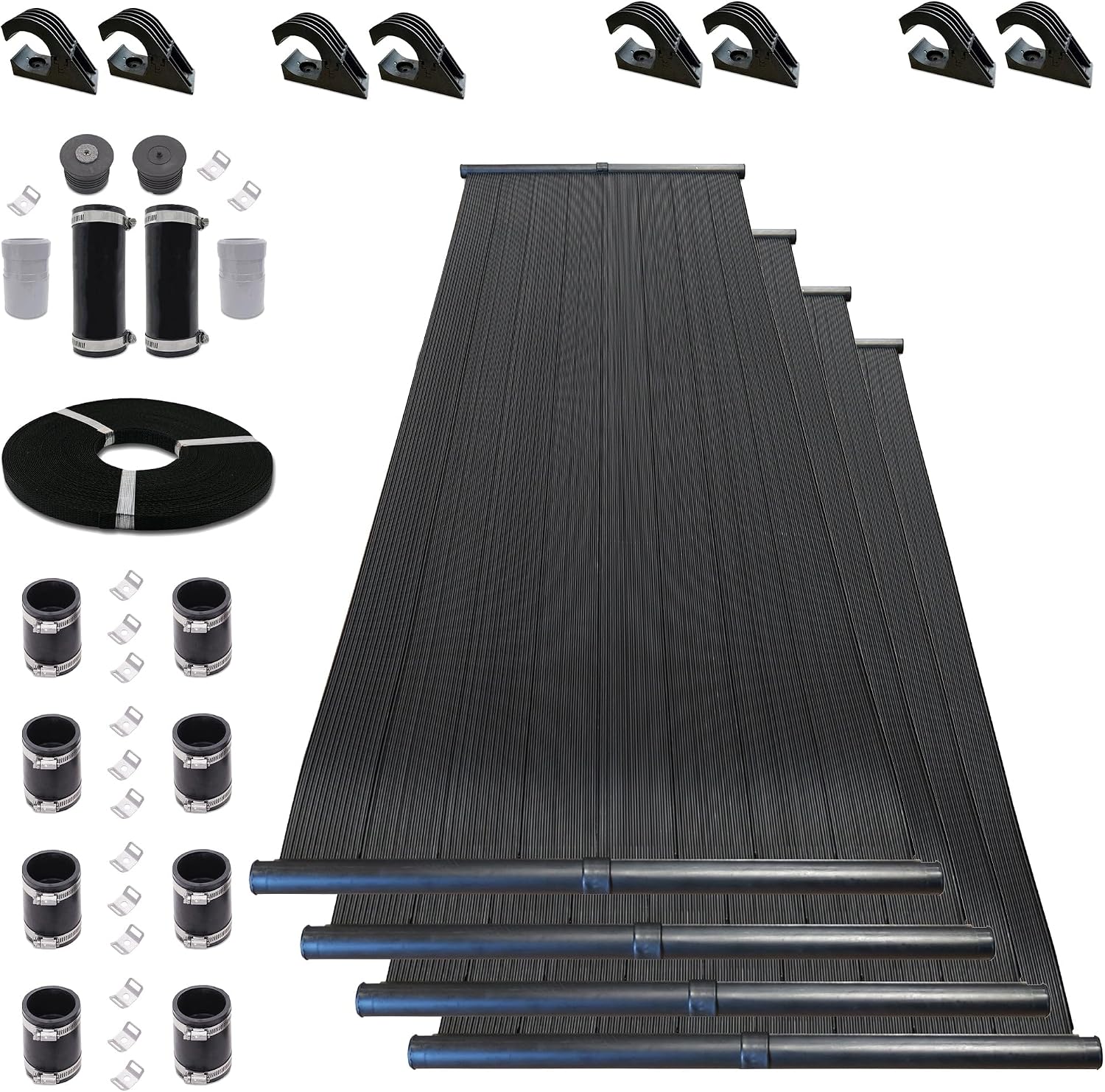
This DIY solar heating kit uses four 4-by-8-foot SwimEasy panels and connects to an existing pool pump and filtration system. The panels use UV-stabilized materials and an over-molded header designed to support strong water flow and heat transfer. The kit includes hardware for mounting, connecting, and securing the collectors, plus the supply and return plumbing connections. The listing states a 15- to 20-year life expectancy.
Check On AmazonIf you click this link and buy, we earn a commission at no additional cost to you.
Solar Blankets Retain Heat Rather Than Actively Heating Water
A solar blanket floats directly on the water, and it is one of the simplest solar options an above ground pool owner can use. It is not plumbed into anything, it does not need a pump upgrade, and using one simply means placing it over the water and removing it before swimming. What it does well is trap the heat already sitting in the pool from the day’s sun and slow the evaporation that carries most of that heat away overnight.
A pool covered consistently can end up roughly 5 to 15 degrees warmer than the same pool left uncovered, depending on conditions, and that spread is wide on purpose: a fully covered pool getting at least six hours of direct sun sits at the top of that range, while a partly shaded cover, an inconsistent covering routine, or a run of cool, windy nights pulls the result toward the bottom. That number gets misread constantly. It is not new heat generated from nothing. Most of that gain is heat the pool would have lost anyway, retained instead of released. On a run of cloudy days, a cover on its own might only hold a couple of degrees, because there is less surface heat available to trap in the first place.
Field Note: I have serviced more than one pool where the owner had reused a cover from a smaller pool, and the gaps around the edges were quietly costing them most of the retention benefit. A cover delivers its full retention benefit only when it covers nearly the entire water surface.

This 15-foot round solar cover is designed for Intex Easy Set and Metal Frame pools. Its bubble surface helps transfer solar heat to the water while the cover insulates the pool and reduces evaporation by up to 95 percent. It also helps keep leaves and debris out and can reduce chemical consumption. A carry bag is included for storage when the cover is not in use.
Check On AmazonIf you click this link and buy, we earn a commission at no additional cost to you.
Running Panels and a Cover Together
The two products solve different halves of the same problem, and that is exactly why pairing them works better than either one alone. Panels do the active heating during daylight hours. The cover holds that heat in the pool once the sun goes down and the panels stop producing. Skip the cover and a good chunk of a sunny day’s gain evaporates off the surface by morning, which means the panels are partly reheating water they already warmed once.
The table below lays out the practical differences side by side so the decision is not abstract.
| Feature | Solar Heater Panels | Solar Blanket Cover |
|---|---|---|
| How it works | Actively circulates pool water through sun-heated tubes | Passively traps existing surface heat and slows evaporation |
| Typical gain | Noticeable rise over consecutive sunny days, scales with collector area and sizing | Can leave the pool roughly 5 to 15 degrees warmer than uncovered, depending on conditions |
| Setup effort | Requires plumbing into the pump and filter line | No plumbing, place and remove by hand |
| Best paired with | A cover to retain the day’s gain overnight | Panels for active daytime heating, or used alone as a lower-cost option |
An owner in a warm climate with a well-sized panel setup and a cover can often stretch the swimming season by weeks on each end at a low ongoing operating cost, since the panels run on the same pump that already handles filtration. An owner relying on a cover alone in a shaded yard is working with a much smaller ceiling, and that is worth knowing before either purchase, not after.
Check Pump Capacity and Plumbing Before Installing Solar Panels
Panels only work if your existing pump can actually push water through them and back to the pool, and this is where I see the most first-time mistakes in above ground solar panel installations. Most above ground pump and filter systems use 1.5-inch hose connections, and most residential solar panel kits ship with adapters to match that fitting. The connection is rarely the problem. The pump’s ability to move water uphill to a roof-mounted panel array, against the added head pressure of elevation, pipe length, and every extra fitting, is where things fall apart.
A stock pump sized for a 15-foot pool’s turnover rate was never built with a second-story roof run in mind, and total dynamic head, pipe diameter, and fitting count all factor into whether it can keep up. On pool forums this comes up constantly, with experienced owners pointing out that a standard above ground pump often cannot maintain the flow a roof-mounted array needs, which is why ground-mounted or single-story rack placement ends up being the more realistic setup for most above ground pools rather than a full roof run. Before buying panels, know where they are going to sit and whether your pump can actually reach that spot with enough flow left over to matter.
Note: A 3-way diverter valve or two 2-way valves let you route water through the panels when the sun is out and bypass them completely at night or during rain, which protects the panels from becoming a heat sink that pulls warmth out of the pool instead of adding it.

This bypass kit is designed for SolarPro pool heaters and lets multiple solar heaters be connected in series. It includes a 3-way ball valve, 72-inch flexible hose, three backwash fittings, a 1.5-inch insert T fitting, six 1.5-inch hose clamps, and Teflon tape. The listing says it is required when using two or more heaters or a 1 HP or larger pump. It carries a 1-year limited warranty against manufacturer defects.
Check On AmazonIf you click this link and buy, we earn a commission at no additional cost to you.
A Practical Sizing Checklist for Above Ground Pool Solar Panels
Before ordering solar heater panels for an above ground pool, walk through this list. It catches most of the mistakes I see on service calls.
- Measure your pool’s surface area and use roughly 50 percent of that number as a starting point for collector coverage, then increase that coverage for shade, wind, cooler weather, or a longer target season. A pool cover may allow a smaller collector area in favorable conditions.
- Confirm your pump’s flow rate and head pressure can reach the mounting location, especially if the panels are going on a roof.
- Check that your existing hose fittings match the panel kit’s connections before ordering adapters separately.
- Pick a spot with at least six hours of direct, unobstructed sun rather than dappled shade.
- Budget for a bypass valve so the panels are not pulling heat out of the pool at night.
Skipping the sun-exposure check is the mistake I catch most often. A rack of panels tucked behind a fence line that only gets morning light will underperform no matter how many square feet you add, and no amount of extra panel area fixes a shade problem.
Why Climate Decides Whether Solar Heating Is Worth It
Solar panels live and die on sun exposure. A cover benefits from sunny conditions too, since there is more surface heat to trap, but it can still reduce heat loss overnight and on cooler, cloudier days when panels are barely producing. In consistently sunny regions like the Southwest, the Southeast, or most of California, a correctly sized panel setup can hold a comfortable swimming temperature through an extended season at a low ongoing operating cost, since the only added draw is running the pump you already own, possibly for longer hours to push water through the panels. In climates with frequent cloud cover, the same setup produces a fraction of that gain, and the payback period becomes much longer.
This is also where it is worth comparing solar heating against other equipment options instead of assuming panels are the only path forward. An above ground pool heat pump and how its heating cost compares to solar is worth reading before committing to a full panel array if your yard does not get consistent direct sun, since a heat pump keeps working on cloudy days in a way solar simply cannot. Solar is not a bad choice in a marginal climate, but it becomes a slower, less predictable one, and owners should go in knowing that instead of finding out mid-season.
Closing Solar Panels and Covers Down for Winter
Buying the equipment is only half the commitment. Follow the kit’s winterizing procedure, since not every system shuts down the same way. A properly designed self-draining system may empty on its own once the flow stops and the panels are angled correctly. A non-self-draining setup usually needs the isolation valves closed and the low-point drains opened manually before the first hard freeze, since standing water left in the tubes or manifold can crack the collector when it expands. If the panels stay in place year-round, make sure the bypass valve is set to route water around them once you shut the system down for the season.
Portable solar mats or compact ground-mounted collectors are simpler: rinse them off, let them dry completely, and store them flat or loosely rolled somewhere out of direct sun so the material does not crack over winter. A solar blanket gets similar treatment. Fold or roll it once it is dry, and check it for tears, brittle bubbles, and damaged areas that may reduce coverage or shorten the cover’s remaining life before storing. When you reopen the pool, check every fitting, valve, and hose connection for cracks or slow leaks before running water through the panels again. A small leak at a fitting is a much easier fix in April than after a full season of water loss you never noticed.

This adjustable solar cover reel fits rectangular above-ground frame pools from 9 to 16 feet wide. An interlocking aluminum shaft and hand crank let you roll and unroll a solar cover without dragging it across the pool edge. The reel attaches to the pool frame without tools and has an integrated locking feature to help prevent unintentional unrolling. The package includes the reel only, not the solar cover.
Check On AmazonIf you click this link and buy, we earn a commission at no additional cost to you.
Final Thoughts: Pick the Product That Matches the Job
If you want the water actively warmer, panels are the tool for that, and they need to be sized to your pool’s surface area and matched to a pump that can actually reach where you plan to mount them. If you want to hold onto the heat your pool already has, a cover does that job for a fraction of the cost and effort. Most owners in a sunny climate end up happiest running both, since neither one covers the other’s job.
Before buying either product, it is worth stepping back and looking at how solar heating fits into the rest of your setup. A short read through choosing the right pump, filter, and heating equipment for an above ground pool will help you confirm your pump and filter can support a solar addition before you spend money on panels that your current equipment cannot circulate through effectively. And if solar still feels like the wrong fit for your climate or yard, a broader look at comparing every above ground pool heating option side by side covers the alternatives, including heat pumps and gas heaters, so you are choosing based on your actual sun exposure rather than whichever product ranked first in a search.
FAQs
🌞 How much can a solar heater raise the temperature of an above ground pool?
It depends heavily on collector or cover size relative to your pool, air temperature, wind, and how many hours of direct sun you get. A well-sized panel system generally produces the largest gain over consecutive sunny days, while a solar cover alone can leave the pool roughly 5 to 15 degrees warmer than uncovered, depending on coverage and exposure. Neither product has one fixed number that applies to every pool.
💧 Do I need a special pump for a solar heater on my above ground pool?
A separate pump is not always necessary for a short, ground-mounted setup, but do not assume the stock pump is automatically sufficient. Check the collector’s required flow against your pump’s performance curve and the system’s estimated total dynamic head, since pipe length, fittings, and filter resistance all add up. Roof-mounted panels raise that bar further because of the added elevation.
🧊 Is a solar cover as effective as solar panels for heating a pool?
No. A cover retains heat the pool already has rather than generating new heat, so it works best alongside panels or as a lower-cost option when active heating is not needed. Panels actively warm circulating water and generally produce a larger gain when properly sized.
🏠 Can above ground pool solar panels be mounted on the ground instead of a roof?
Yes. Ground or rack mounting near the pad is common on above ground setups and keeps the plumbing run short. Just make sure the spot still gets at least six hours of direct sun, since a ground location tucked behind a fence line or shaded by trees will underperform even with a strong pump.
❄️ Do solar heaters work in cloudy or cooler climates?
They still work, but the gain shrinks with less direct sun. In consistently cloudy regions, a heat pump often delivers more predictable results than solar alone, since it does not depend on sun exposure the way panels and covers do.
🔌 Do I need extra electricity to run solar pool panels?
No separate power source is needed. Panels use the same pump you already run for filtration to circulate water through the tubes, though the pump may need to run for more hours a day to push water through the panels, which is part of why operating cost stays low rather than zero.