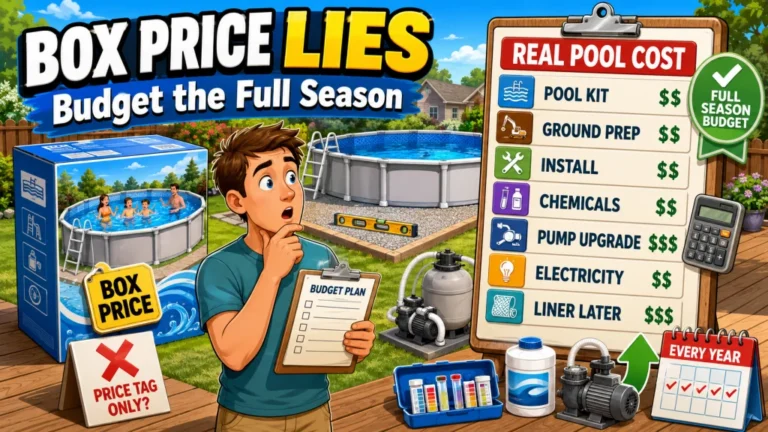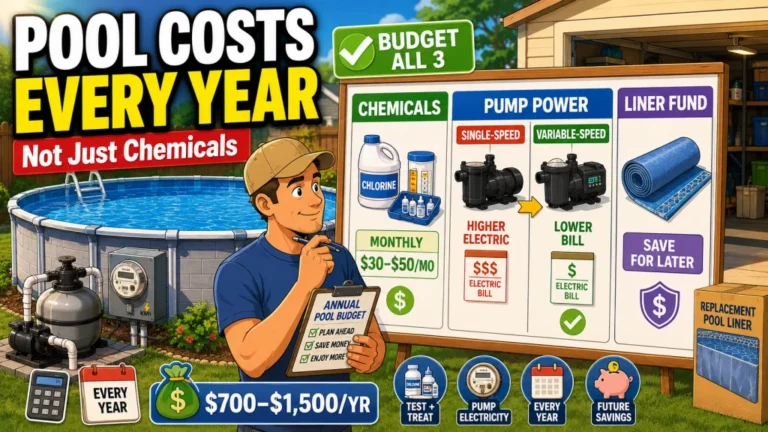
The real purchase and installation cost of an above ground pool breaks down into four clear tiers, and the sticker price on the kit is rarely the number you actually spend to get water in it. I have watched buyers budget for the box price and then get blindsided by leveling, electrical, and first-fill chemicals a few weeks later. This guide walks through what each tier really costs from purchase through the first swim, including the one expense many owners never budget for. If you know which tier fits your yard and your budget, you can plan the real number instead of the one printed on the box.
The Kit Price Is Not the Above Ground Pool Purchase and Installation Cost
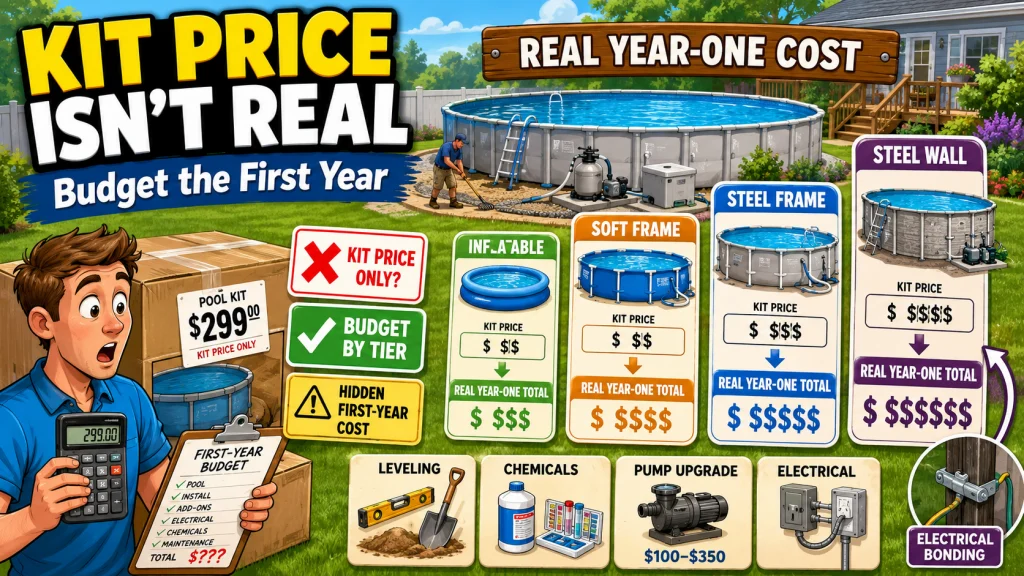
The price tag on an above ground pool kit is what you pay for the box. It is not what you pay to get into the water. I have had more than one owner call me confused about why their “$400 pool” ended up costing closer to $900 by the time the pump was running and the water was balanced. That gap is not a scam or a hidden fee. It is leveling, first-fill chemicals, and in some cases a pump upgrade that the kit price never included.
The honest way to plan for this is by tier, because the gap between kit price and real cost grows as the pool gets bigger and more permanent. A $250 inflatable and a $4,000 steel wall pool do not just cost different amounts upfront. They carry completely different installation cost structures behind them, and treating them the same way is how budgets go sideways.
Tier 1: Inflatable Easy-Set Pools ($200 to $550 Total Year-One Cost)
Inflatable Easy-Set pools run $100 to $300 for the kit itself, and this is the one tier where the box price and the real cost stay close together. There is no installation cost in the traditional sense. Setup is self-contained: inflate the top ring, fill it, and the pool holds its own shape. Most owners have this running within an afternoon with no tools and no leveling crew.
The real add-on cost here is chemical startup, typically $30 to $80 depending on your water source and starting pH. If you are buying a 15-foot or larger inflatable, add $50 to $150 for a replacement pump, because the stock unit on these larger inflatables is undersized for the water volume it needs to circulate. That pushes the honest total for this tier to $200 to $550 for the first year, which is still the cheapest way into an above ground pool by a wide margin.

This 10-foot by 30-inch round pool holds 1,018 gallons and uses puncture-resistant 3-ply PVC. It is ready for water in about 10 minutes and includes a 330 GPH cartridge filter pump with one Type H cartridge. The set carries a 180-day manufacturer limited warranty.
Check On AmazonIf you click this link and buy, we earn a commission at no additional cost to you.
Tier 2: Soft-Sided Frame Pools ($300 to $950 Total Year-One Cost)
Soft-sided frame pools sit at $200 to $800 for the kit, and this is where I start fielding more calls about leveling. Most models in this tier do not require professional installation, but leveling the ground is entirely on the buyer, and skipping it is the single most common mistake I see with this style of pool. An eighth of an inch off over a 15-foot span does not sound like much until the water goes in and one side of the frame is under more stress than it was built for.
First-fill chemical startup runs $30 to $100 here, similar to Tier 1 but slightly higher because these pools hold more water. Add it up and you are looking at $300 to $950 for the first year, assuming you do your own leveling with a level, a rake, and a Saturday afternoon rather than hiring it out.
Field Note: The soft-sided frame pools that fail early almost never fail because of the liner material itself. They fail because the ground underneath was eyeballed instead of measured, and the frame ends up twisting slightly under uneven water pressure over the first season.

This 15-foot by 48-inch round pool holds 4,231 gallons at 90% capacity and uses a corrosion-resistant steel frame with ClickConnect joints. Its 3-layer Tritech liner is reinforced for strength and puncture resistance. The set includes a filter pump, ladder, and pool cover.
Check On AmazonIf you click this link and buy, we earn a commission at no additional cost to you.
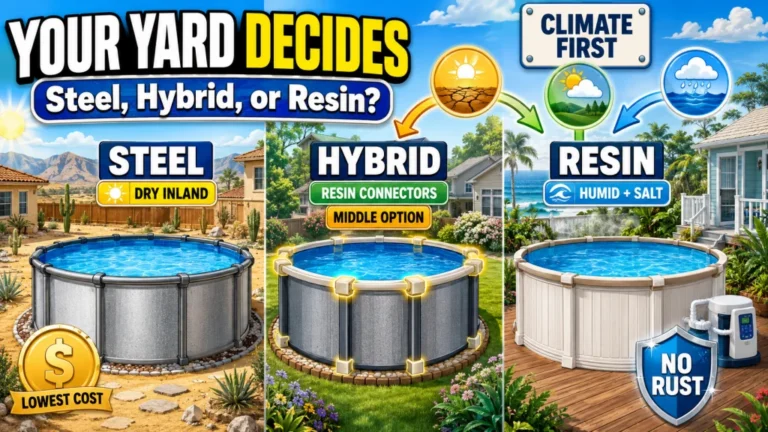
Tier 3: Steel and Hybrid Frame Pools ($600 to $2,700 Total Year-One Cost)
Steel and hybrid frame pools run $500 to $2,000 for the kit, and this tier is where leveling cost starts to swing widely, from $0 if your yard is already flat and you are comfortable doing it yourself, up to $500 for a professional grading job on a sloped or uneven lot. I always tell buyers to walk their yard with a level before they buy, not after, because that single factor decides whether this tier costs $600 or closer to $1,000 before the pool even holds water.
First-fill chemical startup runs $50 to $150 for this size range. Combine kit price, leveling, and chemical startup and the honest total year-one cost lands between $600 and $2,700. That is a wide range on purpose. A flat backyard and a sloped one are not the same job, and pretending otherwise is how people end up surprised at the final bill.
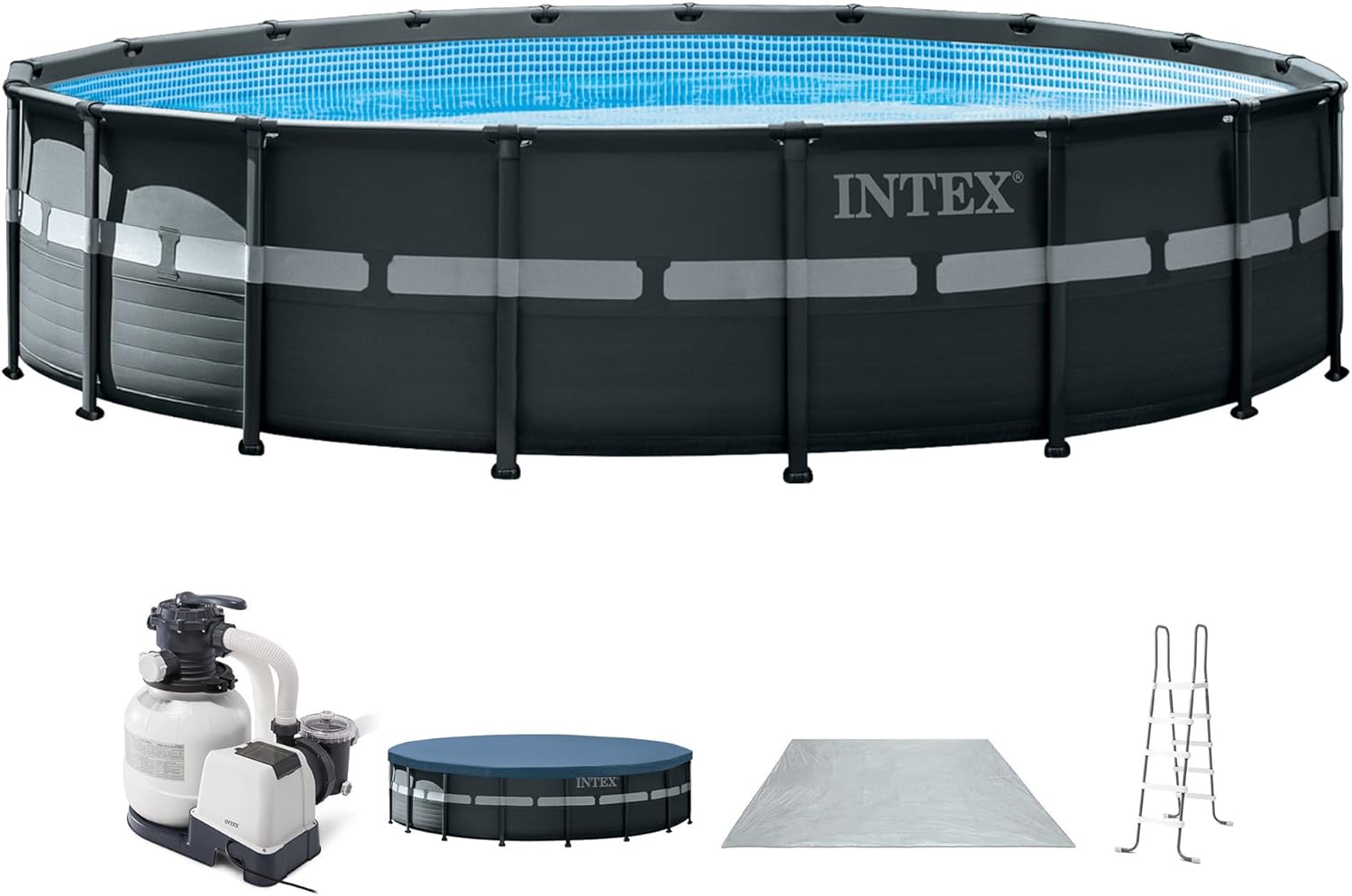
This 18-foot by 52-inch round pool holds 6,981 gallons and uses a 3-ply liner made from polyester mesh and thick PVC. Its galvanized steel frame has inner and outer powder coating, and the set includes a 2,100 GPH sand filter pump, ladder, pool cover, and ground cloth. The liner, frame, and filter pump are covered by a 2-year warranty.
Check On AmazonIf you click this link and buy, we earn a commission at no additional cost to you.
Tier 4: Permanent Steel Wall and Semi-Inground Pools ($3,500 to $13,500 Total Year-One Cost)
Permanent steel wall pools, including semi-inground setups, run $1,500 to $8,000 for the pool itself, and this is the only tier where I recommend professional installation as the default rather than the exception. Leveling and installation on this tier adds $1,000 to $3,000, and electrical bonding, which most jurisdictions require for permanent installations, adds another $800 to $2,500 depending on how far the electrical run has to travel from your panel. That bonding work needs a licensed electrician. This is not a DIY step regardless of how comfortable you are with the rest of the setup.
Warning: Standard above ground pools, including most Tier 4 kits, are engineered for outward water pressure only. If you are considering burying part of the wall to blend a permanent pool into a slope, that only works on a pool specifically rated for semi-inground use. Burying a standard frame that was not built for that load risks a wall collapse, and I have seen exactly this failure on a pool that looked fine for two seasons before the wall gave out.
Add first-fill chemical startup of $50 to $150 and the total year-one cost for this tier runs $3,500 to $13,500. That is a large spread, and the deciding factors are almost always the same two things: how far the electrical run has to travel, and whether the ground needs significant grading before installation can start.

This 12-foot by 24-foot oval semi-inground pool holds 6,508 gallons and uses 14-gauge galvanized steel walls with UV-resistant polymer coping. It can be installed fully or partially inground and includes a skimmer, full-pattern liner, and white fiberglass steps. The listing states a 30-year limited warranty.
Check On AmazonIf you click this link and buy, we earn a commission at no additional cost to you.
What the Cost Ranges Actually Tell You
| Tier | Pool Kit Cost | Installation Add-Ons | Total Year-One Cost |
|---|---|---|---|
| Tier 1: Inflatable Easy-Set | $100-$300 | Chemicals, possible pump upgrade | $200-$550 |
| Tier 2: Soft-sided frame | $200-$800 | DIY leveling, chemicals | $300-$950 |
| Tier 3: Steel and hybrid frame | $500-$2,000 | Leveling (DIY or pro), chemicals | $600-$2,700 |
| Tier 4: Permanent steel wall | $1,500-$8,000 | Pro leveling, electrical bonding, chemicals | $3,500-$13,500 |
Lay the four tiers side by side and the pattern is clear: the further you move toward permanence, the more the installation add-ons outweigh the kit price itself. Leveling goes from optional to non-negotiable, and electrical work only enters the picture once you reach a permanent installation.
Which Cost Tier Should You Budget For?
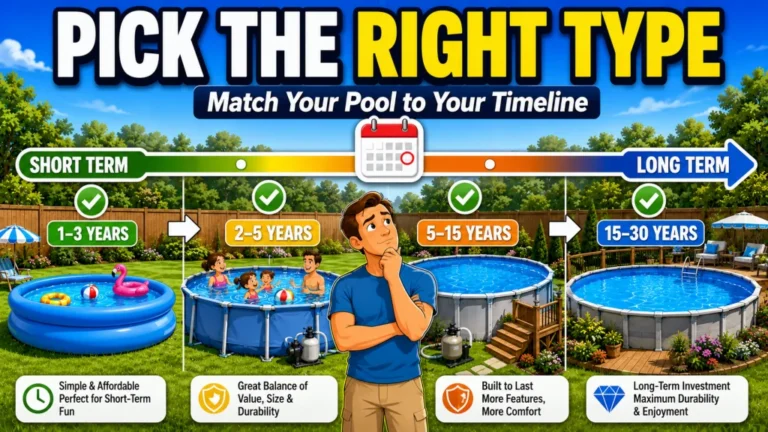
The dollar ranges only mean something once you match them to your own yard and how long you actually want the pool around. Here is how I walk buyers through that decision on site.
Choose Tier 1 if you want a low-risk seasonal pool, do not mind a smaller size and shallower depth, and are not ready to commit money beyond a single summer. Choose Tier 2 if you want more swim room than an inflatable gives you but still want a mostly DIY setup with no professional install involved. Choose Tier 3 if you want a sturdier frame that holds up over multiple seasons and are willing to spend the time, or the money, on getting the leveling right before the water goes in. Choose Tier 4 if you want a permanent backyard fixture, are comfortable budgeting for professional installation and electrical bonding upfront, and are not looking to move or downsize the pool in a year or two.
The yard you have and the number of seasons you expect to keep the pool matter more here than the sticker price on the kit. A buyer set on a permanent fixture who tries to save money by skipping Tier 4’s professional installation is usually the one who calls me later about a wall problem, not the one who saved money.

The C2500 has a 2,500 GPH pump flow rate and 1,900 GPH system flow rate, and is listed for INTEX pools up to 15,200 gallons with 1.25-inch hose fittings. It uses Type B Dacron paper cartridges for filtration. The listing recommends replacing the cartridge every two weeks.
Check On AmazonIf you click this link and buy, we earn a commission at no additional cost to you.
Cost Factors to Check Before You Buy
Before you settle on a tier, run through the real cost factors rather than just comparing kit prices side by side:
- Yard slope and grading needs, since a flat lot and a sloped one are not the same installation job
- Whether your local code requires electrical bonding for a permanent or semi-inground installation
- Whether the pool size you are considering is 15 feet or larger, which usually means budgeting for a pump upgrade
- Water source, since well water often needs different first-fill chemical treatment than municipal water
- Whether you are comfortable doing your own leveling or need to budget for a professional grading crew
Final Thoughts: Match the Tier to Your Yard, Not Just Your Budget
The above ground pool price range you see advertised only tells you what the box costs. Your yard’s slope, your water source, and whether you are ready to commit to a permanent fixture decide the rest. Walk your yard, be honest about how long you want the pool around, and budget for the pump upgrade before the first hot week of summer arrives rather than after.
If you are still weighing which tier fits your yard and budget, comparing the strongest above ground pool options across every budget tier is the next logical step before you commit to a purchase.
FAQs
💰 How much does it cost to install an above ground pool?
Total installation cost depends on the tier. Inflatable and soft-sided pools add little beyond chemicals, while steel wall and semi-inground pools can add $1,000 to $3,000 in leveling and electrical work on top of the kit price.
⚡ Do I need an electrician for an above ground pool?
For permanent steel wall and semi-inground pools, yes. Electrical bonding is required in most jurisdictions and must be done by a licensed electrician, typically running $800 to $2,500 depending on the distance from your panel.
🏗️ Is professional installation worth it for a steel frame pool?
It depends on your yard. If the ground is already flat, DIY leveling is realistic. If the lot is sloped or uneven, professional grading avoids the wall stress and liner problems that come from an uneven base.
🔧 Why do I need a new pump if the kit already came with one?
Stock pumps are sized to the pool’s water volume on paper but often fall short of adequate filtration turnover in real conditions. This mostly affects 15-foot and larger pools, where a $100 to $350 pump upgrade is a common first-year expense.
🧱 Can I bury part of my above ground pool into a slope?
Only if the pool is specifically rated for semi-inground use. A standard frame pool is built for outward water pressure only, and burying one that is not rated for it risks a wall collapse.
🧪 What does first-fill chemical startup cost?
Typically $30 to $150 depending on pool size and your water source, with well water sometimes needing extra treatment compared to municipal water.
Sources and References
- mgkpools.com: leveling and installation cost range for permanent steel wall pools, confirmed March 2026.
- familyhandyman.com: electrical bonding cost range for permanent pool installations, confirmed December 2025.
- royalswimmingpools.com: first-fill chemical startup cost range for new above ground pools.
- troublefreepool.com: community-reported pattern of stock pump inadequacy on 15-foot and larger pools.