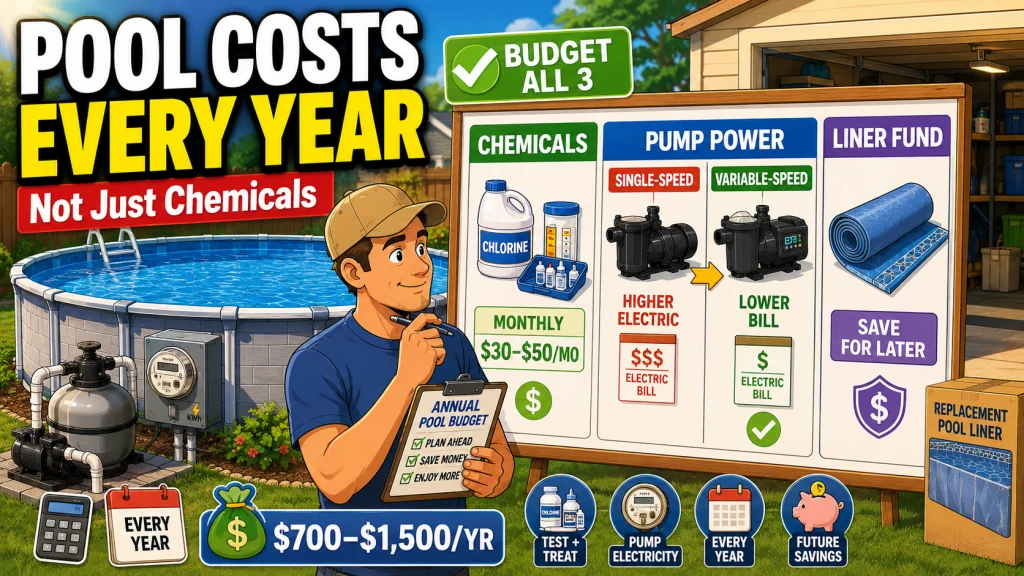
The above ground pool annual maintenance cost usually lands between $700 and $1,500 a year once you add up chemicals, pump electricity, and the liner replacement you are quietly saving up for. The number moves a lot depending on pool size, whether you are running a single-speed or variable-speed pump, and whether you do the work yourself or pay someone to open and close the pool for you. I have watched owners budget for the pool itself and forget that the electric bill and the liner are part of the real cost too. This article breaks each piece down so you know what you are actually signing up for before the season starts.
What an Above Ground Pool Actually Costs to Run Each Year
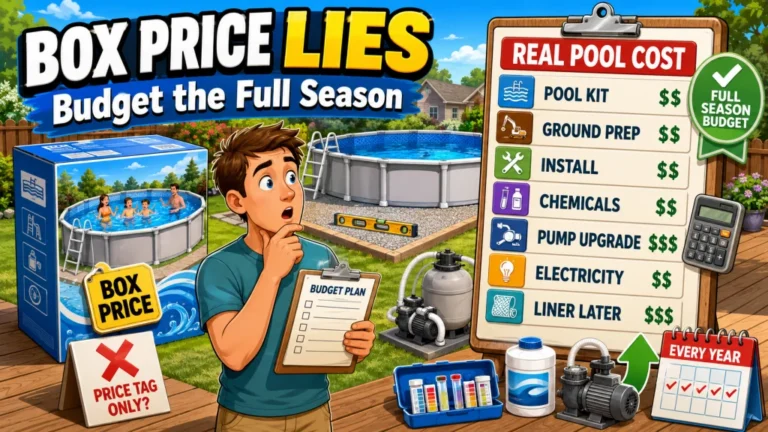
The above ground pool annual maintenance cost breaks down into three real line items: chemicals, pump electricity, and the liner you will eventually replace. Most owners only budget for the first one, then get surprised in August when the electric bill jumps or in year seven when the liner starts pulling away from the seam. In my experience, the biggest cost swing between two owners with the same size pool comes down to pump type and how much of the work they hire out.
Four things set your number for the year: pool size, since a bigger volume needs more chemical and a longer pump run time to hit turnover; pump type, because a single-speed motor and a variable-speed motor can differ by hundreds of dollars in electricity alone; climate, since a longer swim season means more months of chemical use and pump run time; and whether you handle opening, closing, and weekly testing yourself or pay a local service for part of it. Get those four right and you can predict your annual cost within a few hundred dollars, which is more than most buying guides give you.
Chemical Costs You Can Expect Each Season
DIY chemical costs for a residential pool typically run $30 to $50 a month during active swim season, and above ground pools tend to sit at the lower end of that range simply because most of them hold 10,000 to 15,000 gallons, smaller than the 15,000 to 25,000 gallon range a lot of general pool cost guides are built around. Over a full season that works out to roughly $400 to $800 a year in chlorine, shock, pH adjusters, and algaecide, depending on how long your season runs and how consistent you are with testing.
Well water changes this number more than most owners expect. If the well water tests high in iron, you are adding a sequestering agent on top of the normal routine, and that pushes the yearly chemical total toward the higher end of the range. Municipal water with stable pH tends to land you closer to the low end. Either way, chemicals are usually the most predictable annual line item, because the cost scales almost directly with pool volume and season length rather than with equipment choices.
- Pool size in gallons, since chemical dosing scales with volume, not surface area
- Length of the active swim season in your climate
- Water source: well water with high iron or hardness usually costs more to balance than municipal water
- How consistently you test, since catching an imbalance early is cheaper than shocking a green pool back to clear
- Whether you are running a salt system, which shifts some of the chemical cost into salt and cell maintenance instead of chlorine
That last point matters more than people think. A salt system on a standard frame pool also brings up a separate issue I bring up on every install: not every above ground frame is rated for salt, and running one on a frame that was not built for it accelerates rust at the seams. That is a decision worth making before the season starts, not after the chemical budget is already set.

This all-in-one kit tests for free and total chlorine, pH, acid and base demand, total alkalinity, calcium hardness, and cyanuric acid, working with any pool, hot tub, or spa. It includes a carrying case, water comparator, water balance calculator, base demand reagent, color-coded instructions, and a waterproof chemistry guide for quick reference. Taylor test kits are the only testing supplies recommended by the American Swimming Coaches Association, ensuring professional-level accuracy.
Check On AmazonIf you click this link and buy, we earn a commission at no additional cost to you.
Pump Electricity: The Line Item Most Owners Underestimate
The most common call I get every summer is not about the pump breaking, it is an owner asking why their electric bill jumped after they set the pool up. A standard single-speed pump running 8 hours a day at typical residential rates costs roughly $40 to $60 a month to operate. Run the numbers on a typical 4 to 6 month above ground pool season and that comes out to about $160 to $360 a year. In warmer climates where the pool stays open closer to year round, the same pump can run $480 to $720 a year. Either way it is on top of the chemical budget, and it is the number most first-time buyers never see coming because the sticker price on the pool never mentions it.
A variable-speed pump running the same pool costs meaningfully less, typically $15 to $25 a month. Over a 4 to 6 month season that is roughly $60 to $150 a year, or $180 to $300 a year if the pool runs closer to year round. For most seasonal above ground pools, the gap between the two pump types works out to somewhere in the $180 to $420 a year range, and it can reach $300 to $500 a year in longer-season or year-round climates. I have swapped enough stock pumps to say the difference is not marketing, it shows up on the actual bill within the first month.
This is where the cost owners expect and the cost they actually pay start to diverge: the pump type you choose is the single biggest lever you control after the pool is already in the ground. Chemical costs barely move based on your choices. Pump electricity does, by a few hundred dollars a year, every single year you own the pool.
Liner Replacement, Amortized Into Your Yearly Budget
Soft-sided frame pool liners typically last 5 to 9 years, while steel wall liners tend to run 7 to 12 years before they need replacing. A replacement liner for a mid-size round pool generally costs somewhere between $170 and $400 for the liner alone, with premium or thicker options running higher, plus $0 to $300 if you pay someone to install it instead of doing it yourself. Spread that cost across the liner’s expected lifespan and you get an amortized annual cost of roughly $30 to $150 a year, even though you are not writing that check every season.
This is the part of the yearly maintenance budget that catches people off guard, because it does not show up as a monthly bill. It shows up as one uncomfortable expense in year six or seven. The owners who budget for it every year instead of treating it as a surprise are the ones who replace the liner on their own timeline instead of scrambling after a slow leak shows up mid-season. A steel wall pool with a properly leveled base and a sand cove that was actually dug down, not just eyeballed, tends to land at the longer end of that lifespan range. Skip the cove and you are more likely replacing the liner closer to year five.

This 18-foot round overlap liner fits steel-sided above ground pools with 48-inch or 52-inch walls. It uses 25-gauge 100% virgin vinyl with welded seams and installs by draping over the pool wall and securing it with coping strips. A gasket kit for the skimmer and return is included. The liner carries a 25-year limited warranty against manufacturer material defects.
Check On AmazonIf you click this link and buy, we earn a commission at no additional cost to you.
Putting the Full Year Together
Add chemicals, pump electricity, and the amortized liner cost together and most owners land in a fairly narrow band once you account for pool size, season length, and pump type. The table below shows what that above ground pool yearly cost actually looks like across the two most common setups I run into on service calls, assuming a typical seasonal above ground pool rather than a year-round climate.
| Setup | Annual Cost Range |
|---|---|
| DIY, small pool (12 to 15 foot), single-speed pump, seasonal use | $700 to $1,200 |
| DIY, medium pool (18 to 21 foot), variable-speed pump, longer season | $900 to $1,500 |
| Add professional opening and closing service to either setup | +$300 to $500 |
Most DIY owners land around $700 to $1,500 a year using the ranges above. If you add professional opening and closing service, the real annual total often moves closer to $1,000 to $2,000, so factor that in before you assume you are strictly a DIY owner. Notice that the medium pool with a variable-speed pump does not cost dramatically more than the small pool running a single-speed pump, even though it holds more water. That is the pump savings offsetting the extra chemical and space you are covering. A 15-foot pool and an 18-foot pool look like a small jump in size on paper, but the volume difference means many stock single-speed pumps that feel adequate on the smaller pool can become borderline on the larger one, which is part of why the pump choice matters more as the pool gets bigger. For a full breakdown of what you pay before the pool is even filled, our guide to above ground pool buying and setup costs covers the purchase and installation side of this same budget.

This pool winterizing kit is designed for most above ground and in-ground pools up to 30,000 gallons. The package contains two winter pills and is compatible with both chlorine and saltwater systems. It is intended to help limit scaling and green water during seasonal closure. Directions call for adding both pills before closing the pool for the season.
Check On AmazonIf you click this link and buy, we earn a commission at no additional cost to you.
Is Upgrading to a Variable-Speed Pump Worth It?
The electricity gap between a single-speed and variable-speed pump on an above ground pool typically runs $180 to $420 a year for a seasonal pool, and $300 to $500 a year in a longer-season or year-round setup. A variable-speed pump upgrade generally costs $200 to $400 for the unit itself on a standard above ground setup. Run those two numbers against each other and the payback period lands around 6 to 16 months in most climates, which means the upgrade is usually paying for itself before your second full season is over.
I do not push every owner toward the upgrade. If you are running a small inflatable or soft-sided pool for two or three seasons before you replace it entirely, the stock pump is probably fine and the payback window does not have time to matter. But if you are set up in a steel frame or permanent steel wall pool you plan to keep for years, the variable-speed pump is one of the few upgrades on this site where the math is not close. It also runs quieter and puts less hydraulic stress on the filter, which is a smaller factor but not nothing over a decade of use.
Before you choose equipment, compare the pump’s monthly electricity cost, how many years you plan to own the pool, and whether the frame itself is worth upgrading around. A cheap setup makes sense for a temporary pool you will replace in a season or two. A long-term steel wall pool deserves equipment that lowers the yearly cost, not just the checkout price.
One more thing worth knowing before you commit either way: this cost picture only tells you what ownership runs per year, not whether the pool was a good financial decision compared to not having one at all. That is a different question, and it is one our guide on whether an above ground pool is worth it long term answers directly if you are still weighing the purchase.

This 1.5 HP variable-speed pump is designed for above ground pools and uses a permanent-magnet motor with lower-speed filtration options. It includes 1.5-inch and 2-inch ports, programmable controls, automatic dual-voltage sensing from 115V to 230V, and Wi-Fi connectivity. The pump is Energy Star certified and includes a 5-year warranty.
Check On AmazonIf you click this link and buy, we earn a commission at no additional cost to you.
Final Thoughts: Budget for the Year, Not Just the Season
The above ground pool annual maintenance cost comes down to a few decisions that are easy to get right once you know what to look for. If you are running a small pool for a season or two before replacing it, do not over-upgrade the pump, the stock setup is usually fine for that timeline. If you are in a steel frame or permanent steel wall pool you plan to keep for years, price out the variable-speed pump early rather than waiting for the stock pump to fail first. If you are in a cold climate, add the professional opening and closing range to your budget rather than assuming DIY numbers alone. And if you are on well water, build in extra room in the chemical line for iron and hardness instead of budgeting for municipal-water pricing.
If you are still deciding what pool and equipment to buy in the first place, our guide to choosing and sizing the right above ground pool walks through that decision before you get to the maintenance stage covered here. Whatever you land on, run the numbers for your specific pool size, climate, and pump before the season starts. That is the only way the real annual cost of above ground pool ownership stops being a guess and starts being a budget line.
FAQs
💰 How much does it cost to maintain an above ground pool per year?
Most owners land between $700 and $1,500 a year, depending on pool size, pump type, and whether any part of the work is hired out. A small pool with a single-speed pump sits near the low end, while a medium pool with a variable-speed pump and occasional professional help sits near the high end.
🧪 How much do pool chemicals cost per month for an above ground pool?
Expect roughly $30 to $50 a month during active swim season, trending toward the lower end because most above ground pools hold less water than the general residential pool average. Well water with high iron or hardness usually pushes the cost higher.
⚡ Does a variable-speed pump really lower my electric bill?
Yes. A single-speed pump typically costs $40 to $60 a month to run, while a variable-speed pump running the same pool costs closer to $15 to $25 a month. The gap comes from running at a lower speed for most of the day instead of full power the entire time.
🛡️ How much should I budget for a new pool liner?
A replacement liner generally runs $170 to $400 plus installation if you do not do it yourself. Soft-sided frame liners last 5 to 9 years and steel wall liners last 7 to 12 years, so amortized annually that works out to about $30 to $150 a year.
🔧 Is it cheaper to maintain the pool myself or hire a service?
DIY is almost always cheaper on a pure dollar basis, since professional opening and closing service adds roughly $300 to $500 a year on top of the chemical and electricity costs you would pay either way. Hiring out makes more sense if you cannot keep up with weekly testing consistently, since a neglected pool costs more to correct than it does to maintain.
❄️ Does closing the pool for winter add much to the annual cost?
Winterizing chemicals are usually already part of your normal seasonal chemical budget if you do it yourself. A cover only changes the annual number if you are buying a new one or amortizing its replacement over several years. The extra cost mainly shows up if you pay a service to handle closing, which is where the $300 to $500 professional add-on range comes from.
Sources
- Angi, pool maintenance cost breakdown, confirmed live, cited for the $30 to $50 monthly DIY chemical range.
- The Home Depot, 21-foot round above ground pool liner listing, confirmed live, cited for current replacement liner pricing.
- Pool Goods, variable-speed pump energy savings by pool size, confirmed live, cited for the annual electricity savings range on smaller residential pools.