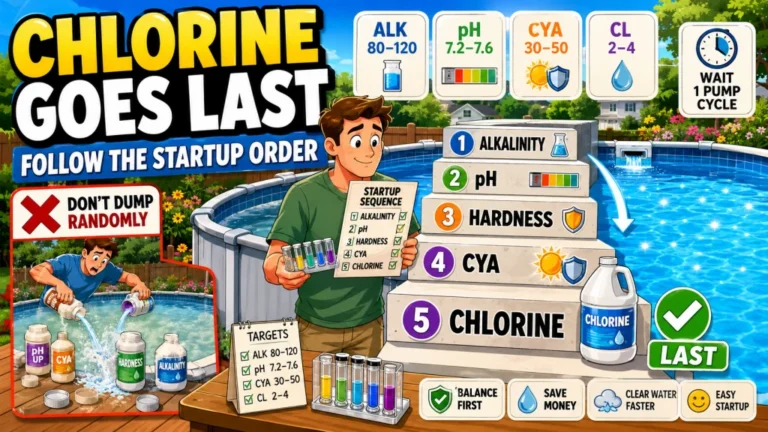
If your above ground pool burns through chlorine no matter how much you dump in, the missing piece is almost always CYA stabilizer. Cyanuric acid protects chlorine from sunlight so it actually has time to sanitize the water instead of breaking down within a few hours. This article covers what CYA does, the 30 to 50 ppm target range for outdoor above ground pools, how trichlor tablets slowly push that number up over a season, and what happens once CYA climbs past 80 ppm. It does not cover the full startup sequence or well water chemistry, both of which get their own coverage elsewhere on this site.
Why Your Outdoor Pool Burns Through Chlorine Without CYA
Cyanuric acid, usually just called CYA or stabilizer, matters because an outdoor above ground pool can sit in direct sun for eight or ten hours a day. I get this call constantly in the first few weeks after opening: the owner shocked the pool, tested it an hour later, and the chlorine reading is already gone. They assume the test kit is broken or the shock was bad. Almost every time, the real problem is that there is no CYA in the water at all.
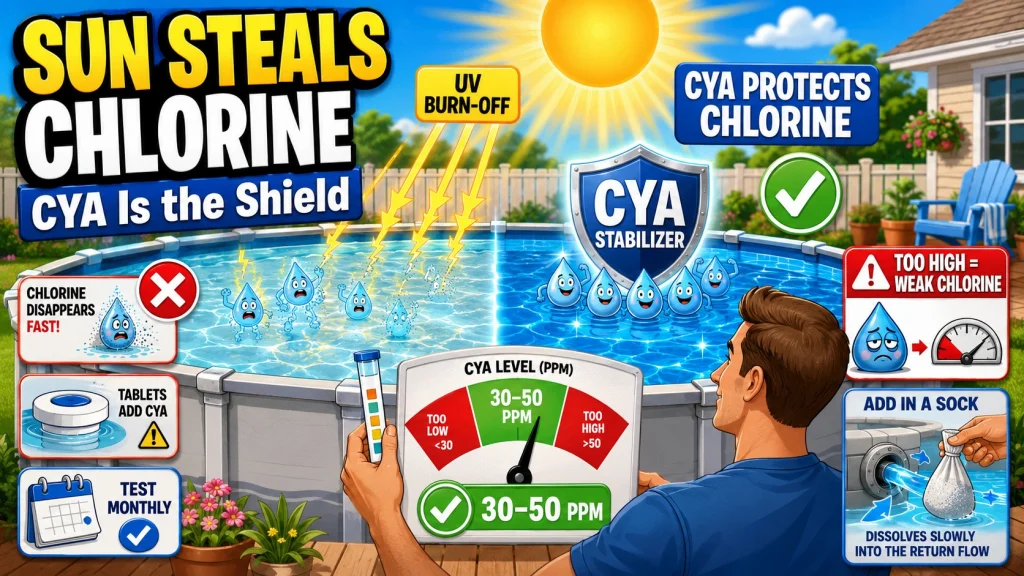
Unprotected free chlorine breaks down under UV light fast, often within two to four hours in direct summer sun. CYA does not sanitize anything by itself. It forms a loose, reversible bond with the chlorine molecule that shields it from UV radiation long enough for it to actually do its job. Skip this step and you are essentially paying to sanitize the air above your pool instead of the water in it.
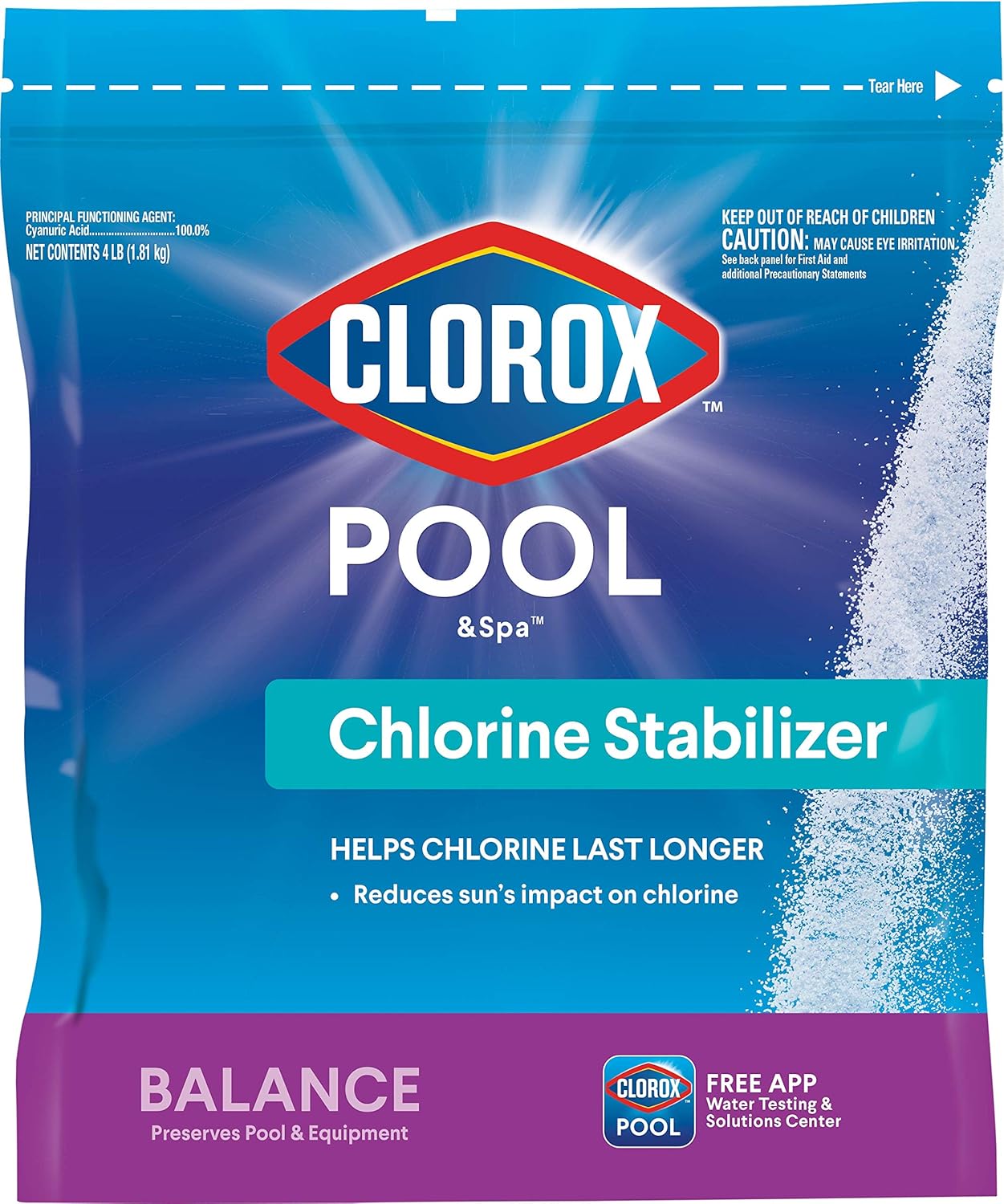
This 4-pound chlorine stabilizer helps protect pool chlorine from UV-driven loss so sanitizer lasts longer in sunlight. It reduces chlorine burn-off and the need for frequent chlorine application. The formula is suitable for saltwater pools, and the Amazon listing shows a 4.7-star rating from more than 9,600 ratings.
Check On AmazonIf you click this link and buy, we earn a commission at no additional cost to you.
What Cyanuric Acid Actually Does in the Water
Think of CYA as a sunscreen for chlorine rather than a chemical that kills anything on its own. Once it is dissolved in the water at the right level, it grabs onto free chlorine molecules and releases them gradually instead of letting the sun strip them away all at once. With CYA sitting in the 30 to 50 ppm range, that chlorine typically lasts three to five times longer outdoors than it would completely unprotected.
CYA is one piece of the broader startup chemical sequence for a new pool, but it is worth understanding on its own because it is the piece most first-time owners either skip entirely or add without knowing why. An indoor or shaded pool can sometimes get away with lower CYA, but that is not the situation most backyard above ground pools are in.
The Chlorine You Are Wasting Without It
I have stood next to plenty of pools where the owner was adding a full jug of liquid chlorine every single day and still could not hold a reading. That is not a chlorine problem. That is CYA at or near zero, meaning the sun is destroying the sanitizer faster than it can build up. The pattern is simple: without CYA, the sun keeps destroying chlorine before it ever gets the chance to hold a reading, and the owner ends up dumping money into the water with nothing to show for it.
Field Note: The pools I get called out to most in July are almost never the ones with a broken pump. They are the ones where the owner has been shocking the water every evening for a week straight, the chlorine reads zero every morning, and nobody has tested CYA once. Ten minutes with a CYA test strip usually explains the whole mystery.
Once CYA is in range, the same chlorine dose holds for a full day instead of disappearing by afternoon. That is the practical payoff: fewer chemical purchases, fewer trips to the pool store, and a chlorine reading that actually means something when you test it.

These test strips check pH, total chlorine, free chlorine, bromine, alkalinity, total hardness, and cyanuric acid using medical industry technology for accuracy comparable to liquid tests. Simply dip the strip, wait 15 seconds, and compare it to the color chart, with no drops or measuring involved. Each color pad uses paper designed to keep colors vibrant and prevent bleeding for reliable readings. AquaChek has over 35 years of experience helping maintain healthy pool and spa water.
Check On AmazonIf you click this link and buy, we earn a commission at no additional cost to you.
The CYA Target Range for Outdoor Above Ground Pools
For an outdoor above ground pool using stabilized chlorine, whether that is trichlor tablets in a floater or dichlor shock, the standard target is 30 to 50 ppm. That range gives the chlorine enough UV protection without overloading the water to the point where the chlorine struggles to work at all.
Here is where a lot of owners get surprised: trichlor tablets already contain CYA baked in. A pool running only on tablet chlorine all summer does not need a separate CYA addition at the start of the season in most cases, but that CYA level will keep climbing every time a tablet dissolves, because there is no way for CYA to leave the water except by draining some out. A 15-foot pool that started the season at 40 ppm CYA using nothing but tablets can realistically be sitting at 90 ppm or higher by late August if nobody is watching it.
| CYA Level | What It Means | What To Do |
|---|---|---|
| 0 to 20 ppm | Little to no UV protection, chlorine breaks down within hours | Add CYA to reach 30 to 50 ppm |
| 30 to 50 ppm | Standard target range for outdoor above ground pools | Maintain, test monthly |
| 50 to 80 ppm | Elevated, chlorine effectiveness starting to drop | Switch to unstabilized chlorine, monitor closely |
| 80 to 100 ppm | Chlorine lock territory, sanitizer struggles to keep up | Plan a partial drain and refill |
| Above 100 ppm | Chlorine is significantly bound up and ineffective | Partial drain and refill before adding more chlorine |
Key point: Do You Actually Need to Add CYA? Here is how to read your own test result. If you are at 0 to 20 ppm on an outdoor pool, add stabilizer until you reach 30 to 50 ppm. If you are already at 30 to 50 ppm, do not add more, just maintain and test monthly. If you are running trichlor tablets, remember that every tablet is quietly adding CYA, so watch the level rather than assuming it stays put. If you are above 80 ppm, stop adding stabilized chlorine or CYA altogether and get the level back down before you chase a chlorine reading with more chemical.
That table is the reason I tell owners to test CYA monthly rather than assuming it is fine because it was fine in May. A pool that runs tablets all season is not a set-it-and-forget-it situation, even though the daily maintenance feels that way for the first few weeks.

This 7-inch floating chlorine dispenser is designed for 3-inch chemical tablets and holds up to three tablets at a time. Adjustable flow vents let the release rate be controlled while the dispenser floats in a pool or spa. Current Amazon marketplace data shows a 4.6-star rating from roughly 3,700 reviews.
Check On AmazonIf you click this link and buy, we earn a commission at no additional cost to you.
When CYA Gets Too High: Chlorine Lock
CYA protects chlorine, but too much of it starts working against you. Above roughly 80 ppm, the bond between CYA and chlorine becomes strong enough that the chlorine has a harder time actually sanitizing the water, a condition pool chemistry communities commonly call chlorine lock. The chlorine is technically still there on a basic test strip, but it is not doing its job the way it should.
Above 100 ppm, adding more chlorine is not the fix. The correct move is a partial drain and refill to bring the CYA number back down into a workable range, then retesting before resuming a normal chlorine routine. This is also the same adjustment that comes up if you ever need to run a SLAM sequence on a green pool: the target chlorine level for a SLAM has to be adjusted based on the current CYA reading, because a fixed chlorine number means something different at 30 ppm CYA than it does at 90 ppm.
Warning: Do not respond to a stubborn low chlorine reading by adding more chlorine before you have tested CYA. If CYA is already high, more chlorine will not fix it and you will just be spending money on a chemical dose that cannot do its job.
How to Add CYA Without Clouding the Water
CYA is slow to dissolve, and that is where most first-timers get it wrong. I have shown up to service calls where an owner dumped granular CYA straight into the pool, and a day later the water has a hazy, almost milky look because the CYA settled into the liner instead of dissolving evenly. The fix is simple but easy to skip if nobody tells you about it ahead of time.
- Add CYA inside a mesh sock or nylon stocking, not directly into the open water
- Hang or hold the sock in front of a return jet so the flow keeps dissolving it
- Run the pump continuously for at least 24 hours after adding CYA
- Wait 24 hours before adding acid or other pH-adjusting chemicals
- Retest CYA after it has fully dissolved rather than assuming the dose worked
CYA specifically deserves this much attention because it behaves so differently from every other chemical you will add during a first fill. Everything else dissolves in minutes. CYA can take days, and testing too early just tells you the dose has not finished working yet, not that it failed.

This liquid cyanuric acid reagent is Taylor model R-0013-C and comes in a 2-ounce bottle. The listed volume is 59 milliliters, making it a replacement reagent for CYA testing rather than a multi-parameter strip kit. Listing data shows a 4.8-star rating from more than 850 reviews.
Check On AmazonIf you click this link and buy, we earn a commission at no additional cost to you.
Final Thoughts: Test CYA Before You Blame the Chlorine
Every outdoor above ground pool needs CYA in the 30 to 50 ppm range to hold onto chlorine long enough to matter. If you are running tablets all season, the question is not whether you will need to manage CYA eventually, it is when the level climbs high enough that a partial drain becomes the right move. Keep a CYA test strip or reagent on hand and check it monthly, not just when the chlorine seems to be misbehaving.
If you are still working through the rest of getting a pool up and running, the broader picture of choosing, setting up, and maintaining an above ground pool covers where CYA fits alongside the pump, filter, and the rest of the first-season routine. CYA is a small line item on a chemical shelf, but it is doing more work than almost anything else in that water once the sun comes out.
FAQs
🧪 How much CYA does an above ground pool need?
Most outdoor above ground pools using stabilized chlorine should sit in the 30 to 50 ppm CYA range. Below that, chlorine breaks down fast in sunlight. Above roughly 80 ppm, chlorine starts losing effectiveness.
🔥 Why does my chlorine disappear so fast outdoors?
Unprotected free chlorine can break down within two to four hours of direct sun exposure. If CYA is at or near zero, you are effectively sanitizing for a few hours at a time no matter how much chlorine you add.
🚫 Can CYA get too high in an above ground pool?
Yes. Trichlor tablets contain CYA, so a pool running only on tablets will see CYA climb over a season. Above 80 ppm, chlorine effectiveness starts to drop, and above 100 ppm a partial drain and refill is usually the correct fix.
🧴 Do trichlor tablets already contain CYA?
Yes, trichlor tablets include CYA as part of the tablet, which is why pools running only on tablets do not usually need a separate CYA dose at first, but do need their CYA level checked as the season goes on.
⏱️ How long does it take CYA to dissolve?
CYA dissolves slowly compared to most pool chemicals, often taking a day or two of continuous pump run time when added correctly in a sock in front of a return jet. Test again only after that window has passed.
💧 Should I add CYA before or after filling the pool?
Add CYA after the pool is filled to its normal operating level, using a sock or nylon bag at the return jet with the pump running. Adding it directly into open water risks clouding from undissolved granules.