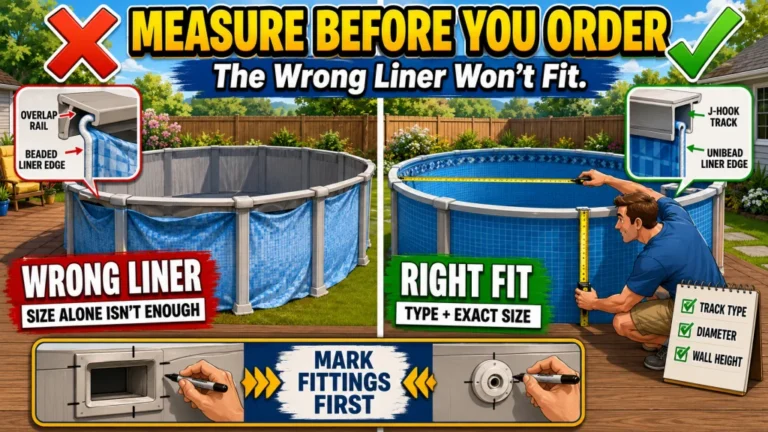
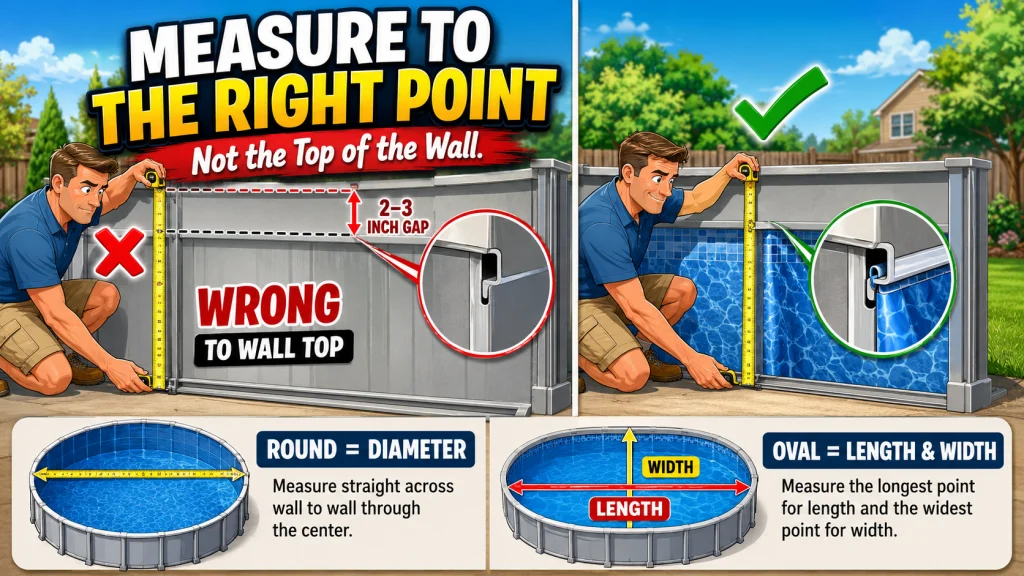
Measuring an above ground pool for a replacement liner takes about ten minutes once you know which dimensions actually matter. Round pools need a wall-to-wall diameter, plus wall height for uni-bead or beaded liners. Oval pools need width and length, plus wall height for those same fitted liner types. The measurement that trips up the most first-time buyers is wall height on a beaded liner, because the correct reference point is the bead receiver, not the top of the wall, and that gap is usually two to three inches. Get this wrong and you either order a liner that won’t reach the top or one that sags with excess material pooling at the bottom.
How to Measure an Above Ground Pool for a Liner
I have watched a lot of owners stretch a tape measure around the outside of the top rail and call it done. That number is close, but close is not what a replacement liner needs. The liner is cut to the pool’s inside dimensions, the actual water-holding shell, not the rail that sits on top of the wall and overhangs it slightly. When you measure from the outer edge of the rail instead of the wall itself, you end up ordering a liner sized for a slightly bigger pool than the one you actually have.
The good news is that measuring an above ground pool for a liner does not require any special tools. A tape measure, a second pair of hands, and about ten minutes standing beside the pool with the water drained or the pool already empty from a teardown will get you every number you need. What matters is measuring the right points in the right order, because a liner that is off by even an inch on wall height can leave you either short of material at the top or with loose fabric bunching at the floor.

This 100-foot open-reel tape uses a double-sided 1/2-inch fiberglass blade with enough reach for large round and oval pool measurements. It has a steel end hook, high-impact ABS case, and slip-resistant rubberized grip. The two-color blade provides separate inch and engineer scales for easier reading during outdoor measuring jobs.
Check On AmazonIf you click this link and buy, we earn a commission at no additional cost to you.
Measuring a Round Above Ground Pool for a Liner
A round pool only needs one primary horizontal measurement: the diameter, taken wall-to-wall through the center of the pool. Stretch the tape measure across the pool, through the middle, and read the number where it meets the opposite wall. Do this from the inside face of the wall, not from the outer edge of the top rail. The rail overhangs the wall by a small amount on almost every steel-wall above ground pool, and that overhang is exactly the kind of number that creates an ordering mismatch if you are not paying attention to it. Diameter is not the only number a round pool needs, either. If your liner type is uni-bead or beaded rather than overlap, you still need wall height on top of the diameter, covered in the next section.
In my experience, the diameter measurement is the one people rush because it looks so simple. A round pool liner measurement is genuinely the easier of the two shapes, but rushing it is still how you end up with a liner that is a size off. If you have the pool’s original spec sheet, most manufacturer listings give an outside dimension, and the liner is cut to the inside dimension. For most 15-foot and 18-foot round setups the difference between outside and inside wall measurements is small, but it is worth checking your specific pool’s listing before you assume the numbers match exactly.
Pro Tip: Measure through the true center from at least two directions rather than relying on a single pass. A pool wall that has settled unevenly over a few seasons can read slightly different depending on where you stretch the tape. If the readings stay different, recheck at both the top and bottom of the wall and confirm whether the pool has shifted out of round before you settle on a liner size. Do not assume the smaller reading is automatically the safer choice.
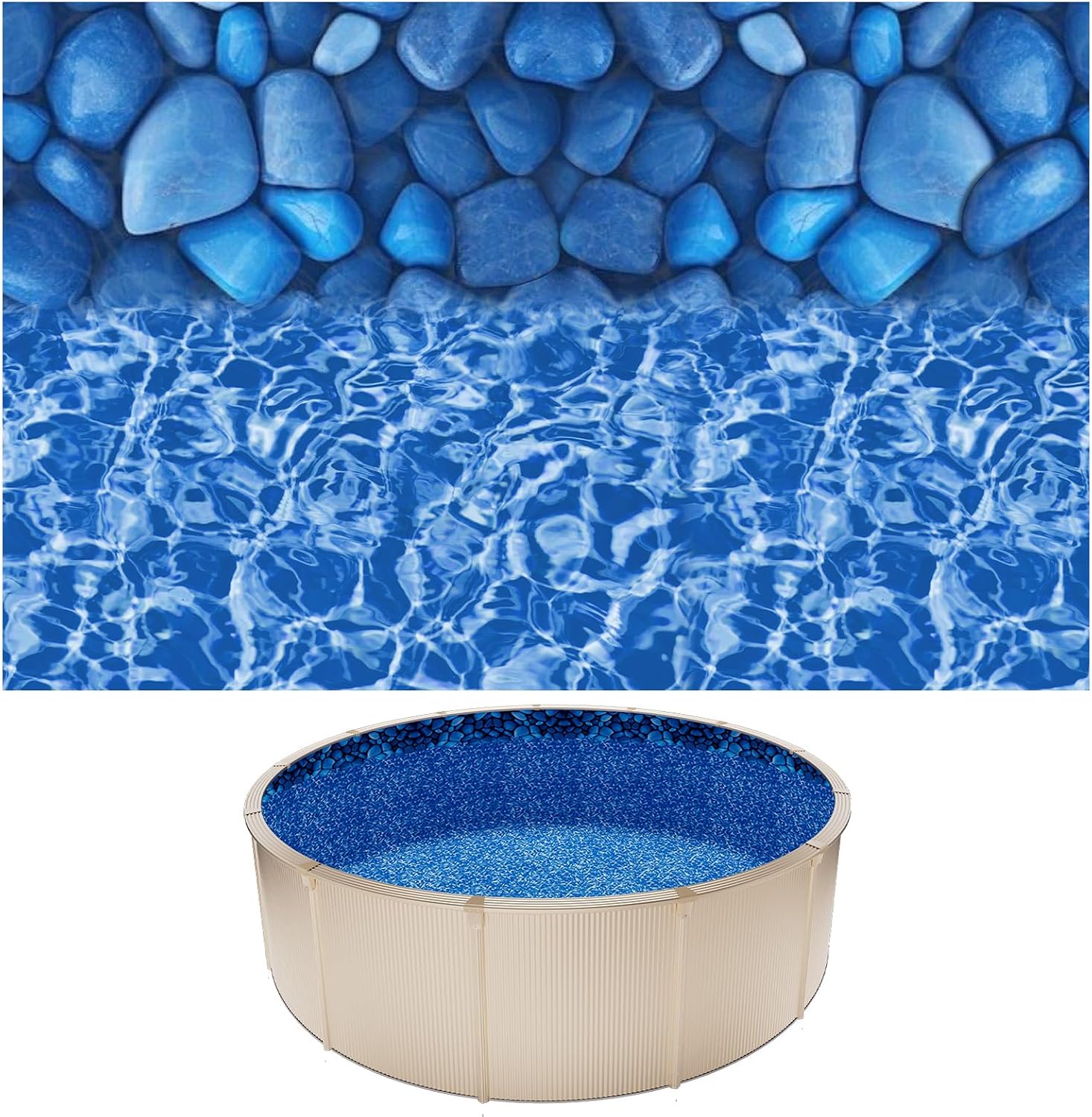
This overlap liner is sized for 15-foot round steel-sided above-ground pools and accommodates 48- to 54-inch wall heights. It uses 10.6-mil PVC vinyl designed to reduce normal wear and tearing. Its smooth surface and anti-slip backing are designed to improve stability during everyday pool use.
Check On AmazonIf you click this link and buy, we earn a commission at no additional cost to you.
Measuring an Oval Above Ground Pool for a Liner
Oval pools need two horizontal measurements plus wall height for non-overlap liners. You need the width, which is the shortest wall-to-wall dimension, and the length, which is the longest wall-to-wall dimension measured at the apex of the curve rather than along a straight section of wall. Missing the apex on the length measurement is an easy mistake, because measuring along the straight side of the oval gives you a shorter number than the true end-to-end length.
I have seen oval liner orders come back wrong because someone measured length along the flat middle section of the pool instead of catching the full curve at each end. On an oval pool, the apex is the farthest point of each curved end, and that is where the length measurement has to be taken for the liner manufacturer to cut the correct shape. If your length measurement looks suspiciously close to your width measurement, that is usually a sign the apex was missed.
- Width: shortest wall-to-wall distance, measured straight across the middle of the oval.
- Length: longest wall-to-wall distance, measured at the curved apex on each end, not along the straight sides.
- Wall height: required for non-overlap liner types, measured from the floor track to the correct reference point on the wall.
- Verification: cross-check your numbers against the pool’s listed dimensions if you have the original spec sheet on hand.
Once you have width and length locked in, wall height is where oval and round pools both run into the same problem, and it is worth its own explanation because this is one of the most common measurement mistakes in this process.
Wall Height: The Measurement Most Buyers Get Wrong
Wall height matters for non-overlap liner types, meaning uni-bead and beaded liners. For a uni-bead liner, measure from the pool floor track straight up to the top of the pool wall. For a beaded liner, the correct reference point is different: measure from the floor track up to the top of the bead receiver, not to the top of the wall itself. On most steel-wall above ground pools, the bead receiver sits two to three inches below the actual top of the wall, and that gap is a common reason a beaded liner arrives either too short to reach the top or long enough that it sags with extra material at the floor.
Field Note: Owners measure to the top of the wall because it is the tallest point they can see, not realizing the liner actually hooks into the bead receiver a few inches lower.
Measuring a beaded liner pool from the floor track to the very top of the wall, then ordering based on that number.
Measuring from the floor track to the top of the bead receiver, the actual channel the liner’s bead locks into, and ordering to that number instead.
This is not a cosmetic difference. A gap of two to three inches on a wall height measurement is enough to change whether the liner reaches the top of the pool at all. If you are not sure which liner type your pool uses, look at how the current liner attaches at the top edge. A standard beaded liner locks into a receiver track. A J-hook or uni-bead liner hangs from a formed hook at the wall top instead of a track, and it still needs the wall height measurement. An overlap liner is different from both: it drapes past the top of the wall and is held by coping strips, and it is the only style that skips the wall height measurement entirely.
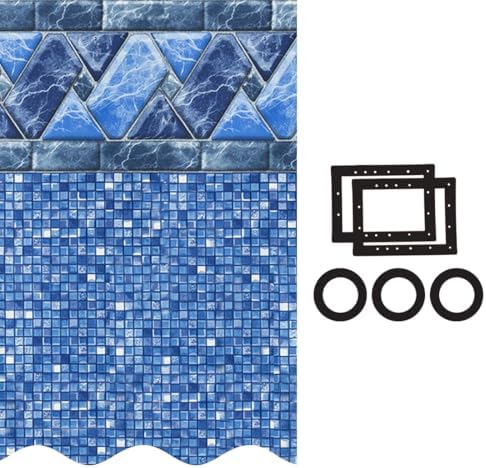
This 24-foot round unibead liner fits flat-bottom pools with 52-inch walls and uses 25-gauge virgin vinyl. The unibead attachment can hang as a J-hook or be converted to a standard bead for a bead receiver. A skimmer and return gasket set is included. The liner carries a 25-year limited warranty against manufacturer material defects.
Check On AmazonIf you click this link and buy, we earn a commission at no additional cost to you.
The Overlap Liner Exception: No Height Measurement Needed
Overlap liners are the simplest above ground pool liner size to order because they skip the wall height measurement entirely. An overlap liner is cut with extra material built in, so the excess simply drapes over the top of the wall and gets secured with a coping strip. This design works across a standard range of wall heights of 48 to 54 inches, which covers the large majority of traditional above ground pools sold for residential backyard use.
If your pool wall falls inside that 48- to 54-inch range, and you are ordering an overlap style, you can skip the height measurement step altogether and focus only on diameter for a round pool or width and length for an oval. This is one of the reasons overlap liners remain a common first replacement choice: fewer measurements mean fewer places to make a mistake.
Choosing between liner styles is really a separate decision from the measurement itself, and if you are still weighing overlap against a bead-style liner, that comparison is worth working through before you commit to a measurement approach that only applies to one type.
Verifying Your Measurements Before You Order
Once you have your numbers, a quick verification pass can catch a measuring mistake before it turns into a shipping delay. Compare your measurements against the pool’s original manufacturer specifications if you still have the box, the manual, or a listing you can find online. Most manufacturer listings show an outside dimension for the wall and rail assembly, so your inside wall-to-wall measurement should normally come in slightly smaller than the published figure. The gap is normal and expected on most residential above ground pools.
Where verification actually earns its keep is catching a measurement that is way off, not a small rounding difference. If your measurement matches or exceeds that published outside dimension, recheck that you did not measure rail-to-rail, since the outer rail overhangs the wall and always reads bigger. If your measurement comes in much smaller instead, make sure the tape passed through the true center rather than catching a bow or twist in the wall. Either way, recheck the measurement rather than trusting a number that does not line up with what you already know about the pool.
If two readings of the same dimension keep coming back different, do not just average them or assume one number is safer. Measure again through the true center from at least two directions, keeping the tape straight and perpendicular to the floor. On an older pool, check both the top and bottom of the wall, since a wall that has bowed or shifted out of round over time can measure differently at different heights. A persistent mismatch is a sign the pool itself may no longer be perfectly round or oval, not a sign to pick whichever number looks more convenient.
| Liner Type | Measurements Needed |
|---|---|
| Round, overlap | Diameter only |
| Round, uni-bead or beaded | Diameter plus wall height (to bead receiver for beaded) |
| Oval, overlap | Width and length only |
| Oval, uni-bead or beaded | Width, length, plus wall height (to bead receiver for beaded) |
Use this table as a quick check before you place an order. If your liner type and pool shape land in a row that requires wall height and you skipped it, go back and take that measurement before you finalize anything.

This overlap liner is designed for 12-by-24-foot oval flat-bottom above-ground pools with wall heights up to 54 inches. It uses premium vinyl designed to withstand chlorine exposure, changing weather, and punctures. Installation involves draping the liner over the pool wall with approximately a 10-centimeter overlap before securing it in place.
Check On AmazonIf you click this link and buy, we earn a commission at no additional cost to you.
Final Thoughts: Measure Once, Measure Correctly
Above ground pool liner measurements are not complicated, but they are unforgiving. A round pool needs a careful wall-to-wall diameter, while an oval pool needs width and length measured at the true apex. Both shapes also require wall height when the liner is uni-bead or beaded rather than overlap. The single number that causes the most returns is wall height on a beaded liner, where the bead receiver sits a few inches below the visible top of the wall. Get that reference point right and the rest of the ordering process is straightforward.
If you have not settled on which liner style makes sense for your pool, it is worth working through the differences between overlap, uni-bead, and beaded liner styles before you finalize your measurements, since the liner type determines exactly which numbers you need. And if your current liner is still holding but showing early wear, it may be worth reading through how to decide between repairing or fully replacing a worn liner before you commit to a full measurement and reorder. For a wider look at how liners fit into the rest of your pool’s equipment setup, the full guide to above ground pool liners covers lifespan, material differences, and buying considerations beyond measurement alone. Measurement is also just one piece of getting your equipment right from the start, and the broader above ground pool equipment guide connects liner decisions to pump sizing, filtration, and the rest of the setup.
FAQs
📏 How do I measure my above ground pool for a new liner?
Measure diameter wall-to-wall for a round pool, or width and length for an oval, always from the inside face of the wall rather than the outer edge of the top rail. Add wall height if your liner type is uni-bead or beaded.
🧵 Do I need to measure wall height for every liner type?
No. Overlap liners skip the wall height measurement entirely because they work across a standard 48- to 54-inch range. Uni-bead and beaded liners both need a wall height measurement to fit correctly.
🔍 What is the difference between measuring to the wall top and the bead receiver?
The wall top is the visible highest point of the pool wall. The bead receiver is the channel a beaded liner actually locks into, usually two to three inches lower. Beaded liners must be measured to the bead receiver, not the wall top.
📐 Why does my oval pool need more measurements than a round pool?
An oval shape has two different horizontal dimensions, width and length, plus wall height for non-overlap liner styles. A round pool only has one horizontal dimension, the diameter, though it still needs wall height added on top of that for uni-bead or beaded liners.
⚠️ What happens if I measure my pool liner incorrectly?
An incorrect measurement usually means the liner either does not reach the top of the wall or arrives with excess material that sags and bunches at the floor. Both outcomes typically mean reordering, which adds weeks of delay.
Sources and References
- The Pool Factory’s above ground pool liner measurement guide, confirmed for wall-to-wall diameter versus rail measurement, bead receiver height for beaded liners, and the standard 48- to 54-inch overlap liner height range.
- SwimmingPool.com’s liner ordering accuracy guidance, confirmed for the importance of precise, inch-level measurement accuracy when ordering a replacement liner.
- In The Swim’s oval pool measurement requirements, confirmed for the three-measurement standard on oval pools, including measuring length at the curve’s apex.