Above ground pool liner types come down to three attachment methods sold under four common labels: overlap, J-hook, uni-bead, and standard beaded, and picking the wrong one means a returned box and a pool sitting empty for another week or two. I have swapped out liners on pools that never had a bead receiver installed, and I have talked owners through the exact one-inch measurement mistake that ruins a uni-bead order. This guide walks through what each liner type is, which pool wall setup it fits, and the one compatibility check that tells you which liner you are actually shopping for. I will also cover thickness, since a heavier liner changes the math on cost and durability too.
Why Above Ground Pool Liner Types Trip Up First-Time Buyers
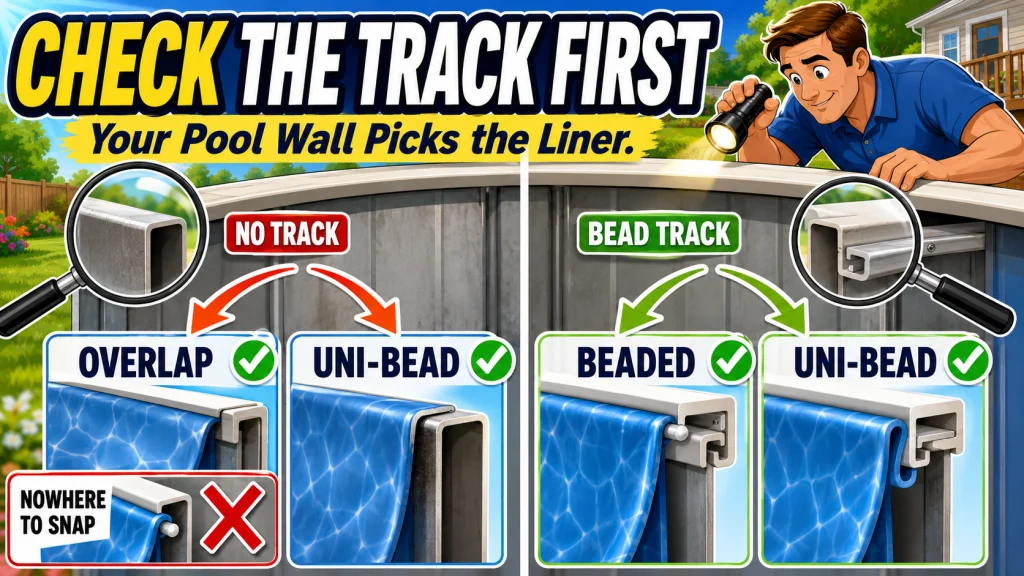
Above ground pool liner types split into three attachment methods, even though retailers often list four labels: overlap, J-hook, uni-bead, and standard beaded. I have had more than one call where someone ordered a beaded liner for a pool that never had a bead receiver track installed, or bought an overlap liner for a pool wall that measured two inches outside the standard range. Both mistakes end the same way: a liner that does not fit, and a pool that cannot go back together until the correct one shows up.
The good news is that the decision is not really about taste. It is about what your pool wall is already built to accept. Once you know whether your pool has a bead receiver track, the choice between the remaining types of above ground pool liners narrows fast, and the rest comes down to budget and how long you want the liner to last.
Overlap Liners: The Default for a First Replacement
An overlap liner drapes over the top of the pool wall and hangs down on the outside, held in place by the coping strips that came with the pool. It is the simplest liner to install and consistently the least expensive option, since the material and manufacturing process are more forgiving than the other two types.
The part owners like most is the wall height flexibility. An overlap liner works on walls measuring 48 to 54 inches high without needing an exact measurement, because the extra material simply overlaps more or less depending on your wall. That flexibility is exactly why I point most first-time liner replacements toward overlap when the pool has no bead receiver track already installed. There is no additional hardware to buy and no wall height math to get wrong.
The trade-off shows up on the outside of the pool. You will see a strip of liner material hanging below the coping once it is installed, which some owners trim for a cleaner look after the pool has settled for a couple of weeks. It is a cosmetic issue, not a functional one.

This 24-foot round overlap liner fits most 48- and 52-inch above-ground pool walls and uses 20-gauge virgin vinyl. It is designed to resist pool chemicals and fading, with durable construction for replacement use. Coping strips secure the overlap installation, and the liner carries a 15-year warranty.
Check On AmazonIf you click this link and buy, we earn a commission at no additional cost to you.
Uni-Bead and J-Hook Liners: Related, But Not Identical
A J-hook liner and a uni-bead liner get talked about as the same thing, and they are close cousins, but they are not identical. A dedicated J-hook liner hooks over the pool wall edge and stays that way, nothing else. A uni-bead liner comes out of the box built the same way, with a J-shaped fastener sewn into the top of the vinyl, but the bead is designed in two layers. If your pool wall has a standard bead receiver track, you can cut away the J-hook section along the built-in perforation and use the remaining bead in the track instead, converting the same liner into a standard beaded install.
That two-mode design is why uni-bead has become the more common label on most retail sites. It works whether or not your pool already has a track, as long as the liner is manufactured to your pool’s exact wall height. That is where uni-bead and J-hook liners differ sharply from overlap: the liner is cut to a specific wall height, not a range. If your measurement is off by even an inch, the liner will not sit correctly, and you will either see wrinkling at the seam or a liner that does not reach the floor evenly around the whole pool. Before you order, work through measuring your pool wall height correctly, since that single number decides whether the liner ships back or fits the first time.
That flexibility is why owners who are unsure about their existing attachment system often lean toward a uni-bead liner over a plain J-hook liner. It gives you a working liner today and the option to switch to a beaded install later if you ever add a receiver track.
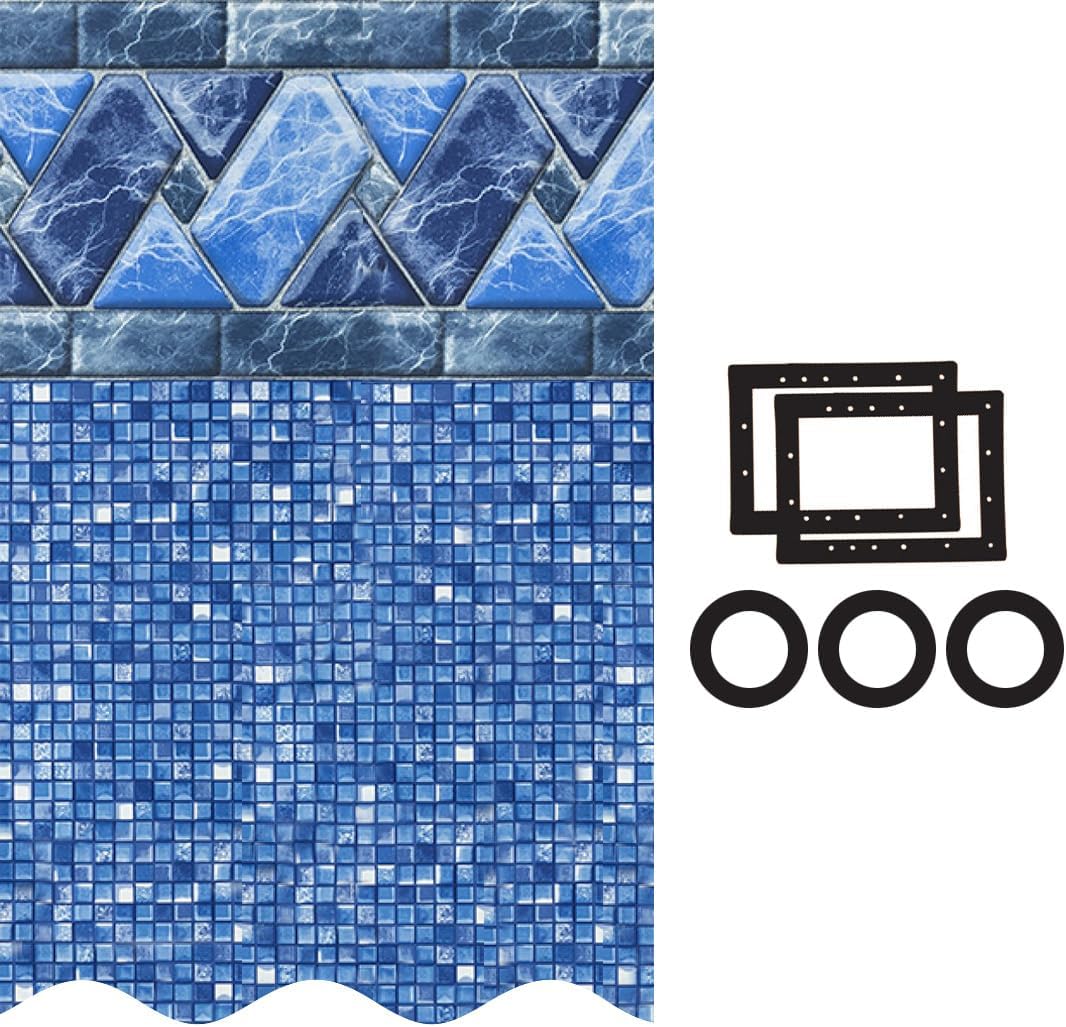
This 24-foot round uni-bead liner is sized for 52-inch flat-bottom steel-sided pools and uses 25-gauge 100% virgin vinyl. The dual bead can hang as a J-hook or be trimmed to use a standard bead receiver. It includes a universal skimmer and return gasket set and carries a 25-year limited warranty.
Check On AmazonIf you click this link and buy, we earn a commission at no additional cost to you.
Beaded Liners: The Easiest Type to Replace Next Time
A beaded liner snaps into a bead receiver track mounted around the inside top edge of the pool wall. The track has to already be there, or you install one separately before the liner goes in. Once it is, replacement gets noticeably easier down the line, since the top rails usually do not have to come off to pull the old liner out.
The measurement that trips people up here is not the distance to the top of the wall. It is the distance from the pool floor to the bead receiver, which is a different reference point entirely. I have seen owners measure to the top rail out of habit and end up with a liner that is too tall or too short by an inch or two, the exact same failure mode as a bad uni-bead measurement, just on the wrong landmark. Take the measurement from the floor to the bead receiver track, in at least two spots around the pool, before you order.
Decking changes the calculus. If your pool already has decking built over the top rail, a beaded liner is usually the better long-term pick, since it lets you swap the liner again later without disturbing the rails or the deck built above them. For a wider look at how liner type fits into the rest of your setup, see the full breakdown of liner buying and compatibility.

This 24-foot round liner is offered in a 52-inch beaded configuration for above-ground pools with a bead receiver. It uses 25-gauge virgin vinyl treated for UV and fade resistance. The beaded installation requires receiver tracking, and the liner includes a 25-year limited prorated warranty.
Check On AmazonIf you click this link and buy, we earn a commission at no additional cost to you.
The Compatibility Decision: What Your Pool Wall Already Tells You
Weighing an overlap liner against a beaded liner on price and pattern alone skips the step that actually decides the purchase. For most standard above ground pools, the first compatibility check is whether a bead receiver track is already installed, and most of the rest follows from that answer.
- Check for a bead receiver track running around the inside top edge of the wall. If a standard bead receiver is present, a standard beaded liner works, and a compatible uni-bead liner can work in its beaded configuration too.
- If there is no track, overlap and uni-bead (used as J-hook) are your options. A standard beaded liner will not attach to a wall that has nowhere to snap into.
- If you are unsure which liner is currently installed, look under the top rail from outside the pool. Visible liner material hanging below the rail means you have an overlap liner now.
- If your pool has decking built over the top rail, factor that in. A beaded liner lets you replace the liner later without pulling the rails, which matters more once decking is in place.
Run through that checklist and the decision between overlap, J-hook, uni-bead, and standard beaded stops feeling like a coin flip. Most first replacements on pools without a track land on overlap for simplicity, uni-bead when the owner wants a cleaner waterline without buying new hardware, and standard beaded only when a track already exists or the owner is planning ahead for the next replacement.
Note: this checklist assumes a common bead receiver and a standard bead profile. Some older pools and certain proprietary pool systems use a receiver track or bead shape that does not match a typical universal bead. Seeing a track on the wall is not automatically enough to guarantee any standard beaded liner will snap in. If your pool is an older model or a less common brand, compare the bead profile itself against the new liner’s spec sheet before ordering, not just the presence of a track.
Liner Thickness: Gauge vs Mil, and Why They Are Not the Same Scale
Once the liner type is settled, thickness is the next real decision, and it is separate from overlap, J-hook, uni-bead, or beaded. Liner thickness gets marketed two different ways: gauge and mil, and the two numbers are not directly interchangeable. Mil is a fixed unit equal to one-thousandth of an inch, so a liner listed at a given mil count is always that physical thickness no matter who sells it. Gauge is a labeling convention that varies by manufacturer, so a liner marked 20-gauge from one brand is not guaranteed to match the actual thickness of a 20-gauge liner from another brand.
In practice, that means the safer comparison is mil to mil when a spec sheet lists it that way, or gauge to gauge only within the same manufacturer’s product line. Do not assume two liners are the same thickness just because they carry the same gauge number from different sellers.
Thicker vinyl generally resists punctures better and fades more slowly under direct sun, which matters most if your yard gets heavy afternoon exposure with little shade. The trade-off is that heavier vinyl is stiffer and can be a little harder to work into a tight fit during installation. Fit still matters more than thickness alone. A liner ordered to the wrong wall height will cause problems no matter how heavy the vinyl is. For a wider look at how liner cost fits into everything else your setup needs, the full equipment cost breakdown for above ground pools lays out where liner replacement sits against pump, filter, and cover spending.
Lifespan follows the same logic. It depends more on installation quality, sun exposure, water balance, and winter care than on gauge or mil alone, so treat any liner’s expected life as a range tied to how the pool is actually maintained, not a number guaranteed by the thickness label.

This 24-foot round overlap liner fits flat-bottom steel-sided pools with 48- or 52-inch walls and uses 25-gauge virgin vinyl. Its layered construction is designed to resist abrasion, pool chemicals, and UV fading, while the overlap style installs with coping strips rather than a bead receiver. It includes a 25-year limited warranty.
Check On AmazonIf you click this link and buy, we earn a commission at no additional cost to you.
Final Thoughts: Match the Liner to the Wall You Already Have
Above ground pool liner types boil down to one decision tree, whether you count three attachment methods or the four labels retailers sell them under: check for a bead receiver track first, then choose based on budget and how much you care about a clean waterline. Overlap stays the simplest and cheapest path when there is no track. A J-hook or uni-bead liner gives you a cleaner look, with uni-bead adding the option to convert to beaded later, as long as your wall height measurement is exact. Standard beaded is worth the extra step of installing a track if you are planning ahead for an easier swap next time, especially under decking.
Whatever you land on, do not skip the measurement step, and do not assume thickness numbers translate the same way across brands. A liner ordered to the wrong height goes right back in the box, and that is time your pool sits empty that you did not need to lose.
FAQs
🏊 What is the difference between overlap and uni-bead pool liners?
Overlap liners drape over the wall and are held by coping strips, fitting a range of wall heights with no exact measurement needed. Uni-bead liners hook directly onto the wall edge and must be made to your pool’s exact wall height.
🔧 Can I put a beaded liner on a pool that has no bead receiver track?
Not without installing a bead receiver track first. A beaded liner has nothing to snap into on a pool wall that never had a track added.
📏 Do I need to measure my pool before ordering a uni-bead liner?
Yes, and the measurement has to be accurate. Uni-bead and beaded liners are made to a specific wall height, and being off by even an inch will prevent the liner from fitting correctly.
🔀 Is a J-hook liner the same as a uni-bead liner?
They are related but not identical. A dedicated J-hook liner only hooks over the wall. A uni-bead liner starts out the same way but can be converted into a standard beaded install if you add a receiver track later.
🧵 What is the difference between liner gauge and mil?
Mil is a fixed measurement, one-thousandth of an inch, so it means the same thing across every brand. Gauge is a manufacturer-specific label, so compare mil to mil when it is listed, or gauge only within the same brand’s lineup.
♻️ Can I convert an overlap pool to use a beaded liner later?
Yes, but you have to install a bead receiver track around the top of the wall first. Without that track, the wall cannot accept a beaded or uni-bead-as-beaded liner.
⏳ How long does an above ground pool liner last?
Lifespan depends more on installation quality, sun exposure, water balance, and winter care than on liner type or thickness alone. Treat any estimate as a range tied to how the pool is actually maintained.
Sources
- Royal Swimming Pools Knowledge Base, above ground pool liner replacement guide covering overlap, uni-bead, and beaded types and standard 20-gauge thickness.
- The Pool Factory, instructions for installing a uni-bead liner as a J-hook on nearly any above ground pool.
- Swimmingpool.com, guide on replacing an above ground pool liner, including the wall measurement accuracy warning.
- In The Swim, comparison of overlap, beaded, and J-hook above ground pool liner types.