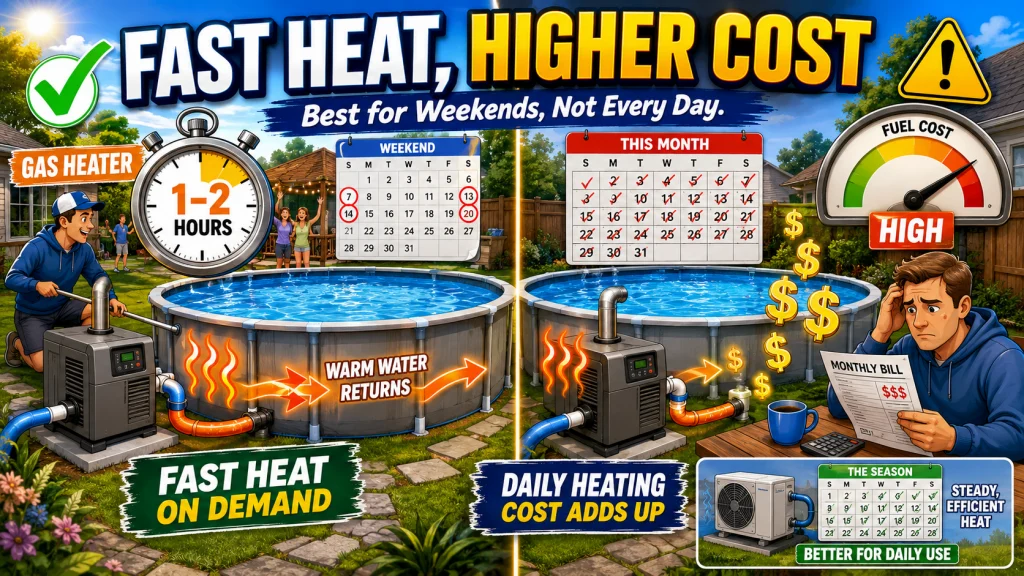
An above ground pool gas heater warms water faster than almost anything else you can bolt onto a pool pad, but “faster” depends entirely on the heater’s actual BTU output relative to your pool’s volume, not on gas heating as a category. A 100,000 BTU unit on a 4,440-gallon pool raises the water roughly 2 to 3 degrees an hour, which means a full cold-to-swimming heat-up on that pool usually runs several hours, not the “1 to 2 hours” some product pages imply. Gas still earns its higher operating cost for owners who swim occasionally and want the pool ready on short notice, for vacation properties, and for cold-climate setups where a heat pump struggles. For daily swimmers in a mild climate, the same math usually points toward a cheaper option.
Above Ground Pool Gas Heater: When the Speed Is Worth the Bill
I get this call every spring: someone bought an above ground pool gas heater because a buddy swore by it, and now they are staring at the propane bill wondering if they made a mistake. The honest answer depends on how often that pool actually gets used, and on whether the heater they bought has enough BTU output for their pool’s volume in the first place. A correctly sized gas heater will raise water temperature faster than almost any other option a homeowner can install, and for a pool that only gets used on weekends or during a short vacation window, that speed solves a real problem. For a pool used every day of the summer, the same heater turns into an expensive habit.
This guide sticks to gas heaters for above ground pools specifically. It does not cover heat pumps, which work on a different principle and a different cost curve, and it does not cover solar heating, which trades speed for a much lower operating cost. What follows is the honest math on how fast a gas heater actually works, what it costs per hour, and the specific situations where that tradeoff makes sense.
How a Gas Heater Actually Warms the Water
A gas heater burns natural gas or propane to fire a heat exchanger, and pool water gets pumped through that exchanger on its way back to the pool. The heating rate comes down to BTU output, and this is where a lot of buyers get the math wrong before they ever turn the heater on. A 4,440-gallon pool, which is roughly the volume of a 15-foot round pool at standard depth, holds about 37,000 pounds of water. Raising that entire volume by 10 degrees takes about 370,000 BTU of delivered heat, so a 100,000 BTU heater running at full output needs close to 4 hours to do it under ideal conditions, and longer once you factor in wind, evaporation, and an uncovered pool losing heat while it works.
That is a very different number from the “10 degrees an hour” figure that shows up on some retail pages, and it matters because it changes what “fast” actually means for your specific pool. A 100,000 BTU heater is not undersized or defective if it takes several hours to heat a mid-size pool. It is simply working at the rate its BTU rating allows. The heaters that heat a pool in an hour or two are the larger units, often in the 250,000 to 400,000 BTU range, and those are the ones actually capable of the fast turnaround that makes gas heating worth the cost for occasional use.
The BTU rating printed on the box also needs a second look. Manufacturers usually list input BTU, which is the fuel energy going into the burner, not the output BTU actually transferred to the water. Combustion and heat exchanger losses on many conventional heaters bring delivered heat to somewhere around 80 to 84 percent of the input rating, so a heater listed at 100,000 BTU input is often closer to 80,000 to 84,000 BTU actually reaching the water. High-efficiency models can do meaningfully better than that, with some rated in the low-to-mid 90s for thermal efficiency, so check the listed thermal efficiency on the specific unit instead of assuming one percentage applies to every heater.
| Scenario | Approx. Heat-Up Time (65°F to 82°F) | Typical Hourly Operating Cost |
|---|---|---|
| 100,000 BTU input gas heater, 4,440-gallon pool | roughly 8 hours, longer with wind or heat loss | 1 to 2 dollars |
| 250,000 BTU input gas heater, 4,440-gallon pool | roughly 3 hours for the full rise, faster for a smaller recovery | 2 to 4 dollars |
| 100,000 BTU heat pump, 4,440-gallon pool | 6 to 8 hours | Lower per hour, but similar or longer runtime |
Read that table as a starting point for your own pool, not a guarantee. What actually makes gas heating feel fast in practice is buying a heater with enough BTU output for a quick turnaround, since gas units are commonly available in much higher output ranges than heat pumps. The combustion method itself does not heat water faster BTU for BTU. It just makes the bigger, faster-recovering units realistic to buy and run.

This 105,000 BTU natural gas heater is designed for above-ground pools and spas at elevations from 0 to 4,999 feet. Polymer headers help prevent rust staining, while the all-copper fin-tube heat exchanger is formed from a single piece of extruded copper. Its design is built to maintain heating performance through wind, rain, leaves, and other outdoor conditions without requiring a fan for draft control.
Check On AmazonIf you click this link and buy, we earn a commission at no additional cost to you.
What a Gas Heater Really Costs to Run
Operating cost scales directly with BTU output, so the per-hour number only means something once it is attached to a specific heater size. A 100,000 BTU natural gas heater typically runs 1 to 2 dollars per hour depending on local gas prices, while a larger 250,000 BTU unit, the kind that can cut a full 17-degree heat-up down to roughly three hours and handle a smaller temperature recovery in an hour or two, usually runs closer to 2 to 4 dollars per hour. Propane costs more per BTU than natural gas in most markets, so the same heater running on propane lands higher than either of those ranges.
Using the 4,440-gallon example at a 17-degree rise, a 100,000 BTU input unit takes roughly 8 hours under favorable conditions, which puts one full heating session in the 8 to 16 dollar range for natural gas. The larger 250,000 BTU unit gets there in roughly 3 hours but at a higher hourly rate, so the total session cost ends up in a similar ballpark. What actually separates the two is not total cost per session so much as how long the pool sits unheated while it works up to temperature.
The cost only becomes a real problem when a session repeats daily. An owner heating the pool once a week for a weekend swim is looking at a manageable monthly total. An owner trying to hold the pool at swimming temperature every day of the season is multiplying that per-session cost by every single day, and that total adds up faster than most people expect when they are only comparing the heater’s sticker price at the store.
Field Note: The owners who end up happiest with a gas heater are the ones who told me upfront that they only wanted the pool ready for a couple of weekend swims, not a heated pool running all summer. The ones who called me confused about their gas bill were almost always running the heater daily, the way you would run a heat pump, instead of firing it up on demand before they actually planned to swim.
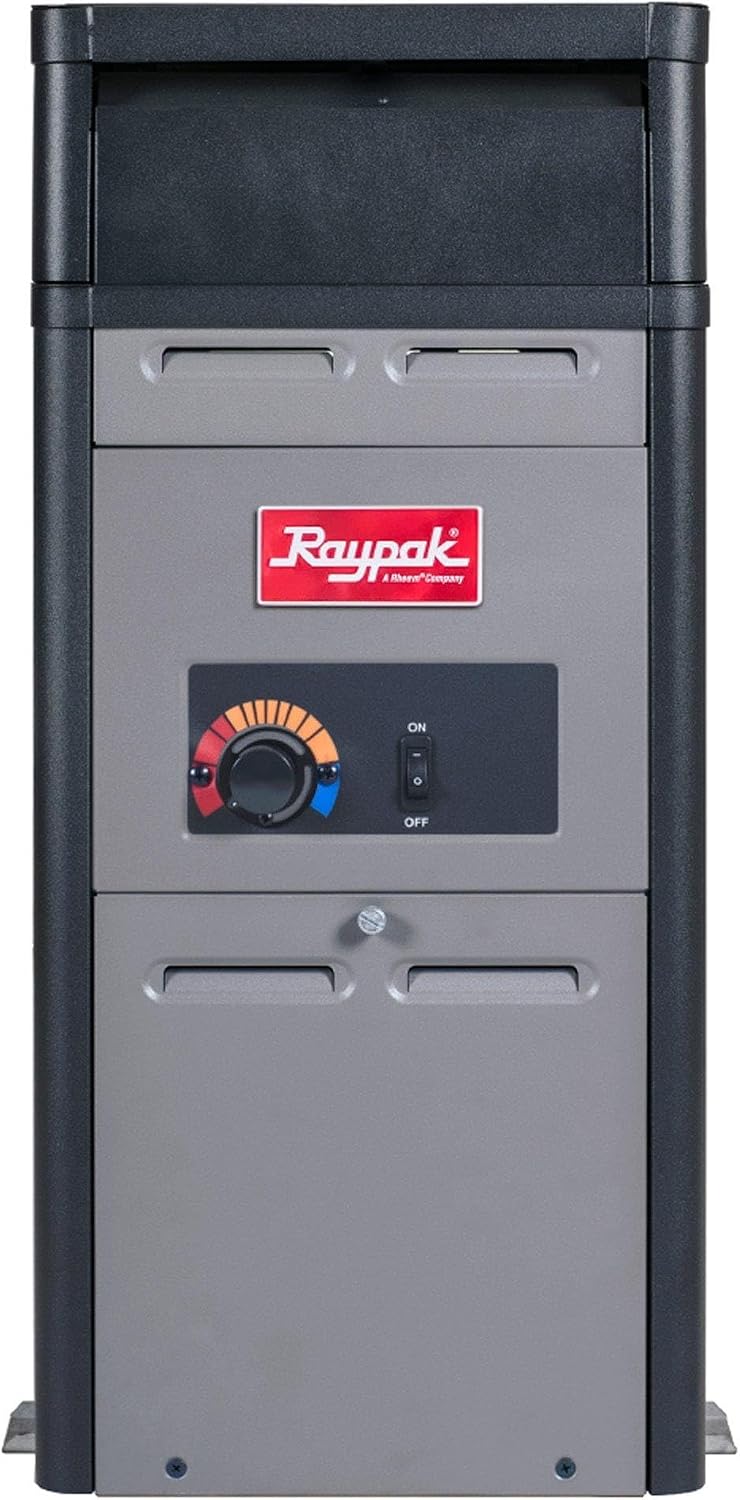
This 105,000 BTU propane heater is designed for above-ground pools and spas. It combines a polymer header with copper tubing for the heat-transfer system. The unit uses analog controls and is specified for installations at elevations from 0 to 1,999 feet.
Check On AmazonIf you click this link and buy, we earn a commission at no additional cost to you.
When a Gas Heater Is the Right Call
Gas heating earns its cost in a handful of specific situations, and it is worth being honest about which one actually describes your pool before you spend the money on a bigger unit. The clearest case is an owner who swims a couple of times a week and wants the water ready within a few hours of deciding to swim, using a heater sized with enough BTU output to make that turnaround realistic.
- Vacation or seasonal properties that sit unused for weeks and need the pool heated before arrival, since there is no reason to run a slower heater on a schedule nobody is around to manage during the week.
- Climates where a heat pump’s output and efficiency drop noticeably in cool air, which varies by model but tends to show up as air temperatures fall through the 50s, making a gas heater’s more consistent output the more reliable option.
- Properties that already have gas service near the pool area and, just as important, a line and meter sized to actually supply the heater’s BTU demand.
- Owners who want heat on demand for a specific event or weekend rather than a pool held at temperature all season.
If your situation lines up with more than one of those, and you size the heater’s BTU output to your pool’s volume rather than guessing, a gas heater is doing exactly the job it was built for. For a side-by-side look at how a heat pump handles the same pool sizes over a full season, our comparison of above ground pool heat pumps and their realistic runtimes walks through the slower, lower-cost alternative in more detail.

This 150,000 BTU natural gas heater is built for above-ground pools and spas and supports 120V or 240V installation. It uses corrosion-resistant polymer headers and 2-inch water connections. The unit is rated for elevations from 0 to 4,999 feet and is designed to be fully serviceable for long-term operation.
Check On AmazonIf you click this link and buy, we earn a commission at no additional cost to you.
When Gas Heating Stops Making Sense
Daily swimmers in a mild climate are usually better served by a heat pump, because the operating cost of running a gas heater every day outpaces what most owners are willing to spend once they see a full season of bills side by side. If your climate keeps air temperature comfortably mild through most of the swim season, a heat pump can maintain temperature efficiently without the faster recovery a large gas unit offers, and a daily swimmer does not usually need that recovery speed in the first place.
The other situation where gas heating stops making sense is a property without existing gas infrastructure sized for the heater’s demand. Running new gas service to a pool pad is not a small add-on, and it is the kind of cost that can quietly double the price of the whole heating project once a licensed contractor gives you the real number. I have seen owners get quoted for the heater itself, budget for that number, and then get blindsided by the installation estimate that follows. Before committing to a gas heater on cost alone, get the installation quote first, not last.
What Installation Actually Involves
Gas heaters are not a plug-in appliance the way some stock pump kits are. Connecting one requires a licensed plumber or HVAC technician, and many jurisdictions require a permit for gas appliance installation before the unit can legally run. Budget an additional 500 to 1,500 dollars beyond the heater’s purchase price for that connection work, and confirm the permit requirement with your local building department before you schedule anything.
Having a gas line somewhere near the pool area does not automatically mean the installation is simple. The existing line and meter need enough capacity for the heater’s BTU demand, the regulator needs to be rated for that load, and the distance from the meter to the heater affects both pipe sizing and installation cost. A technician can check gas line capacity, meter rating, and regulator sizing before you buy, and that check is worth doing before the heater, not after it is sitting in the driveway.
Propane models add one more layer: a tank on site and a periodic refill schedule, which is its own recurring task separate from the per-hour operating cost. None of this is meant to talk anyone out of a gas heater when it is the right fit. It is meant to make sure the number you are comparing against a heat pump actually includes the full installation picture, not just the heater price tag on the box. For a broader look at how a gas heater fits alongside the rest of your setup, our breakdown of above ground pool equipment and what each piece actually does covers where heating decisions sit relative to your pump, filter, and liner choices.
Estimate Your Real Heat-Up Time and Session Cost Before You Buy
Every heat-up time you see online, including the ones in this guide, is only an estimate until you run the numbers for your own pool. The calculation needs four things: your pool’s gallons, its starting temperature, the temperature you actually want to swim at, and the heater’s real BTU output rather than the input number printed on the box.
Start with the temperature rise you need. Multiply your pool’s gallons by 8.34 to get the weight of the water in pounds, then multiply that by the number of degrees you need to raise it. That gives you the total BTU required. Divide that number by the heater’s delivered BTU output, remembering that output typically runs 80 to 84 percent of the input rating printed on the unit, and you get a rough heating time under calm, covered conditions. Wind, evaporation from an uncovered surface, and cool overnight air will all stretch that estimate longer in practice, sometimes significantly.
Once you have a realistic time estimate, multiply it by the heater’s hourly operating cost at your local gas or propane price to get a real session cost, not a generic range pulled from a different pool size. Pair that with the installation check from the previous section, confirming your gas line, meter, and regulator can actually support the heater’s demand, and you have the full picture before you spend money: how long it will actually take, what one heating session will actually cost, and whether your property can support the heater you are looking at.

This 135,000 BTU natural gas heater uses a cupro-nickel heat exchanger designed for corrosion resistance in pool and spa environments. Its digital control panel lets you set water temperature and monitor performance, while low-NOx combustion reduces emissions. Hayward also uses a managed cupro-nickel water-flow system designed to protect key components and support efficient operation.
Check On AmazonIf you click this link and buy, we earn a commission at no additional cost to you.
Final Thoughts: Match the Heater’s Output to How You Actually Swim
The choice between a gas heater and a heat pump comes down to one honest question: are you heating the pool for a specific swim, or are you trying to hold it at temperature all season? A correctly sized gas heater is built for the first situation. It can get the water ready faster because gas heaters are commonly available at higher output levels and hold more consistent capacity in cool air than a typical heat pump, it costs more per hour to do it, and it makes the most sense for occasional use, vacation properties, and colder climates where a heat pump falls behind. If you are swimming daily in a mild climate, run the real numbers on a heat pump before you commit to gas, because the installation cost and the per-session price both add up faster than a heater’s sticker price suggests, and a heater sized wrong for your pool will not deliver the speed you bought it for either way.
FAQs
🔥 How long does it take to heat an above ground pool with a gas heater?
It depends on the heater’s BTU output relative to your pool’s volume. A 100,000 BTU input heater on a 4,440-gallon pool typically takes roughly 8 hours for a full 17-degree heat-up, while a larger 250,000 BTU input unit on the same pool can do it in roughly 3 hours.
💰 How much does it cost to run a gas heater for an above ground pool?
A 100,000 BTU natural gas heater typically runs 1 to 2 dollars per hour, and a larger 250,000 BTU unit runs closer to 2 to 4 dollars per hour. Propane costs more per BTU than natural gas, so a propane heater runs higher than either range.
⛽ Is propane or natural gas better for an above ground pool heater?
Natural gas is cheaper per BTU in most markets, so it costs less to operate if you already have a gas line to the pool area. Propane makes sense when no gas line exists, but plan for a tank and periodic refills on top of the higher per-hour cost.
🔧 Do I need a permit to install a gas heater on my above ground pool?
Many jurisdictions require a permit for gas appliance installation, and the connection itself needs a licensed plumber or HVAC technician. Check with your local building department before scheduling installation, since this requirement varies by area.
📏 Does having a gas line near the pool mean installation will be simple?
Not necessarily. The existing line, meter, and regulator need enough capacity for the heater’s BTU demand, and distance from the meter to the heater affects pipe sizing and cost. Have a technician check capacity before you buy the heater, not after.
❄️ Does a gas heater work better than a heat pump in cold weather?
Generally yes, because a gas heater generates heat directly rather than pulling it from the surrounding air, so its output stays more consistent as air temperature drops. Heat pump efficiency and output vary by model, but most lose ground in cool air, which is where gas heating tends to hold its advantage.