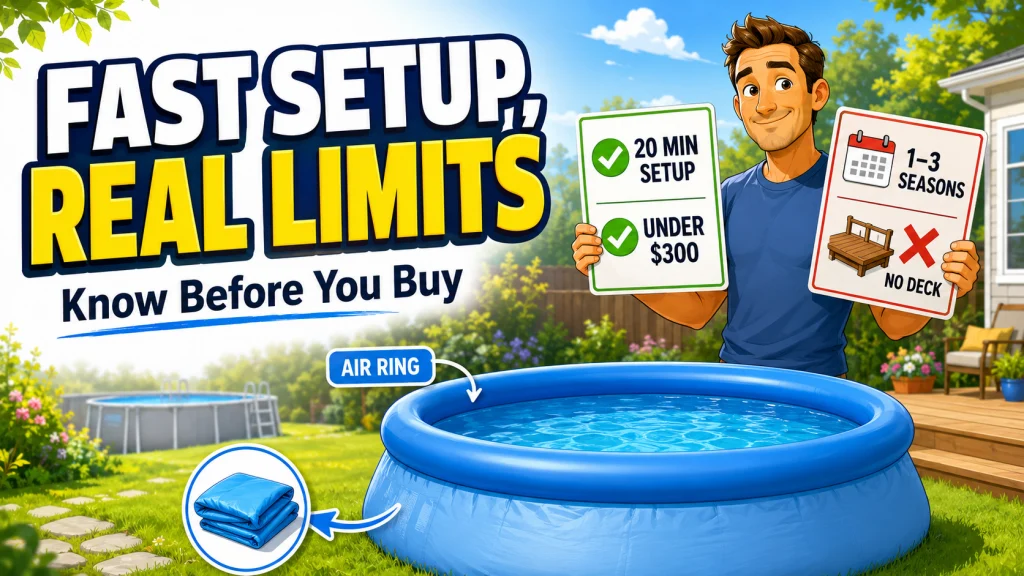
An inflatable above ground pool gets you in the water for under 300 dollars with about 20 minutes of setup and no tools. It also tops out at a 1 to 3 season lifespan, can’t support a deck, and on the larger models the pump that ships in the box is not sized for the water it has to move. I have set up and serviced enough of these to know exactly where they earn their keep and where they get returned to the garage by August. This covers what an inflatable Easy-Set style pool actually delivers, where the stock pump falls short on bigger sizes, and who should buy one instead of stepping straight into a frame pool.
What an Inflatable Above Ground Pool Actually Gets You
Picture a renter with a backyard for the first time in July, or a parent who wants something for the kids by the weekend, not by next month. That’s who usually ends up looking at an inflatable above ground pool. It holds its shape a different way than every other pool in this category. There’s no metal frame to bolt together. Instead, an air-filled ring runs around the top edge, and once you start filling it with water, the weight of that water pushes the walls outward and holds the whole thing upright. No poles, no top rails, no tools. For a first-time buyer working against a deadline, that simplicity is the whole appeal, and it’s a fair reason to buy one.
What it isn’t is a permanent backyard fixture. I tell people to think of it as a seasonal appliance, not an installation, and understanding that upfront saves you from feeling let down later.
How the Easy-Set Design Actually Holds Water
The inflatable ring at the top isn’t decorative. It’s doing the same job a steel top rail does on a frame pool, just with air pressure instead of metal. You inflate the ring, run a garden hose in, and as the water climbs the vinyl walls stretch tight against that inflated collar. An Intex Easy-Set pool is the model most people picture when they hear “inflatable pool,” and it’s the design that popularized this whole category. Once it’s full, the setup is done. There’s no cove to dig, no frame to level, and no second person needed to hold anything in place while you work.
That’s also why setup runs about 20 minutes for most sizes, start to finish, water fill included on the low end. Compare that to a steel frame pool, where ground prep alone usually eats an entire afternoon before you’ve even touched the liner. The tradeoff for that speed shows up later, and it’s worth understanding before you buy.
What You Actually Get for the Money
Cost is the first thing people ask about, and it’s genuinely the lowest entry point in the above ground category. Most inflatable models run 100 to 300 dollars complete, and “complete” means something here: the pump, the drain plug, sometimes a ladder or filter cartridge, all in one box. You’re not pricing out a pump separately or hunting down a compatible filter size afterward.
There’s also a practical off-season advantage nobody mentions in the glossy listing photos. Deflate the ring, drain it, and it folds down flat enough to store in a closet or the trunk of a car. If you’re renting, or you know you’re moving in a year or two, that portability is a real reason to pick an inflatable pool over a frame pool that has to be broken down piece by piece and stored as a stack of poles.
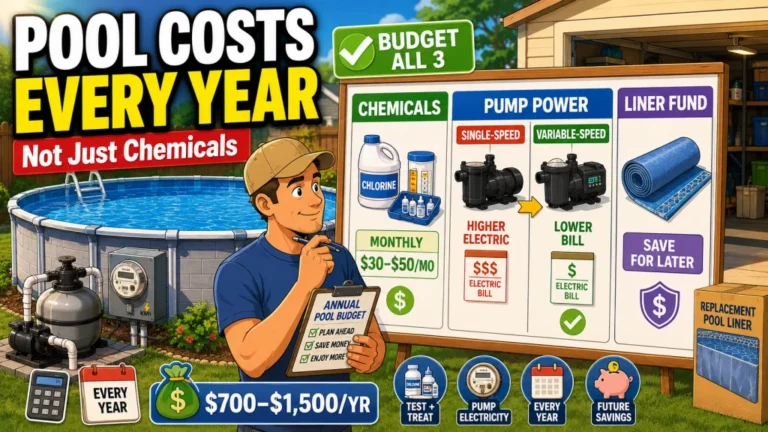
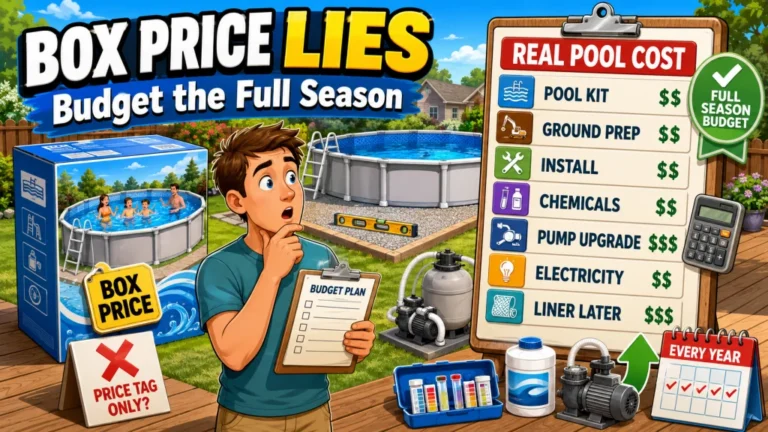
The real cost of owning one isn’t just the sticker price, though. Over a season or two you’re realistically buying a filter cartridge or two as the original one clogs, a vinyl patch kit for the small puncture that almost always shows up by August, and maybe a basic pool cover to keep leaves out between uses. None of that adds up to much on top of the pool itself, but it’s worth budgeting for so the “under 300 dollars” sticker price doesn’t come as a surprise once the pool’s actually been in use for a few weeks.

This 10-ft by 30-in round inflatable pool holds 1,018 gallons and is ready for water in about 10 minutes. The set includes a 330 GPH cartridge filter pump with dual-suction fittings and HydroAeration Technology, along with one Type H cartridge, providing improved circulation, filtration, and water clarity. Built with puncture-resistant 3-Ply PVC, the pool comes with a patch for easy repairs. All Intex products include a 180-day manufacturer limited warranty.
Check On AmazonIf you click this link and buy, we earn a commission at no additional cost to you.
What You Give Up Compared to a Frame Pool
The inflatable ring that makes setup easy is also the reason this pool can never be part of a deck. Deck integration needs a rigid top rail to attach hardware to, and there’s nothing rigid up there to attach to. If a finished deck around the pool is part of your plan at all, an inflatable model takes that option off the table before you even fill it with water.
Depth is limited too, usually 30 to 48 inches depending on the model, which keeps these squarely in splash-and-cool-off territory rather than actual swimming depth. Add in that the vinyl walls puncture more easily on rough ground or with sharp pool toys, and you’ve got a pool that’s genuinely disposable in the way a frame pool isn’t. Most owners get 1 to 3 seasons out of one before a puncture, UV fading, or a failed seam ends it. That’s not a defect. It’s the design tradeoff for the low price and the 20-minute setup.
| Pool Size | Stock Pump Range | Minimum Turnover Needed | Verdict |
|---|---|---|---|
| Under 10 ft | 330 to 530 GPH | Roughly matches stock pump | Adequate as shipped |
| 15 ft (26 in depth, ~2,587 gal) | 530 GPH | ~325 GPH minimum | Meets minimum on paper, thin real world margin |
That table is the short version of a problem that only shows up once you size up. Small inflatable pools and larger ones don’t play by the same rules, and the pump is where that difference actually costs you something.

This 6-pack of vinyl repair patches is designed for Intex products, offering handy extras for quick fixes. Each patch measures 7.5 sq. in. and applies easily by drying the torn area, removing the adhesive cover, and pressing it onto the damaged spot.
Check On AmazonIf you click this link and buy, we earn a commission at no additional cost to you.
The Pump Sizing Problem Nobody Mentions at Checkout
Here’s the disclosure I think every buyer of a larger inflatable pool deserves before they hit purchase. The 15-foot Easy-Set style pool, in its shallower 26-inch depth version, ships with a 530 GPH cartridge pump. That pool holds around 2,587 gallons, and the mathematical minimum turnover rate for that volume works out to roughly 325 GPH. The stock pump technically clears that number, but only on paper. Once you account for hose length, filter resistance, and a summer of leaves and sunscreen loading up the cartridge, there’s almost no real world margin left.
In practice, that means the water on a 15-foot inflatable pool takes noticeably longer to turn over than it should, and that shows up as cloudier water and more frequent algae fights, especially in hot weather when bather load and sun exposure both spike. The pump isn’t broken. It’s just sized to the bare minimum for the pool it was boxed with, which is a common pattern across entry-level kits, not a flaw specific to one brand.
Field Note: I have swapped out more stock pumps on 15-foot Easy-Set style pools in their first season than in every season after combined. A 1,500 to 2,000 GPH replacement pump is the practical target for reliable clarity on a pool this size, not the bare mathematical minimum. That upgrade cost should be part of your real budget for the pool, not an afterthought when the water turns green in July.
Smaller models don’t have this problem. Anything under 10 feet in diameter sits close enough to its stock pump’s range that the included equipment genuinely does the job. The pump sizing gap is specifically a larger-model issue, and it’s the single biggest thing separating “this pool was worth it” from “I should have bought the next size up in a frame pool instead.”

This pump uses HydroAeration Technology to improve water circulation, filtration, clarity, and negative ion levels at the surface. It delivers a 1,500 GPH flow rate at the pump and 1,180 GPH in the pool, suitable for Intex above ground pools up to 9,400 gallons with a 1.25 inch hose fitting. Installation just requires hooking up the hoses and plugging in, with partial assembly needed. It uses easy to clean Type A Dacron paper cartridges, which should be replaced every 2 weeks.
Check On AmazonIf you click this link and buy, we earn a commission at no additional cost to you.
Who an Inflatable Pool Is Actually Right For
None of this makes an inflatable pool a bad purchase. It makes it a specific-purpose purchase, and once you match it to the right situation it’s genuinely a good one. I’d point a buyer toward this category over a frame pool in a few clear situations:
- Renters who can’t dig, level ground, or leave a permanent structure behind when the lease ends
- Families with young kids who want a splash pool for a summer or two, not a swimming pool
- First-time owners who want to test whether above ground pool ownership is something they’ll actually keep up with before committing to a frame pool and a multi-year liner
- Anyone working with a hard budget ceiling under 300 dollars for the whole setup
That said, plenty of buyers search for an inflatable pool for adults expecting something closer to a real swimming pool, and that’s usually where the disappointment starts. These are shallow, portable, short-lifespan pools by design. If you want to swim laps, host more than a couple of adults at once, or build any kind of deck around the pool, an inflatable model is the wrong tier to buy into, no matter how good the price looks.
When You Should Skip the Inflatable Tier Entirely
If you already know a deck, real swimming depth, or more than a season or two of use is part of your plan, buying inflatable first is usually a detour rather than a savings. You’ll end up back at a frame pool anyway, having spent money on equipment that doesn’t carry over. In that case, reading up on how a soft-sided frame pool compares or how all the above ground pool types compare will point you toward the format that’s actually rated for what you’re planning, rather than one you’ll be replacing by next summer.
A quick way to check yourself: if you’re picturing this pool still being in the yard next July, or you’re already thinking about what the deck around it might look like, that’s a sign you skipped a step. Those plans belong to a frame pool from the start, and starting there saves you the cost of an inflatable model you’ll outgrow before the season’s over.
Final Thoughts: Buy the Tier That Matches Your Actual Plans
An inflatable above ground pool does exactly what it’s built to do: get you swimming fast and cheap, without any real setup skill required. Where it disappoints people is when it gets bought as a stand-in for a pool they actually wanted to keep for years, or sized up without anyone mentioning the pump math from earlier. Match the pool to how long you actually plan to keep it, and this tier does its job well. If your plans have already outgrown it, start with our guide to picking the right pool instead.

This 15-ft by 48-in round inflatable pool holds 3,736 gallons and is ready for water in about 15 minutes. The set includes a 1,000 GPH cartridge filter pump with dual-suction fittings and HydroAeration Technology, one Type A cartridge, a ladder, pool cover, and ground cloth. Built with puncture-resistant 3-Ply PVC, the pool comes with a patch for easy repairs. All Intex products include a 180-day manufacturer limited warranty.
Check On AmazonIf you click this link and buy, we earn a commission at no additional cost to you.
FAQs
🏊 How long does an inflatable above ground pool actually last?
Most inflatable models last 1 to 3 seasons before a puncture, UV fading, or a seam failure ends them. Storage habits and how careful you are with sharp pool toys and rough ground both affect where you land in that range.
⏱️ How long does it take to set up an inflatable above ground pool?
About 20 minutes for most sizes, including inflating the top ring and starting the water fill. There’s no frame to assemble and no ground leveling required, which is the main reason people choose this tier.
🔧 Is the stock pump enough for a 15-foot inflatable pool?
It’s tight. A 15-foot model in the 26-inch depth version holds around 2,587 gallons, needing roughly 325 GPH minimum turnover. The 530 GPH pump that ships in the box clears that number on paper, but hose resistance and filter load erase most of the margin in practice.
💧 What is the best inflatable above ground pool for a tight budget?
Any model under 10 feet in diameter is the safer budget pick, since the stock pump range on those sizes genuinely matches what the pool needs. Once you go to 15 feet, budget in a pump upgrade as part of the real cost.
🏗️ Can I build a deck around an inflatable above ground pool?
No. Deck attachment needs a rigid top rail, and an inflatable pool’s top ring is air-filled, not structural. If a deck is part of your plan, a frame pool is the right tier, not an inflatable one.
👨 Is an inflatable pool for adults deep enough to actually swim in?
Not really. Most inflatable models run 30 to 48 inches deep, which is splash-and-cool-off depth rather than swimming depth. Adults who want to swim laps or host more than a couple of people at once are better served by a frame pool.