Both Intex and Bestway build a pump into most of their complete above ground pool sets, and the number printed on the box is not always the number that matters. In this guide I run the turnover rate math against the real system flow rates on Intex’s Krystal Clear pumps and Bestway’s Flowclear pumps, not just the bigger pump flow number on the label, so you can tell whether your kit pump is actually keeping up. I also cover what an upgrade looks like in practice, and why moving an Intex pump onto a Bestway pool, or the other way around, is more of a plumbing project than a quick swap. This is a pump-only comparison. If you are deciding between a full Intex setup and a full Bestway setup, that is a different question than the one answered here.
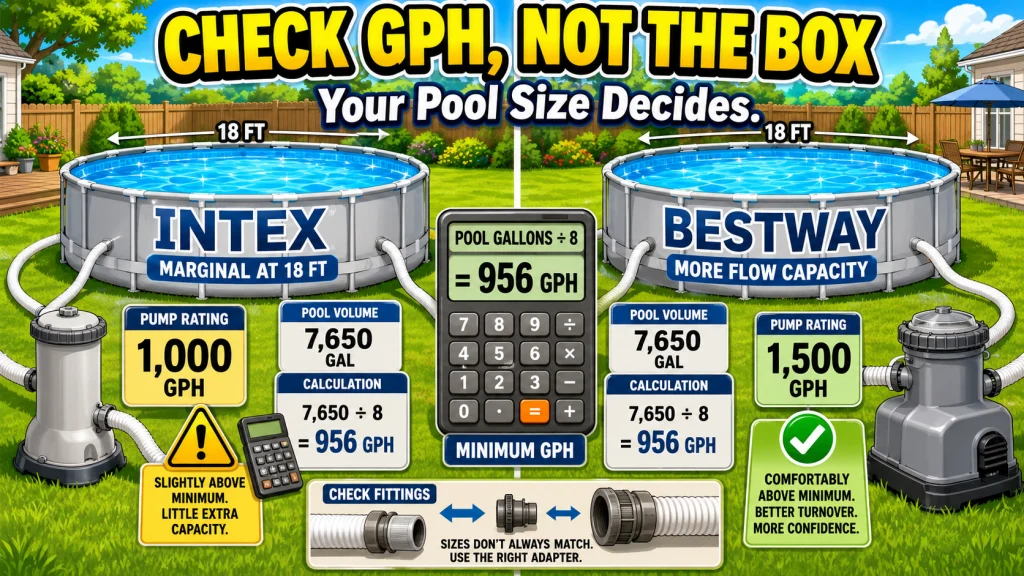
Why the Number on the Pump Box Isn’t the Whole Story
I have set up Intex kits and Bestway kits back to back in the same week, and the pump that comes in the box is the part buyers trust the most and check the least. Comparing Intex and Bestway pumps does not start with brand loyalty. It starts with reading the right number: how many gallons per hour the pump actually pushes through the whole system, filter and all, not just the larger figure printed on the housing. An above ground pool stock pump is sized by the manufacturer for that specific model, and the honest way to check it is against your pool’s real gallon capacity, not against its diameter alone.
Here is the practical test before you look at any model number: divide your pool’s gallon capacity by 8, and that is the minimum flow rate the pump needs to hit for one full turnover in an 8-hour window. The catch is which flow number you use for that comparison. Pump manufacturers publish two different figures for the same pump, and mixing them up is where most turnover calculations, including some I have seen published elsewhere, go wrong. The next section walks through the difference before we get to specific pumps and pool sizes.
Pump Flow Rate vs. System Flow Rate: Which Number to Use
Every cartridge pump has a pump flow rate, which is how fast the motor can move water on its own, and a system flow rate, which is how fast water actually moves once it has gone through the hoses, the cartridge, and the fittings. The pump flow rate is the bigger, more marketable number, and it’s what gets printed largest on the box. The system flow rate is the one that actually determines how long a real turnover takes, and manufacturers publish it too, just in smaller print.
| Pump | Pump Flow Rate | System Flow Rate | Listed Maximum Pool Capacity |
|---|---|---|---|
| Intex C530 Krystal Clear | 530 GPH | 475 GPH | up to 3,800 gal. |
| Intex C1000 Krystal Clear | 1,000 GPH | 750 GPH | up to 6,000 gal. |
| Intex C1500 Krystal Clear | 1,500 GPH | 1,180 GPH | up to 9,400 gal. |
| Bestway Flowclear 1,000 GPH cartridge | 1,000 GPH | 780 GPH | up to 5,100 gal. |
| Bestway Flowclear 1,500 GPH cartridge | 1,500 GPH | ~1,050 GPH | up to 8,400 gal. |
Look at the gap between the two columns. The Intex C1000 loses a quarter of its advertised flow by the time water has gone through the filter, and the Bestway 1,000 GPH cartridge pump loses about the same share. That is not a defect. It is simply how a cartridge filter works, and both manufacturers publish the real number if you look past the headline figure. Any Intex pump vs Bestway pump comparison has to compare the same column on both sides. Comparing an Intex pump flow rate against a Bestway system flow rate makes one brand look better than it is for no real reason.
Field Note: Product listings do not always surface the same measurement first. One retailer page may lead with pump flow rate in the title and bury system flow rate further down the specification list, while another lists system flow rate more prominently. Comparing the number that happens to be easiest to find on each page, instead of the same measurement on both, is an easy way to end up with an apples-to-oranges conclusion. Always check the specification list for both figures before comparing two different pumps.
With that distinction in hand, the turnover math in the next section uses system flow rate throughout, since that is the number that tells you what your pool is actually getting.

This 1,000 GPH Flowclear filter pump is recommended for 300 to 5,100-gallon above ground pools. Its 110 to 120-volt energy-saving plug includes an automatic shutoff timer that can run the pump for up to 10 hours per cycle. The pump works with Type III-A/C filter cartridges and is compatible with almost all leading above ground pool brands.
Check On AmazonIf you click this link and buy, we earn a commission at no additional cost to you.
The Turnover Rate Math, Run on Real Pool Capacities
Turnover rate is the time it takes a pump and filter to cycle the pool’s full water volume once. For this guide, I’m using one full turnover every 8 hours as the practical sizing benchmark, since it lines up with how Intex rates its own pump capacities. It is not the only number in circulation: Bestway’s own sizing guidance recommends a shorter turnover window, closer to 6 hours, for some of its filter pump lineup, so treat 8 hours as a useful benchmark rather than a fixed industry rule, and check your own manufacturer’s operating guidance if it says otherwise. Whichever window you use, turnover is a sizing benchmark rather than a guarantee. Chemistry, filter condition, circulation pattern, and bather load still matter for clear water, and a pump that clears turnover in 6 hours can still sit in a green pool if the chlorine and pH aren’t managed. Turnover just tells you whether the equipment itself has the capacity to do its part.
| Pool Model | Manufacturer Water Capacity | Stock Pump (System Flow) | Turnover Time |
|---|---|---|---|
| Bestway Steel Pro MAX 15′ x 48″ | 4,231 gal. (90% full) | Flowclear 1,000 GPH cartridge, 780 GPH system flow | ~5.4 hours |
| Intex Prism Frame 18′ x 48″ | 6,423 gal. (90% full) | C1500 Krystal Clear, 1,180 GPH system flow | ~5.4 hours |
Those two current kits both clear turnover with real margin to spare. That doesn’t prove every kit on the market is sized correctly, it only proves these two specific model-and-pump combinations are. It does show why the exact pool-and-pump pairing matters more than the brand name stamped on the box. Where the math gets tight is when the pump isn’t the one the pool actually shipped with, either because it’s an older kit, a resale pool with a swapped part, or a standalone replacement bought on price rather than on spec.
Field Note: Intex’s own product listing shows the 18-foot Prism Frame pool bundled with the 1,500 GPH pump today. Older Intex 18-foot frame pools, and some resale listings I still see, were bundled with the 1,000 GPH pump instead. Run the math on that combination: a 6,423-gallon pool against a 750 GPH system flow comes out to about 8.6 hours, just over the 8-hour target. It’s not a dramatic miss, but it’s the kind of gap that matters once summer heat and a full afternoon of swimmers are added on top.
That’s the real lesson behind the mandatory disclosure I’d give any buyer sizing a 15-foot or larger pool: know your model’s actual published water capacity, know the system flow rate of the exact pump attached to it right now, and run the division yourself rather than trusting the pool’s diameter or the pump’s headline GPH number.
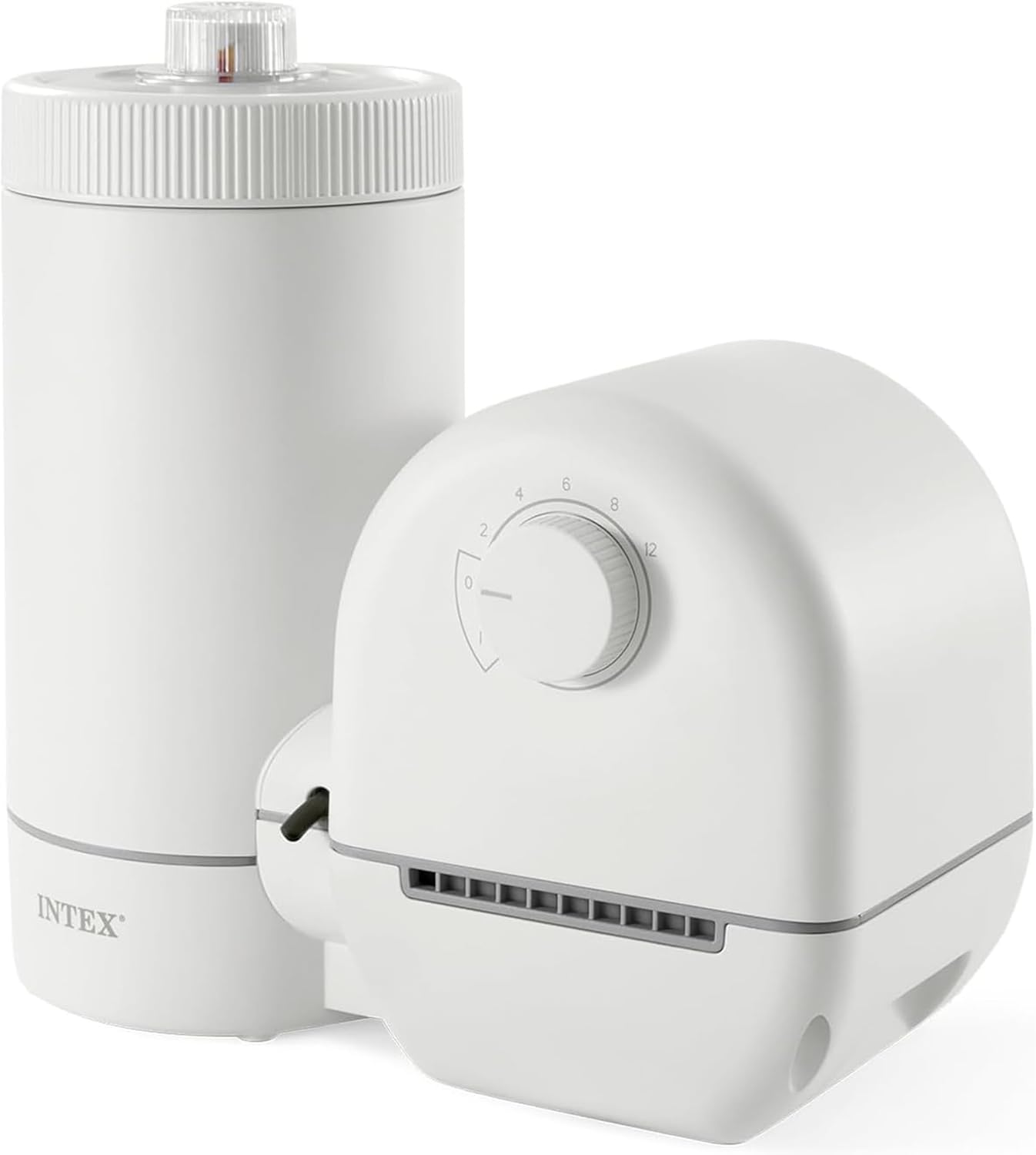
This 1,500 GPH cartridge filter pump is listed for above ground pools from 700 to 9,400 gallons. It uses a replaceable Dacron cartridge and a gauge indicator that signals when the filter needs attention. A built-in 2 to 10-hour automatic cycle supports scheduled filtration, while HydroAeration Technology improves circulation. It includes a 2-year limited warranty.
Check On AmazonIf you click this link and buy, we earn a commission at no additional cost to you.
What the Intex Krystal Clear Lineup Actually Covers
Intex sells the Krystal Clear cartridge pump in several tiers, and which one ships with a given pool depends on the exact model and model year, not just the diameter. The C530 (475 GPH system flow) is rated by Intex for pools up to 3,800 gallons, and it’s compatible with several 12-foot and some 13 to 15-foot Easy Set models. Because Easy Set pools have sloped, soft sides rather than vertical walls, a 15-foot Easy Set holds meaningfully less water than a 15-foot rigid frame pool of the same diameter, so don’t assume the C530 is automatically wrong just because “15-foot” is in the pool’s name. Check the specific model’s published gallon capacity against the 475 GPH system flow before deciding either way.
The C1000 (750 GPH system flow) is Intex’s mid-tier pump, rated up to 6,000 gallons and compatible with 18-foot Easy Set pools and 18 to 20-foot frame pools in Intex’s own listings. That puts it right at the edge for larger 18-foot models: a pool near the top of that 6,000-gallon rating will turn over in just under 8 hours, while a pool closer to the Prism Frame’s 6,423-gallon capacity will run closer to 8.6 hours with this pump alone. The C1500 (1,180 GPH system flow), which Intex now bundles with the 18-foot Prism Frame set, clears that same pool with real margin. If you’re comparing pump tiers across pool sizes in the same product line, comparing Intex and Bestway pools by size breaks down which pump ships with which specific model in more depth than a pump-only comparison can.

This cartridge pump delivers 530 GPH pump flow and 475 GPH system flow for INTEX above ground pools up to 3,800 gallons. It uses a Type A Dacron filter cartridge and 1.25-inch hose fittings. HydroAeration Technology supports circulation and filtration, while the cartridge is designed for routine cleaning and replacement. A 2-year manufacturer limited warranty is included.
Check On AmazonIf you click this link and buy, we earn a commission at no additional cost to you.
What the Bestway Flowclear Lineup Actually Covers
Bestway’s cartridge pump lineup follows a similar pattern to Intex’s. The 1,000 GPH Flowclear cartridge pump (780 GPH system flow) is rated for pools up to 5,100 gallons and is the pump bundled with the Steel Pro MAX 15′ x 48″ set, which holds 4,231 gallons, well inside that rating. The 1,500 GPH Flowclear cartridge pump carries a system flow of roughly 1,050 GPH and is rated for pools up to 8,400 gallons by retailers selling it, which covers most 18-foot Bestway models with room to spare. Bestway’s smaller pool tiers, such as the 14′ x 33″ Steel Pro MAX, ship with a 530 GPH pump; Bestway doesn’t publish a system flow figure as consistently for that smaller tier, so check the spec sheet for your exact model rather than assuming it scales the same way as the larger pumps.
When buyers compare the Bestway Flowclear against the Intex Krystal Clear, flow rate is usually only half the question. The other half is noise, and it’s a place Bestway tends to hold a real edge. Independent testing from zwembadwijzer.nl found the Flowclear pump measurably quieter than the standard Intex pump. That lines up with what I hear from owners in tighter suburban yards where the pump sits ten feet from a bedroom window. A quieter pump doesn’t filter any better, but if you’re running it 10 to 12 hours a day through a hot stretch, the noise difference is the kind of thing that actually changes whether an owner leaves it running long enough to matter.
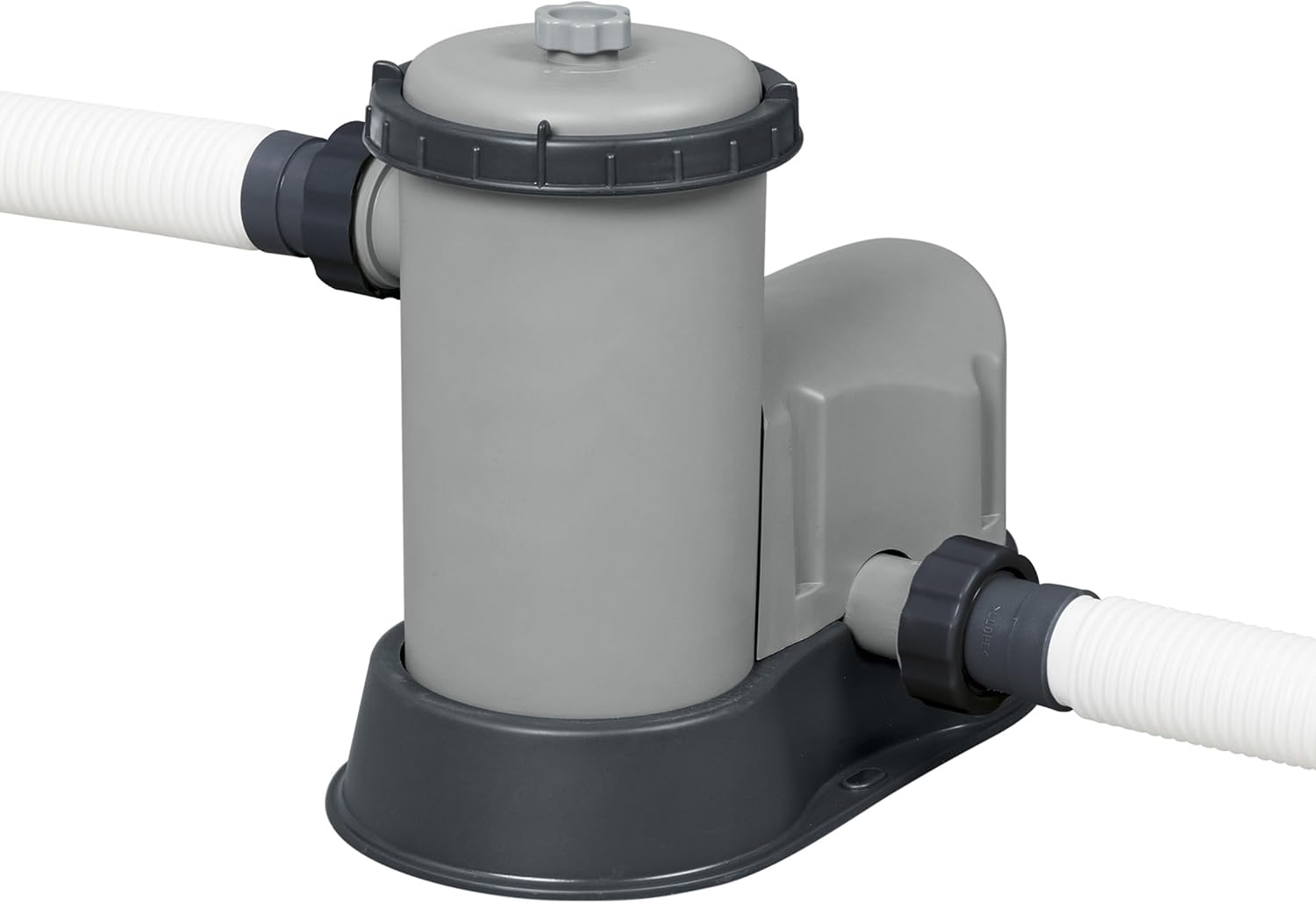
This Flowclear filter pump is listed for above ground pools from 300 to 8,400 gallons and works with Type III or Type A/C filter cartridges. Amazon lists a 1,050 GPH flow figure in its specifications and recommends six hours of daily operation. The product description also notes an energy-saving plug with a timer that can run for up to 10 hours.
Check On AmazonIf you click this link and buy, we earn a commission at no additional cost to you.
When It’s Worth Upgrading Beyond the Stock Pump
Whether an upgrade makes sense comes down to four things: your pool’s actual gallon capacity, the system flow rate of the pump currently attached to it, how much of a margin that leaves against the 8-hour target, and how the filter performs once it’s a few weeks into the season and slightly dirty. A pool sitting a full hour or more past the 8-hour benchmark, or one running an older or mismatched pump like the C1000-on-a-Prism-Frame combination above, is a reasonable candidate for a dedicated aftermarket pump. Choose that replacement by its published system flow rate, not by the pump-flow number in the product name. Plenty of suitable aftermarket pumps are marketed in the 1,500 to 2,000 GPH pump-flow class, the same class as the Bestway Flowclear pump earlier in this guide, but it’s the system flow figure underneath that number that actually decides whether the upgrade closes your specific gap. A pump in that class, once you’ve confirmed its real system flow, typically costs between $100 and $200. The stock pump doesn’t have to go in the trash. I usually tell owners to keep it as a backup or a vacuum-only pump, since it still works fine, it’s just outmatched as the sole filtration source once the numbers say so.
Before buying anything, check three things on your current setup: the fitting size on your pool wall (most Intex and Bestway pools use either 1.25-inch or 1.5-inch connections), whether your outlet is GFCI-protected the way the pump requires, and whether you want a built-in timer or plan to add one separately. Skipping that check is the single most common reason an above ground pool pump upgrade turns into two trips to the hardware store instead of one.
- Find your pool’s manufacturer-published water capacity, not just its diameter, before comparing any pump numbers.
- Use system flow rate, not pump flow rate, when you run the turnover calculation.
- Match the new pump’s hose fitting size to your pool’s existing connections.
- Check that your outdoor outlet has GFCI protection before you plug anything in.
- Decide whether the old pump gets kept as a backup or used only for manual vacuuming.
That list is the same sequence I walk through on a service call, and it applies whether you’re staying with your current brand or shopping outside it. Brand switching is where the next complication shows up, and it’s worth understanding before you order anything.
Why an Upgrade Usually Means Staying in One Brand
If you’re upgrading from a Bestway stock pump to an Intex replacement pump, or the reverse, the fittings are not a guaranteed match. Bestway hoses commonly run 40mm while Intex has shipped both 1.25-inch and 1.5-inch connections depending on the model year, and a TroubleFreePool discussion on Intex and Bestway hose compatibility lays out exactly how often owners end up hunting for the right adapter rather than finding a direct fit. Adapters do exist, but they add another seal that can leak, another part that can crack, and another trip to a hardware store that may not stock the exact size needed.
Buying whichever pump is cheapest or best-rated online without checking the brand of your actual pool, then discovering the threads don’t match once it arrives.
If you’re shopping for a Bestway pump replacement or an Intex one, starting within that same brand’s lineup first removes the fitting question entirely, and only crossing brands once you’ve confirmed the exact hose diameter and adapter needed.
My practical recommendation for most owners is to buy within the same brand for both replacements and upgrades. If you do decide to cross brands, treat the adapter as a real line item in your budget and installation time, not an afterthought. For the bigger picture on how these two brands compare as complete systems, not just on pumps, the full Intex vs Bestway above ground pool comparison covers frame strength, liner type, and price tier side by side.
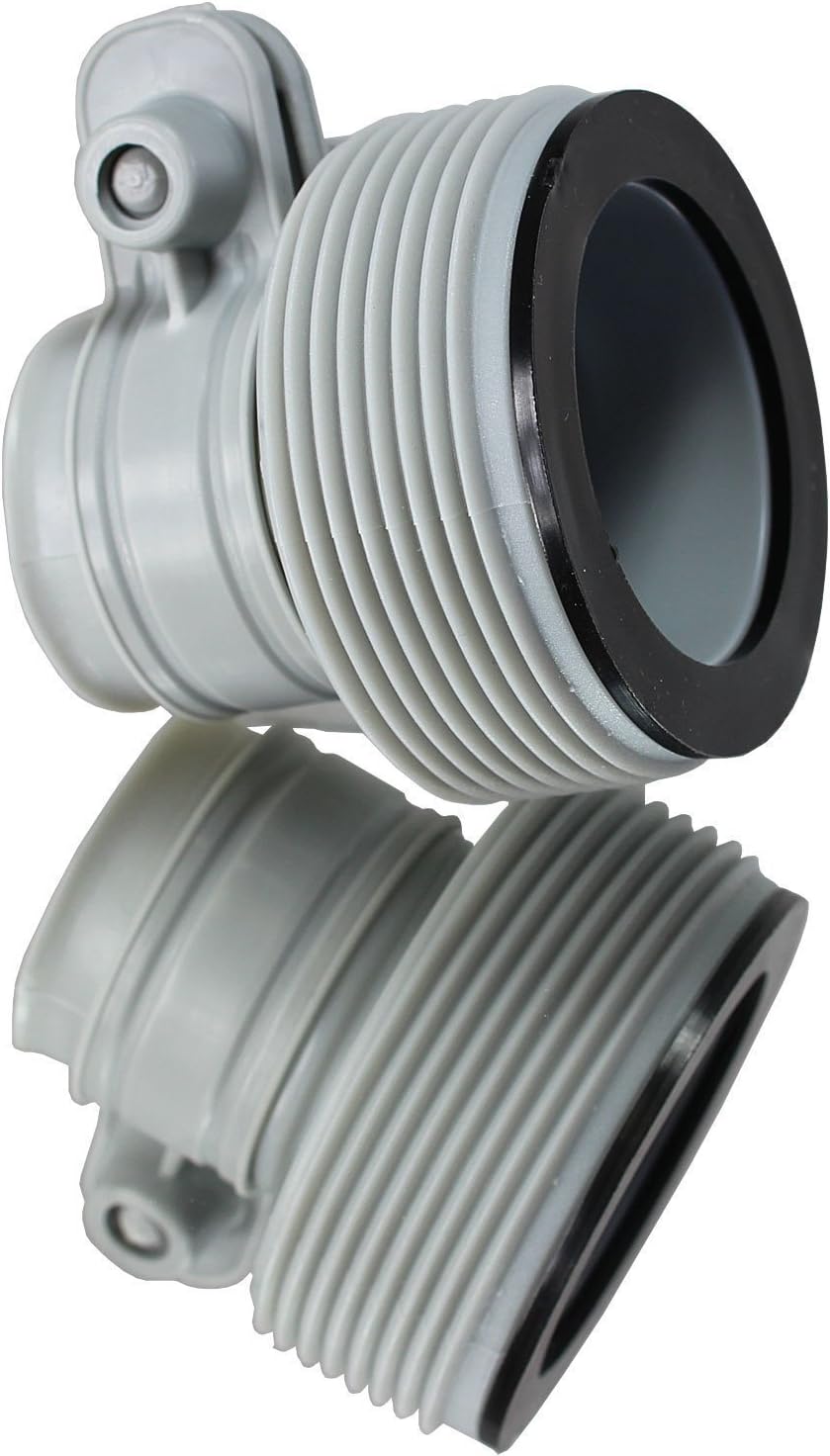
This set includes two Type B hose adapters for converting INTEX pool fittings from 1.25 inches to 1.5 inches. It is designed for upgrades from a 1,000 GPH INTEX pump or smaller to a 1,500 GPH pump or larger. Two adapters are generally needed for a larger pump connection, and the listing identifies the parts as 10722/25009.
Check On AmazonIf you click this link and buy, we earn a commission at no additional cost to you.
Final Thoughts: Check the System Flow Rate Before You Judge the Pump
Neither brand hides what its pump does. The specifications, both the flashy pump flow number and the smaller system flow number underneath it, are published right on the product page. The mistake I see over and over isn’t a bad pump, it’s the wrong number being used to judge it. Today’s manufacturer-matched kits, an Intex Prism Frame 18-footer with its C1500 pump or a Bestway Steel Pro MAX 15-footer with its 1,000 GPH Flowclear, both clear an 8-hour turnover with real margin when you check the actual system flow rate against the actual water capacity.
The risk shows up when a pump gets separated from the model it was designed for: an older kit still running last decade’s smaller pump, a resale pool with a swapped part, or a standalone replacement bought on price instead of spec. Before you conclude your stock pump is fine or decide it needs replacing, find your model’s published water capacity, find the system flow rate of the pump currently attached to it, and do the division yourself. If you’re still deciding on pool size and want the broader buying picture beyond pumps, picking the best above ground pool for your yard walks through frame types, liner life, and budget tiers together. And if your current pump is already failing rather than just questionable on paper, start by sourcing replacement parts for Intex and Bestway pumps before assuming a full upgrade is your only option.
FAQs
🔧 Is the stock pump enough for an 18-foot above ground pool?
It depends on which exact pump is attached to your pool, not just its diameter. Today’s Intex Prism Frame 18-footer ships with a 1,500 GPH pump that clears turnover comfortably, but older 18-foot Intex kits shipped with a smaller 1,000 GPH pump that runs close to the 8-hour target. Check your model’s published water capacity against your pump’s system flow rate, not its pump flow rate, to know for sure.
⏱️ How long should I run my above ground pool pump each day?
Enough hours to complete one full turnover of your pool’s volume, which for most residential setups means aiming for the 8-hour turnover standard. Hotter weather, heavier bather use, and an undersized pump all push that number higher, and turnover is a sizing benchmark rather than a guarantee of clear water.
🔄 Can I use an Intex pump on a Bestway pool?
Sometimes, but the fittings are not guaranteed to match without an adapter. Bestway and Intex have used different hose diameters across different model years, so check your exact connection size before buying, and budget for an adapter if you cross brands.
💧 How do I calculate the right pump size for my pool?
Find your pool’s manufacturer-published water capacity and divide it by 8 to get the minimum system flow rate needed for a full turnover in 8 hours. Compare that number against your pump’s system flow rate, printed near the smaller pump flow number on the spec sheet, not the larger headline figure.
🧰 Is the Bestway Flowclear pump quieter than the Intex Krystal Clear pump?
Independent testing has found the Flowclear pump measurably quieter than the standard Intex pump. It doesn’t filter any better because of that, but it matters if your pump sits close to a house or a neighbor’s yard and runs most of the day.
💰 How much does an above ground pool pump upgrade cost?
A dedicated aftermarket pump with enough system flow rate to close your specific gap typically costs between $100 and $200. Shop by the system flow number, not the pump-flow class in the product name, and that range is worth considering once your pool’s turnover time runs a full hour or more past the 8-hour benchmark.
Sources and References
- Intex’s C530 Krystal Clear pump flow rate and system flow rate specifications
- Intex’s C1000 Krystal Clear pump flow rate and system flow rate specifications
- Intex’s C1500 Krystal Clear pump flow rate and system flow rate specifications
- Intex’s Prism Frame 18′ x 48″ pool set water capacity and included pump
- Bestway’s Steel Pro MAX 15′ x 48″ pool set water capacity and included pump
- Bestway’s 1,000 GPH Flowclear pump flow rate and system flow rate specifications
- Bestway’s 1,500 GPH Flowclear pump flow rate and system flow rate specifications
- Zwembadwijzer’s comparison of Intex and Bestway pump noise levels
- a TroubleFreePool forum discussion on Intex and Bestway hose fitting compatibility