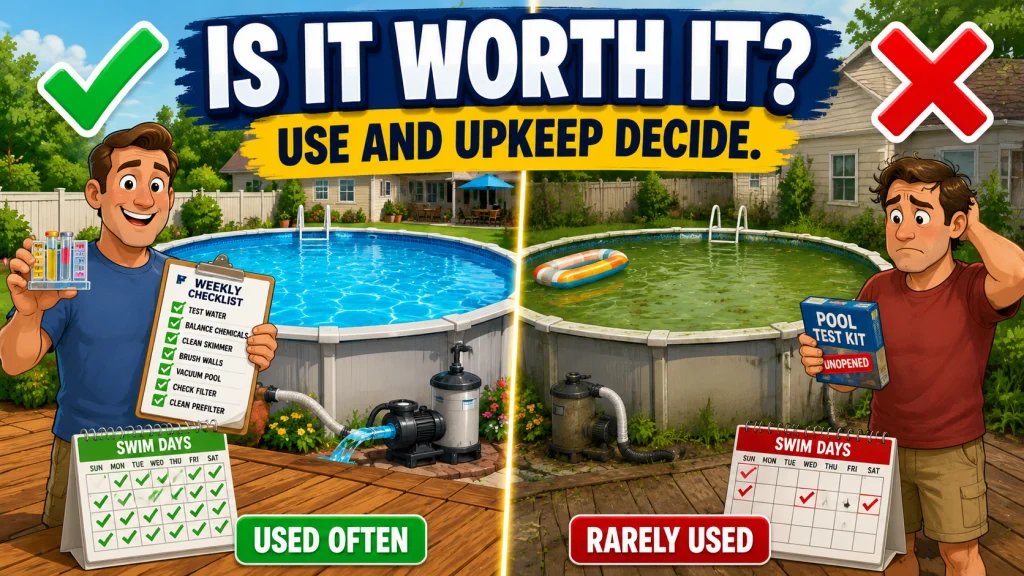
An above ground pool is worth the money for some families and a regrettable purchase for others, and the difference has almost nothing to do with the pool itself. It comes down to how many months a year you will actually use it, whether you can commit to weekly maintenance, and whether you are hoping for any resale payback (you will not get one). I have installed pools for people who got a decade of real use out of a 15-foot frame pool, and I have hauled away pools that were assembled once, used for a few weeks, and then abandoned before August. This article walks through the specific situations where an above ground pool delivers clear value, the situations where it disappoints, and the maintenance and resale realities that decide which one you end up being.
Is an Above Ground Pool Worth It? The Honest Answer
Yes, for the right household, and no for the household that treats it like a shortcut to an inground pool experience. That is not a dodge. Get your expectations lined up with what the pool can actually deliver and a mid-range frame pool earns its keep for years. Get them wrong and you end up with a green tank taking up half the backyard by the second July.
The mistake I see most often with first-time buyers is treating the purchase price as the whole decision. The sticker price on a 15-foot kit tells you almost nothing about whether the pool is worth it for your specific yard, climate, and patience level. What matters is cost per season of actual use, and that number swings wildly depending on how consistently the pool gets maintained.
Where an Above Ground Pool Delivers Clear Value
Some households get their money’s worth every single season, and the pattern is consistent enough that I can usually tell within the first conversation whether a buyer is going to be happy a year from now.
- Families with kids roughly 4 to 14 years old who want a seasonal backyard activity, since that age range gets the most consistent daily use out of a pool before interest shifts to other things.
- Households in hot climates who will realistically use the pool 3 or more months a year, which changes the cost-per-swim math completely compared to a 6-week window up north.
- Homeowners who want the pool experience without a $50,000-plus inground commitment, and who understand upfront that they are buying convenience, not equity.
- Renters who need a pool that can move with them, since a frame or soft-sided pool can be drained and relocated in a way a concrete pool never can.
- Anyone testing whether pool ownership fits their lifestyle before considering a permanent inground installation later.
Notice what all five situations have in common: the buyer’s expectations already match what an above ground pool can actually deliver. Nobody on that list is expecting a diving-ready deep end or a value bump at closing. That alignment between expectation and reality is the single biggest predictor of whether someone tells me they are glad they bought the pool.

This 12-foot round above-ground pool stands 30 inches high and holds 1,710 gallons. Its construction combines metal and PVC. The set includes a filter pump, filter cartridge, and repair patch, with a stone-print finish on the pool.
Check On AmazonIf you click this link and buy, we earn a commission at no additional cost to you.
Where an Above Ground Pool Disappoints You
The regret calls follow a pattern too, and it almost never starts with the pool failing mechanically. It starts with a mismatch between what the buyer pictured and what they actually got.
- Adults who expect inground water depth: above ground pools are shallower and are not built for diving, which surprises buyers who grew up around inground pools.
- Families who underestimate the weekly commitment: a pool that goes unchecked for even ten days in peak summer heat can turn green, cloudy, and unpleasant fast.
- Buyers who assume every included pump will adequately handle a pool larger than 15 feet without an upgrade, which is one of the most common surprises I run into on service calls.
- Anyone planning to use the pool fewer than about 20 times a season, since the cost-per-use math rarely works out once you count chemicals, electricity, and opening or closing labor.
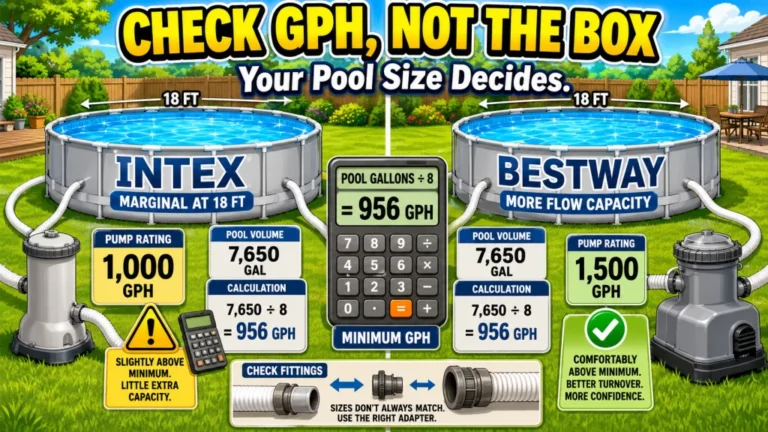
That third point deserves a real example, because it is the one that catches first-time buyers off guard the most. A 15-foot pool and an 18-foot pool look like a small size jump on paper, but the volume difference is significant enough that a stock pump that was already borderline on the smaller pool becomes flatly inadequate on the larger one. Buyers see two similar-looking kits at similar price points and assume the equipment scales with the pool. The equipment does not always scale adequately with the pool size. The pump you need is tied to gallons and turnover rate, not to how the pool looks in the listing photo.
Field Note: The pool that sat unused the longest was not the cheapest one I ever installed. It was the most expensive. The owners bought a premium steel wall kit expecting it to basically maintain itself because it cost more than the neighbor’s inflatable. Price tier has nothing to do with how much attention the water chemistry needs.

This 1,500 GPH sand filter pump is designed for Intex above-ground pools up to 8,400 gallons and includes two 1.5-inch connector hoses. A six-function valve supports filtering, backwashing, rinsing, recirculating, draining, and closing, while the built-in 24-hour timer provides preset cycles. The in-pool system flow rate is 1,050 GPH, and Intex includes a 2-year limited warranty.
Check On AmazonIf you click this link and buy, we earn a commission at no additional cost to you.
The Maintenance Commitment Is the Real Variable
If you want one honest sentence to decide whether an above ground pool is worth it for your household, it is this: the pool is not the variable; your consistency is. I have serviced two nearly identical 15-foot setups on the same street: one owner spent a normal amount for the season, while the other spent several times more because the second household let the chemistry swing between green and clear all summer instead of testing on a schedule.
Owners in real maintenance discussions describe the same pattern in dollar terms. On the community forum troublefreepool.com, long-time above ground pool owners describe a normal season landing around a few hundred to a few hundred and change in chemicals and routine upkeep, while a problem year can run into several thousand dollars once something bigger goes wrong, a failed liner, a pump that has to be replaced mid-season, or chemistry that got away from the owner and needed repeated shock treatment to bring back. The pool itself is rarely the reason for the jump. It is almost always one of those three failures stacked on top of a normal season’s chemicals and electricity. A pool maintained on a consistent testing schedule costs meaningfully less than one that only gets attention after the water already looks bad, since restoring a green pool typically means extra sanitizer, longer filter runtime, and more testing on top of whatever the owner would have spent staying ahead of it. For a full breakdown of what a normal season and a problem season each look like in dollars, the annual maintenance cost breakdown walks through both scenarios line by line.
| Your situation | Likely verdict |
|---|---|
| You test water weekly and stay ahead of problems | Worth it. Costs stay predictable and the pool stays usable all season. |
| You only check the pool when it already looks off | Expensive. You will pay for both regular chemicals and repeated shock treatment. |
| You use it fewer than 20 times a season | Hard to justify. The cost-per-swim math rarely works at that usage level. |
| You are buying mainly hoping to recoup cost at resale | Not worth it for that reason. Above ground pools add essentially no resale value. |
The table simplifies the decision, of course, since climate, water source, and pool size all shift the numbers. But the pattern holds across almost every service call I get: the pools that stay worth it are the ones where someone in the house treats a test kit as a weekly habit, not an emergency response tool.

This all-in-one kit tests for free and total chlorine, pH, acid and base demand, total alkalinity, calcium hardness, and cyanuric acid, working with any pool, hot tub, or spa. It includes a carrying case, water comparator, water balance calculator, base demand reagent, color-coded instructions, and a waterproof chemistry guide for quick reference. Taylor test kits are the only testing supplies recommended by the American Swimming Coaches Association, ensuring professional-level accuracy.
Check On AmazonIf you click this link and buy, we earn a commission at no additional cost to you.
Resale Value and Renting: What to Actually Expect
If part of your worth-it calculation includes getting some of the purchase price back when you sell the house, you can drop that from the equation now. Above ground pools are treated as personal property by most appraisers, the same category as a shed or a trampoline, because they are not permanently attached to the home. That means they contribute close to nothing to an appraisal, and in some cases a buyer who does not want a pool will ask for a credit to cover removal instead of paying more for the house because one is there.
This is a meaningfully different situation from an inground pool, which is why I always tell buyers to separate the two decisions in their head. If you are weighing an above ground pool purely against the cost of a permanent installation, it helps to look at the full purchase and installation cost breakdown side by side with what a permanent pool would run, because the numbers are not close and the resale outcome is not close either. An above ground pool is a lifestyle purchase for the years you own the house, not a home improvement in the appraisal sense.
Renters face a slightly different version of the same question. A soft-sided or frame pool can be drained and taken to the next house, which is genuinely one of the better reasons to buy one instead of waiting for a permanent installation you cannot take with you. Just confirm the lease terms first. Some landlords restrict any pool deeper than 24 inches because of liability and insurance, and finding that out after the pool is already assembled in the yard is a bad way to spend a Saturday.
The 60-Second Household Readiness Test
Everything covered so far comes down to five honest questions. Answer them before you buy, not after the pool is already sitting in the yard.
- Does your climate give you at least three months of realistic swimming weather?
- Will the pool likely get used more than 20 times in a season?
- Is there one specific person in the household willing to test the water on a weekly schedule?
- Are you comfortable knowing the pool will add essentially nothing to your home’s resale value?
- Does your budget have room for an unplanned pump or liner problem in a bad year, not just a normal season’s chemicals?
If you answered yes to four or five of these, an above ground pool is likely to earn its keep in your yard. Two or three yes answers usually means the pool can still work, but only after you adjust your size, budget, or expectations first. Zero or one yes answer is the profile of the buyer who calls me two summers later asking how much it costs to have the whole thing hauled away.

This 15-foot round above-ground pool stands 48 inches high and uses a metal frame. The blue model is sold as the pool only rather than as a complete equipment bundle. The listing is therefore for the backyard pool itself without an included pump package.
Check On AmazonIf you click this link and buy, we earn a commission at no additional cost to you.
Final Thoughts: Answer the Usage Question Before the Money Question
Before you run the cost numbers, answer one question honestly: how many months a year and how many times a season will this pool realistically get used in your yard? Everything else in the worth-it calculation flows from that answer. A family that will use a pool 40 or 50 times a summer gets real value out of even a mid-range setup. A family hoping for 15 or 20 uses is fighting math that rarely works out, no matter how carefully they shop.
If the usage case is solid, the next step is sizing the equipment correctly from day one instead of discovering the stock pump is undersized halfway through your first July. For a full walkthrough of pool types, sizing, and what actually drives the price difference between kits, the guide to choosing the right above ground pool is the right place to start before you commit to a specific size or brand.
FAQs
🏊 Is an above ground pool worth it for a family with young kids?
Usually yes, especially for kids roughly 4 to 14 years old who will use it consistently through the season. The value drops if the family only uses it occasionally or lives somewhere with a short warm-weather window.
💰 Do above ground pools add value to a home?
No, not in any meaningful way. Appraisers generally treat them as personal property rather than a permanent home improvement, so do not factor resale value into your decision.
🧮 How many years should I plan to keep a pool for it to be worth the cost?
There is no universal number of years. A pool used 40 or 50 times a season can deliver good value quickly, while one used only a handful of times may remain difficult to justify even after several years. Usage frequency matters more than ownership length.
🏡 Should renters install an above ground pool?
It can make sense since the pool can be drained and moved to your next place, unlike a permanent installation. Confirm your lease allows it first, since many landlords restrict pools deeper than 24 inches.
⚠️ What is the biggest reason people regret buying an above ground pool?
Underestimating the weekly maintenance commitment is the most common one I hear. A pool that is not checked and adjusted regularly in summer heat can turn green within days, and that surprises a lot of first-time owners.
🌡️ Is an above ground pool worth it in a cold climate?
It depends heavily on how short your warm season is. If you realistically get fewer than 3 months of usable swimming weather, the cost per use climbs fast and the pool is harder to justify compared to a warmer climate.
Sources and References
- Opendoor, analysis of how appraisers treat above-ground pools as personal property with near-zero appraised value.
- Trouble Free Pool community forum, owner discussion of real annual maintenance cost ranges and what drives the variability.
- Trouble Free Pool community forum, owner thread on common regrets and limitations reported after buying an above ground pool.