The pool I took down last fall had been standing for 22 years, and the steel wall panels were still solid enough that I could have left them up another few seasons. In fifteen years of installing and replacing above ground pools, I have seen that same result maybe half a dozen times, and I have replaced dozens of pools that failed in 3 to 5 years. This piece walks through what the long-lasting installations actually had in common, what the short-lived ones had in common instead, and why above ground pool lifespan usually comes down to three specific conditions rather than luck or brand.
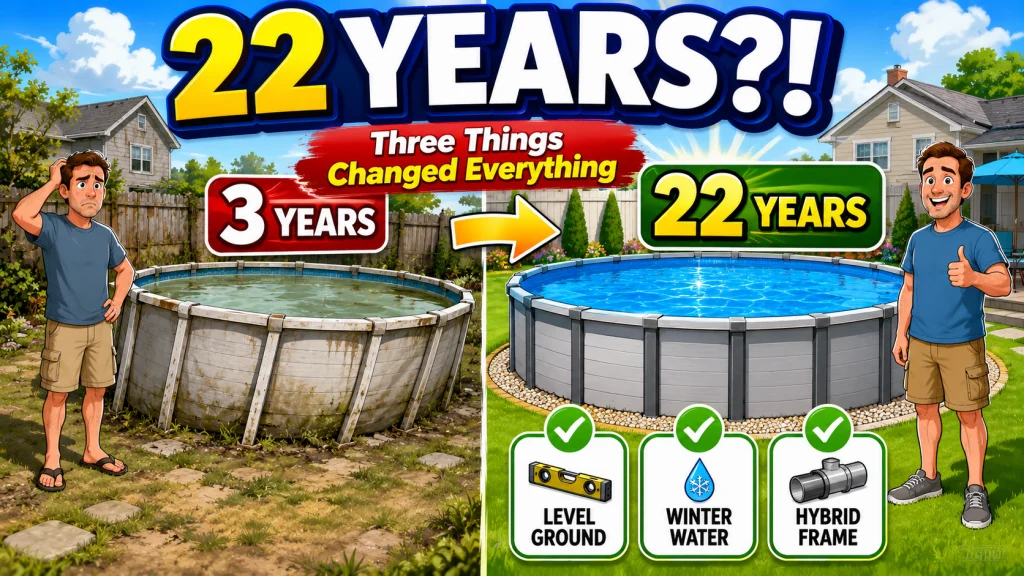
The Pool That Lasted 22 Years
The steel wall was still solid when I pulled it apart. The uprights were still plumb, not leaning the way most 10-year-old frames start to lean. The liner was on its fourth replacement, which tells you the family used the pool hard for over two decades and just kept doing the maintenance that kept it usable. Nobody in that family would have called themselves meticulous. They just did three things consistently, without ever framing it as a system.
I have also replaced pools that failed in 3 years, sometimes on a nicer, more expensive kit than the 22-year pool ever was. Above ground pool quality gets blamed for a lot of failures that were really about what happened to the pool after it left the box. The difference between a pool that makes it two decades and one that gets hauled to the curb after a few summers is not luck, and it is not really about which brand was printed on the liner.
What the Long-Lasting Pools Had in Common
Across the handful of installations I have seen make it past 15 or 20 years, three conditions kept showing up together. None of them are expensive, and none require a special product, which is probably why they get overlooked.
- Ground prep done correctly at installation, with nothing built up and everything dug down to undisturbed soil
- Water left in the pool through winter, even in years the family barely used it, so the walls kept the pressure that holds their shape
- A hybrid frame with resin uprights and top rails, so the steel is limited to the wall panels rather than the connection points
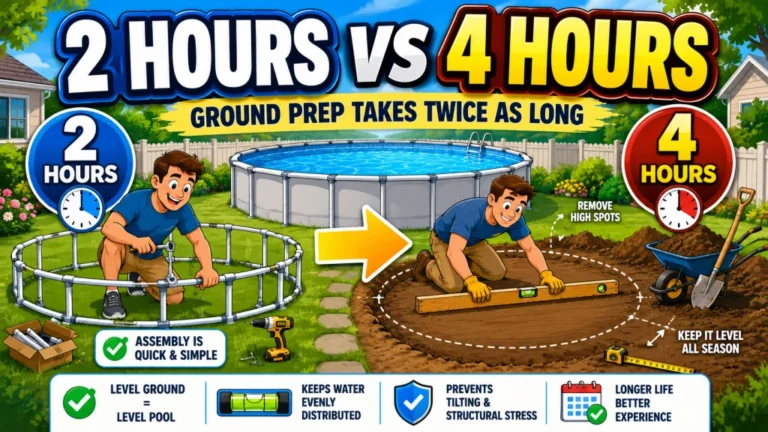
The ground prep piece is straightforward: a pool sitting on native soil that was correctly leveled at installation does not develop the slow lean that comes from settling fill dirt. Native soil has already been compressed by years of rain, freeze, and thaw before the pool ever arrives, so there is very little air pocket left in it to collapse under new weight. Loose fill dirt is the opposite: it goes in full of small air gaps, and every wet season after that pushes more of those gaps closed. The settling does not happen once and stop, it happens gradually over months as the soil finds a new resting density, which is why a pool can look level in June and visibly tilted by September even though nobody touched it. The winter water piece surprises people, since it seems backwards to leave a pool full when nobody is swimming in it. But an empty above ground pool wall has nothing pushing back against the weight of snow and frost from the outside, and that is exactly when walls buckle. Frost heave makes this worse on top of the snow load itself: freezing ground expands and pushes upward against whatever sits on it, and a pool with water inside resists that movement far better than one standing empty through repeated freeze-thaw cycles. If you want the specific water levels to aim for through the off-season, our guide on keeping the right water level over winter covers that in more detail.
The material piece is the one people ask about least, and it matters more than most buyers expect. On a hybrid frame, the steel is confined to the wall panels themselves, which see less condensation and trapped moisture than the joints and connection points do. Corrosion almost always starts where two components meet, not across a flat panel, and resin connection points simply do not corrode the way steel ones do.
What the Pools I Replaced in 3 to 5 Years Had in Common
The failed installations were not random either. Most of the pools I replaced early had fill dirt under one side that had settled, the same pattern that shows up as a leaning wall a few months after a rushed setup. A smaller number had corroded connection points from running a salt chlorinator on a steel-framed pool without ever checking whether the frame was rated for it. Two or three failed because the owner drained the pool completely for winter, and the empty walls collapsed under snow load with nothing inside to resist it.
These three causes are not equally common, and they are not equally severe either. Fill dirt settling is by far the one I see most often, but it usually gives an owner months of warning in the form of a visible lean before anything actually fails. Salt corrosion on an incompatible frame is rarer, since most owners never convert to salt at all, but once it starts it eats through connection points quietly and the damage is often already serious by the time it is visible. A full winter drain is the rarest cause on this list, and also the fastest and least forgiving: a wall can buckle in a single hard freeze with almost no warning beforehand.
Field Note: The salt chlorinator failures are the ones that sting the most to see, because they are entirely preventable. A steel-framed pool and a salt system are not automatically incompatible, but the owner needs to know which parts of that specific frame are rated for salt exposure before the generator goes in, not after the corrosion shows up at the seams.
None of these three failure patterns are about a cheap pool falling apart on its own. A soft-sided frame kit set up correctly, kept full over winter, and run with the right chemical system for its materials will outlast a nicer pool that skips any one of those three conditions.
What a 22-Year Owner Says About It
My own installs are not the only place this pattern shows up. A long-running discussion thread on tractorbynet.com includes an owner describing a steel wall pool that ran for 22 seasons before it finally rusted through around the skimmer, a failure point rather than a full structural collapse. The pool did not fail because the steel was inherently weak. It failed at the one spot where moisture and connection points meet, decades after most cheaper installations would have already been replaced.
The thread is full of owners comparing notes on pools that lasted anywhere from 5 to over 20 years, and the pattern that keeps showing up is not the brand or the price point. It is maintenance quality, the same thing I see decide outcomes on my own jobs. Two owners running the identical pool kit can land a decade or more apart in lifespan depending on how carefully those basics get handled.
The Liner Replacement Reality
A liner on any above ground pool needs replacing every 5 to 9 years on a soft-sided frame pool, or 7 to 12 years on a steel wall pool, depending on chemical management and how much direct sun the pool gets. That is not a sign the pool is failing. A well-maintained pool structure outlasts multiple liner cycles, which is exactly what happened on the 22-year pool: four liners over two decades, on the same wall and uprights the whole time.
Budget for a liner in the 200 to 800 dollar range, spread over 7 to 10 years, as a normal cost of long-lasting above ground pool ownership rather than a red flag. Owners who panic at a second or third liner replacement and assume the pool is on its way out are usually looking at a completely healthy structure that just needs its wearable component swapped, the same way a roof needs shingles replaced without the house itself being a problem.
Final Thoughts: Three Conditions, Not a Miracle Pool
A 22-year above ground pool is not common, but it is not a fluke either. The pattern behind it is the same one this whole piece has traced: what happens in the ground before the pool ever goes up, what happens to the water once nobody is swimming in it, and what happens at the joints once a chemical system gets added. Owners who handle those three moments well tend to get decades out of a kit that looks identical to one that failed three summers into ownership down the street.
If you are still deciding which frame type and material combination gives you the best odds at a long-lasting setup, our guide to choosing the right above ground pool type breaks down the tradeoffs between steel, resin, and hybrid frames. And if the ground under your pool has not been touched yet, it is worth reading through getting the ground preparation right before setup before anything else goes in the ground.
Sources and References
- A long-running forum discussion among above ground pool owners documents a steel wall pool that lasted 22 seasons before failing at the skimmer connection.
- A winterization guide featuring advice from working pool professionals confirms that keeping water in an above ground pool over winter helps the walls stay upright under snow load, while a mostly empty pool is more likely to have its walls pulled in.
- A guide to converting above ground pools to salt water systems confirms that steel and aluminum pool frames are prone to corrosion from salt chlorine generators, while resin and vinyl components hold up better.
FAQs
⏳ How long do above ground pools typically last?
Most soft-sided frame pools last 7 to 10 years, and steel or hybrid frame pools commonly reach 15 to 20 years or more when the ground was prepared correctly and the frame material matches the chemical system in use. Pools that skip ground prep or run an incompatible salt system often fail in 3 to 5 years instead.
🧊 Should I drain my above ground pool completely for winter?
No. Leaving water in the pool, lowered a few inches below the skimmer, gives the walls something to push back against snow and frost. A fully drained pool has nothing resisting that outside pressure, which is a common cause of wall collapse over winter.
🧂 Can I run a salt water system on a steel frame above ground pool?
Only if the specific frame is rated for salt exposure. Standard steel components corrode faster under a salt chlorine generator, while resin and specially coated frames are built to handle it. Check the manufacturer’s rating before converting rather than assuming any steel pool will tolerate salt.
🪵 How often does an above ground pool liner need replacing?
Plan on 5 to 9 years for a soft-sided frame pool and 7 to 12 years for a steel wall pool, depending on chemical management and sun exposure. Needing a new liner is normal wear, not a sign the pool structure is failing.
🏗️ Does ground preparation really affect how long a pool lasts?
Yes, more than almost anything else. A pool set on correctly leveled, undisturbed soil avoids the slow settling that tilts the wall and stresses the liner. Most of the early pool failures I see trace back to fill dirt under one side rather than a defect in the pool itself.