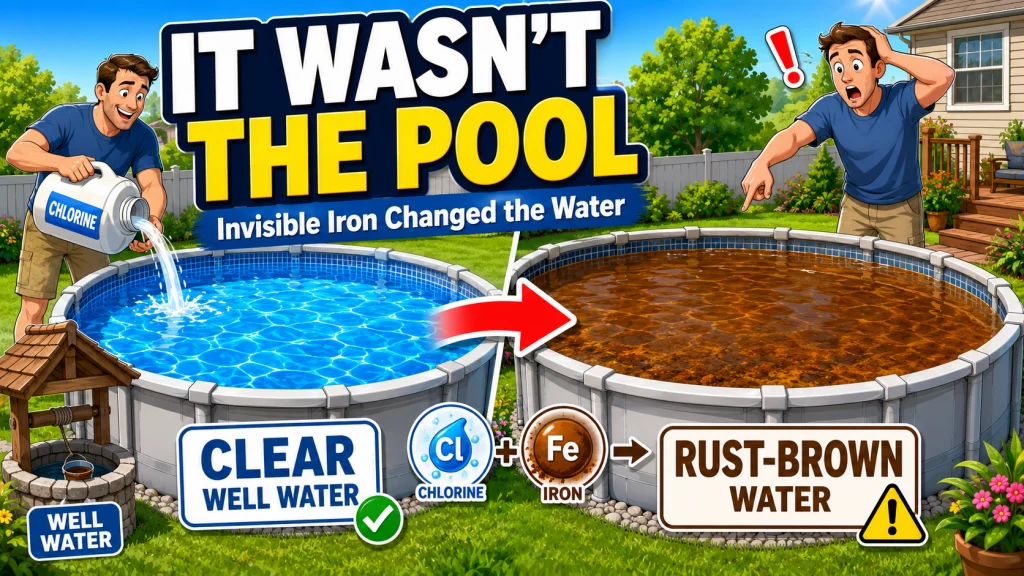
A homeowner called me after their brand-new above ground pool turned from clear to rust-brown within ten minutes of adding chlorine shock, and they were convinced the pool itself was defective. It was not the pool. It was the well water they filled it with, and a mineral in that water that chlorine reveals the moment it touches it. In this one I am walking through what actually happened, why it happens almost exclusively to owners on private wells, and the single test that would have prevented three days of unusable pool water.
The Call Where the Pool Turned Brown in Ten Minutes
I got a call from a homeowner who had just watched their brand-new above ground pool go from clear to rust-brown within ten minutes of adding chlorine shock. They thought the pool was defective straight out of the box. It was not the pool. What happens when well water hits chlorine for the first time has nothing to do with the liner, the frame, or anything the manufacturer built.
The water itself was the problem, and it had been the problem since the hose was still running.
What Actually Happened at That Pool
Field Note: The homeowner had filled the pool with well water straight from their property, a deep well that tested clear and odorless at the kitchen tap, so there was no reason to suspect anything was wrong with it. They added chlorine shock as the final step of their startup chemistry, exactly the way most startup guides tell you to. Within minutes the water turned brown. By the next morning, the pool floor was coated in a rust-colored sediment that had not been there the night before.
That kind of overnight change scares people, and it should. A pool that looked completely normal at bedtime and looked like standing floodwater by morning is not a small cosmetic issue in most owners’ minds. It is exactly the kind of overnight change that makes someone want to call the manufacturer before they think to call anyone else.
Why Clear Well Water Can Still Ruin an Above Ground Pool
The well water contained dissolved ferrous iron, and dissolved ferrous iron is colorless. That is the part that trips people up. Water can test perfectly clear at the tap and still be carrying iron that has not oxidized yet, which means there is no visual warning before you start adding chemicals. Chlorine shock is a strong oxidizer, and the moment it contacts dissolved ferrous iron, it converts it into ferric iron, which is rust. Ferric iron does not stay dissolved. It precipitates out as a visible brown solid, and that is exactly what coated the pool floor overnight.
Here is the part that feels backwards until you understand the chemistry: the clearer the original well water looked, the more dissolved iron it could actually be carrying without showing any color at all. A slightly cloudy or tinted water source would have been an early warning sign. This one gave none, right up until the chlorine hit it.
| Iron Form | Appearance in Water | What Triggers the Change |
|---|---|---|
| Ferrous iron (dissolved) | Clear, colorless, undetectable by sight | Present before chlorine is added |
| Ferric iron (oxidized) | Rust brown, visible sediment | Chlorine or other strong oxidizer contact |
It is the same well water pool problem I run into every summer, just with a different owner and a different backyard each time.
What I Told This Owner to Do Once the Water Had Already Turned
At that point, testing for iron was no longer useful. The only real option was to run the filter continuously until the precipitate settled out of suspension, then vacuum it off the pool floor carefully, without stirring it back up. They ended up rinsing the cartridge filter three to four times over the course of the process, since the rust sediment clogs media fast once it starts moving through the system. It took three days for the water to clear enough to use, and the pool was swimmable again on day four.
Three days is a long time to lose in the middle of July, and none of it was necessary. The whole episode traces back to a step that got skipped before the hose was even disconnected.
What Should Have Happened Before the First Drop of Chlorine
Filling a pool with well water and watching it turn brown by morning is more common than most first-time owners expect, and every case I have seen traces back to the same missing step. A quick water test for iron and hardness before adding any chemicals would have caught this before it became a problem.
- Test the fill water for iron and hardness before starting any chemistry, not after.
- If iron reads above 0.3 ppm, add a metal sequestrant first, before chlorine touches the water.
- Run the pump for 24 to 48 hours after the sequestrant to let it bind the dissolved iron.
- Only then begin the normal chemical startup sequence, chlorine included.
- Recheck iron levels after the sequestrant step if the water source is known to run high.
A more complete walkthrough of the full startup order, sequestrants included, is covered separately in this guide to starting up a pool filled with well water, and the broader chemical startup sequence for any above ground pool lives in the full above ground pool chemical startup guide. Neither one replaces the iron test itself. That test is the step that decides whether you need a sequestrant at all.
What Skipping the Test Actually Cost
The math on this one is not close. A basic iron test at a local water testing service or pool store runs about $10. Skipping it, in this owner’s case, meant three days of unusable pool water during the hottest stretch of July, four separate cartridge filter cleanings, a metal sequestrant product bought after the fact instead of before, and a partial water exchange to dilute the iron that was still left in the pool once the visible sediment was gone.
| Skipping the Iron Test | Running the $10 Iron Test First |
|---|---|
| 3 days of unusable, rust-brown pool water | Pool usable on the normal startup timeline |
| 4 cartridge filter cleanings | 0 emergency filter cleanings |
| Sequestrant bought after the damage, plus partial water exchange | Sequestrant used correctly before chlorine, no water loss |
None of that is a guess. It is the actual sequence this owner went through because the testing happened after the pool turned brown instead of before the hose was even hooked up. By the time they finally swam in that pool, they had already spent more time fixing the water than enjoying it.
How Often I See This
Every summer I hear about at least three or four above ground pool owners in rural areas who fill from a well and go through some version of this exact experience. It is almost exclusively a private well issue. Owners on municipal water rarely deal with this, since municipal supplies are treated and monitored for iron and other minerals long before the water ever reaches a garden hose. If your fill source is a private well, that protection simply does not exist, and the responsibility for testing the water shifts entirely to you.
Part of why these calls cluster in summer is timing. Most owners fill their pool and run startup chemistry within the same week or two, right when everyone else on a well in the area is doing the same thing after a long winter of the well sitting mostly idle. Shock goes in as the last step for almost everyone, which means the same oversight shows up in a wave rather than trickling in one call at a time.
Not every private well causes this, and it is worth being clear about that so this does not sound like a reason to avoid well water entirely. Iron content varies a lot from one well to the next, even on the same street, depending on depth, the surrounding geology, and how the well was drilled. Some owners run a well-fed pool for years without ever seeing a hint of discoloration, while a neighbor a few hundred feet away hits this exact problem the very first time they fill up. That is exactly why testing matters more than assuming your water is fine because someone else’s well has never given them trouble.
Final Thoughts: Well Water Is Fine, Untested Well Water Is Not
Well water can be an excellent fill source for an above ground pool. I have set up plenty of pools that ran clean all season on well water with no issues at all. The difference between those pools and the one in this story is a single test that takes a few minutes and costs about as much as a fast food meal. The chlorine did exactly what chlorine is supposed to do. The mistake happened before the first scoop ever hit the water, and that is the part worth remembering before you fill from a well.
Sources and References
The well water and iron oxidation details in this article are backed by the following sources.
- TractorByNet forums include owner threads describing well water turning brown immediately after chlorine is added.
- The EPA’s private wells program outlines testing recommendations for homeowners who rely on well water rather than a municipal supply.
- TroubleFreePool covers metal sequestrant use and iron treatment sequencing for pool owners dealing with high-iron fill water.
FAQs
🚰 Why did my above ground pool water turn brown after I added chlorine?
This usually happens when the fill water contains dissolved ferrous iron, often from a private well. Chlorine oxidizes the iron into ferric iron, which is rust colored and visible, even though the water looked clear beforehand.
🧪 How do I know if my well water has too much iron for a pool?
Test the water before filling or before adding any chemicals. Iron above 0.3 ppm is generally the threshold where a metal sequestrant should be used before chlorine is introduced.
🛠️ What do I do if my pool water already turned brown?
Run the filter continuously until the rust sediment settles, then vacuum it from the pool floor without stirring it up. Expect to rinse a cartridge filter several times during the process, and expect the water to take a few days to fully clear.
💧 Is well water safe to use for an above ground pool?
Yes, in most cases, as long as it is tested for iron and hardness before chemical startup. Well water without a known iron problem can fill and maintain a pool with no issues at all.
⏱️ How long does it take to fix a pool after well water turns it brown?
In a typical case, expect around three days of filtering and vacuuming before the water is clear enough to swim in again, depending on how much iron precipitated out.
🏘️ Does this brown water problem happen with city water too?
Rarely. Municipal water supplies are treated and monitored for iron before delivery, so this is almost exclusively a private well issue.