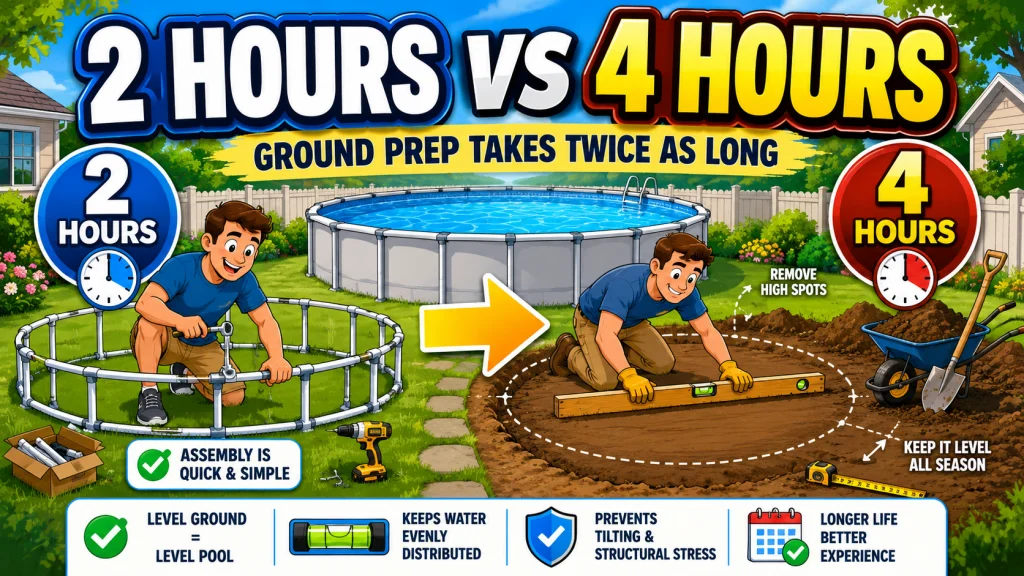
In fifteen years of installing above ground pools, I have found that ground preparation takes roughly twice as long as putting the pool itself together, and that ratio holds whether I am setting up a small round frame pool or a larger oval kit. A 15-foot pool that goes together in about 2 hours of assembly usually needs 4 hours or more of proper ground work first, and most of the callbacks I get later in the season trace straight back to owners who tried to shortcut that half of the job. This piece walks through where that time actually goes, why so many pools drift out of level a couple of months after they are filled, and what a correctly prepared site looks like before the pool ever comes out of the box.
The Two Hour Pool That Needs Four Hours of Ground Work
I get asked why ground prep takes twice as long as pool assembly almost every time I show up to a job with a truck full of tools and the wall panels still in the box. The honest answer is that assembling a 15-foot frame pool is mechanical work: connect the rails, stand the wall, snap the top rim together, maybe 2 hours if nothing fights you. The ground underneath it does not follow a manual at all, because the yard never matches the flat diagram printed on the instructions. Every lot has a slope somewhere, even if it is not visible standing at eye level, and finding that slope is the first job before any digging starts. Most days I can tell before I even unload the pool kit whether I am walking into a digging job or an assembly job, just from how the yard sits.
The time estimate you see quoted on a listing or in a quick-start guide almost always covers assembly only. Nobody puts “plus half a day of digging” on the box, so first-time buyers plan their weekend around 2 hours and end up frustrated when the project runs closer to 6. Ask me how long the entire project really takes, start to finish, and the honest number always includes both halves of the job, with the ground usually taking the longer share of the day.
What Above Ground Pool Installation Tips Rarely Mention About the Ground
On a typical suburban lot, the ground work for a 15-foot pool breaks down into a handful of distinct steps, and each one takes real time when done correctly. Skipping any single step is exactly where the shortcuts show up later in the season.
- Marking and measuring the pool footprint accurately, not eyeballing it
- Walking the footprint with a level board to find the lowest point
- Removing all grass, roots, and organic material from the area
- Digging down until the entire footprint matches that lowest point
- Compacting the exposed, undisturbed soil before adding anything on top
- Adding and leveling sand inside the track area only, never underneath it
- Forming the cove where the floor meets the wall
Here is roughly how that breaks down in hours on a 15-foot round pool with a mild slope, the kind of yard I see most often:
| Ground Prep Step | Typical Time |
|---|---|
| Marking and measuring the footprint | 15 to 20 minutes |
| Finding the low point across the area | 10 to 15 minutes |
| Removing grass and organic material | 45 minutes to 1 hour |
| Digging down to match the low point | 1.5 to 2 hours |
| Compacting the exposed soil | 20 to 30 minutes |
| Adding and leveling sand inside the track | 30 to 45 minutes |
| Forming the cove | 15 to 20 minutes |
Add that up and you land close to 4 hours, twice the assembly time, on a yard that only looks mildly uneven. A steeper lot or heavier clay soil pushes that number higher. None of these steps are difficult on their own, but skipping one to save 20 minutes is usually the decision that costs a homeowner an entire re-level the following season.
Most homeowners get the slope wrong just standing there looking at it. A yard can look flat from eye level and still be 2 to 3 inches off across a 15-foot footprint, which is more than enough to tilt a pool once thousands of gallons of water are pushing down harder on one side than the other. A level board or even a cheap laser level catches what your eyes cannot, and it is worth doing before a single shovel comes out.
The Most Common Call I Get Every July and August
The most common service call I receive in the middle of summer is not a pump failure or a chemistry problem. It is an above ground pool that has gone noticeably out of level somewhere between 6 and 8 weeks after installation. By the time the owner calls, they can usually see it themselves: one side of the wall looks like it is leaning, or the water line sits visibly higher on one side than the other.
Field Note: When I get to the site, I find the same thing almost every time. There is fill dirt under one side of the pool, pushed there from the high side during setup instead of dug out and hauled away. The pool filled, looked level for a few weeks, and then the compressed fill settled under the weight of thousands of gallons of water. A pool that was level on install day was visibly tilted before the season was over.
That settling is not a slow process you can catch early and fix with a shim. Loose fill dirt compacts unevenly under sustained water weight, and once the wall starts to lean, the fix is almost always the same one that should have happened at the start: draining the pool, pulling it apart, and digging the real ground down to the low point instead of building the low point up. If you want the full walkthrough of how that process works from measuring the footprint to forming the cove, our above ground pool ground preparation guide covers every step in order.
What Correctly Prepared Ground Actually Looks Like
Correctly prepared ground has one defining feature: every inch of the pool footprint sits on soil that has never been disturbed. There is no fill dirt anywhere inside the load-bearing area, and the only material added on top is a thin, compacted layer of sand inside the track, never underneath it. On a yard that already slopes, reaching that state means shaving down every high spot in the footprint until nothing stands taller than the lowest natural point in the yard, not building the low spots up to meet the high ones.
Pushing dirt from the high side of the yard into the low side, then leveling on top of that loose fill. It looks flat on install day and creates the exact settling problem described above.
Digging down from every high point until the entire footprint matches the lowest natural point in the yard, so the pool sits on undisturbed soil from edge to edge.
This is also why digging the site down to its lowest point takes longer than it sounds on paper. Filling a low spot with a few shovels of dirt is fast. Digging out a high spot until it matches the lowest point across a 15-foot or 18-foot circle is slower, dirtier, and produces a pile of soil you need somewhere to put. I have never once seen a filled-in low spot outlast a full season once real water weight is sitting on top of it.
The Conversation I Would Rather Have Before the Shovel Comes Out
The hardest conversation I have with a homeowner is telling someone who has already spent 4 hours pushing dirt from one side of the yard to the other that all of it needs to be undone and started over by digging down instead. Nobody wants to hear that after a full afternoon of work, and by that point the pool kit is usually already sitting half open on the lawn with everyone eager to get in the water.
That conversation is a lot easier to have before the work starts than after. It is the entire reason this article exists: not to make ground preparation sound harder than it is, but to set the expectation correctly from the beginning so nobody spends a Saturday doing work that has to be redone. A homeowner who understands that split before the truck even shows up rarely feels ambushed by it partway through the job.
Final Thoughts: Budget the Ground the Way You Budget the Pool
The pool assembly takes about 2 hours because it goes together with a manual and a rubber mallet, following the same steps regardless of whose backyard it lands in. The ground takes as long as it takes because you are working with whatever that specific yard actually is, not whatever the manual assumes. Some lots are close to flat and move faster. Others have a slope you cannot see until you put a level board down, and those take longer no matter how much anyone wants to skip ahead to the fun part.
The time you invest in ground preparation is time you do not spend re-leveling a pool three months later, draining it, and doing the digging you skipped the first time around. If you are still in the planning stage, our full ground preparation guide for above ground pools walks through the entire sequence in more detail, from marking the footprint to forming the final cove.
Sources and References
- A discussion thread among owners who have installed their own above ground pools repeatedly names ground leveling as the toughest part of the entire project, ahead of wall assembly or liner placement.
- A professional installer’s list of common above ground pool setup mistakes identifies pushing dirt from high spots into low spots as the single most frequent error, since that fill eventually settles under the pool.
- A long-running pool owner community thread on ground leveling confirms that loose or organic fill under a pool risks uneven settling and structural problems unless it is properly graded and compacted first.
FAQs
🕒 How long does ground prep actually take for an above ground pool?
For a 15-foot pool on a mildly sloped yard, plan on about 4 hours, roughly twice the 2 hours a stock frame kit takes to assemble. Steeper slopes, heavier clay soil, or a larger pool footprint push that number higher.
Can I use fill dirt to level an above ground pool site?
No. Loose fill dirt compacts unevenly under the weight of a filled pool and tends to settle within weeks to months, tilting the pool. Digging down from the high points to match the lowest point in the yard is the approach that holds up.
📏 How far out of level can an above ground pool be before it is a problem?
Most installers work to keep a pool within about 1 inch of level across the entire footprint. Beyond that, the wall can start to lean visibly and the liner takes uneven pressure at the seams.
🌱 Can I set an above ground pool up directly on grass?
Grass and the organic material underneath it break down over time, which creates uneven settling under the pool. It needs to be stripped away down to bare, undisturbed soil before any sand goes in.
🧱 Does sand belong under an above ground pool or just inside the track?
Sand belongs inside the track area only, as a thin cushioning layer between the liner and the ground. It should never be used underneath the track itself, since sand under the track can wash out and let the pool settle or sink.