I have had the same conversation about solar covers and child safety more times than I can count, and it usually starts with a parent pointing at the cover floating on their above ground pool and telling me that is what keeps the kids out. It does not, and the reason matters more than most people expect once they hear it. This piece walks through why the solar cover pool safety assumption is so common, what a solar cover actually does when a child falls onto it, and what genuinely reduces the risk of an above ground pool child safety incident instead.
The Conversation I Have Too Often
It usually starts the same way. A parent walks me through their above ground pool setup, points to the solar cover sitting on the water, and says something close to that is what keeps the kids out. I have to tell them it does not, and I can watch the moment land on their face every time. Nobody sets out to misunderstand their own pool equipment. They just never had a reason to question it until I brought it up.
This is not a conversation I have once and move on from. I have it at nearly every installation where there are kids in the house, because the solar cover safety conversation matters enough that I would rather repeat myself than skip it once.
Why the Misconception Makes Sense
A solar cover on an above ground pool looks solid from the deck. It stretches across the entire water surface, catches the light a certain way, and reads as some kind of physical barrier between a child and the water underneath it. Nobody looking at that setup from a few feet away is being careless by assuming it does something protective. The assumption makes intuitive sense, which is exactly why it is so persistent and so dangerous.
Part of this comes down to how the eye reads a flat, evenly stretched surface. A pool cover pulled taut across the water looks the same from the deck whether it can hold weight or not, and the brain does not have a separate visual category for a surface that only looks solid. Add in the fact that the water underneath is completely still and reflective, and the whole setup reads as one continuous solid plane rather than a thin sheet floating on something that can swallow it the moment weight lands on top.
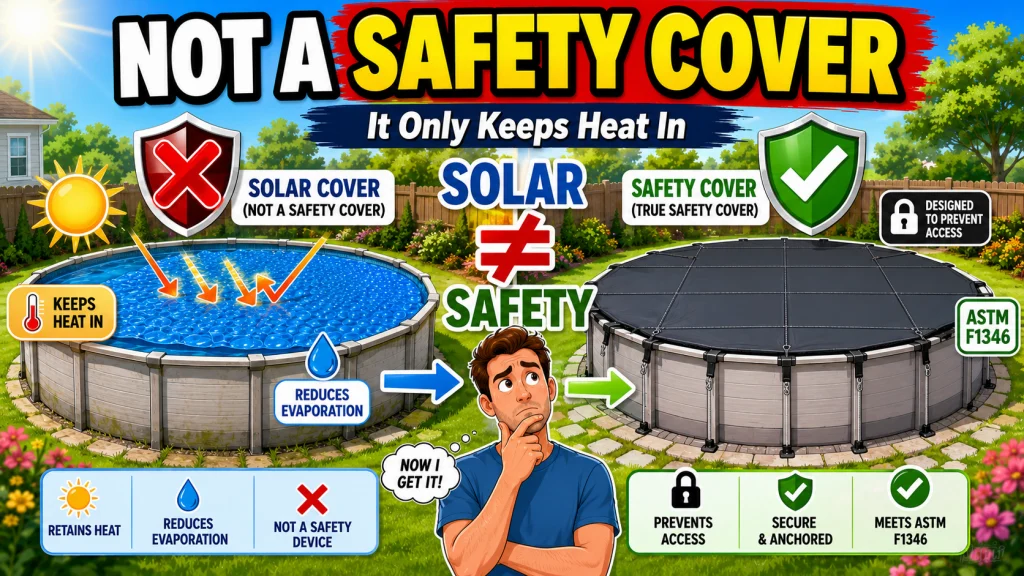
What a solar cover does not do is support weight. It is a sheet of thin polyethylene bubble material floating directly on the water, with no frame, no anchoring, and no structural integrity of any kind. A child who falls onto a solar cover does not land on a surface the way they would on solid ground. They land on something that immediately wraps around them in the water, and the minimal air gap between the cover and the surface gives them almost nowhere to find a breath. Planning for child safety around an above ground pool has to start from that fact, not from how solid the cover looks standing on the deck.
The Incident That Changed How I Explain This
Field Note: A customer I had installed a pool for years earlier called me during their third season of ownership. Their neighbor’s child had fallen onto the solar cover on a pool similar to theirs. The child was pulled out quickly and was not seriously harmed, but the event changed how that family thought about pool safety overnight. They asked me what would actually have prevented it. I told them what I tell everyone now: a solar cover is not a safety cover.
That call is the reason I bring this up unprompted at every install rather than waiting for someone to ask. Most families never have a scare like that neighbor did, which is exactly why the misconception survives so easily. It takes one close call to change how a household thinks about a pool cover, and I would rather have the conversation before that happens than after. After enough of these conversations, I eventually realized this was not just something installers talked about among themselves. It is a documented, recognized concern in the pool safety world.
This Is Not a Fringe Concern
The pool safety community explicitly labels the claim that solar covers prevent drowning as dangerously false, and documents entrapment as a real, recognized risk with floating covers specifically, not a rare edge case. A child who falls onto a solar cover can become wrapped in it underwater, which is a different and in some ways worse situation than falling into open water with nothing overhead.
The U.S. Consumer Product Safety Commission has warned about this exact scenario going back decades, after investigating drownings connected to solar pool covers. That warning exists because the failure mode is consistent: someone ends up partially under the cover, cannot find the small gap of air between the material and the water, and struggles to reorient toward the edge in time. This is a documented pattern, not an isolated tragedy that never repeats.
What Actually Provides Safety on an Above Ground Pool
A few specific measures genuinely reduce access risk, and none of them are the solar cover.
- A locking ladder that gets raised and locked whenever the pool is not in use, removing the only way up to the water
- A fence around the pool that meets the local barrier requirement, which is the most effective access control available
- A dedicated pool safety cover rated to ASTM F1346, which requires a solid deck surrounding the pool to anchor the system correctly
The locking ladder is the cheapest and fastest of the three, and it works because an above ground pool’s wall height is itself a barrier once the only way over the top is removed. A fence around the pool goes further, since it controls access from every direction rather than relying on a single ladder staying locked every single time.
An ASTM F1346 safety cover is the most involved option of the three, because it needs a solid deck around the perimeter to anchor properly, which is not something every above ground pool setup has in place. If you are comparing cover options for your specific setup, our guide to choosing a real safety cover walks through what to look for beyond the ASTM label itself.
The Conversation I Have at Every Install Now
I tell every customer with kids in the house the same three things before I leave the job site. The solar cover is for heat retention and evaporation control, not for safety, and it should never be treated as anything more than that. Removing the ladder whenever the pool is not in use is the minimum step, and it costs nothing beyond the habit of doing it every time. A fence is the real answer if the household wants access control that does not depend on someone remembering to lock a ladder correctly.
None of this is meant to scare a family away from owning a pool. It is meant to replace one specific wrong assumption with an accurate one, so the decisions that follow are based on what a solar cover actually is rather than what it looks like from the deck. For anyone weighing cover options as part of a broader setup decision, it helps to start from our overview of above ground pool cover types before deciding which category actually fits the goal.
Final Thoughts: A Useful Product, Not a Safety Device
A solar cover earns its place on a pool for what it actually does well: keeping the water a little warmer and cutting down how much of it evaporates between swims. That is a real, useful job, just not the one most parents assume it is doing. No product that simply floats on the surface of the water should be relied on to keep a child from entering that water, no matter how solid it looks standing on the pool deck. The families who understand that distinction early are the ones who end up putting the right barrier in place before anything happens, not after.
Sources and References
- A pool safety industry guide comparing pool cover types explicitly identifies the claim that solar covers prevent drowning as dangerously false, and confirms that floating covers can increase entrapment risk.
- A U.S. Consumer Product Safety Commission consumer warning documents drownings connected specifically to solar pool covers and describes the entrapment mechanism behind them.
- A municipal swimming pool code section covering enclosures and safety devices confirms that a lockable, removable, or secured ladder is an accepted barrier method for above ground pools under ASTM F1346-related requirements.
FAQs
🌊 Can a solar cover prevent a child from drowning?
No. A solar cover is a thin floating sheet with no structural support. A child who falls onto one can become wrapped in the material underwater instead of landing on a solid surface, which is why it should never be treated as a safety device.
🛟 What is the difference between a solar cover and a safety cover?
A solar cover floats on the water and is designed for heat retention and evaporation control. A safety cover rated to ASTM F1346 is engineered and anchored to support the weight of a person, which a solar cover cannot do at all.
🪜 Should I remove the ladder when my above ground pool is not in use?
Yes. Raising and locking or removing the ladder takes away the only practical way for a child to reach the water on their own, since the pool wall itself becomes a barrier once the ladder is no longer in place.
🧱 Do above ground pools need a fence around them?
Local barrier requirements vary, but a fence around the pool is the most effective access control available, since it protects from every direction rather than depending on a single ladder staying secured every time.
📋 What does ASTM F1346 mean for a pool safety cover?
ASTM F1346 is the performance standard a cover must meet to count as a real safety cover. It covers several requirements together, including the ability to support weight, limiting gaps a child could slip through, and controlling standing water on the surface. It also requires a solid deck around the pool to anchor correctly, which not every above ground setup has.