Not every above ground pool alarm on the market actually counts as a recognized safety feature, and that detail catches more owners off guard than you’d think. ASTM F2208 covers four categories of pool alarms, but California’s pool safety law only recognizes some of them as qualifying drowning prevention features, and that difference trips people up constantly. In this guide, I break down what ASTM F2208 actually covers, walk through each alarm category you’ll run into when shopping, and explain why a wearable device can meet the standard and still not count under California law. By the end, you’ll know which alarm setup holds up to scrutiny and why it should never be the only layer of protection around your pool.
Why an Above Ground Pool Alarm Isn’t Automatically a Safety Feature
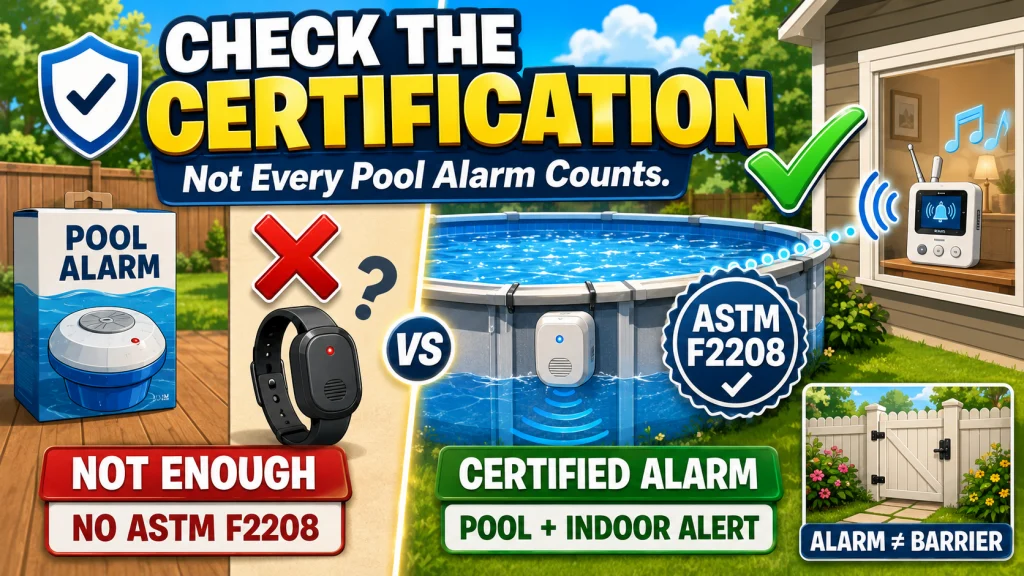
I get asked about pool alarms almost as often as I get asked about pumps, usually right after a customer has already bought one and wants to know if it’s “the good kind.” Here’s the short answer: for a water-entry alarm, the kind placed in or at the pool to detect someone entering the water, it only counts as a recognized drowning prevention feature under California law if it’s independently certified to ASTM F2208, the Standard Safety Specification for Residential Pool Alarms. A device that just beeps when it senses splashing without that certification does not establish that it meets the recognized performance standard, no matter how the listing describes it.
This isn’t a technicality that only matters if you happen to live in California. States that reference the same model code language point to the identical ASTM F2208 standard, and even where it isn’t legally required, it’s the benchmark that separates a device built to a tested performance spec from one that just sounds good on a product page. If you’re comparing two alarms and only one lists ASTM F2208 certification in the manual or on the packaging, that is the one with documented testing against the recognized performance requirements.

This floating pool alarm is independently tested to ASTM F2208 and works with above-ground, inground, inflatable, and soft-sided pools. Its 85+ dB alarm detects objects weighing 15 pounds or more, while adjustable sensitivity helps manage unwanted alerts. One unit can monitor a pool up to 20 by 40 feet. The system uses a 9-volt battery and includes a receiver for monitoring from inside the home.
Check On AmazonIf you click this link and buy, we earn a commission at no additional cost to you.
What ASTM F2208 Actually Requires
California requires that when a building permit is issued for constructing a new residential pool or spa, or for remodeling an existing one, at a private single-family home, the pool must be equipped with at least two of seven recognized drowning prevention features. A water alarm independently certified to ASTM F2208 is one of those seven, sitting alongside options like an isolation fence, a certified safety cover, and exit alarms on doors leading to the pool area. What the law itself requires is the certification; the performance details behind that certification come from the referenced ASTM standard, not the statute text.
The ASTM standard is specific about what a qualifying alarm has to do. Beyond just detecting entry, a certified device is tested to:
- Sound both at the pool and inside the house through a remote receiver within 20 seconds of detecting unauthorized entry.
- Show its operating status with a visible indicator light, including a low-battery or fault indication rather than failing silently.
- Reset automatically once the water settles, instead of requiring a manual rearm every time.
- Pass the nuisance-alarm tests specified for its alarm category and test conditions.
What trips people up is assuming any device labeled “pool safety alarm” automatically satisfies this. It doesn’t. The certification has to come from independent testing to the ASTM F2208 spec for that specific model, not just a manufacturer’s own claim that the product improves safety. When I’ve had customers ask which alarm to buy for a 15-foot or 18-foot frame pool, the first thing I tell them to check isn’t the price or the brand: it’s whether the listing or the manual actually states ASTM F2208 certification. If that language is missing, assume it doesn’t qualify until you can confirm otherwise.
The ASTM F2208 Alarm Categories You’ll See When Shopping
ASTM F2208 defines four functional categories of pool alarms, and it’s worth keeping these separate from how California decides which ones count toward the legal requirement. All four categories fall within the standard’s scope; California’s qualifying status is a separate question layered on top. The California statute separately mentions surface-motion, pressure, sonar, laser, and infrared alarm technologies. Those are technology descriptions, not the law’s way of mapping onto ASTM’s four functional categories, so don’t treat the two lists as interchangeable.
Type A: Surface Alarms
These float directly on the water and detect the wave disturbance created when something enters the pool. They’re the most affordable ASTM F2208-certified option I see installed, and for a straightforward above-ground setup without a lot of wind exposure, they’re a practical first choice. The tradeoff is that a pool sitting in an open, windy yard can trigger false alarms more often, since the sensor is reading surface disturbance and wind chop can look similar to entry from certain angles. If your pool sits exposed on a slope or in an open field with no windbreak, factor that into which unit you pick.
Type B: Subsurface Alarms
These detect displacement below the water surface rather than surface waves, which makes them less prone to wind-related false alarms than a floating unit. Many above-ground models attach to the pool wall or top rail, while some floating units also rely on subsurface sensing rather than surface motion. They tend to cost more and take a bit more care to install correctly on a frame or steel-wall pool, but for owners who’ve dealt with a surface unit going off every time the wind picks up, this is usually the upgrade that actually solves the problem.
Type C: Perimeter Alarms
Perimeter alarms are positioned to detect movement around the pool perimeter or above the water surface rather than in the water itself. Depending on the design, they may use infrared beams, cameras, or other motion-detection technology, and some setups can flag an approach before actual entry into the water. Coverage depends heavily on sensor placement, sight lines, and whether the entire relevant detection zone around the pool is actually monitored, so this category rewards careful installation more than the other three.
Type D: Personal Immersion (Wearable) Alarms
A wearable alarm attaches to a child’s wrist or person and sounds when it detects submersion. This is the category most people get wrong: personal immersion alarms are covered under ASTM F2208 as their own type, so a wearable can be built to that standard. What disqualifies it isn’t the ASTM classification, it’s California’s own law, which explicitly states that a swimming protection alarm designed for individual use, including one worn by a child, is not a qualifying drowning prevention safety feature. The device only activates once the wearer is already in the water, which means it’s reacting to an event that a barrier or a fixed water alarm is meant to prevent from reaching that point at all. Treat a wearable alarm as a supplemental layer for a child who’s already being supervised near the water, never as the primary safety device for an above-ground pool.
Door and Gate Alarms: A Different Legal Category Entirely
Conventional door, window, and gate-open alarms don’t fall under the ASTM F2208 water-alarm classifications at all. They’re a separate category built around detecting access to the pool area rather than entry into the water. California recognizes exit alarms on a home’s doors and windows that provide direct access to the pool as their own standalone qualifying feature, distinct from the water alarm requirement. A gate alarm on a pool fence serves a similar purpose but isn’t automatically granted the same legal status; local codes and inspectors vary on what they’ll accept, so it’s worth confirming with your local building department rather than assuming a gate alarm satisfies the same line item as a certified exit alarm.
For above-ground pools with a deck that connects straight to a back door, an exit alarm is often the more relevant addition alongside a water alarm, since it can catch an unsupervised child at the point of leaving the house rather than only after they’ve reached the pool. The two devices are solving different problems in the sequence, which is exactly why the guidance keeps coming back to using more than one layer rather than treating any single alarm as the whole answer.

This battery-powered pool door alarm is UL Listed under UL 2017 for water hazard entrance alarm equipment. Its 85 dB horn sounds within 7 seconds after a protected door opens, even if the door is closed again. An adult pass-through feature allows authorized access without triggering the alarm. The unit is made in the USA and includes a 1-year warranty.
Check On AmazonIf you click this link and buy, we earn a commission at no additional cost to you.
Comparing the Options Side by Side
Laid out next to each other, the tradeoffs are easier to see than when you’re reading separate product descriptions on a shopping site.
| Alarm Type | ASTM Classification | Best Fit | Main Limitation |
|---|---|---|---|
| Surface alarm | Type A | Sheltered yards, budget setups | Wind can trigger false alarms |
| Subsurface alarm | Type B | Open, exposed yards | Higher cost, more install care |
| Perimeter alarm | Type C | Setups with a clear, unobstructed detection zone | Coverage depends heavily on placement and detection zone |
| Wearable (personal immersion) alarm | Type D | Supplemental use only | Not qualifying under California law |
| Door or window exit alarm | Not ASTM F2208 classified | Pools with direct house or deck access | Detects access, not water entry |
None of these rows is a standalone answer. The right combination depends on how your yard is laid out, whether the pool connects to the house, and how exposed the setup is to wind. That’s exactly why the safety guidance keeps circling back to using more than one device rather than picking a single winner.
The Limitation Every Alarm System Still Shares
Surface and subsurface alarms generally react after water entry has already created a detectable disturbance. A perimeter or access alarm may alert a little earlier, at the point of approach rather than full entry, but every one of these devices still depends on someone being close enough to hear the alert and respond. The seconds between any of these alarms sounding and an adult actually reaching the pool are the entire safety window.
An alarm sitting in a backyard with nobody home, or with the volume too low to carry into the house, cannot provide an immediate rescue response if nobody nearby can hear it and reach the pool. I’ve had customers install a certified alarm and treat it as a complete solution, then leave the property for the weekend without anyone nearby to hear it go off. That’s backwards. A pool alarm is a notification system, not a barrier. It buys you seconds, and what you do with those seconds, and whether anyone is around to use them, is the part the alarm itself can’t control.
Why Layering Beats Betting on One Device
Both the Consumer Product Safety Commission and the National Drowning Prevention Alliance land on the same conclusion from different angles: no single device, alarm included, should be the only thing standing between a curious kid and an unsupervised pool. Layering a physical barrier with a certified water alarm, an access alarm, and active supervision reduces risk in a way that stacking multiple alarms of the same type never will, since each layer is designed to catch a different failure point in the sequence.
For an above-ground pool specifically, the practical version of this looks less complicated than it sounds. Before adding an alarm to the mix, it helps to confirm what’s actually protecting the pool already.
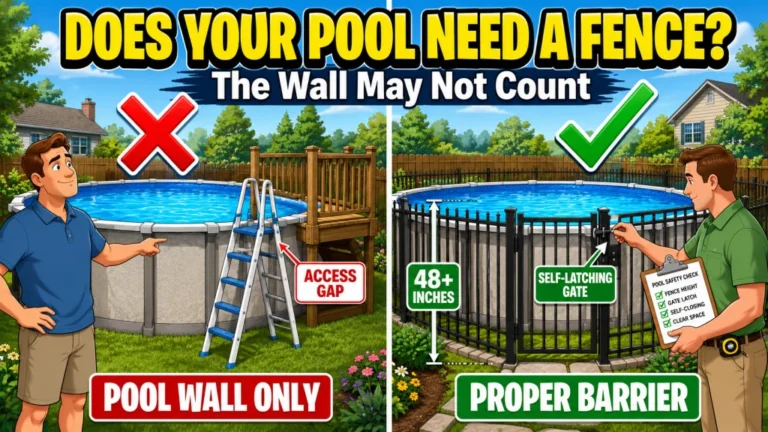
- Confirm the pool’s own wall height and access ladder are already limiting casual entry, since above-ground structures can serve as part of the barrier when set up correctly.
- Confirm the water alarm passed the certification check described above before adding any other layer on top of it.
- Add a door or window exit alarm when the house provides direct pool access, and consider a gate alarm when a fenced access point creates a separate route into the pool area.
- Treat any wearable device as a supplement for supervised swim time, never as a substitute for a certified water alarm.
- Test the alarm’s volume from inside the house, not just standing next to the pool, since that’s where you’ll actually be when it matters.
None of this needs to be expensive or complicated to set up correctly; it just needs to be treated as a system with more than one part, which is the same lesson that shows up constantly around above ground pool fence height and gate requirements. An alarm fits into that same layered approach. It was never meant to carry the job on its own.

This UL 2017-compliant pool entry alarm monitors gates, doors, windows, and sliding doors. Its 110 dB siren activates when the magnetic contact is broken, while two bypass buttons provide a 10-second pass-through period for adults. A secondary sensor supports screen-door setups, and the IP65 weather-resistant housing includes a low-battery indicator. The alarm operates on one 9-volt battery.
Check On AmazonIf you click this link and buy, we earn a commission at no additional cost to you.
What to Verify for Your Specific Pool Before Buying
ASTM F2208 certification tells you a device meets the recognized standard in general, but it doesn’t tell you whether a specific model fits your pool. That’s the second check most buying guides skip, and it’s usually the one that determines whether an owner ends up happy with the purchase or returning it a month later.
Before you check out, confirm the manufacturer’s documentation directly addresses the following for the specific model you’re looking at:
- Whether the listing confirms the alarm is suited to above-ground, soft-sided, or steel-wall pools specifically, not just pools in general.
- The maximum pool size or coverage area the sensor is rated for, since a single unit rated for a small pool may not cover an 18-foot or larger setup.
- Mounting depth and the required distance from the pool wall or edge, which affects whether it fits your pool’s frame and liner configuration.
- How far the indoor receiver actually reaches, tested from where you sleep or spend the most time, not just the manufacturer’s rated range.
- Whether the unit auto-rearms after triggering, and whether it gives a distinct low-battery or tamper warning.
- Whether sensitivity is adjustable, and how the manufacturer recommends testing for nuisance alarms from wind, rain, or pump operation before relying on it.
- Whether “meets ASTM F2208” on the listing is backed by an independent certification for that exact model, rather than a general reference to the standard.
Running through this list takes a few extra minutes at most, and it’s the difference between an alarm that actually does its job in your yard and one that ends up muted in a drawer because it went off every time the wind picked up.
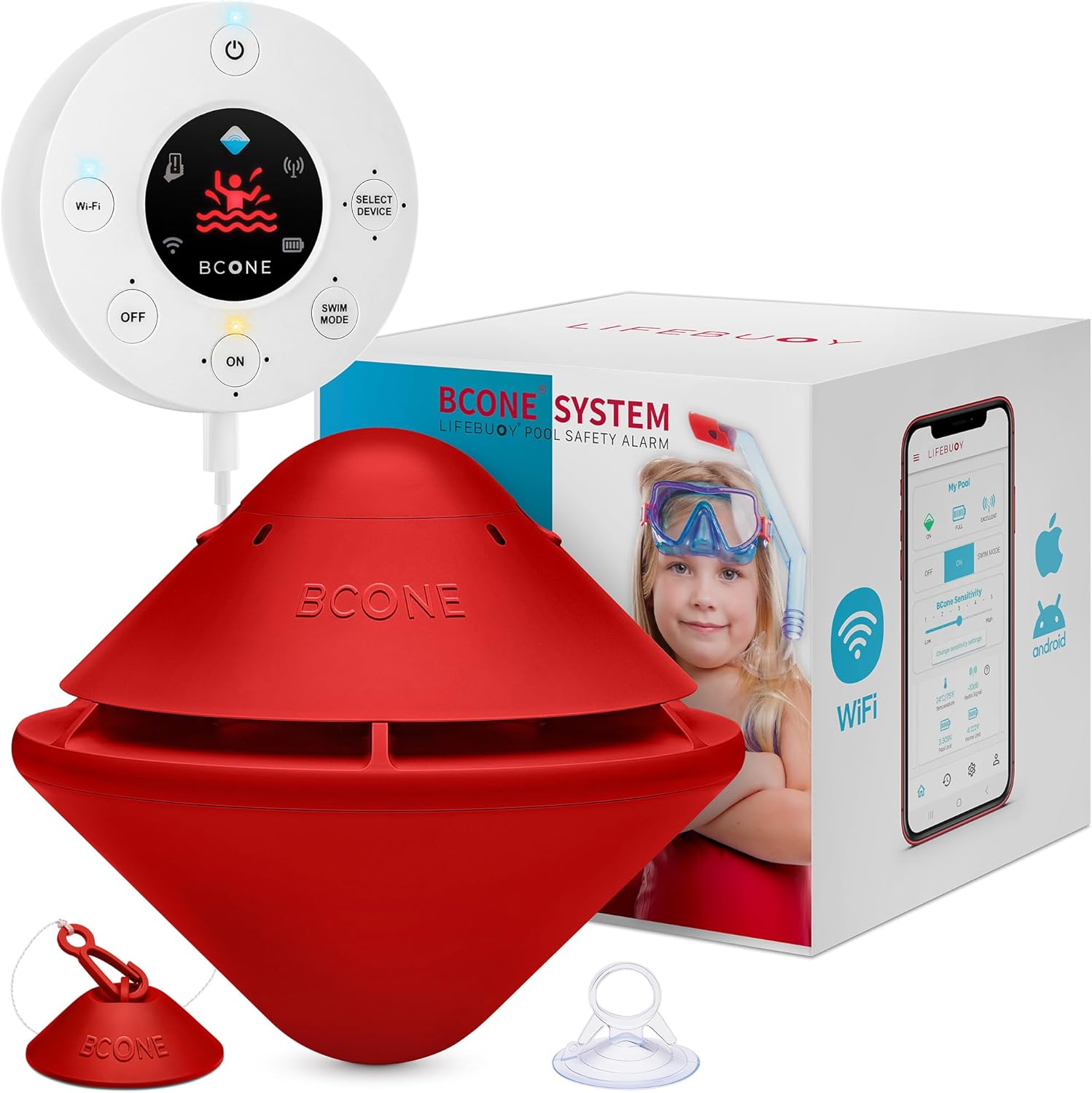
This floating pool alarm meets ASTM F2208 requirements and works with multiple pool types. Alerts sound through both the pool and home units, while smartphone connectivity provides remote system control and support for Alexa and Google Assistant. Up to four pool units can connect to one home unit for larger or multiple pools. The IP68 waterproof system includes automatic reactivation after Swim Mode and a 3-year manufacturer warranty.
Check On AmazonIf you click this link and buy, we earn a commission at no additional cost to you.
Final Thoughts: What to Actually Check Before You Buy
If you take two things away from this, make them these: first, verify certification for the exact model, not just the product category. Second, confirm that model actually fits your pool and yard, whether that’s a surface, subsurface, or perimeter unit, and do not treat a wearable device as a substitute for a fixed water alarm that qualifies under the applicable requirements.
An alarm is one piece of a bigger picture that includes how the pool area is enclosed and who’s actually supervising. For a fuller picture of how all of that fits together for an above-ground setup, it’s worth working through the broader above ground pool safety features you actually need. Pair that with the routine covered in seasonal above ground pool maintenance and safety upkeep so nothing gets forgotten once summer gets busy.
FAQs
🏊 Is a wristband alarm enough for an above ground pool?
Not on its own. A wearable alarm can be certified under ASTM F2208 as a personal immersion alarm, but California’s pool safety law specifically excludes individual-use devices from qualifying as a drowning prevention safety feature. Use it as a supplement during supervised swim time, not as your primary water alarm.
🔧 How do I know if a pool alarm meets ASTM F2208?
Check the product listing, packaging, or manual for an explicit statement of independent ASTM F2208 certification for that specific model. If that language isn’t there, don’t assume the alarm qualifies just because it’s marketed as a safety product.
⏱️ How fast should a certified pool alarm sound?
Under the ASTM F2208 standard referenced by California law, a certified alarm is required to sound within 20 seconds of detecting unauthorized entry, both at the pool and through a remote receiver inside the house.
💧 Do I need both a water alarm and a door alarm?
Not as a blanket rule for every owner. A water alarm and a door, window, or gate alarm each protect a different point in the access sequence, so combining them makes sense when a house or deck provides direct pool access. What’s actually required depends on local code and what other qualifying safety layers are already in place.
🌬️ Why does my surface pool alarm keep going off for no reason?
Surface alarms read water disturbance, and wind can create enough surface movement to trigger a false alarm, especially in an exposed yard. A subsurface alarm is less prone to this since it reads displacement below the surface instead.
🛡️ Can a pool alarm replace a fence around an above ground pool?
No. A water alarm sounds after entry happens, while a fence is meant to prevent entry from happening at all. Both the CPSC and NDPA recommend using barriers, alarms, and supervision together rather than relying on any single layer.
✅ What else should I check besides ASTM certification?
Confirm the model is rated for your pool’s size and type, check the indoor receiver range from where you actually sleep, and verify it auto-rearms and warns on low battery. A certified alarm that doesn’t fit your specific pool may not provide reliable coverage in your setup.
Sources and References
- U.S. CPSC: Pool Alarms voluntary standards overview and ASTM F2208 categories
- Guardian Pool Fence: California pool fencing and alarm law requirements
- UpCodes: California Swimming Pool Safety Act statute text
- U.S. CPSC: Safety Barrier Guidelines for Residential Pools
- National Drowning Prevention Alliance: Layers of Protection