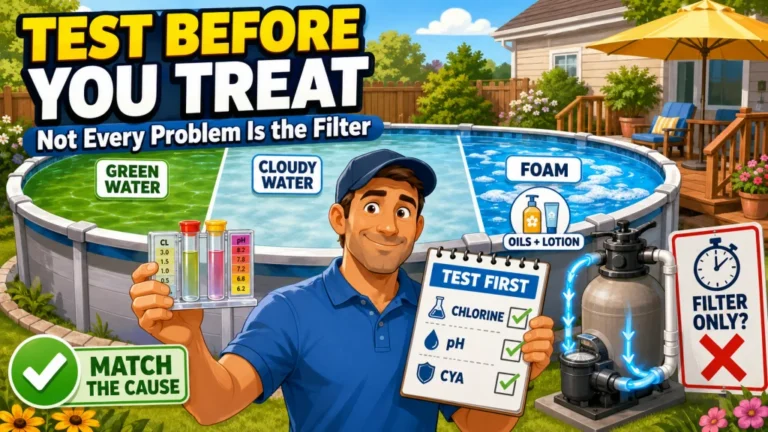
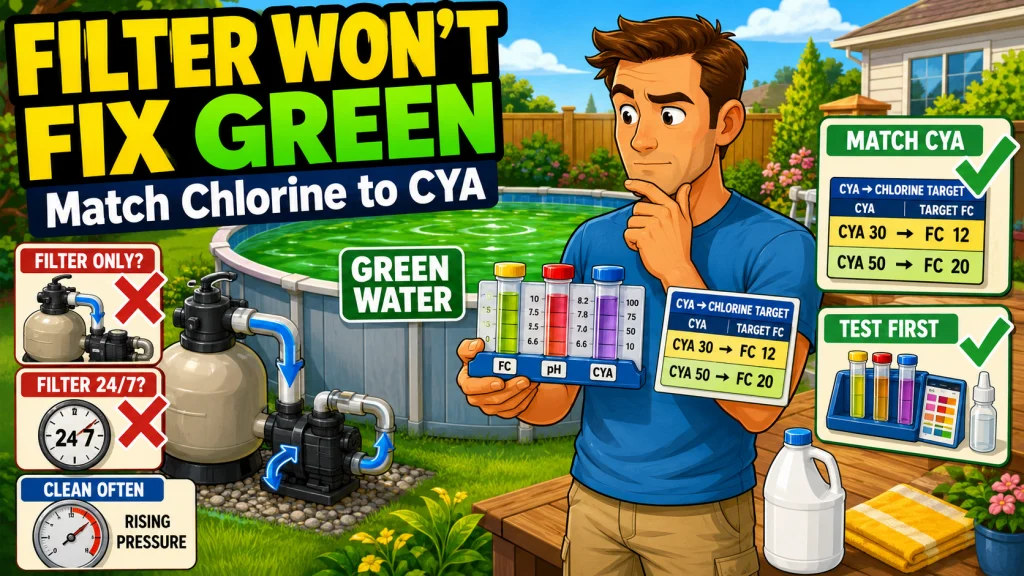
Above ground pool green water is not a filtration problem, it is a chlorine problem, and no amount of extra filter run time fixes it on its own. Green means algae has taken hold because chlorine dropped below the level needed to kill it, and the only reliable fix is the SLAM method: raising free chlorine to a target based on your CYA level and holding it there until the algae is dead. This walks through why the filter alone cannot clear a green pool, the SLAM steps specific to above ground pools, and the cartridge filter cleaning schedule that active SLAM treatment demands. It covers green water and SLAM only, not cloudy water or foam, which are different problems with different causes.
Green Means Algae, Not a Dirty Filter
Above ground pool green water means algae, plain and simple. Algae is a living colony, and it establishes itself when free chlorine has been too low for too long to keep killing it faster than it grows. That is the whole diagnosis. Running the pump and filter longer, backwashing more, or adding a clarifier will not touch the actual cause, because none of those steps raise chlorine to a level that kills algae.
I get this call every summer from an owner who has run the filter around the clock for three days and is still staring at pea soup. The frustration is understandable, because the instinct to filter harder makes sense for cloudy water. Green water is a different animal, and treating it like a filtration problem just burns electricity while the algae keeps multiplying.
Why the Filter Alone Cannot Clear Green Water
A filter is a mechanical strainer. It catches particles that pass through it, but algae in the water column reproduces faster than any residential filter can physically remove it, especially in a cartridge system sized for an above ground pool rather than a commercial application. The community at troublefreepool.com puts it bluntly in one of their most-referenced threads on the topic: a cloudy green pool is a chemical problem, not something the filter alone can solve. Chlorine kills the algae. The filter’s real job in this situation is cleaning up the dead algae afterward, not preventing the bloom in the first place.
This is why I tell owners to stop touching the filter settings and start testing chlorine and CYA instead. If your free chlorine has been sitting near zero for even a few days in warm weather, especially with some sun exposure, that is enough time for algae to take hold. Once it does, the fix is not more filtration, it is enough chlorine, held at the right level, for long enough to finish the job.
Before You Start SLAM, Make Sure You Have These Ready
A SLAM stalls more often from a missing supply than from a wrong step. Once you commit to treating a green above ground pool, having everything on hand from the first hour matters more than getting fancy with technique. Check for these before you add the first dose of chlorine:
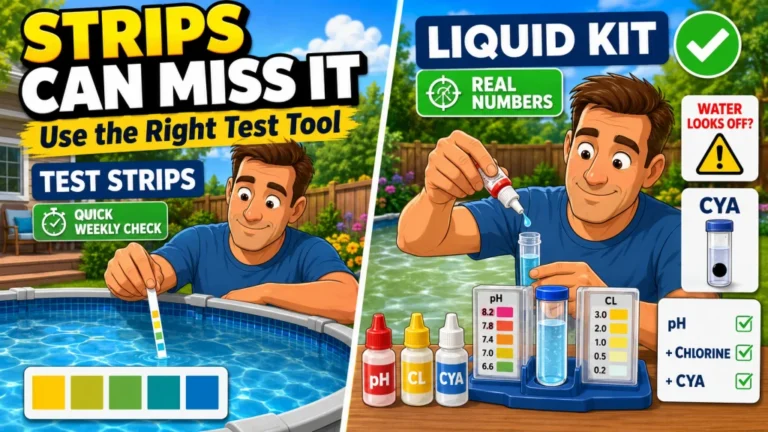
- A test kit that reads both CYA and free chlorine accurately at high levels, not just test strips that top out well below SLAM range
- Enough liquid chlorine for several top-offs, not just one shock dose; a green pool typically needs repeated additions over multiple days, not a single treatment
- A pool brush to work algae off the walls and floor before and during SLAM, since chlorine reaches suspended algae faster than algae still clinging to surfaces
- A vacuum plan for once the water clears enough to see dead algae settling on the floor
- A spare or freshly cleaned cartridge on hand, since the one currently in your filter is about to get worked hard over the next day or two
Skipping any one of these usually shows up as a delay, not a failure: an owner without enough chlorine on hand ends up chasing the SLAM level for an extra day, and an owner without a spare cartridge ends up running a clogged one longer than they should just because cleaning it feels inconvenient in the moment.

This 18-inch pool brush uses nylon bristles for cleaning pool walls, tiles, and floors. Its polished aluminum back provides a rigid cleaning head, while the EZ Clips attachment is designed for connection to a compatible pool pole. The pole is not included.
Check On AmazonIf you click this link and buy, we earn a commission at no additional cost to you.
The SLAM Method for Above Ground Pools
SLAM stands for Shock, Level, and Maintain, and it is the community-standard method documented on troublefreepool.com for clearing an algae-green pool. The core idea is simple even though it takes discipline to follow through: raise free chlorine to a level tied to your CYA reading, keep it there without letting it drop, and confirm the algae is actually dead before you stop. Here is the sequence, adapted for an above ground pool with a typical cartridge filter setup.
- Test your CYA first. The chlorine target for SLAM depends entirely on your cyanuric acid level, not on a flat number that works for every pool. Higher CYA binds more of your chlorine, so it takes more free chlorine to reach the same sanitizing power.
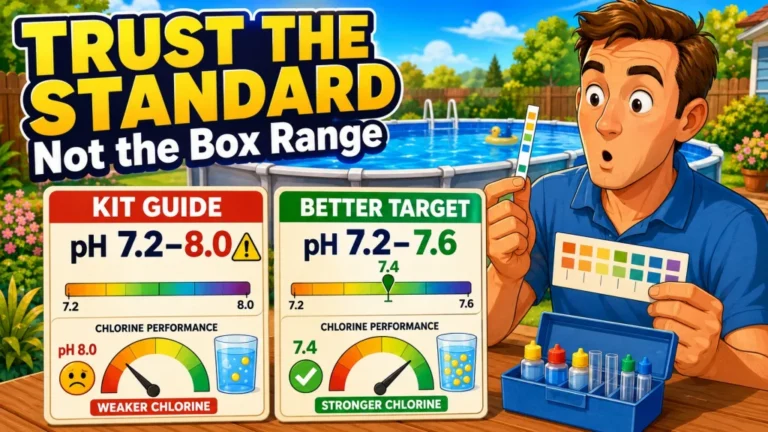
- Adjust pH to 7.2 to 7.4 before you add any shock. A high pH reduces how effectively chlorine works, so fixing pH first means every gallon of chlorine you add afterward does more of its intended job.
- Add liquid chlorine (sodium hypochlorite) to reach your SLAM target. Look for a concentration in the 8.25 to 10 percent range, which is the standard strength sold for pool use and what most SLAM guidance assumes when calculating doses. Based on troublefreepool.com’s SLAM process guidance and its chlorine and CYA reference chart, a pool at 30 ppm CYA needs roughly 12 ppm free chlorine to SLAM, a pool at 50 ppm CYA needs roughly 20 ppm, and a pool at 80 ppm CYA needs roughly 31 ppm. Liquid chlorine at this concentration is preferred during SLAM because it does not add any CYA or calcium the way tablets or cal-hypo shock does.
- Test every 2 to 4 hours and top off. Algae consumes chlorine quickly while it is dying, so the level will drop between doses. Do not let it fall below your SLAM target during the active treatment; every drop below target gives the algae room to recover.
- Confirm completion with an Overnight Chlorine Loss Test. Add chlorine to your SLAM level at dusk, then test again at dawn before any sunlight has had a chance to burn chlorine off. If free chlorine dropped less than 1 ppm overnight, the algae is dead and the SLAM is done. A bigger drop means live algae is still consuming chlorine and you are not finished yet.
Notice that none of those five steps mention the filter. That is intentional. The filter is not the tool doing the work here, chlorine is, and treating the filter as the fix is the single most common reason a green pool drags on for a week or two instead of clearing in two or three days.

This chlorinating liquid contains 10% sodium hypochlorite for pool and spa water treatment. The four-gallon quantity is intended for sanitizing and shock treatment while helping restore water clarity. It comes in liquid form for direct use according to the product instructions.
Check On AmazonIf you click this link and buy, we earn a commission at no additional cost to you.
SLAM Chlorine Targets by CYA Level
Because the correct SLAM level depends on CYA rather than a single universal number, it helps to see the relationship laid out directly before you start dosing chlorine into your above ground pool.
| CYA Level | Approximate SLAM Target (FC) |
|---|---|
| 30 ppm | 12 ppm |
| 50 ppm | 20 ppm |
| 80 ppm | 31 ppm |
If your CYA sits somewhere between these reference points, the target scales roughly in proportion, and a full test kit with a CYA reading is worth the ten minutes it takes before you start dumping chlorine in blind. Guessing at a chlorine level without knowing CYA is one of the most common reasons a SLAM stalls out around day four instead of finishing on schedule.

The K-2006C uses titration-drop testing and includes 2-ounce reagent bottles. It tests free and total chlorine, bromine, pH, acid and base demand, calcium hardness, total alkalinity, and stabilizer levels. The broad test range makes it suitable for checking the water chemistry needed before and during pool treatment.
Check On AmazonIf you click this link and buy, we earn a commission at no additional cost to you.
The Cartridge Filter Problem During SLAM
Above ground pools typically run cartridge filters rather than sand or DE systems, and cartridges trap dead algae quickly once the chlorine starts doing its job. That is a good sign chemically, but it creates a maintenance headache: a cartridge that clogs with dead algae stops filtering efficiently, and some of that trapped material can work its way back into the water instead of staying captured.
Warning: Expect to clean the cartridge far more often than normal during an active SLAM. Real-world reports from pool owners fighting an algae bloom describe rapid pressure rise and the need for frequent cleaning once algae starts loading up the filter.
The honest answer from experienced owners on troublefreepool.com is that you clean the cartridge as often as the water demands, sometimes every few hours during the worst of it. A practical target during heavy SLAM days is checking the cartridge every 6 to 8 hours and cleaning whenever it looks loaded or the pressure gauge climbs.
Running a clogged cartridge does not just filter poorly, it can reduce flow, slow down how quickly the water clears, and let fine debris keep circulating instead of staying trapped. If you notice your filter pressure climbing fast in the first day or two of a SLAM, that is expected. Pull the cartridge, hose it off thoroughly, and get it back in place rather than letting it run overloaded overnight.
After the SLAM Passes
Once your Overnight Chlorine Loss Test confirms the algae is dead, the job is not quite finished. Dead algae settles to the pool floor, and it needs to be physically removed rather than left to slowly work its way through the filter over the following week. Vacuum the floor to waste if your setup allows it, since sending that dead material straight out rather than through the filter saves your cartridge from another round of heavy loading.
If vacuuming to waste is not an option on your equipment, vacuum with the cartridge in place, then pull it and give it one more thorough cleaning once the visible debris is gone. After that, you can return to normal filtration and your regular chlorine maintenance routine. If green water becomes a repeat problem rather than a one-time event, it is worth stepping back and looking at overall above ground pool chemical maintenance rather than treating each bloom as an isolated incident, since a recurring pattern usually points to a chlorine routine that is not holding between doses.

This weighted vacuum head is designed for above-ground and inground pools with vinyl liners. Two self-adjusting air-relief valves control suction, while perimeter brushes help loosen debris from the pool floor. The swivel hose adapter supports 1-1/4-inch to 1-1/2-inch vacuum hoses, which are sold separately.
Check On AmazonIf you click this link and buy, we earn a commission at no additional cost to you.
Final Thoughts: Chase Chlorine, Not the Filter Dial
Every hour spent adjusting filter run time on a green pool is an hour algae keeps winning. The fix is not complicated, it just requires accepting that chlorine, held at the right level for your CYA, is the only thing actually killing the problem. Test CYA, adjust pH, dose to your SLAM target, hold it there, and confirm with the overnight test before you call it done.
If what you are actually seeing is cloudy rather than green water, the cause and the fix are different, and it is worth reading that situation separately rather than assuming SLAM applies. For the wider picture of troubleshooting an above ground pool beyond this one problem, the full above ground pool troubleshooting guide is a good next stop, and if the water is murky but not green, see the guide on diagnosing cloudy above ground pool water instead.
FAQs
🧪 Will running the filter longer clear a green above ground pool?
No. Algae reproduces faster than a residential filter can remove it. The filter’s job is cleaning up dead algae after chlorine has killed it, not preventing or reversing a green pool on its own.
🧫 What SLAM chlorine level do I need for my CYA?
It scales with CYA: roughly 12 ppm free chlorine at 30 ppm CYA, roughly 20 ppm at 50 ppm CYA, and roughly 31 ppm at 80 ppm CYA. Test your CYA before dosing rather than guessing at a chlorine level.
🧽 How often should I clean my cartridge filter during SLAM?
Check it every 6 to 8 hours during active treatment and clean whenever it looks loaded or pressure climbs. A heavy algae bloom can clog a cartridge multiple times a day in the first day or two.
🌙 What is the Overnight Chlorine Loss Test?
It is the way you confirm a SLAM is finished. Dose to your SLAM level at dusk, test again at dawn, and if free chlorine dropped less than 1 ppm overnight with no sun involved, the algae is dead and the SLAM is complete.
🧴 Why use liquid chlorine instead of tablets during SLAM?
Liquid chlorine (sodium hypochlorite), typically in the 8.25 to 10 percent range sold for pools, adds no CYA and no calcium to the water. Tablets and cal-hypo raise those levels every time you use them, which makes future SLAM treatments harder because higher CYA requires even more chlorine to reach target.
🧹 Can I swim while my above ground pool is in a SLAM?
It is not recommended while free chlorine is held at SLAM level, since that level is intentionally high to kill algae quickly. Wait until the SLAM is complete and chlorine has been brought back down to a normal maintenance range.
Sources and References
- Trouble Free Pool’s community discussion on cloudy green water that will not clear up confirms that green pools are a chemical problem rather than a filtration problem.
- Trouble Free Pool’s SLAM: Shock, Level, and Maintain guide confirms the pH-before-shock step, the liquid chlorine recommendation, and the Overnight Chlorine Loss Test criteria described above.
- Trouble Free Pool’s chlorine and CYA reference chart confirms the CYA-dependent SLAM target levels cited in the table above.
- Trouble Free Pool’s discussion on cartridge filter cleaning frequency during a SLAM confirms that cleaning intervals during active treatment can run as often as every few hours.
- JustAnswer’s pool and spa expert discussion on algae causing rapid filter pressure rise confirms that frequent filter cleaning is required once an algae bloom starts loading the filter media.