The correct above ground pool chemical target ranges are the same six numbers used for any residential pool, but the packaging that comes with most above ground kits does not always print them accurately. This guide lays out the six parameters that actually matter, free chlorine, pH, total alkalinity, cyanuric acid, calcium hardness, and combined chlorine, along with the ranges that hold up against pool industry standards rather than brand marketing copy. It also covers the specific spot where a well-known kit brand’s own guide gets pH wrong, and why that error quietly makes a pool harder to keep clear. This is a targets article only. It does not cover how often to test or which kit to test with.
The Correct Above Ground Pool Chemical Target Ranges
Above ground pool chemical target ranges are not a separate standard from any other residential pool. The chemistry does not know or care whether the wall is steel, resin, or poured concrete. Where owners get into trouble is trusting the range printed on their pool kit box over the numbers the pool industry actually works from, and the two do not always match. Here is the set I check against on every service call, not the version that comes folded inside the box.
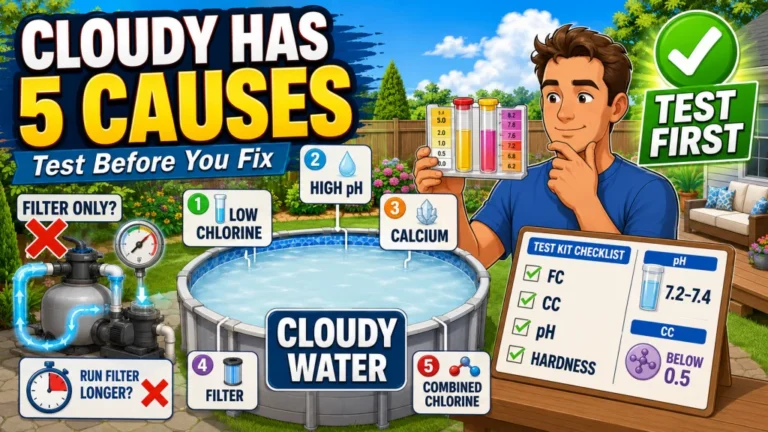
| Parameter | Correct Target Range | Note |
|---|---|---|
| Free Chlorine | 2-4 ppm | For normal operation. A shock-level target depends on your CYA reading and is its own topic, not covered here. |
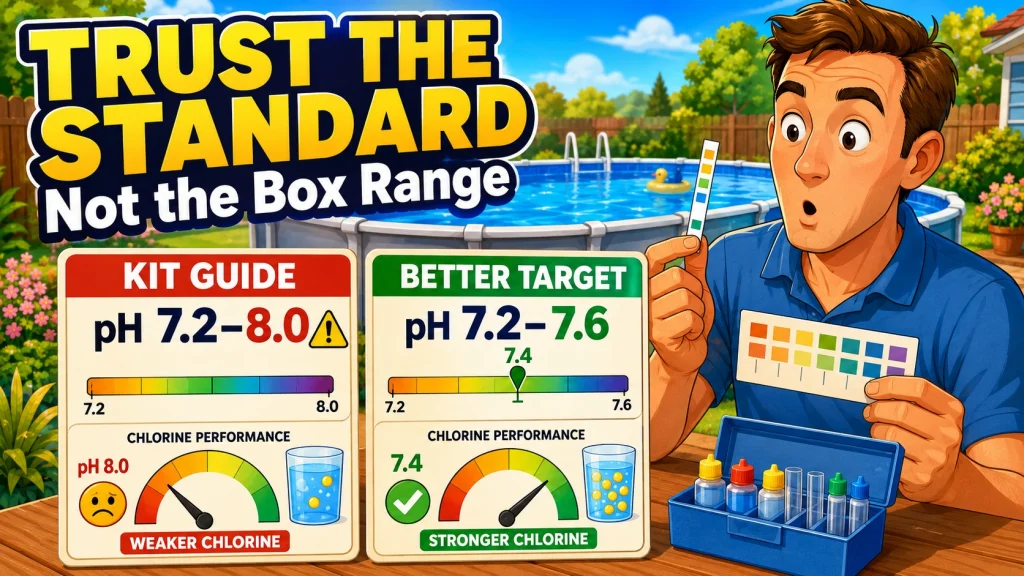
| pH | 7.2-7.6 | Not 7.2-8.0, which some kit guides still print. |
| Total Alkalinity | 80-120 ppm | Keeps pH from swinging between tests. |
| Cyanuric Acid (CYA) | 30-50 ppm | For outdoor pools running stabilized chlorine. |
| Calcium Hardness | 175-225 ppm | Vinyl liner target, lower than the plaster pool standard. |
| Combined Chlorine (CC) | Below 0.5 ppm | Above that, a shock treatment is needed. |
Two of these numbers cause more confusion than the other four combined, and both are worth walking through on their own: the pH range, and the calcium hardness figure. If you want the fuller picture of where chemical targets fit against the rest of pool upkeep, the full chemical levels overview for above ground pools is the place to start before drilling into any one number.
Why Your Pool Kit Chart May Not Match These Numbers
Some of the confusion here is not even a mistake. A lot of charts are printing an acceptable range, the widest window water can sit in and still be considered safe to swim in, not an operating target, the number that actually keeps your above ground pool water balance easy to manage week to week. A pool at pH 7.8 is not going to hurt anyone swimming in it. It is still inside a range plenty of sources call acceptable. It is just a worse number to run your pool at, because chlorine is already working harder than it has to well before 8.0.
The same gap shows up with calcium hardness. A chart built for pools in general, plaster and vinyl together, is going to print a wider acceptable band than the number that is actually correct for your specific liner. Once you know a range is describing what will not hurt you rather than what keeps the chemistry easiest to hold, the targets in this article make more sense next to a chart that looks looser.
Where a Popular Kit Guide Gets pH Wrong
Bestway’s own guidance lists a pH sweet spot of 7.2 to 8.0. The pool industry standard, the range that shows up consistently across independent pool chemistry resources, is 7.2 to 7.6. That difference sounds small until you understand what pH is actually doing to your chlorine.
Chlorine works as a sanitizer in the form of hypochlorous acid. As pH climbs, more of that chlorine converts into hypochlorite ion instead, which is roughly 20 percent as effective at killing algae and bacteria. Hold a pool at 8.0 instead of 7.2 and you are effectively running about five times more chlorine to get the same sanitizing power. That is the part the box does not explain.
| pH Level | What It Means for Your Chlorine |
|---|---|
| 7.2 | Chlorine works close to full sanitizing strength. |
| 8.0 | Chlorine drops to roughly 20 percent as effective at the same ppm reading. |
Key point: A pool that seems to eat chlorine no matter how much you add is worth checking against pH before you assume the chlorine itself is the problem.
Field Note: I have walked into more than one backyard where the owner was dumping in chlorine every other day and blaming a bad batch of shock. The chlorine was fine. The pH had drifted to 7.9 because they were chasing the number on the box, and once we brought it down to 7.4, the same chlorine dose held for a full week instead of two days.

This product lowers and balances pH levels in pool water for improved clarity and more efficient chlorine performance. Balanced pH helps prevent scale formation on pool surfaces and equipment, along with eye and skin irritation for swimmer comfort. Swimmers can return to the water immediately after application, and it is compatible with all pool types. HTH recommends using 6-Way Test Strips weekly to maintain pH between 7.2 and 7.8 ppm.
Check On AmazonIf you click this link and buy, we earn a commission at no additional cost to you.
Why Vinyl Liner Pools Need Less Calcium Than Plaster Pools
Plaster inground pools run a calcium hardness target of 200 to 400 ppm because low-calcium water pulls calcium straight out of the plaster surface over time. An above ground pool with a vinyl liner does not have that problem. There is no calcium in the liner material for soft water to draw from, so the lower end of that plaster range simply does not apply here.
What matters more for a vinyl liner is the other direction: too much calcium. High calcium hardness leads to scaling on the liner and on fittings, which shows up as a rough, cloudy film that is a pain to remove once it sets in. That is why 175 to 225 ppm, noticeably lower than the plaster standard, is the correct target for a vinyl liner above ground pool. It is not a rounding difference or a typo carried over from an inground guide. It reflects a real difference in what the surface is made of.
- Test calcium hardness alongside your regular chemistry checks, not only when the water looks cloudy.
- Target 175 to 225 ppm for a vinyl liner pool, not the 200 to 400 ppm plaster figure.
- Watch for a rough film on the liner or fittings as an early sign of scaling from calcium running high.
- Adjust with the correct product for your reading rather than guessing based on how the water looks on a given day.

These test strips check pH, total chlorine, free chlorine, bromine, alkalinity, total hardness, and cyanuric acid using medical industry technology for accuracy comparable to liquid tests. Simply dip the strip, wait 15 seconds, and compare it to the color chart, with no drops or measuring involved. Each color pad uses paper designed to keep colors vibrant and prevent bleeding for reliable readings. AquaChek has over 35 years of experience helping maintain healthy pool and spa water.
Check On AmazonIf you click this link and buy, we earn a commission at no additional cost to you.

These tablets kill harmful bacteria and prevent equipment corrosion, scale, and stains, while killing and preventing green, mustard, and black algae. A built-in chlorine stabilizer extends sunlight protection, and conditioners help create silky smooth feeling water. Use 2 tablets weekly per 10,000 gallons, adding more as needed to maintain sanitation. Safe for vinyl, plaster, fiberglass, and tile surfaces, with dosage guidance available through the Clorox Pool App.
Check On AmazonIf you click this link and buy, we earn a commission at no additional cost to you.
Final Thoughts: Trust the Standard, Not the Box
Keep this chart separate from the number printed inside your pool kit lid. If the two disagree, do not average them together and do not assume the wider number is just as good because it still counts as acceptable. Use the tighter pH target, match calcium hardness to a vinyl liner rather than a plaster pool, and treat every chemical addition as a response to an actual reading, not a guess based on how the water looks that day. Once your targets are set correctly, the next question is how often to actually check them, and a weekly maintenance routine built around these targets is the natural next step.

This calcium hypochlorite shock treatment offers fast-acting, non-stabilized chlorine for routine algae control and sanitization, with 65 percent available chlorine for crystal-clear water. It is suitable for above ground or in-ground pools, spas, and hot tubs. Pre-dissolve or dilute before adding to avoid bleaching the liner, spreading granules in the deepest part of the pool and brushing if needed. Use 1 pound per 10,000 gallons weekly to maintain 5 to 10 ppm chlorine levels.
Check On AmazonIf you click this link and buy, we earn a commission at no additional cost to you.
FAQs
🧪 What is the correct pH range for an above ground pool?
7.2 to 7.6 is the correct target. Some kit guides list a range up to 8.0, but chlorine loses a large share of its sanitizing power well before it reaches that point.
⚗️ Why does my pool kit say pH should go up to 8.0?
That range comes from the brand’s own printed guidance, not the pool industry standard. At the high end of that range, chlorine converts to a form that is only about 20 percent as effective, which is why pools run this way often seem to need constant chemical additions.
💧 What should calcium hardness be for a vinyl liner pool?
175 to 225 ppm. That is lower than the 200 to 400 ppm target for plaster inground pools, since a vinyl liner has no calcium in the surface for soft water to pull from, and too much calcium instead causes scaling.
🧫 What is a safe combined chlorine level?
Stay below 0.5 ppm. Once combined chlorine climbs past that, it is a sign chlorine is being used up fighting contaminants and a shock treatment is needed.
📊 Where can I find accurate above ground pool chemical levels?
The Pool School section on troublefreepool.com is the resource that matches academic pool chemistry rather than a single brand’s simplified version, and it is a better reference than most kit packaging.