Above ground pool cloudy water almost always comes down to one of five separate causes, and each one needs a different fix. Low chlorine, high pH, an imbalanced calcium hardness reading, a filter that has stopped doing its job, and combined chlorine that has built up past 0.5 ppm all produce the same milky look in the water, but only one of them actually responds well to more filter time, and only after the underlying chemistry behind it is corrected first. Get the diagnosis wrong and you can spend a week adding chemicals or running the pump around the clock with nothing to show for it. This is the diagnosis tree I walk owners through on every cloudy pool service call, in the order I actually test.
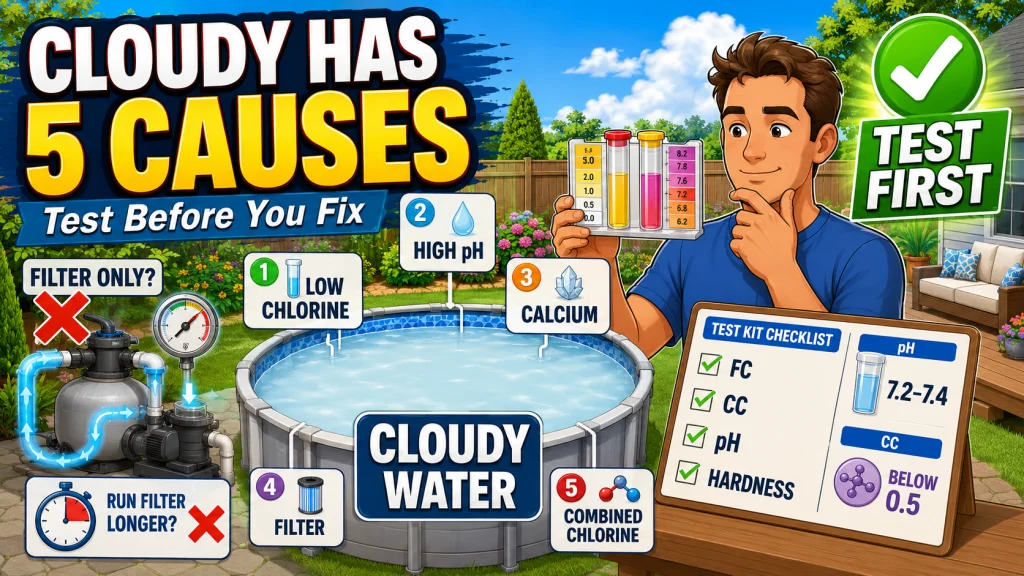
Cloudy Water Has Five Causes, Not One
Most advice for cloudy above ground pool water treats the problem like a single condition with a single cure: add clarifier, run the filter, wait. That works exactly once out of five times. The other four causes do not respond to more filtration on their own, because the filter was never the thing driving the cloudiness in the first place. High pH and calcium imbalance can keep the water cloudy until the chemistry is corrected, no matter how long the filter runs, high combined chlorine needs to be broken down chemically rather than filtered away, and a filter that is itself clogged or channeled will actually push the same haze back into the pool the longer it runs.
I have stood next to enough pools with owners staring at the water wondering why three days of extra filter time did nothing to know this is the most common frustration I hear. The fix is not more effort in the same direction. It is testing before doing anything else, because free chlorine, combined chlorine, and pH tell you which of the five causes you are dealing with before you spend money or time on the wrong one.

This all-in-one kit tests for free and total chlorine, pH, acid and base demand, total alkalinity, calcium hardness, and cyanuric acid, working with any pool, hot tub, or spa. It includes a carrying case, water comparator, water balance calculator, base demand reagent, color-coded instructions, and a waterproof chemistry guide for quick reference. Taylor test kits are the only testing supplies recommended by the American Swimming Coaches Association, ensuring professional-level accuracy.
Check On AmazonIf you click this link and buy, we earn a commission at no additional cost to you.
Cause 1: Low Chlorine Letting Biological Growth Take Hold
Low free chlorine is the cause I see most often, and it is also the one that genuinely does respond to time and filtration once the chlorine is corrected. When free chlorine drops below the level your cyanuric acid (CYA) reading requires, bacteria and microscopic algae start multiplying faster than the sanitizer can knock them back. The water does not turn green yet. It just goes hazy, almost like a fine dust suspended in the water that never settles.
This is different from a fully green pool, which is its own problem with its own recovery sequence. If your water has already gone green rather than just cloudy, that calls for the full SLAM Process, meaning raising and holding shock-level chlorine until the water passes an overnight test, rather than a routine chlorine bump, and I walk through that separately in the SLAM method for a green pool. For plain cloudiness without a green tint, raising free chlorine to shock level and holding it there until the water clears is the correct move, and filter run time helps once the chlorine is where it needs to be, not before.
Cause 2: High pH Precipitating Calcium Out of the Water
Once pH climbs above roughly 7.8, dissolved calcium in the water starts precipitating out as microscopic solid particles. Those particles are what give the water its milky, almost chalky appearance, and this is the cause where running the filter longer does the least good. The filter was never designed to strain out particles this fine at the rate they are forming, so you can run the pump all weekend and the haze barely moves.
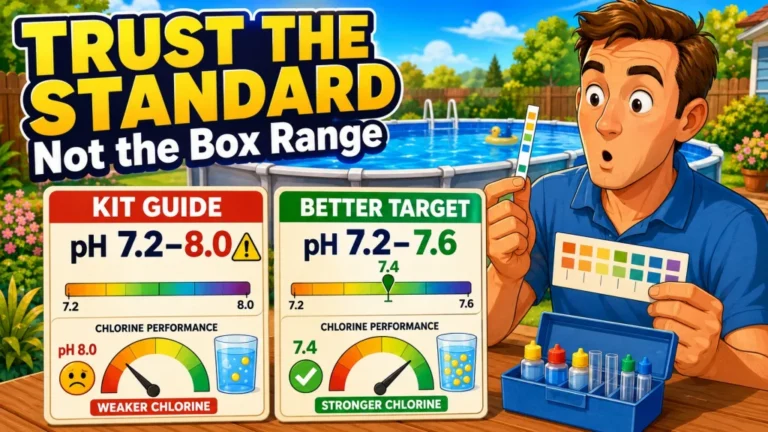
I have had owners tell me they already added more chlorine and it did not help. That tracks, because this is not a sanitizer problem to begin with. Bringing pH back down to the 7.2 to 7.4 range stops new calcium from precipitating, and the existing haze typically settles or filters out over the following 24 to 48 hours once the chemistry is corrected. Test pH before adding anything else if the water looks milky rather than dull or green.
Field Note: I have watched owners dose clarifier into a pool with pH sitting at 8.0, wondering why the cloudiness came right back within a day. Clarifier binds particles together so the filter can catch them, but if pH is still driving new calcium out of solution, you are just running the same race on a treadmill.

Clorox Pool&Spa pH Down is a 5-pound granular pH reducer designed for swimming pools. It lowers high pH and helps reduce conditions that contribute to scale buildup. The granular formula is suitable for chlorine and saltwater pools and provides a dry option for bringing pool water back into its intended pH range.
Check On AmazonIf you click this link and buy, we earn a commission at no additional cost to you.
Cause 3: Calcium Hardness Sitting Outside the Right Range
Calcium hardness works a little differently depending on which direction it is off. Soft or well water with low calcium hardness tends to show up most in pools with metal fittings, heaters, or other equipment exposed to aggressive water, and it usually gets worse when low calcium hardness is paired with low pH or low alkalinity rather than acting alone. On the other end, calcium hardness running high, especially alongside elevated pH or total alkalinity, produces the same milky, chalky look through the same precipitation mechanism as Cause 2.
For a vinyl liner above ground pool, the target range is roughly 175 to 225 ppm. If your fill water comes from a well, test calcium hardness before you assume the problem is chlorine or filtration, because well water quality varies enough from one property to the next that guessing costs you a wasted week. Adjusting calcium hardness into range, rather than adding more sanitizer or running longer filter cycles, is what actually resolves this cause.
Cause 4: A Filter That Has Stopped Filtering
This is the one cause where extra run time can genuinely make things worse instead of better. A cartridge filter that is clogged, or a sand filter that has channeled, stops removing particles and starts recirculating them through the same path over and over. Every extra hour on the pump just pushes the same haze back into the pool instead of trapping it.
- Pull the cartridge and inspect it. If it is gray, matted, or has not been cleaned in the current season, clean or replace it before touching chemistry.
- For sand filters, backwash fully and check the pressure gauge before and after. A pressure drop that does not return to normal after backwashing points to channeling or media that needs replacing.
- Check flow at the return jets. Weak return flow with normal pump operation usually means the filter side, not the pump side, is the bottleneck.
- Confirm the filter has actually run its full recommended cycle for your pool’s gallon count, not just “most of the day.”
I have replaced cartridges that owners swore they had “just cleaned,” only to find the pleats packed solid with fine sediment a rinse with a garden hose never touches. If the filter media still looks loaded after cleaning, treat that as a replacement decision rather than another chemistry experiment. If the filter itself is the bottleneck, fixing chemistry first and filtration second gets you nowhere. Clear the mechanical problem, then let the corrected filter do its job on whatever chemical cause is layered underneath it.

The Aqua Comb is a handheld cartridge-filter cleaning tool that attaches to a standard garden hose. Its UV-protected ABS body, nylon comb and barrel valve, and stainless steel 30-mesh hose seal are designed for repeated filter cleaning. It operates at 35 to 55 psi and works with both saltwater and chlorine-based filter systems.
Check On AmazonIf you click this link and buy, we earn a commission at no additional cost to you.
Cause 5: Combined Chlorine Past 0.5 ppm
Combined chlorine (CC) is chlorine that has already reacted with contaminants in the water and is no longer available to sanitize anything new. Once CC climbs above about 0.5 ppm, it produces chloramines, and chloramines are what actually causes the sharp chemical smell and eye irritation people usually blame on “too much chlorine.” The water clouds because the chloramines themselves, along with whatever organic material is feeding them, are still suspended in solution.
This is not a low chlorine problem in the way Cause 1 is. Your free chlorine reading might look fine on a basic test strip while CC is quietly climbing in the background, which is why testing CC specifically matters instead of assuming FC alone tells the whole story. A proper shock, dosed to break through the combined chlorine rather than just top off free chlorine, is what clears this cause. Running the filter without addressing CC first just moves the same irritating, cloudy water around the pool. The filter can pull out debris, but it cannot oxidize chloramines for you, so nothing changes until the shock breaks them down.

HTH Super Shock Treatment is a powdered pool treatment supplied as a six-pack of 1-pound bags. It is designed to kill bacteria and reduce chlorine odor while treating pool water. The powdered format provides a dedicated shock treatment for pool-cleaning and water-care applications.
Check On AmazonIf you click this link and buy, we earn a commission at no additional cost to you.
Test Before You Touch Anything
Every one of these five causes produces roughly the same visual result: water that looks dull, hazy, or milky instead of green or brown. That is why so many owners end up with five different answers for the same cloudy-water symptom depending on which forum or product label they follow. Test FC, CC, and pH before adding a single chemical or extending a single filter cycle. The results point you toward which cause you are actually dealing with, and applying the wrong fix, like adding more chlorine to a pH problem, just burns money and buys you another few days of cloudy water.
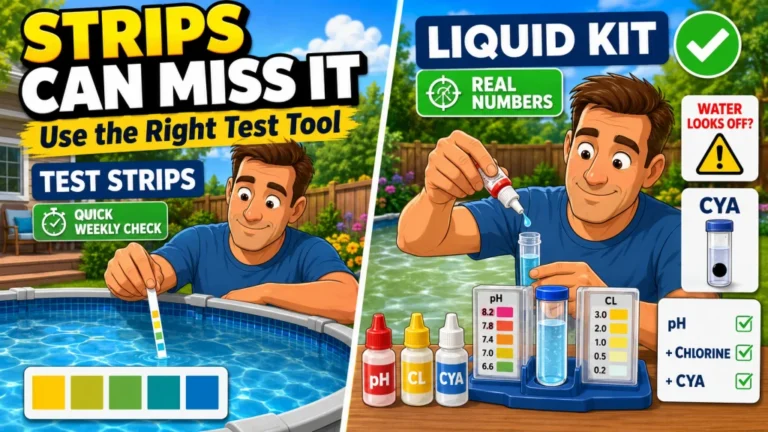
If your test method cannot separate FC from CC, you are guessing at one of the most important causes on this list, since a normal-looking chlorine reading can still be hiding a combined chlorine problem underneath. The same goes for the filter: if the cartridge pleats stay gray and packed after a rinse, that is a failed filter media problem, not a chemistry mystery, and no amount of retesting water chemistry will fix it.
| What You Test | Target Range | What an Off Reading Suggests |
|---|---|---|
| Free chlorine (FC) | Shock level until clear, then routine range for your CYA | Low FC points to Cause 1 |
| Combined chlorine (CC) | Below 0.5 ppm | High CC points to Cause 5 |
| pH | 7.2 to 7.4 | High pH points to Cause 2 |
| Calcium hardness | 175 to 225 ppm (vinyl liner) | Out of range points to Cause 3 |
| Filter condition | Clean media, normal pressure and flow | Clogged or channeled points to Cause 4 |
Once you know which cause the numbers point to, the fix is specific rather than a shot in the dark. That is the difference between a pool that clears in a day or two and one that stays hazy for a week while an owner keeps adding clarifier and hoping.
How Long Each Fix Should Take to Show Results
Applying the right fix does not always mean instant clarity, and knowing what to expect keeps you from giving up on a correct fix too early or letting a wrong one drag on. This is the part most cloudy-pool guides skip entirely. Here is roughly what I tell owners to watch for once they have identified the actual cause.
| Cause | What Should Happen After the Right Fix | When to Retest |
|---|---|---|
| Low free chlorine | Haze fades gradually as chlorine holds at shock level; this is not instant | Every few hours, then again the next day |
| High pH | New haze stops forming first, then existing cloudiness clears over 24 to 48 hours | Retest pH within a few hours of adjusting |
| Calcium hardness | Clearing is usually slower, especially on well water fills | Retest after a full filter cycle |
| Filter problem | Pressure and return flow improve quickly; water clarity catches up over the following day | Check pressure and flow right after cleaning or replacing media |
| High combined chlorine | Smell and eye irritation fade as CC breaks down under shock | Retest CC a few hours after shocking |
If a pool has not moved in the direction this table describes after the expected window, that is a sign either the wrong cause was targeted or a second cause is layered underneath the first one. Retest all five parameters rather than assuming the original diagnosis was wrong entirely.
Final Thoughts: Match the Fix to the Cause, Not the Symptom
Cloudy water is one of the most common calls I get, and the reason it drags on for some owners and clears fast for others usually comes down to whether the right cause got identified first. If you have already tried adding chemicals and running the filter longer with no change, that is a strong sign you are dealing with Cause 2, 3, or 4 rather than Cause 1. That pattern often shows up alongside other symptoms too, and I cover the wider picture in diagnosing common above ground pool problems.
What trips owners up is not any single cause being complicated. It is reaching for the same fix every time regardless of what the test kit is actually telling them. Keeping up with the basics between symptoms also means you are not starting from zero each time a pool clouds up; a steady seasonal above ground pool maintenance routine catches most of these causes before they turn into a cloudy pool in the first place.
FAQs
🌊 What is the fastest way to fix cloudy pool water in an above ground pool?
Test FC, CC, pH, and calcium hardness first, then match the fix to whichever reading is off instead of guessing. Skipping straight to clarifier or extra filter time only works if low chlorine turns out to be the actual cause.
🧪 Why is my above ground pool water cloudy even though my chlorine tests fine?
Free chlorine can read normal while combined chlorine climbs quietly in the background, or the real cause could be high pH, calcium hardness, or a clogged filter rather than chlorine at all. Test CC and pH separately before assuming chlorine is fine.
⏱️ Will running my filter longer fix cloudy pool water?
Only if low chlorine is the cause. If the cause is high pH or calcium hardness, extra run time will not fix the chemistry creating the haze. If the filter itself is clogged or channeled, extra run time can actively make things worse by recirculating particles instead of trapping them.
💧 What pH level causes cloudy pool water?
Once pH climbs above roughly 7.8, dissolved calcium starts precipitating into microscopic particles that cloud the water. Bringing pH back to 7.2 to 7.4 stops new precipitation and lets existing haze clear over 24 to 48 hours.
🔧 How do I know if my filter is causing the cloudiness?
Check for weak flow at the return jets, a pressure gauge that will not drop after backwashing, or a cartridge that looks matted and gray. Any of those point to the filter itself as the bottleneck rather than chemistry.
🧴 Should I add clarifier before testing my water?
No. Clarifier only helps if fine particles are the whole problem, and it will not fix high pH, low calcium hardness, or a clogged filter. Test FC, CC, and pH first so you are not masking a cause that keeps coming back.
⚗️ What is combined chlorine and why does it make water look cloudy?
Combined chlorine is chlorine that has already reacted with contaminants and can no longer sanitize. Above about 0.5 ppm it forms chloramines, which cause both the cloudy appearance and the sharp chemical smell people often mistake for too much chlorine.
Sources and References
- Trouble Free Pool’s diagnosis guide for cloudy pool water, covering filtration, circulation, and water balance causes.
- Trouble Free Pool’s breakdown of free chlorine, pH, and calcium hardness, used for the target ranges referenced above.
- iopool’s explanation of the five common causes of milky pool water, including the pH and calcium precipitation mechanism.