Sizing a pump for an above ground pool comes down to one number: how many gallons per hour it needs to move to turn over your entire pool volume in 8 hours. Horsepower doesn’t answer that question, GPH does. This walks through the exact calculation for the common above ground pool sizes, shows where the pump that ships with a 15-foot or 18-foot kit falls short, and gives you the practical upgrade range without oversizing past what your filter can actually handle.
Above Ground Pool Pump Size Isn’t About Horsepower
I get asked some version of this question every week from someone standing next to a pool that just won’t clear up: “is my pump big enough?” They almost always describe it in horsepower, and that’s the wrong unit for this problem. An above ground pool pump size calculation is really a gallons-per-hour question, matched against how much water your specific pool holds. A pump can carry a big horsepower rating and still be the wrong pump if its GPH output can’t turn over your pool’s volume in a reasonable window. Here’s the actual math, not the marketing number on the box.
The calculation itself only needs two numbers: your pool’s total gallons, and the standard turnover window outdoor residential pools are built around. Everything below walks through where that window comes from and applies it to the sizes people actually own.
The 8-Hour Turnover Standard, and Why It Matters
“Turnover” means every gallon in the pool has passed through the filter once. The accepted standard for outdoor residential pools, above ground included, is one full turnover every 8 hours. That window isn’t arbitrary. It’s built around a typical day of sun exposure, bather load, and debris, giving the filter enough passes to keep up with what’s being added to the water faster than it can settle or bloom into algae.
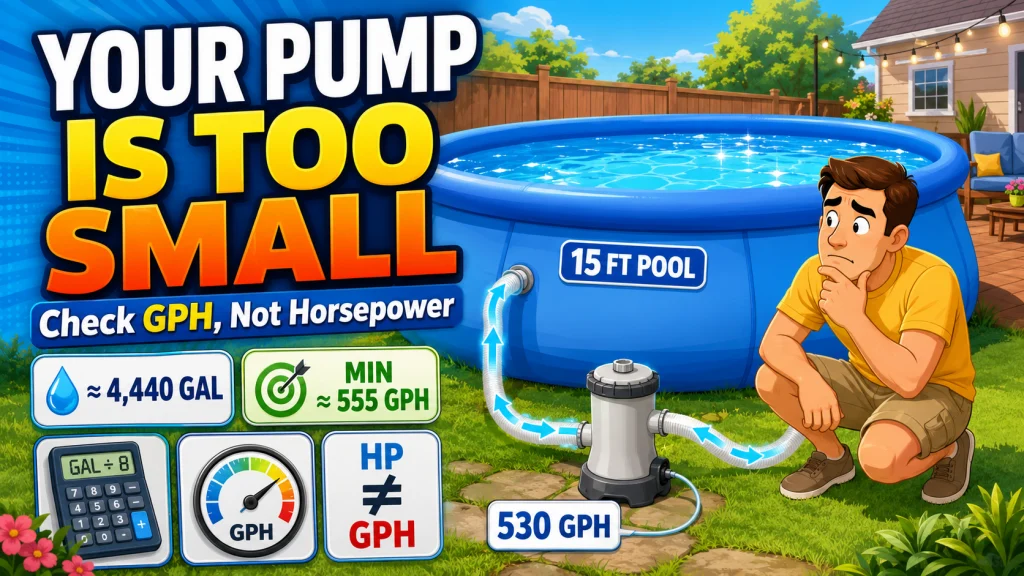
To find your minimum required GPH, take your pool’s total gallons and divide by 8. A pool holding 4,440 gallons needs at least 555 gallons per hour moving through the system. That’s the floor, not a comfortable margin, which matters once you start accounting for hose length, fittings, and a filter that’s due for a backwash.
Pool Volume and Minimum GPH by Size
Here’s what size pump for an above ground pool actually looks like once you run the numbers across the sizes people commonly own. These are round pools at typical depths, since that’s what most above ground kits ship as.
| Pool Size | Approx. Volume | Minimum Pump GPH |
|---|---|---|
| 12 ft round, 36 in deep | ~2,036 gal | 255 GPH |
| 15 ft round, 48 in deep | ~4,440 gal | 555 GPH |
| 18 ft round, 48 in deep | ~6,400 gal | 800 GPH |
| 21 ft round, 52 in deep | ~8,600 gal | 1,075 GPH |
| 24 ft round, 52 in deep | ~11,300 gal | 1,413 GPH |
If your pool doesn’t match one of these exactly, the process to check your own above ground pool pump GPH is the same regardless of size:
- Find your pool’s rated gallon capacity, usually printed on the box or in the manual
- Divide that number by 8 to get your minimum required GPH
- Compare that figure against the GPH rating printed on your pump, not its horsepower
- If your pump’s GPH is below that minimum, it’s undersized for the pool it’s running
That checklist works for any round above ground pool, even if your exact model isn’t in the table above, and it’s worth running even if you already own the pump. A lot of owners never check because the pump came in the box and they assumed it was matched to the pool.
Running the Numbers on a Pool That Isn’t in the Table
If your pool’s dimensions don’t line up with a standard size, the gallon capacity is usually printed right in the manual or on the box the liner or pump came in. If you can’t find it, use the actual water depth you fill to, not the wall height, since most owners run their pool a few inches below the top for splash-out room, and that difference changes the volume math.
Say your pool works out to 5,000 gallons. Divide by 8 and you get 625 GPH minimum. If your filter’s rating is listed in GPM instead of GPH, the conversion is straightforward: divide GPH by 60. That same 625 GPH minimum works out to roughly 10.4 GPM, which is the number you’d actually compare against a filter’s flow rating. Running both conversions before you shop keeps the pump and the filter on the same footing instead of comparing two numbers in different units and assuming they match.

This filter system is built with durable thermoplastic materials for long-lasting performance and features an extra-large, non-woven cartridge for superior water clarity, extended filter cycles, and maximum water flow. A built-in pressure gauge and air release valve simplify operation, while a secure locking system prevents dead locking. It includes a 1.5 in threaded connector and operates at 115V/60Hz. Note that filter-only versions do not include the pump, system base, or pump-to-tank connection.
Check On AmazonIf you click this link and buy, we earn a commission at no additional cost to you.
What This Means for the Pump That Came in the Box
Here’s where the calculation gets uncomfortable for a lot of owners. The stock pump included with a 15-foot Easy-Set style pool is rated at 530 GPH. Run that pool’s ~4,440 gallons through the formula and the minimum comes out to 555 GPH. The stock pump is under that minimum before you’ve even accounted for hose resistance or a dirty filter cartridge, which means there’s no real margin left once the pool is actually in use.
It gets worse, not better, on the next size up. Owners of 18-foot and larger models tell me almost the same thing every summer: the pump that came with the kit can’t keep up once the water’s warm and the pool’s getting used daily. At ~6,400 gallons, an 18-foot pool needs 800 GPH minimum, and most stock pumps bundled with entry-level 18-foot kits were never built to hit that number. If you’re running a stock pump on a 15-foot or larger above ground pool, the math is worth doing before you assume the equipment that shipped with your pool is actually adequate for it. It’s one piece of a bigger decision too. Pump GPH is just one factor in choosing the right above ground pool equipment overall, alongside filter type and liner condition.

This pump uses HydroAeration Technology to improve water circulation, filtration, clarity, and negative ion levels at the surface. It delivers a 1,500 GPH flow rate at the pump and 1,180 GPH in the pool, suitable for Intex above ground pools up to 9,400 gallons with a 1.25 inch hose fitting. Installation just requires hooking up the hoses and plugging in, with partial assembly needed. It uses easy to clean Type A Dacron paper cartridges, which should be replaced every 2 weeks.
Check On AmazonIf you click this link and buy, we earn a commission at no additional cost to you.
Don’t Oversize Past What Your Filter Can Handle
Once someone learns their pump is undersized, the instinct is to swing hard the other way and buy the biggest pump available. That’s its own mistake. Your filter has its own flow rate ceiling, and if the pump you install pushes more gallons per minute than the filter is rated to handle, the system gets overworked instead of improved. Water moves through too fast for the filter media to actually catch debris, and you end up with a pump that’s technically powerful and a filter that’s functionally useless.
The fix is matching the two together, not maximizing one in isolation. Filters are usually rated in GPM rather than GPH, so divide your pump’s GPH by 60 before you compare the two numbers directly. Pick a pump whose converted GPM output the filter can actually process. Oversizing the pump relative to the filter is a common upgrade mistake I see just as often as the original undersized-pump problem, and it’s just as avoidable once you know to check both numbers in the same unit.

This filter system features an oversized 50 sq. ft. filtration area suited for pools up to 15600 gallons, with single-cell technology that distributes captured dirt for longer filter cycles. It houses a 0.75 HP, 3720 GPH pump that is DOE compliant and optimized for low noise operation. A tightening ring and latch locking system ensures air-tight performance, and the unit includes a pressure gauge and release valve. The complete set comes with a heavy duty tank, cartridge element, base, pump, two 1.5 in. connection hoses, and adapters, all molded from non-corrosive, UV resistant material.
Check On AmazonIf you click this link and buy, we earn a commission at no additional cost to you.
The Practical Upgrade Target, Not Just the Mathematical Minimum
The mathematical minimum from the table above is a floor, not a target to aim for. For most above ground pools from 15 to 24 feet, a 1,500 to 2,000 GPH pump is the practical replacement range once you’re upgrading. That gives you real margin for hose resistance, a filter that needs backwashing, and the extra bather load and sun exposure that show up on the hottest days of the season, without pushing past what a typical above ground filtration setup can handle.
Field Note: I rarely see a homeowner regret upgrading to a 1,500 to 2,000 GPH pump on a 15-foot or larger pool. I hear a lot more regret about not doing the math before the water turned green the first time. The upgrade cost is small compared to a summer of fighting cloudy water with chemicals instead of fixing the actual turnover problem.

This sand filter pump delivers a 2500 GPH flow rate with a 2000 GPH system flow rate, suitable for pools up to 9000 gallons. A 24-hour programmable timer offers 9 settings from 2 to 24 hours for automated filtration, while the 6-way valve provides filter, waste, closed, backwash, recirculate, and rinse settings. It includes hose adapters and a conversion kit for compatibility with Intex, Bestway, and other above-ground pools. The thick-walled, UV-resistant, anti-corrosion design supports a 50 lbs sand capacity and comes with a two-year warranty.
Check On AmazonIf you click this link and buy, we earn a commission at no additional cost to you.
What Your Number Actually Means
Once you’ve run the math, where you land changes what you should do next. If your pump’s GPH comes in below the minimum for your pool’s volume, that’s not a chemical problem first. It’s a turnover problem, and no amount of shock or algaecide fixes a pump that physically can’t move enough water in a day.
If your pump sits just barely above the minimum, don’t treat that as a pass. A dirty cartridge, a long hose run, or extra fittings all eat into that margin, so a pump reading a few GPH over the floor can still behave like an undersized one in practice. If your pump’s output is well above what your filter is rated to handle, the problem isn’t sizing at all anymore. It’s mismatch, and the fix is sizing the two pieces together rather than assuming bigger is automatically better. If your water is cloudy even though the math checks out on both ends, the cause is probably somewhere other than pump or filter sizing, most often chemical balance or a filter overdue for cleaning.
Final Thoughts: Check the GPH Before You Trust the Box
An above ground pool pump size calculation isn’t complicated, but it’s a step most owners skip because the pump already came with the pool. Run your gallons against the turnover formula and compare the result to your pump’s actual GPH rating. If you’re short, upgrade into the 1,500 to 2,000 GPH range for most 15-foot and larger pools, and check your filter’s flow rating before you buy so the two pieces of equipment are actually matched. Once you know your pump is sized correctly, it’s worth looking at how sand and cartridge filters compare so the rest of your filtration setup can keep up with it, or exploring the full pump and filter buying guide for everything else that affects water clarity.

This system includes an 18 in. polymeric tank, a 7-position filter control valve, a 1 HP PowerFlo Matrix pump, a one-piece deluxe base, and a 1½ in. hose package. The 7-position VariFlo valve provides maximum flow at a lower pressure drop, while a large pressure sand and water drain allows for rapid winterizing or servicing. An integral top diffuser ensures even water distribution across the sand bed for optimal filtration.
Check On AmazonIf you click this link and buy, we earn a commission at no additional cost to you.
FAQs
🧮 What size pump do I need for my above ground pool?
Take your pool’s rated gallon capacity and divide it by 8. That number is the minimum GPH your pump needs to deliver. A 15-foot pool at roughly 4,440 gallons needs at least 555 GPH.
⏱️ How is above ground pool pump GPH different from horsepower?
GPH measures how many gallons the pump actually moves per hour, which is what turnover depends on. Horsepower measures motor strength but doesn’t tell you the flow rate, so two pumps with the same horsepower can have very different GPH ratings.
🏊 Is the stock pump on a 15-foot above ground pool big enough?
Usually not. The stock pump on most 15-foot Easy-Set style pools is rated around 530 GPH, and that pool’s volume needs at least roughly 555 GPH. There’s no real margin left once hose resistance and filter load are factored in.
🔧 How do I size an above ground pool pump if my pool isn’t a standard size?
Find your pool’s exact rated gallon capacity from the manual or manufacturer spec sheet, then divide that number by 8. That gives you the minimum GPH regardless of whether your pool matches a common size.
⚠️ Can a pump be too powerful for an above ground pool?
Yes, if it outpaces your filter’s rated flow. Check your filter’s GPM rating before buying a bigger pump, since a pump that overpowers the filter can overwork the system without improving water clarity.