A federal regulation that took effect in 2021 changed what kind of replacement pool pump manufacturers are allowed to build, and most above ground pool owners only find out about it when their old pump dies and the replacement options look different than they expected. The short version: the rule targets self-priming pumps, which is the category most in-ground pools use, while most stock above ground pool pumps are built as non-self-priming units that were largely left alone by the same rule. That does not mean the regulation is irrelevant to you. It means the answer depends on the size of your pool, how your pump is sitting relative to the water line, and whether you are upgrading past what a stock kit pump was ever designed to handle.
The Federal Rule Behind Your Replacement Pump Options
If you are shopping for a variable speed pump for an above ground pool because your old one just failed, you have probably noticed the shelf looks different than it did a few years ago. Fewer plain single-speed models, more boxes advertising multiple speed settings and a WEF rating you have never had to think about before. That shift traces back to a Department of Energy energy efficiency rule that took effect on July 19, 2021, and it is the reason the replacement pump market for pools has changed shape even though most owners never read the regulation itself.
Here is the detail that gets left out of most explanations aimed at in-ground pool owners: the rule does not apply the same way to every pump. It separates pumps into self-priming and non-self-priming categories, and that distinction, not horsepower alone, is what actually decides whether your replacement has to be variable-speed.
What a Variable Speed Pump Actually Does
A single-speed pump has one setting: on, running at full power, for as long as it is switched on. A variable-speed pump can run at several different speeds, which means it can filter your above ground pool at a low, quiet setting for most of the day and only ramp up when you need higher flow, such as running a pressure cleaner or a heater.
The energy math behind this is not subtle. Pump power draw scales with the cube of speed, so cutting the speed in half does not cut the energy use in half, it cuts it much further. That is why running a pump at a lower speed for a longer stretch of time typically uses roughly 40 to 90 percent less electricity than the same turnover achieved at full single-speed, with the exact figure depending on the speed setting used and how much resistance is in the plumbing and filter.
For an above ground pool, this matters most during the months you are actually running the pump daily. A smaller pool volume means the pump does not need to work as hard to hit a full turnover, which is exactly the kind of situation where a low, steady speed setting saves the most money compared with a single-speed pump cycling on and off at full power.
The 2021 Federal Regulation, Explained Without the Legal Language
The 2021 dedicated-purpose pool pump standards, which took effect on July 19, 2021, set the first minimum efficiency requirements for pool pumps sold in the United States. In plain English, this is why many bigger replacement pumps now show up as variable-speed models: manufacturers can no longer build new self-priming pumps at or above roughly 0.711 hydraulic horsepower, a range that lines up with most 1 HP-class units, unless the pump meets the efficiency standard, and in practice only variable-speed technology clears that bar. That is why self-priming replacement pumps in that size range are now variable-speed almost across the board.
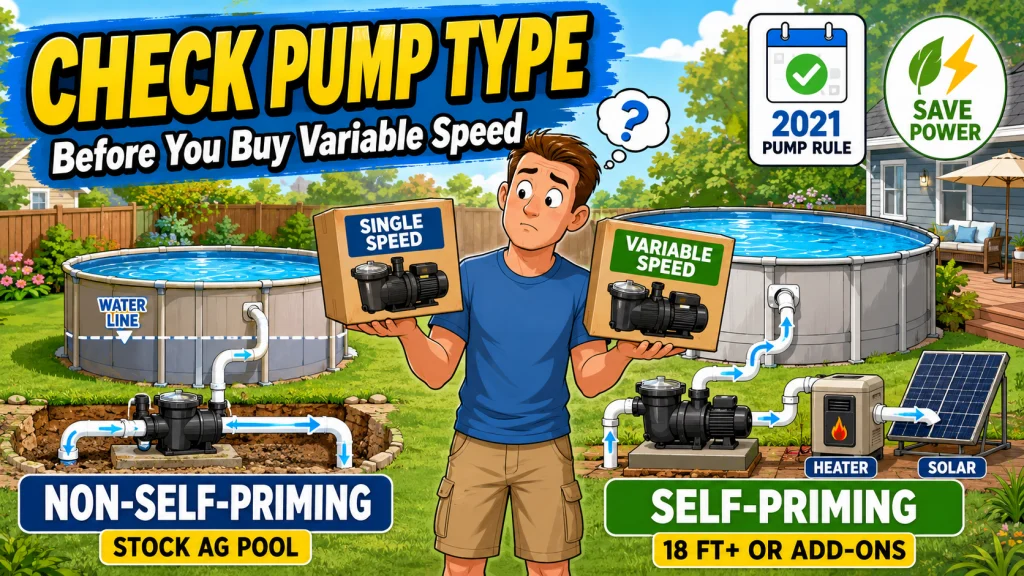
The part that gets missed in most coverage of this rule: it treats self-priming and non-self-priming pumps as two separate categories with two separate efficiency thresholds, and most stock pumps built for above ground pools fall into the non-self-priming category because they sit below the water line and do not need to lift water to prime themselves. Non-self-priming pumps carry lower minimum efficiency requirements, so a large share of them still qualify as compliant single-speed units even after the 2021 rule took effect. A separate, later motor-level rule finalized in 2023 extended similar requirements down to smaller motor sizes, phased in through 2025 and 2027. That second rule sits on top of the original 2021 pump standard, it is not the same regulation restated with a new date.
Note: The 2023 motor rule’s later phases began applying stricter standards to larger dedicated-purpose pool pump motors in late 2025, with a further phase reaching smaller motor sizes in 2027. Those phases extend efficiency requirements across the same motor classes the original 2021 rule already covered on most in-ground setups. They do not change the picture for a stock non-self-priming above ground pool pump, though they are worth knowing if you are comparing information written for in-ground pool owners.
What This Actually Means If You Own an Above Ground Pool
Here is where the regulation gets misread most often. It is not true that every above ground pool owner replacing a 1 HP-class pump is automatically forced into variable-speed technology. Most stock kit pumps for above ground pools are non-self-priming, and a large share of non-self-priming pumps in typical above ground sizes still meet the lower efficiency bar as single-speed units. If your pool is a standard 12 to 18-foot setup running a simple filter with no heater and no solar add-on, you may still be able to buy a compliant single-speed replacement.
Where the picture changes is at the upper end of above ground pool sizing and equipment. Larger pools, especially 18-foot and up, semi-permanent installations, and setups running a heater or a solar add-on often need more hydraulic horsepower to hit an adequate turnover rate than a basic non-self-priming stock pump was built for. Once you move into a higher-flow self-priming style pump to cover that load, you are back inside the category the 2021 rule targets directly, and a variable-speed model becomes the realistic replacement option regardless of whether you were shopping for one.
Field Note: The calls I get about this are almost always the same story. An owner’s stock pump dies mid-season, they go looking for a straight swap, and the sizing conversation turns into a regulation conversation because the pump they actually need for their pool volume happens to sit right at the self-priming threshold. It is not a scam or an upsell, it is just where their pool landed on the size chart.
If you are not sure whether your current pump is self-priming or non-self-priming, or whether your pool actually needs more flow than the stock unit provides, that sizing question is a separate topic from the regulation itself, and it is worth working through with a pump sizing calculator built for above ground pools before you assume either outcome.

This pump features a 6-function valve for filtering, backwashing, rinsing, recirculating, draining, and closing the system, along with a built-in 24-hour timer offering 2 to 12 hour pre-set cycles. Suitable for above ground pools up to 17,200 gallons, it includes two 1.5-inch connector hoses for easy installation. The sand can last up to 5 years with regular backwashing, and the pump delivers a flow rate of 2,800 gph. Intex's HydroAeration technology improves circulation, filtration, and water clarity. Backed by a 2-year limited warranty.
Check On AmazonIf you click this link and buy, we earn a commission at no additional cost to you.
How to Tell Which Pump Category You Are Shopping In
Before you get anywhere near a savings calculation, it helps to know which category your own pump actually falls into, and horsepower alone will not tell you that. A pump sitting low, close to the pool wall, set up to run on gravity feed with no need to draw water upward to get started, is doing the job most stock above ground pool pumps are built for. That is the non-self-priming style, and it is what the lower efficiency threshold was written around.
A self-priming pump looks and behaves differently. It has to pull water up and over a lift before it can start circulating, which usually means a larger strainer basket, a taller lid, and a setup built to sit above the water line rather than tucked beside it. Semi-permanent installations, larger pools, and any setup running a heater or solar add-on tend to push toward this style because it can move more water against more resistance.
The fastest way to confirm which category a listing falls into is to read the label or spec sheet directly instead of guessing from the horsepower number alone. Look for the words “self-priming” or “non-self-priming” printed on the pump itself or in the product specs, along with the THP, HHP, or WEF rating if it is listed. Once you know the category, the rest of the decision, single-speed versus variable-speed, savings, and payback, actually applies to your situation instead of a generic one.

This pump delivers up to 9,114 GPH with a maximum head of 64 feet, suited for inground and above ground pools of small to medium size. Inverter technology adjusts speed from 1200 to 4000 RPM to improve efficiency and reduce energy use, while a built-in timer and LED panel with 4 preset speeds allow automatic scheduling. Its reinforced polymer flow chamber resists saltwater and pool chemicals for long-term durability. It runs on 220V, has 2.5-inch inlet and outlet hoses, and carries an IPX5 waterproof rating.
Check On AmazonIf you click this link and buy, we earn a commission at no additional cost to you.
The Energy Savings Math for an Above Ground Pool
Above ground pools run on a shorter season and a smaller water volume than most in-ground pools, so the savings numbers you see quoted for in-ground setups do not translate directly. Running a pump for around 8 hours a day across a typical 5-month swim season, a single-speed pump in the 0.75 HP range commonly costs somewhere in the $10 to $15 per month range in electricity, depending on local utility rates. A variable-speed equivalent running at a lower speed for a longer stretch to hit the same turnover typically lands closer to $4 to $7 per month.
| Pump Type | Typical Monthly Cost | Seasonal Cost (5 Months) |
|---|---|---|
| Single-speed (0.75 HP class) | $10 to $15 | $50 to $75 |
| Variable-speed equivalent | $4 to $7 | $20 to $35 |
Over a full season, that works out to roughly $30 to $80 in electricity savings, against a variable-speed pump that typically costs $50 to $150 more upfront than a comparable single-speed model. Run that math forward and most owners see the price difference pay for itself within 1 to 3 seasons, faster if local electricity rates run high or the pump gets used for more months out of the year.
None of this changes if your pool is small enough that a compliant single-speed non-self-priming pump is still on the shelf and doing the job. The savings case only matters once you are choosing between a single-speed and a variable-speed option for the same pump size, which is exactly the decision a larger above ground pool or an equipment-heavy setup tends to force.

This pump removes up to 4890 gallons of water per hour and lifts it up to 30 feet, making it well suited for basement sewage, wastewater, and rainwater removal. An integrated vertical float switch enables automatic operation, turning on above 8.4 inches of water and off below 3.7 inches. Built with a corrosion-resistant stainless steel housing and cast-iron volute, it features a top suction design to reduce clogging and a 20-foot UL power cable. Backed by a 1-year warranty.
Check On AmazonIf you click this link and buy, we earn a commission at no additional cost to you.
When a Variable Speed Pump Is Actually Worth It for an Above Ground Pool
The decision comes down to a short list of conditions:
- Your pool is 18 feet or larger, where the required flow often pushes you into the range where 1 HP-class replacements become common anyway.
- You are running a heater, solar add-on, or other equipment that demands more turnover than a basic stock pump was sized for.
- You plan to keep the pool set up for 5 or more seasons, giving the payback period time to actually pay off.
- Your local electricity rates run on the higher side, which shortens the payback window considerably.
If none of those apply, a compliant single-speed non-self-priming pump can still be a perfectly reasonable, lower-cost replacement. Bigger, more equipped setups are simply the ones where the shelf increasingly stocks variable-speed as the default.

This pump uses HydroAeration Technology to improve water circulation, filtration, clarity, and negative ion levels at the surface. It delivers a 1,500 GPH flow rate at the pump and 1,180 GPH in the pool, suitable for Intex above ground pools up to 9,400 gallons with a 1.25 inch hose fitting. Installation just requires hooking up the hoses and plugging in, with partial assembly needed. It uses easy to clean Type A Dacron paper cartridges, which should be replaced every 2 weeks.
Check On AmazonIf you click this link and buy, we earn a commission at no additional cost to you.
Final Thoughts: Match the Pump to What Your Pool Actually Needs
If your stock pump is still covering your pool’s turnover with no heater, no solar add-on, and no plans to size up, a compliant single-speed replacement is a reasonable choice, and there is no need to chase variable-speed technology just because it exists. Once you are sizing up for an 18-foot or larger pool, adding equipment that demands more flow, or planning to keep the pool running for years rather than one season, the pump you actually need is already sliding into the range where variable-speed is the realistic option, and often the only one on the shelf.
If you are still working through the broader equipment decisions around your pump and filter setup for an above ground pool, or comparing that against the rest of your above ground pool equipment buying decisions, start there before locking in a specific pump size or speed type.

This sand filter pump features a 0.33 HP copper motor with overload protection and a max flow rate of 3,000 GPH for fast, efficient circulation. Key components come pre-installed for easy setup, even for first-time users. The reinforced, corrosion-resistant thermoplastic tank is easy to carry, while the multi-port valve and durable threaded fittings help prevent leaks, with a compatible adapter for above-ground frame pools. It offers 6 modes, including filter, backwash, rinse, waste, winter, and closed, for complete pool maintenance.
Check On AmazonIf you click this link and buy, we earn a commission at no additional cost to you.
FAQs
⚡ Do I have to buy a variable-speed pump for my above ground pool now?
Not automatically. Most stock above ground pool pumps are non-self-priming and can still be replaced with a compliant single-speed unit. Variable-speed becomes the realistic option once your pool or equipment needs a self-priming, higher-flow pump.
🏊 Does the 2021 pump regulation apply to above ground pools?
It applies to the pump category, not the pool type. Above ground pools mostly use non-self-priming pumps, which carry a lower efficiency threshold than the self-priming pumps the rule targets most directly.
💵 How much does a variable-speed pump actually save on an above ground pool?
Typically somewhere in the range of $30 to $80 per swim season in electricity, depending on local utility rates and how many hours a day the pump runs.
🔧 How do I know if my pump is self-priming or non-self-priming?
Non-self-priming pumps sit below the pool’s water line and rely on gravity feed, which describes most stock above ground pool pumps. Self-priming pumps can lift water to prime themselves and are more common on in-ground setups or larger above ground upgrades.
📏 What size above ground pool actually needs a variable-speed pump?
18 feet and larger is where the required flow most often pushes a replacement pump into the range where 1 HP-class, self-priming units become common, which is where variable-speed becomes the standard option.
⏱️ How long until a variable-speed pump pays for itself?
Most owners see the higher upfront cost pay back within 1 to 3 seasons, faster with higher electricity rates or longer daily run times.
Sources and References
- The U.S. Department of Energy’s overview of dedicated-purpose pool pump motor standards, confirming the July 19, 2021 compliance date for pool pump efficiency requirements and the separate, later compliance dates for the motor-level rule.
- The Code of Federal Regulations section covering dedicated-purpose pool pump motors, which lays out the phased 2025 and 2027 compliance dates by motor horsepower class referenced in this article.
- Jandy’s technical explanation of the DOE pool pump regulations, confirming that most above ground pool pumps fall under the non-self-priming category with a lower minimum efficiency threshold than self-priming pumps.
- ENERGY STAR’s guidance on pool pump efficiency, supporting the energy savings range cited for variable-speed pumps compared with single-speed equivalents.