An above ground pool heat pump does not burn fuel to make heat. It pulls heat that already exists in the outside air and moves it into your pool water, which is why it can deliver heat at a lower operating cost than a gas heater during regular use. A smaller above ground pool volume does not make the heat pump itself run more efficiently, but it does mean far less total water to heat, so the same unit reaches swimming temperature much faster and for less money than it would on an inground pool. I will walk through how the process works, what size actually fits a typical above ground setup, and where colder or drier air begins to reduce heat output and operating value. By the end you should know whether a heat pump fits your pool, your climate, and how often you actually swim.
Why Above Ground Pool Owners Ask About Heat Pumps First
Most of the confusion around an above ground pool heat pump comes from comparing it to a gas heater, which behaves completely differently. A gas heater burns propane or natural gas and pushes that heat directly into the water, so its BTU output stays roughly the same no matter what happens outside. A heat pump instead pulls its heat from ambient air, so both the outside temperature and the total amount of water it needs to warm change how long the job takes.
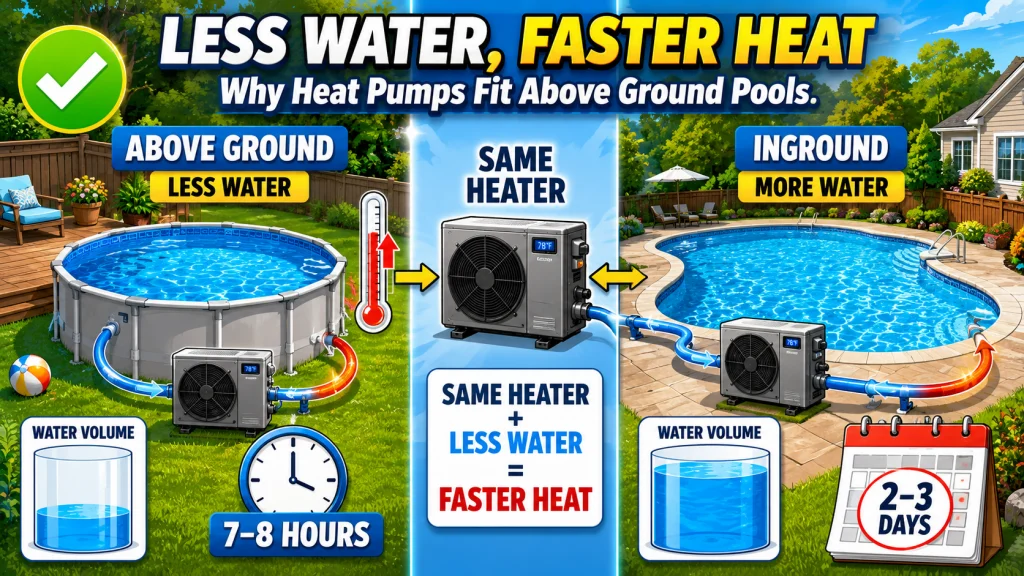
That second part, the amount of water, is where above ground pools have a real advantage over inground pools. It is not that a heat pump becomes a more efficient machine on a smaller pool. It is that a smaller pool simply needs less total heat energy to climb the same number of degrees, and that difference in total heating load is what makes a heat pump such a practical, cost-effective choice for above ground setups specifically. The rest of this guide walks through exactly how much of an advantage that is, in real numbers, and where the limits of that advantage sit.
How a Heat Pump for an Above Ground Pool Actually Heats Water
Inside the unit, a fan draws outside air across an evaporator coil, and a refrigerant inside that coil absorbs heat energy straight out of the air passing over it. A compressor then raises the pressure and temperature of the refrigerant vapor before it enters the heat exchanger. From there, a heat exchanger transfers that concentrated heat into the pool water as it circulates through on its way back from the filter. Nothing is burned in this process. The unit is simply relocating heat that was already sitting in the outside air.
That relocation process is why the efficiency numbers look strange the first time you see them. The U.S. Department of Energy rates residential heat pump pool heaters with a coefficient of performance, or COP, typically between 3.0 and 7.0 under federal test conditions of 80°F ambient air, 63% relative humidity, and 80°F pool water, meaning a unit can deliver 3 to 7 units of heat for every single unit of electricity it consumes.1 A gas heater, by comparison, delivers close to one unit of heat per unit of energy burned. That gap is the whole reason a heat pump uses so little electricity to run: you are paying to move heat, not to create it, and moving heat is dramatically cheaper than making it. The COP itself does not change because your pool is smaller, it changes with air temperature, humidity, and water temperature, which is a separate factor from the volume advantage covered next.
The Above Ground Volume Advantage in Real Numbers
Raising water temperature takes a predictable amount of energy: roughly 8.34 BTU per gallon per degree Fahrenheit of rise. A common 15-foot by 48-inch above ground pool holds about 4,440 gallons at its recommended fill level, and a 10-degree rise on that volume works out to roughly 370,000 BTU. Under ideal conditions, with no wind or evaporation loss and with the unit maintaining its full rated output, a 50,000 BTU heat pump would need about 7.4 hours to close that gap. Real-world heating almost always takes longer than that once you account for wind, humidity, and the unit occasionally running below its rated output, but the theoretical number is still useful for comparing pool sizes on the same basis.
That is exactly what makes the comparison to an inground pool worth doing. Using the same 50,000 BTU unit and the same ideal-condition math, a 15,000-gallon inground pool needs about 25 theoretical hours for a 10-degree rise, and a 25,000-gallon pool needs roughly 42 theoretical hours. Both numbers assume the same steady output and no heat loss, so they are directly comparable to the above ground figure above. The above ground pool volume advantage is not marketing language. It is basic thermodynamics: less water standing between the unit and your target temperature means fewer total BTU are needed to get there, on any heat pump you choose.
| Pool Type | Typical Volume | Theoretical Time to Raise 10°F with a 50,000 BTU Heat Pump |
|---|---|---|
| 15-foot by 48-inch above ground, at fill level | ~4,440 gallons | ~7.4 hours |
| 18-foot by 52-inch above ground, at fill level | ~6,800 gallons | ~11.3 hours |
| Inground pool, smaller end | ~15,000 gallons | ~25 hours |
| Inground pool, larger end | ~25,000 gallons | ~42 hours |
These figures are ideal-condition estimates meant for comparing pool sizes against each other, not a promise of exactly how many hours your pump will run this week. Stronger wind, cooler air, lower humidity, and leaving the pool uncovered can all increase real-world heating time. Once you see the gap between above ground and inground volumes laid out on the same basis, the next question is which BTU rating actually matches the pool you already have or are about to buy.

The FibroPool FH135 delivers 35,000 BTU of air-source heating for small above ground and inground pools and spas. It runs on 120-volt household power and can deliver up to 5.5 times heating efficiency. Its compact round cabinet is designed for tight equipment areas and quiet operation.
Check On AmazonIf you click this link and buy, we earn a commission at no additional cost to you.
Above Ground Pool Heat Pump Size: Matching BTU to Your Pool
Most heat pumps built for residential above ground and small inground use fall somewhere between 30,000 and 75,000 BTU. A 50,000 BTU unit is a practical reference point for many above ground pools in the 4,000 to 10,000 gallon range, which covers most 15-foot and 18-foot round pools. Pools approaching 15,000 gallons, or pools you plan to heat through cooler shoulder-season weather rather than just peak summer, often need more. Some manufacturer sizing charts call for 65,000 BTU in summer conditions and closer to 85,000 BTU for spring and fall use on pools in that larger range, so do not assume every above ground pool defaults to the same 50,000 BTU unit.
Choosing the right heat pump size depends on more than pool volume alone:
- Pool volume in gallons, calculated from diameter or length and average depth, not the marketing size printed on the box
- Desired temperature rise above your typical daytime air temperature during swim season
- Whether the pool sits exposed to wind or is somewhat sheltered by a fence or structure
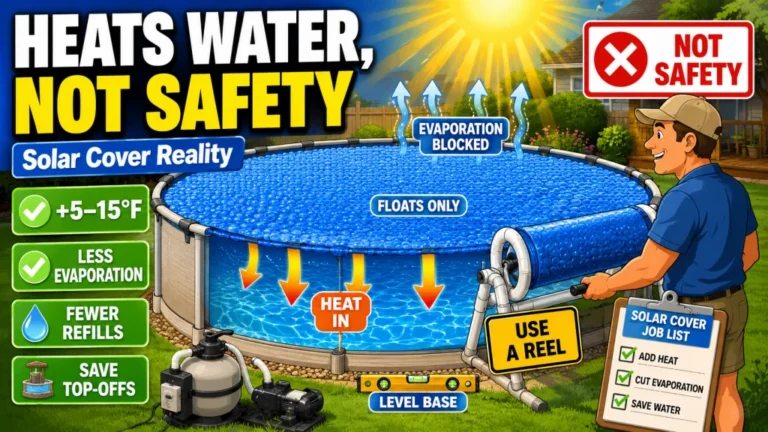
- Whether you plan to run a solar cover or insulated pool cover overnight to hold heat between heating cycles
- How many hours per day your pool pump already runs, since the heat pump only heats while water is circulating through it
A larger unit is not just a bigger electric bill. It reaches your target temperature faster, runs fewer hours to deliver the same amount of heat, and holds up better once shoulder-season air gets cooler or the wind picks up across the water. The tradeoff runs the other way too: a bigger heat pump usually costs more upfront and can require a larger electrical circuit, so sizing up only makes sense if you actually plan to use the pool in cooler weather or want faster recovery after a cover comes off. Monthly operating costs typically fall between $50 and $150, and that range moves with your local electricity rate and target temperature as much as with pool size.

The TURBRO Beluga B50V delivers 50,000 BTU of heating for above ground and inground pools. Its full DC inverter compressor adjusts output as heating demand changes, while WiFi controls support remote temperature and timer settings. The unit operates on 220 to 240 volts and uses a titanium heat exchanger for resistance to pool chemicals and saltwater.
Check On AmazonIf you click this link and buy, we earn a commission at no additional cost to you.
What to Check Before Buying an Above Ground Pool Heat Pump
The BTU number on the box is only part of the buying decision. Many higher-output residential heat pumps require a dedicated 208V or 230V circuit, while some compact units built for smaller above ground pools operate on a 120V supply, although their circuit and amperage requirements still vary by model, so confirm what your electrical setup can actually support before you settle on one. You will also want to compare the heat pump’s required flow rate with your system’s actual operating flow. Heat pump specifications are often listed in GPM, while some above ground pool pumps are marketed in GPH, so convert the units before comparing them, since a heat pump that is not getting enough water flow through its heat exchanger will not heat effectively even if the BTU rating looks right on paper.
It also helps to know that BTU and COP ratings are measured under specific test conditions, typically 80°F ambient air, 63% relative humidity, and 80°F pool water for COP testing. A unit rated highly under those conditions will perform differently once fall air drops into the 50s, so use published ratings to compare models against each other rather than as a guarantee of real-world output in your climate. A few other details are worth confirming before you buy: the clearance space the unit needs for airflow and service access, how much noise it produces at the distance from your seating area or a neighbor’s fence, and whether the model is rated for use with a saltwater chlorination system if your pool runs one, since not every heat exchanger material handles salt the same way.

This 15-foot round Sun2Solar cover uses solar energy to help warm pool water while retaining heat after sunset. Its 12 mil design also reduces evaporation by up to 95 percent and helps keep leaves and debris out of the pool. The cover can be trimmed as needed around pool features for a closer fit.
Check On AmazonIf you click this link and buy, we earn a commission at no additional cost to you.
Where Climate Limits Above Ground Pool Heat Pumps
A heat pump only works as well as the air around it. The Department of Energy notes that heat pump pool heaters run efficiently as long as outside air stays above roughly 45 to 50 degrees Fahrenheit, and efficiency drops off once temperatures fall below that range.1 That is not a flaw in the unit, it is a direct result of how the whole system works. Less usable heat sitting in colder air means the compressor has to work harder for the same output.
Air temperature is not the only variable, though. Many published COP and BTU ratings are measured under warm, humid test conditions, and lower humidity can reduce real-world output compared with those numbers. Hot desert air can still support effective heating, but a unit running in a dry climate may not deliver the same capacity shown on a spec sheet tested under warmer, more humid conditions. In northern climates, a heat pump is usually best framed as a season extender rather than a year-round solution: it can stretch a swim season into cooler spring and fall weeks, but it will not turn an above ground pool into a heated pool through a Midwest winter. If your pool sits somewhere in between warm and cold, or humid and dry, your specific swim schedule matters more to the decision than any single climate label.
Heat Pump vs Gas Heater: Speed vs Running Cost
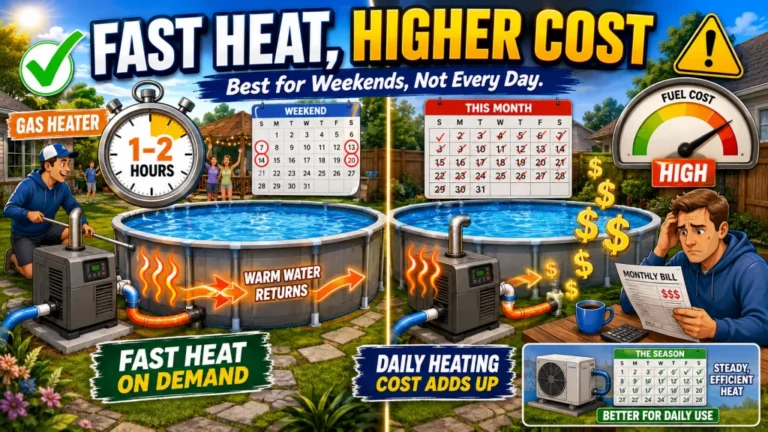
A properly sized gas heater can warm an above ground pool much faster than a heat pump, often within a few hours rather than most of a day, because it typically runs at a much higher BTU output and does not depend on ambient air temperature the way a heat pump does. That speed comes at a price, since gas heaters cost noticeably more per hour to run. A heat pump costs less for every BTU it actually delivers, but it needs several hours to reach the same target, which is a tradeoff worth sitting with before you buy either one.
The same pattern shows up in our full breakdown of gas heaters for above ground pools: daily or near-daily swimmers tend to come out ahead with a heat pump because the lower running cost compounds over a full season, while occasional swimmers who want the pool warm on short notice usually lean toward gas. Some owners in milder climates skip powered heating altogether and start with solar heating as a lower cost option before deciding a heat pump is worth the upgrade. None of these options is universally correct. The right pick depends on how often you actually get in the water and how much patience you have for a slower warm-up.

The FibroPool FH270 delivers 70,000 BTU of electric heating for larger above ground and inground pools, including above ground pools up to 27 feet round. It operates on 220 to 240 volts with a COP of 5.77. A weatherproof enamel-coated steel enclosure protects the unit outdoors, while the digital controller provides direct temperature adjustment.
Check On AmazonIf you click this link and buy, we earn a commission at no additional cost to you.
Final Thoughts: Let Your Pool Size and Swim Habits Decide
An above ground pool heat pump earns its cost through the same volume advantage that makes above ground pools cheaper to run in general: less water means less total heat energy needed to warm it, and less energy needed means a lower monthly bill once the unit is running. Sizing still depends on your actual gallons, your climate, and whether you are covering the pool overnight to hold heat, so treat any single BTU number as a starting point rather than a rule that applies to every pool.
Before you buy, run the same exercise I walk owners through when they are trying to decide between a heat pump and a gas heater: calculate your actual pool volume, check your coldest typical swim-season air temperature against the 45 to 50 degree efficiency threshold, and decide honestly whether you are heating for daily use or occasional weekends. For the full picture of how a heat pump fits alongside pumps, filters, and covers, our above ground pool heater comparison guide and our broader above ground pool equipment guide cover the rest of the setup that keeps a heat pump running efficiently once it is installed.
FAQs
🔥 How long does it take a heat pump to heat an above ground pool?
Under ideal conditions, a 50,000 BTU heat pump can raise a 15-foot pool holding around 4,440 gallons by 10 degrees Fahrenheit in about 7 to 8 hours. Wind, low humidity, cooler air, and an uncovered pool will stretch that time in practice.
📏 What size heat pump does a 15-foot above ground pool need?
A 50,000 BTU heat pump is a common reference point for pools in the 4,000 to 10,000 gallon range. Larger above ground pools or extended shoulder-season use often call for 65,000 to 85,000 BTU instead.
❄️ Do heat pumps work in cold weather?
Efficiency drops once outside air falls below roughly 45 to 50 degrees Fahrenheit. In northern climates, a heat pump extends the swim season rather than enabling year-round swimming.
💰 Is a heat pump cheaper to run than a gas heater?
Yes, for regular use. A heat pump costs less per BTU delivered, usually $50 to $150 a month depending on climate, while a gas heater costs more per hour but heats the pool faster for one-off use.
🔌 Does a heat pump need the pool pump running to work?
Yes. Water has to circulate through the heat pump’s heat exchanger to pick up heat, so the pump needs to run whenever the heat pump is actively heating the pool.
🌡️ What temperature can a heat pump comfortably maintain for an above ground pool?
Most residential units can comfortably hold 84 to 88 degrees Fahrenheit in suitable air conditions. The true maximum setting varies by model, and holding that maximum gets harder as outside air cools or dries out.
Sources and References
- U.S. Department of Energy, Heat Pump Swimming Pool Heaters, for coefficient of performance ranges, test conditions, and the 45 to 50 degree Fahrenheit efficiency threshold.
- U.S. Department of Energy, Swimming Pool Heating and Maintenance, for general pool heating efficiency guidance.
- The Pool Factory, Sizing Your Heat Pump Pool Heater, for BTU-per-gallon sizing guidance across summer and shoulder-season use.
- ENERGY STAR, Pool Pumps, for background on residential pool pump circulation and energy use.