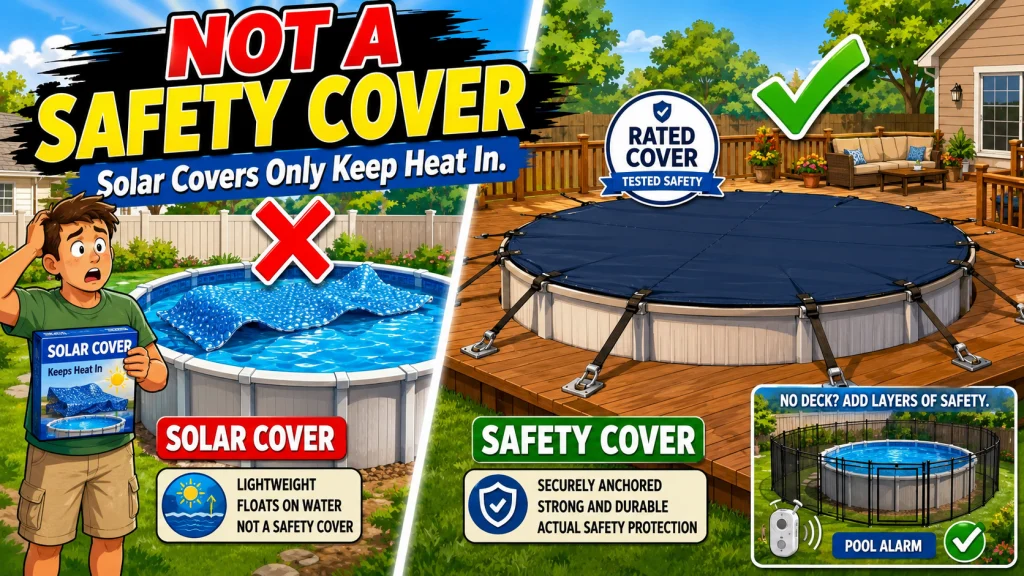
An above ground pool safety cover is not just any cover stretched over the water. It is a cover tested and rated to hold the weight of a person who falls onto it without them going into the water. A solar cover does not meet that definition, and floating it on the surface can actually make a fall more dangerous, not less. Most safety covers also require a solid deck around the pool to anchor to, which a lot of above ground setups do not have. I have had this exact conversation with more owners than I can count, usually right after they tell me the solar cover “should be fine” for keeping the dog or the toddler out. Here is what actually qualifies as a safety cover, why a solar cover is not one, and what to do if your pool cannot take a real safety cover at all.
What Actually Makes a Cover a Safety Cover
An above ground pool safety cover is not defined by how heavy, solid, or expensive it looks. It is defined by a test standard. In the United States, that standard is ASTM F1346, and it requires a cover to support a specific weight load spread across a section of the surface, roughly 485 pounds distributed over a small area, without a person breaking through into the water. That is the entire point of the rating: it is built for the moment someone, usually a child or a pet, wanders onto the pool when nobody is watching.
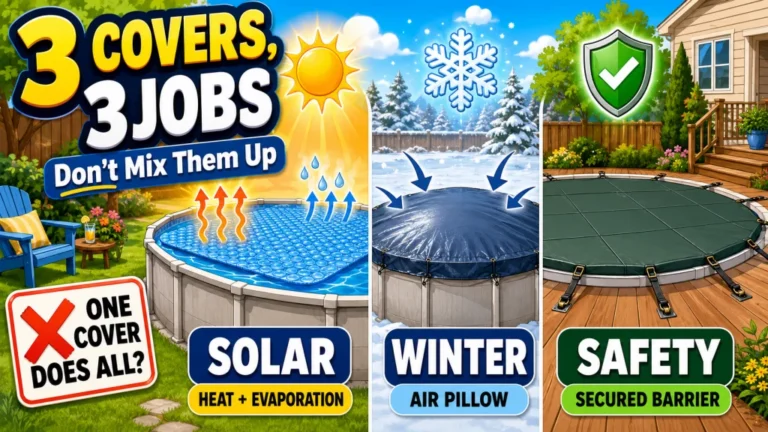
If a cover is not tested and labeled to this standard, it is not a safety cover, no matter how it looks or feels underfoot. A thick tarp, a snug-fitting winter cover, or a bubble-style solar blanket can all appear solid from a few feet away, but none of them are built or tested to hold a person’s weight. In my experience, the confusion almost always comes from the word “cover” doing too much work. Owners hear “pool cover” and assume every version does the same basic job of keeping people out. It does not. Debris protection, heat retention, and fall protection are three separate jobs, and only one type of cover is engineered for the last one.
Why a Solar Cover Is Not a Safety Cover
A solar cover floats freely on the water surface. It is not tethered to the pool wall, it has no anchor system, and it carries no weight rating at all, because it was never engineered to hold weight in the first place. Its entire job is heat retention: trapping the sun’s warmth in the water and slowing evaporation overnight. That is a genuinely useful function, and I recommend a solar cover to plenty of owners for exactly that reason. What it does not do is stop a fall.
The dangerous part is what happens after someone falls onto one. Because a solar cover floats loose on the surface instead of anchoring to the deck, it can shift and wrap around a person or pet the moment weight lands on it, pulling them under the material rather than simply letting them fall through to open water. That combination of no weight support and a floating surface that can trap someone beneath it is why industry sources are direct about this: a solar cover is treated as an entrapment risk, not a protective barrier, and the idea that it can prevent a drowning is considered flatly false rather than just an overstatement.
- It has no ASTM rating and was never tested to hold a person’s weight
- It is not anchored to the pool structure, so it can shift under load
- It can trap a person or pet beneath the surface material after a fall
- It provides zero fall protection even when the pool is otherwise fenced or alarmed
None of this means a solar cover is a bad product. It just means it belongs in the heat retention conversation, not the child safety conversation, and those two conversations should never get merged when there are young kids or pets with regular yard access.

This 25-by-45-foot safety cover is designed to fit 23-by-43-foot pools and is listed for both inground and above-ground installations. It uses heavy mesh polypropylene with triple-stitched construction and meets the ASTM F1346 safety standard. Installation hardware is included for securing the cover around the pool.
Check On AmazonIf you click this link and buy, we earn a commission at no additional cost to you.
Safety Cover Options for Above Ground Pools, and the Deck They Require
Genuine safety covers use a system of straps and spring-loaded anchors that attach to a solid surface around the entire perimeter of the pool. This anchor system is what actually holds the weight load when someone falls onto the cover, not the fabric itself. That is standard on most inground installations, where a concrete or paver deck already surrounds the pool and gives the installer somewhere solid to drill and set the anchors.
Above ground pools complicate this. A safety cover can be installed on an above ground pool, but only if the pool has a wooden or other solid deck running around the entire perimeter for the strap anchors to attach to. If your pool sits on grass, gravel, or a small set of steps with no continuous deck surface, there is nowhere for the anchor system to go, and a standard safety cover is not an option no matter how much you are willing to spend on one. This is the detail that catches a lot of above ground owners off guard, because most cover buying guides are written with inground pools in mind and never mention it.
If you do have a full deck around your pool, treat the safety cover the same way you would on an inground setup: confirm the ASTM F1346 rating before buying, and have the anchors installed into solid decking material, not into loose boards or a structure that flexes under load. Our guide to sizing and choosing above ground pool equipment covers how a cover fits into the rest of your setup if you are still working through what your pool needs.
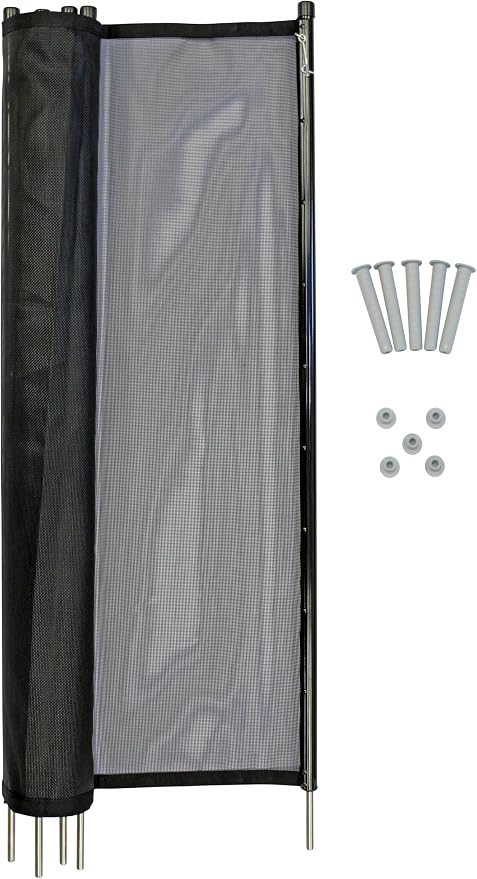
This removable 4-by-12-foot pool fence section uses black protective mesh and is UL certified to ASTM F2286 safety standards. It is designed to restrict unauthorized access to the pool area and can be combined with additional sections for a larger perimeter. The system is designed for DIY installation and removable use.
Check On AmazonIf you click this link and buy, we earn a commission at no additional cost to you.
What to Do If Your Above Ground Pool Does Not Have a Deck
Most above ground pools I install do not have a full perimeter deck, at least not right away, which means a traditional strap-anchored safety cover is off the table for a lot of owners. That does not leave you without options. It just means the layered approach looks different. A pool alarm that detects surface disturbance can alert you the moment something falls into the water, and it works independently of whatever cover is on the pool at the time. It is not a substitute for supervision, but it closes the gap during the moments supervision slips.
The piece that actually restricts access, rather than just alerting you after the fact, is a secure fence barrier around the pool itself or around the yard. For an above ground pool without a deck to anchor a safety cover to, a proper fence is the most effective way to keep a child or pet from reaching the water unsupervised in the first place. I bring this up on almost every install where the owner mentions young kids or a new puppy, because people default to thinking about the cover first when the fence is usually doing more of the actual work.
| Cover or Barrier Type | Prevents a Fall Into the Water? |
|---|---|
| Solar cover | No, floats loose and can trap a person beneath it |
| Winter cover with cable and winch | No, blocks debris only, not rated for human weight |
| ASTM F1346 safety cover with deck anchors | Yes, when properly installed and maintained |
| Secure fence barrier around the pool or yard | Yes, restricts access before a fall can happen |
| Surface disturbance pool alarm | No, alerts after entry rather than preventing it |
Look at that table and the pattern is clear: only two items on it actually stop a fall before it happens, and one of them, the safety cover, is not available to every above ground pool. A fence is the option nearly every above ground owner can install regardless of deck situation, which is why I treat it as the baseline rather than a nice extra.
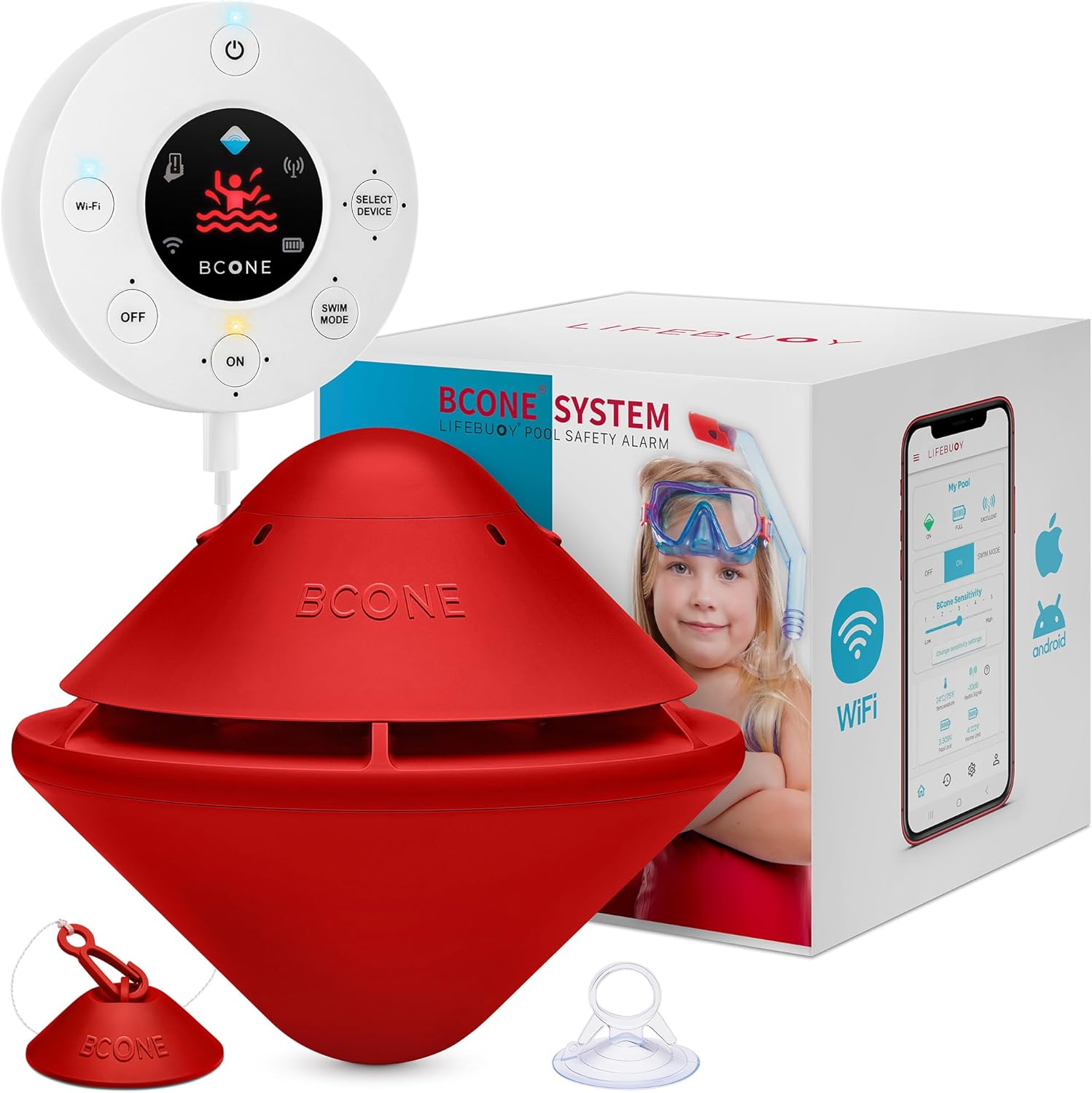
BCone is a floating ASTM F2208-certified alarm for inground and above-ground pools. It combines a pool unit with a home unit and smartphone connectivity, with adjustable sensitivity and voice-assistant support. The pool unit is IP68 waterproof, supports pools up to 20 by 40 feet per unit, and carries a 3-year manufacturer warranty.
Check On AmazonIf you click this link and buy, we earn a commission at no additional cost to you.
The Winter Cover and Air Pillow Are Not Safety Devices Either
The standard above ground winter cover, secured with a cable and winch around the top rail, does one job well: keeping leaves, debris, and sunlight out of the water during the off-season. The air pillow that sits underneath it during freezing weather is there to absorb ice expansion so the pool wall does not take the pressure. Neither piece of equipment is tested or rated to support a person’s weight, and neither should ever be treated as a barrier against a fall.
I have seen owners assume that because the winter cover looks taut and the pillow underneath makes it feel firm, it must be safe to walk near the pool, or that a curious pet could not break through it. That assumption is wrong, and it is one of the more common mistakes I run into during fall closing season, right when supervision naturally gets a little more relaxed because the pool “is closed for the year.” A winter cover under tension can still give way under concentrated weight, and once someone breaks through, the cable and winch system does nothing to help them get back out.

This 24-foot round above-ground pool cover uses 9-mil LDPE-coated fabric with a dense 10-by-10 scrim and reinforced seams. A steel-core cable, rust-resistant metal grommets, and molded winch secure the cover around the pool. Its black underside blocks sunlight to help limit water blooms during winter storage.
Check On AmazonIf you click this link and buy, we earn a commission at no additional cost to you.
Final Thoughts: Match the Cover to the Job It Is Actually Rated For
The core mistake I see is treating “the pool is covered” as the same thing as “the pool is safe.” A solar cover keeps the water warm. A winter cover keeps debris out. Neither one keeps a person out of the water if they fall onto it, and only an ASTM F1346-rated safety cover with a proper deck anchor system is built for that job. If your above ground pool has a full perimeter deck, price out a genuine safety cover and confirm the rating before you buy. If it does not, put your budget into a secure fence barrier first, and pair it with a surface alarm rather than assuming any style of cover has you protected.
If you are still deciding what to add to your setup, our breakdown of above ground pool cover types compares winter, solar, and safety options side by side, and our guide to above ground solar covers goes deeper into what a solar cover is actually good for once you are clear on what it is not.
FAQs
🛟 What makes a pool cover a safety cover?
A safety cover is tested and certified to the ASTM F1346 standard, meaning it can support a defined weight load without a person falling into the water. If a cover does not carry that rating, it is not a safety cover, regardless of how solid or heavy it feels.
☀️ Can a solar cover keep my pool safe for kids and pets?
No. A solar cover floats loose on the water with no anchor system and no weight rating. It can shift and trap a person or pet beneath it after a fall instead of preventing one, so it should never be relied on for safety.
🪵 Do I need a deck to install a safety cover on an above ground pool?
Yes. A safety cover anchors with straps drilled into a solid deck surrounding the entire pool. If your above ground pool does not have a continuous deck around it, a standard strap-anchored safety cover cannot be installed.
🚨 What if my above ground pool does not have a deck?
A secure fence barrier around the pool or yard is the most effective option, since it restricts access before a fall can happen. Pairing it with a surface disturbance pool alarm adds a second layer that alerts you if the water is disturbed.
❄️ Is a winter cover safe to leave on with kids or pets around?
No. A winter cover with a cable and winch system, along with the air pillow underneath it, blocks debris and manages ice pressure, but neither is rated to support a person’s weight. Treat it the same as an unprotected pool for supervision purposes.
⚖️ How much weight does an ASTM-rated safety cover need to support?
ASTM F1346 requires a certified safety cover to support roughly 485 pounds distributed over a small section of the surface, enough to prevent a person from breaking through if they fall onto it. Solar and winter covers carry no such rating.
Sources
- Pool Guard USA, pool cover types and safety myths, confirmed live, cited for the solar cover drowning myth and entrapment risk warning.
- Leslie’s Pool Supplies, winter covers versus safety covers comparison, confirmed live, cited for the deck requirement for above ground pool safety cover installation.
- Backyard City Pools, pool safety cover overview, confirmed live, cited for the ASTM F1346 weight support standard.