An above ground pool suction cleaner connects to the skimmer opening and rides on the suction your existing pump already produces, so it needs no extra electrical connection and usually costs somewhere between 30 and 100 dollars. It is the cheapest automatic cleaning option for an above ground pool, and for a lot of yards it is the right one. It is not, however, a cure for every debris problem, and I would rather tell you where it falls short before you buy one than let you find out midsummer. This guide covers exactly how a suction-side cleaner works in an above ground pool, what it actually picks up, what it cannot do, and a pump load tradeoff most buying guides skip entirely.
The Honest Case for an Above Ground Pool Suction Cleaner
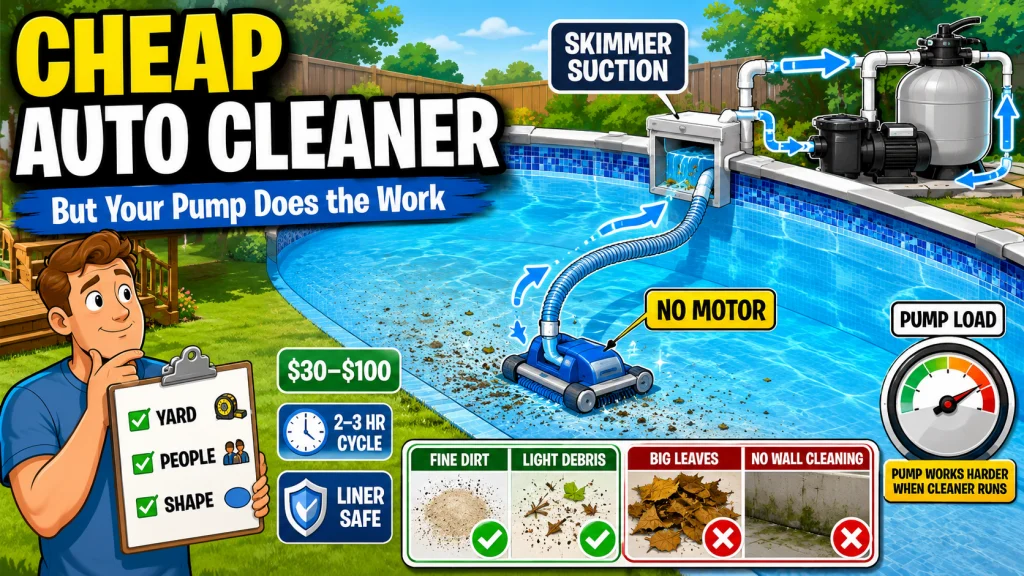
An above ground pool suction cleaner is the simplest automatic cleaning device you can put on a vinyl pool. It has no motor of its own, no battery, and no cord. A hose runs from the cleaner head to your skimmer, and whenever your pump is running, water gets pulled through that hose on its way to the filter, dragging the cleaner around the pool floor as it goes. For light debris loads and a buyer who wants something that works automatically without an extra outlet or an extra monthly charge, it is the correct choice more often than any other automatic cleaner on the market.
What follows is the part most retail pages leave out: what it does well, what it quietly makes worse, and the pump condition that decides whether it is worth buying at all.
How It Connects to Your Above Ground Pool
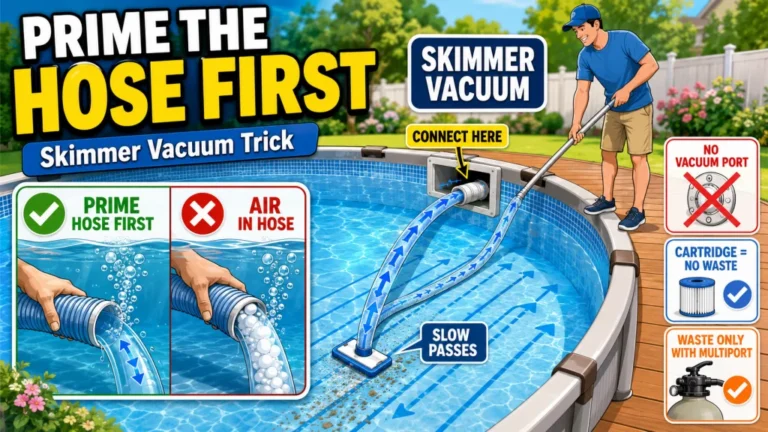
A suction-side cleaner for an above ground pool has one job: turn your pump’s own suction into movement. The hose connects between the cleaner head and your skimmer’s suction port, in the same spot a manual vacuum hose would go. Once the pump is running, that suction pulls water and debris through the hose, past the pump, and into your existing filter, which is what traps the dirt the cleaner picks up. There is no separate collection bag to empty and no second pump to install. That is also why this style of cleaner is sometimes described as an above ground pool automatic cleaner that runs on suction rather than on its own motor.
Setup is quick. Most models designed for above ground vinyl pools connect without special tools or fittings, since they are built to hook straight into a standard skimmer basket the same way a manual vacuum plate does. Once connected, the cleaner’s movement comes entirely from water flow, not from any onboard mechanism, so a weak pump gives you a slow, half-hearted cleaner no matter how good the cleaner head itself is.
Compatibility Checks Before You Buy
Before you order one, a few quick checks save you from a cleaner that technically works but never quite covers your pool. Hose length matters more than most buyers expect: the cleaner needs enough hose to reach the far side of your pool floor with a little slack left over, and a hose that is too short simply leaves a ring of dirty floor it can never reach.
Ladders, steps, and the wrinkles where the liner meets the cove at the base of the wall can also snag a cleaner mid-cycle, so it is worth knowing your pool’s floor layout before you buy rather than after. Pool shape plays a role too: a round pool with a centered skimmer tends to give the cleaner even coverage, while a long oval or rectangular layout can leave the far corners undercovered if the hose or return flow pushes the cleaner off course. Finally, confirm the cleaner is actually built for a vinyl above ground floor and not a general “pool vacuum” listing meant for a different pool type, since the cleaning head and bristle setup are not interchangeable between surfaces.

The AquaBug is designed to clean the bottoms of above-ground and on-ground pools using SmartDrive programmed steering. It connects directly to the skimmer, installs without tools in under 10 minutes, and includes a 32-foot hose. Its turbine and gearing system maintains balanced water flow, while the bumper ring helps guide the cleaner away from walls, steps, and ladders.
Check On AmazonIf you click this link and buy, we earn a commission at no additional cost to you.
What an Above Ground Pool Suction Vacuum Actually Cleans
Once it is running, a suction vacuum for an above ground pool moves across the floor in a random pattern. There is no mapping, no sensor, and no memory of where it has already been. Over a typical 2-to-3-hour run cycle, that randomness works in your favor: it tends to cover most of the pool floor simply by wandering long enough, the same way a robot vacuum eventually covers a room without following a fixed route.
It is good at fine debris. Sand, fine dirt, and small particles that settle on a flat vinyl floor get pulled up efficiently, since the hose diameter and suction pressure are well matched to that size of material. If your main debris problem is cloudy floor grit rather than anything falling from a tree, this is close to the ideal tool for the job, and it can usually run with minimal attention in a light-debris pool.

Dual bands of bristles loosen debris while the vacuum removes it, and a 10-inch cleaning path helps cover the pool floor efficiently. Programmed cleaning is designed to reduce missed areas. The cleaner uses one moving part and requires no assembly, connecting directly to the hose for operation.
Check On AmazonIf you click this link and buy, we earn a commission at no additional cost to you.
What It Does Not Do
The honest limitations matter as much as the strengths. A suction cleaner does not climb the pool wall. It stays on the floor by design, so any debris or scum line sitting above the waterline is not this device’s job at all. If wall cleaning matters to you, that is a robotic cleaner’s territory, not a suction cleaner’s, and no amount of tweaking the hose or flow will change that.
It also struggles with anything bigger than fine grit. Whole leaves, twigs, and larger debris tend to clog the intake throat before they ever reach the filter, which stalls the cleaner and sometimes requires you to walk out and clear it by hand mid-cycle. This is well documented across cleaner buying guides: suction cleaners are consistently recommended for light debris situations and consistently flagged as the wrong tool once a yard has real tree cover overhead.
Warning: If your pool sits under or near mature trees that drop whole leaves regularly, a suction cleaner will spend more time stuck than cleaning. That situation calls for a different cleaning approach entirely, not a stronger suction cleaner.
The Pump Load Tradeoff Nobody Mentions
Here is the part almost no buying guide walks through clearly. A suction cleaner does not add flow to your system, it redirects flow that was already heading to your filter. While the cleaner is running, the same pump output now has to move water through the cleaner hose and cleaner head before it reaches the skimmer basket and filter, which adds resistance to that path. On a pool with a comfortably sized pump, this is a non-issue. On a pool where the pump is already borderline for its filter and pipe size, running the suction cleaner during the same cycle can measurably reduce how much water is actually reaching the filter for chemical turnover, even while the cleaner itself is working fine.
In practice, this shows up as two separate symptoms that owners often blame on the wrong cause: a suction cleaner that moves sluggishly, and filtration that seems to lag even though the cleaner appears to be doing its job. Both can trace back to the same root, which is a pump that is being asked to do the cleaner’s job and the filter’s job through the same limited suction capacity at the same time. If you already know your pump is on the small side for your pool’s size, that is worth factoring in before you buy, since running the cleaner and expecting unchanged filtration performance at the same time is not a realistic assumption.
Pro Tip: Watch for concrete signs, not just a general feeling that something is off: the cleaner crawling noticeably slower than usual, weaker return flow out of the jets while it runs, or water that stays a bit cloudy even after the floor looks clean. Any of those point to a pump working right at its limit. Running the cleaner on a shorter, separate window rather than the entire filter cycle is a simple way to protect turnover without giving up the convenience.
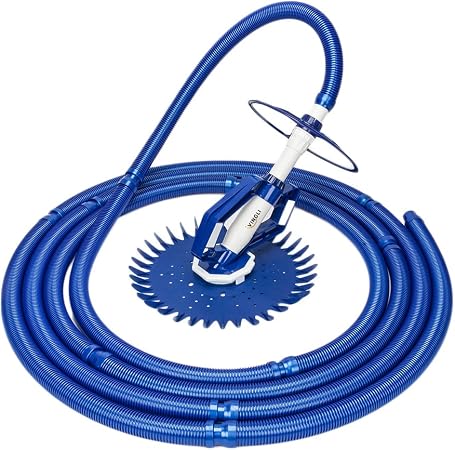
This suction-powered cleaner includes 33 feet of heavy-duty hoses and adjustable suction power for tuning the cleaning flow. It uses a plastic body with a suction-side installation. The listing identifies it as a 2025 model and shows a 4.0-star rating from more than 4,000 reviews.
Check On AmazonIf you click this link and buy, we earn a commission at no additional cost to you.
When Suction Is the Right Call, and When It Is Not
Matching the cleaner to the situation is really the whole decision. A suction cleaner earns its keep on a pool with a light debris load, few or no overhanging trees, and a pump that is not already stretched thin for its filter size. Pool size matters too: on a smaller pool, roughly under 18 feet, the random movement pattern has less floor to cover, so the same cleaner tends to reach full coverage faster and more reliably than it would on a much larger pool. It also makes sense for an owner who mainly wants set-it-and-forget-it convenience at the lowest possible cost, and for pools where the main problem is fine sand or dirt settling on the floor rather than leaves or wall grime.
Your yard drops heavy leaf debris regularly, wall cleaning matters to you, or you want full pool coverage without ever stepping in to clear a clogged intake.
Debris is mostly fine sand and dirt, trees nearby are minimal, your pump is not already borderline for your filter size, and you prefer low cost and no extra electrical setup over full wall-to-floor coverage.
If your situation lands closer to the first column, a cleaner that connects through the skimmer is not going to solve your actual problem no matter which suction model you pick, and it is worth looking at how a robotic cleaner handles both the walls and the floor instead.
Final Thoughts: Match the Cleaner to Your Debris, Not Your Budget Alone
A suction-side cleaner is the cheapest way to automate above ground pool cleaning, and for a fine-debris, low-tree yard with a healthy pump, it is a genuinely smart buy, not just a budget compromise. The mistake I see most is buyers choosing it purely on price without checking whether their yard’s actual debris load and pump size line up with what a suction cleaner can realistically handle.
Before you buy, take an honest look at what actually falls into your pool over a normal week, and check whether your pump is already working hard just to keep your filter turnover on schedule. Those two answers matter more than any single cleaner’s brand or price point. For the broader equipment picture beyond just the cleaner, our complete above ground pool equipment guide and our full guide to above ground pool cleaning equipment both cover how this decision fits alongside your pump, filter, and the rest of your setup.

Wanda the Whale is a hydraulic-powered above-ground suction cleaner with a 32-foot hose. Its plastic body is lightweight and self-propelled for automatic cleaning. The listing includes a 1-year manufacturer warranty and shows a 4.0-star rating from more than 2,200 reviews.
Check On AmazonIf you click this link and buy, we earn a commission at no additional cost to you.
FAQs
🧹 How does an above ground pool suction cleaner work?
It connects by hose to your skimmer, and your pump’s suction pulls water and debris through the hose and into your filter. The pump’s flow, not a motor in the cleaner, is what moves it around the pool.
🍃 Can a suction cleaner handle leaves and twigs?
Not reliably. Larger debris tends to clog the cleaner’s intake and stall it mid-cycle. Suction cleaners are best matched to fine sand and dirt, not whole leaves or sticks.
🧱 Will a suction cleaner clean my pool walls?
No. Suction cleaners stay on the pool floor by design. If wall cleaning matters to you, that is a job for a robotic cleaner instead.
⚙️ Does running a suction cleaner affect my pump or filtration?
Yes, to some degree. The cleaner redirects the suction your pump was already using for filtration, so on a pump that is already borderline for your filter size, running the cleaner can reduce how much water reaches the filter during that time.
💲 How much does an above ground pool suction cleaner cost?
Most suction-side cleaners for above ground pools fall somewhere between 30 and 100 dollars, since they have no motor or electronics of their own and rely entirely on your existing pump.
⏱️ How long should I run my suction cleaner each day?
A 2-to-3-hour cycle is typically enough for the random movement pattern to cover most of the pool floor. Running it during your normal filter cycle is the simplest way to keep it consistent.
Sources and References
- The Pool Factory’s comparison of robotic and suction-side cleaners for above ground pools, used to confirm the skimmer connection method and no-tools setup described above.
- Pool Parts To Go’s comparison of robotic, pressure-side, and suction-side cleaners, used to confirm that suction cleaners are best suited to light to moderate debris loads.
- In The Swim’s guide to suction pool cleaners, used to confirm that a full pump or skimmer basket restricts flow into the filter during operation.