Sand and cartridge filters both clean your above ground pool water, but they ask something very different of you week to week. A cartridge filter needs pulling out and hosing down every week or two. A sand filter mostly just sits there until the pressure gauge tells you to backwash it, which takes a few minutes every few weeks. Cartridge costs less to buy. Sand costs less of your time. Here’s the honest trade-off, including the above ground specific plumbing detail that trips people up when they try to upgrade.
The Filter Decision Most Owners Never Actually Make
Most above ground pool owners don’t choose a filter. It comes bundled with the pool kit, almost always a cartridge, and they never think about it again until the water starts looking cloudy every few days no matter how often they clean the filter. That’s usually the moment someone starts asking about a sand filter vs cartridge filter for their above ground pool, and by then they’ve already spent a season learning the cartridge’s maintenance rhythm the hard way.
Both filter types physically remove debris from the water. The difference that actually matters to you as an owner isn’t filtration quality, it’s how often you have to touch the equipment and what that costs upfront versus over time.
How a Cartridge Filter Actually Works
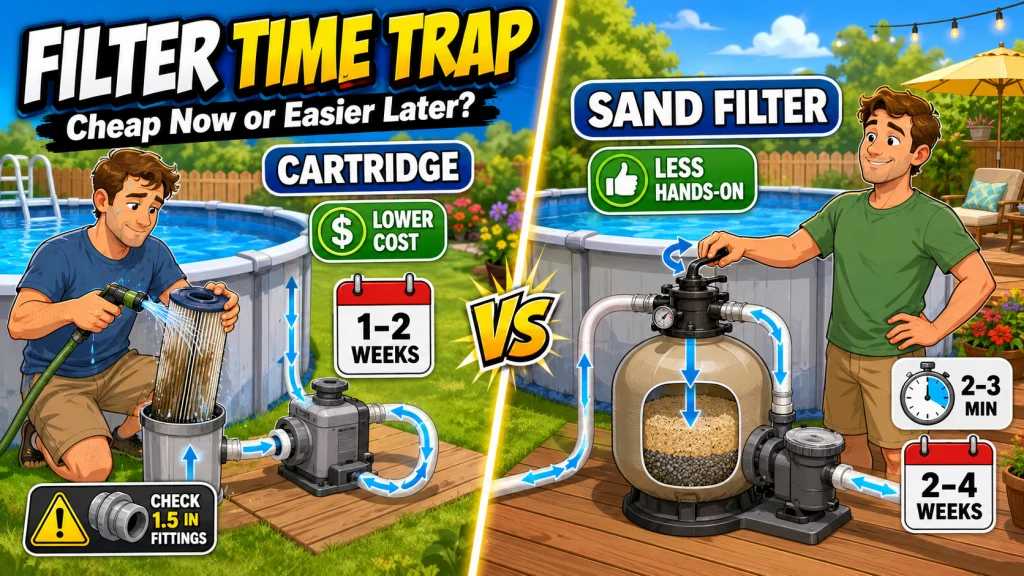
Water passes through a pleated polyester cartridge that physically traps particles as they pass. There’s no backwash step. Instead, you pull the cartridge out, hose off the accumulated debris, and put it back in. On a typical pool that’s every 1 to 2 weeks in peak season, more often if the pool’s seeing heavy use or a lot of debris from nearby trees.
Cartridge filters are the default equipment in most above ground pool kits, which is exactly the problem for a lot of owners. Kit cartridges are frequently undersized for the pool they’re bundled with. The filter’s surface area should be larger relative to the pool’s volume than what most kits ship with, and when it isn’t, you end up cleaning a cartridge more often than the filter type actually requires, just to compensate for equipment that was sized for cost, not performance. It’s one half of the pump and filter system your pool runs on, and undersizing shows up on both sides of that pairing.
I see this play out the same way on 15 and 18-foot pools almost every summer. The water turns cloudy after a busy weekend, and the owner reaches for shock or extra chlorine, assuming it’s a chemical problem. It’s usually not. It’s an undersized cartridge that was never rated to handle that much pool volume in the first place, working overtime and still falling behind.
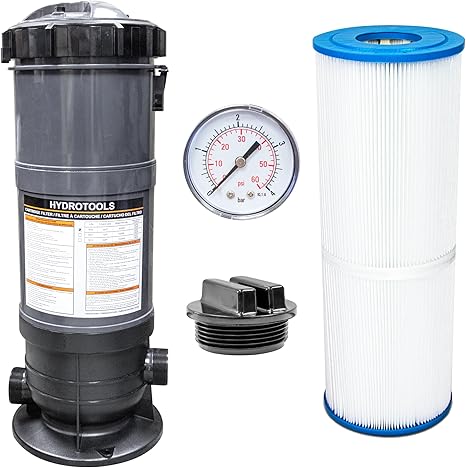
With 50 square feet of filtration area, this filter suits pools up to 24000 gallons and uses Sure-Flo elements that filter down to 50 microns for fine particle capture. Built from weather, UV, and corrosion-proof resin, the double-reinforced cartridges are designed for long-term durability with easy access for maintenance. It works efficiently with high-powered pumps and fits a variety of pool sizes and types. Backed by a one-year guarantee against manufacturing defects.
Check On AmazonIf you click this link and buy, we earn a commission at no additional cost to you.
How a Sand Filter Actually Works
Instead of a removable cartridge, water passes down through a bed of filter sand, and debris gets trapped in the sand itself. There’s no part to pull out and hose off. Maintenance instead comes down to watching the pressure gauge. When pressure reads 8 to 10 PSI above the clean, just-rinsed baseline, the filter’s telling you it’s loaded up and needs backwashing, a reverse flow process that flushes the trapped debris out through a waste line. The backwash cycle itself only takes 2 to 3 minutes.
The sand itself isn’t permanent. Expect to replace the full sand bed every 5 to 7 years as it breaks down and loses its ability to trap fine particles effectively.
The Maintenance Frequency Gap
Run both filter types on the same 15-foot pool and the difference in weekly time investment is the whole decision. A properly sized cartridge filter needs cleaning every 1 to 2 weeks during peak season. A properly sized sand filter on that same pool needs backwashing every 2 to 4 weeks. Sand wins clearly on frequency, and the gap only gets wider on larger pools carrying more bather load and debris.
| Factor | Cartridge Filter | Sand Filter |
|---|---|---|
| Cleaning frequency | Every 1-2 weeks | Backwash every 2-4 weeks |
| Time per cleaning | Removal + hose-off | 2-3 minute backwash |
| Upfront cost | 50-200 dollars | 150-400 dollars |
| Media replacement | Cartridge as needed | Full sand bed every 5-7 years |
That table is really a time-versus-money trade. Cartridge systems cost less to buy but ask for more of your weekends. Sand systems cost more upfront but mostly run themselves between backwash cycles. Either way, filter maintenance only tells half the story. If you haven’t already run your pool’s numbers through the pump size calculator, an undersized pump can make either filter type work harder than it should.

This 1.5 HP pump runs at 3450 RPM with a pure copper motor and stainless-steel shell, delivering a flow rate of 333 liters per minute and lifting water up to 43 feet. It features two 1.5 inch NPT threads for tool-free installation and a detachable filter basket with a transparent lid for easy monitoring. Built from one-piece reinforced ABS plastic, it resists corrosion and is ETL certified for safety, suited to above-ground pools, hot tubs, and spas.
Check On AmazonIf you click this link and buy, we earn a commission at no additional cost to you.
The Above Ground Plumbing Detail That Trips People Up
Here’s the consideration that generic filter comparisons never mention, and it’s specific to above ground pools. Most above ground pool plumbing runs on 1.5-inch hose connections. Not every sand filter system on the market is built to connect cleanly to that configuration, since a lot of sand filter hardware is designed around inground pool plumbing standards first. If you’re upgrading from a stock cartridge to a sand system, verify the hose connection compatibility before you buy, not after it arrives and doesn’t thread onto your existing setup.
Field Note: I’ve seen more than one sand filter box go back after arriving with fittings that didn’t match the pool’s 1.5-inch hose connections. Checking the connection size on both your pool and the filter system before ordering avoids that entire hassle, and it’s the kind of detail worth adding to your above ground pool equipment checklist before you order anything.

This kit converts the 40mm hose included with most soft-sided pools to fit standard 1.5 inch filter ports, offering compatibility with brands like Intex, Bestway, and Polygroup. It comes complete with 2 fittings, gaskets, and a roll of Teflon tape for a full setup. Made from heavy duty plastic, it is built to last through multiple pool seasons.
Check On AmazonIf you click this link and buy, we earn a commission at no additional cost to you.
When Each Filter Type Actually Makes Sense
A cartridge filter is the right call on pools under 15 feet, where the cleaning frequency stays manageable and doesn’t eat into your weekend every time. It’s also the better fit if you don’t want to deal with backwash waste water at all, or if your yard doesn’t have anywhere for that waste water to drain. That last part matters more than people expect. A few hundred gallons of backwash water has to go somewhere, and if the only option is across a patio or toward a neighbor’s yard, that’s a real problem you’re signing up for every few weeks, not just a minor inconvenience.
- Cartridge fits: smaller pools, no interest in managing backwash drainage, comfortable with a weekly-to-biweekly maintenance task
- Sand fits: 15-foot and larger pools, a preference for low-touch maintenance, enough yard space and drainage for a backwash cycle
Sand becomes the better fit once you’re at 15 feet and larger, where weekly cartridge cleaning starts to feel like a real chore rather than a quick task. It’s also the right choice for owners who specifically want a low-touch system and have the physical space and drainage capacity a sand filter unit and its backwash cycle require. Filter type is just one piece of the larger picture too, alongside whether a variable speed pump makes sense for your setup, since both decisions affect how much hands-on time your pool actually needs each week.
A Quick Check Before You Choose
Once you’ve read through the trade-offs, the actual decision comes down to a handful of yes-or-no questions about your specific setup, not a general opinion about which filter type is “better.”
- Is your pool under 15 feet, or 15 feet and larger?
- Are you genuinely fine pulling a cartridge out and hosing it off every 1 to 2 weeks during peak season?
- Does your yard have somewhere for backwash water to drain without flooding a patio, lawn, or a neighbor’s yard?
- Have you checked that the filter system you’re considering actually matches your pool’s hose connection size?
- Would you rather pay less upfront, or spend less time on maintenance across the whole season?
Answer those five honestly and the right filter type for your pool is usually obvious. Most of the back-and-forth people go through comparing spec sheets and reviews comes down to one or two of these questions they hadn’t actually thought through yet.
Final Thoughts
If you answered under 15 feet and don’t mind a weekly task, a cartridge system is the simpler and cheaper path. If you answered 15 feet or larger with real drainage space and a preference for low-touch upkeep, sand is worth the higher upfront cost. Either way, confirm your hose connection size before you order a sand system for an above ground setup, since that’s the detail that turns an upgrade into a return shipment.

This 0-60 PSI pressure gauge uses a 1/4-inch brass fitting and can serve as a side-mount replacement for sand, cartridge, and DE pool filters. Its easy-read dial lets you monitor filter pressure and identify when backwashing or cleaning may be needed. It is designed to work with a wide range of swimming pool filtration systems.
Check On AmazonIf you click this link and buy, we earn a commission at no additional cost to you.
FAQs
🏊 Is a sand filter or cartridge filter better for an above ground pool?
Neither is universally better. Cartridge filters cost less upfront but need cleaning every 1 to 2 weeks. Sand filters cost more upfront but only need backwashing every 2 to 4 weeks, which makes them the lower-maintenance option on 15-foot and larger pools.
🧽 How often do I need to clean a cartridge filter?
Every 1 to 2 weeks in peak season for a properly sized cartridge. Undersized cartridges, which are common in kit pools, often need cleaning more often than that just to keep up.
⏱️ How long does backwashing a sand filter take?
About 2 to 3 minutes per cycle. You’ll need to backwash when the pressure gauge reads 8 to 10 PSI above its clean baseline, which typically works out to every 2 to 4 weeks.
🔧 Will any sand filter connect to my above ground pool’s plumbing?
Not necessarily. Most above ground pools use 1.5-inch hose connections, and not every sand filter system is built for that configuration. Check hose connection compatibility before buying a sand filter upgrade.
📅 How long does pool filter sand last before it needs replacing?
Around 5 to 7 years under normal use. After that, the sand loses its ability to trap fine particles effectively and needs a full replacement rather than just a top-off.